
Gold history, mapped from the first objects to modern money
Gold did not move through history in one straight line. It became adornment, sacred material, political tribute, coinage, colonial prize, rush-era promise and monetary reserve at different times in different places.
Gold entered human material culture thousands of years before coinage. Early societies valued its color, workability and resistance to corrosion; ancient states then connected it to temples, rulers, tribute and long-distance trade. Coinage added standardized monetary use, medieval and early-modern networks moved gold across continents, nineteenth-century rushes accelerated migration and extraction, and the gold standard tied currencies to fixed gold values before modern central-bank reserve systems replaced convertibility.
- No single “discovery date” explains gold history.
- Objects, mines, coins and monetary systems have separate timelines.
- Power and belief mattered as much as scarcity.
- Use the era guides below for evidence and context.
Eight changes that altered gold’s role
This is a navigation map, not a claim that every region changed at the same moment. The dates mark broad transitions whose local evidence must be checked separately.
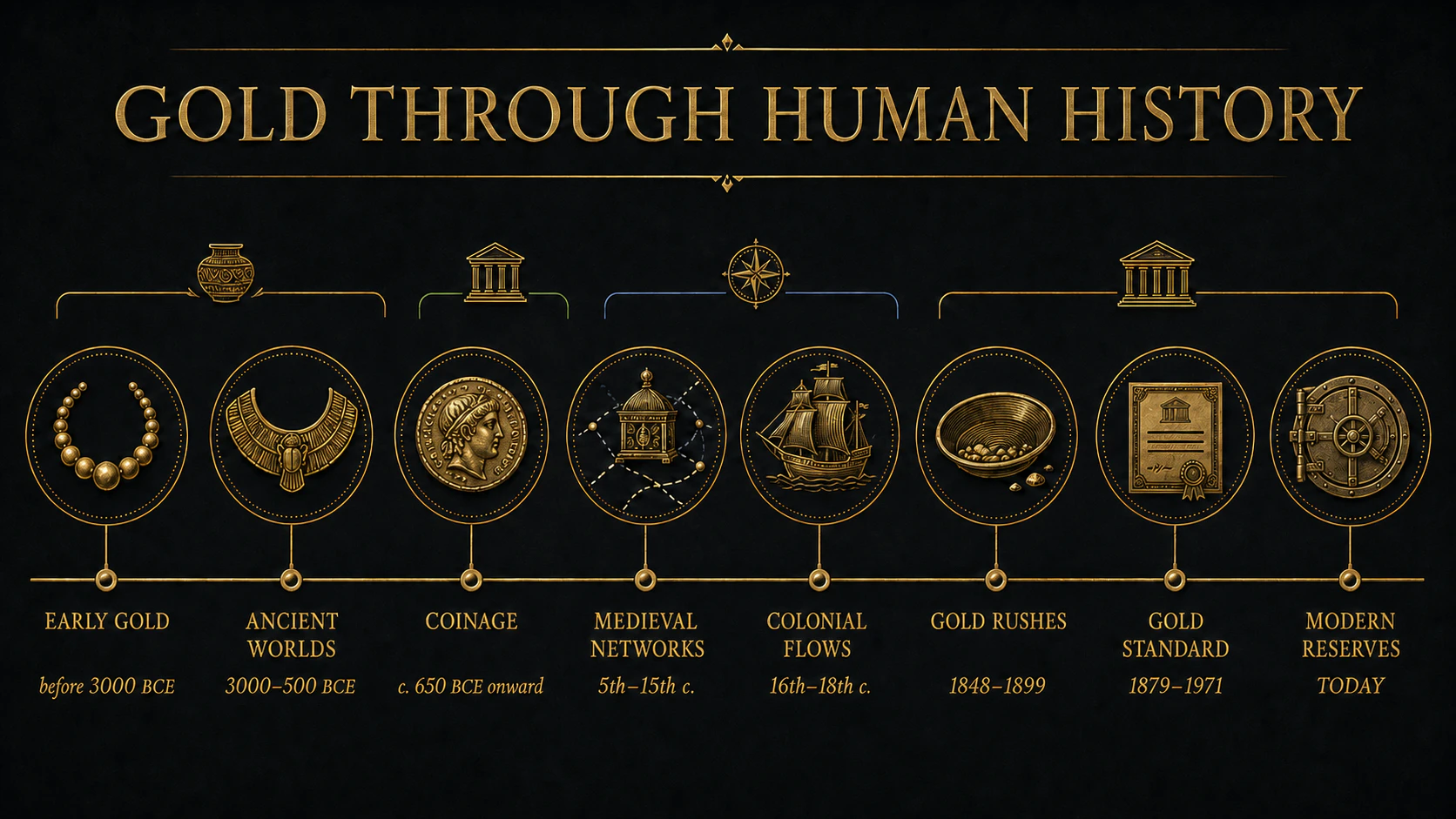
Reusable GoldConsul visual
Reuse this visual
You may reuse Gold Through Human History Timeline in an editorial or educational article under GoldConsul’s visual reuse terms. Credit the visual, link to this source page, and keep its facts and labels unchanged.
Copy the suggested embed code
<figure>
  <a href="https://goldconsul.com/gold-history/"><img src="https://goldconsul.com/wp-content/uploads/2026/08/gold-through-human-history-timeline.webp" alt="Timeline from early gold and ancient worlds through coinage, medieval networks, colonial flows, gold rushes, the gold standard, and modern reserves" width="1672" height="941" loading="lazy"></a>
  <figcaption>Source: <a href="https://goldconsul.com/gold-history/">GoldConsul — Gold Through Human History Timeline</a></figcaption>
</figure>Start with the question you actually have
A useful history hub should shorten the route to an answer. These six paths lead to the strongest existing GoldConsul guides.
When did people begin using and extracting gold?
Separate early artifacts from evidence of organized mining and refining.
How did states turn gold into power?
Follow mines, tribute, temples, trade routes and early monetary systems.
What did gold mean in worship and scripture?
Keep textual description, archaeology and later symbolism in separate evidence boxes.
How did gold return to European coinage and trade?
Trace supply, empires, guilds, sacred art and the revival of gold currencies.
Why did discoveries transform entire regions?
Look beyond strike dates to migration, law, labor, Indigenous dispossession and environmental costs.
When did gold back currencies—and why did that end?
Distinguish public redemption, international settlement and reserve ownership.
Gold through history: the fuller sequence
Each turning point changed who controlled gold, why people wanted it and what kind of evidence historians can use.
Adornment comes before money
The earliest surviving gold objects are small ornaments and prestige goods, not coins. Gold could be hammered and shaped without smelting it into a complex alloy, while its color and resistance to tarnish made it visually distinctive. The exact “first” depends on what archaeologists have recovered, dated and published.
Ancient states connect gold to divine and royal power
Egypt, Nubia, Mesopotamia, the Indus world, China, Greece and other societies developed different relationships with gold. The Metropolitan Museum’s Egyptian overview links Egypt’s supply to the Eastern Desert and Nubia while emphasizing that surviving objects and metal composition vary across periods.
Coinage standardizes weight, authority and payment
Early electrum issues associated with Lydia helped turn weighed precious metal into officially marked units. The British Museum’s Money Gallery explains that early Lydian pieces followed weight standards and that separate gold and silver coinage spread from Lydia into wider imperial systems.
Medieval gold moves through empires, trade and sacred art
Gold did not vanish after Rome. Byzantine coinage, Islamic and Mediterranean trade, African supply, Carolingian reforms, church treasuries and later European gold currencies created changing networks. A broad “Middle Ages” label can hide major regional and chronological differences.
Conquest and Atlantic flows change the scale
European expansion connected American gold, forced labor, imperial finance and Atlantic trade. This period must not collapse Indigenous cultures into a single “city of gold” story. The El Dorado tradition began with specific Colombian ritual context and was enlarged by European searching, retelling and commercial fantasy.
Gold rushes accelerate migration—and externalize costs
California, Australia, southern Africa, the Klondike and other rushes shared a powerful promise but produced different legal, social and environmental systems. The National Park Service California history emphasizes mass migration and harm to Indigenous communities; its Klondike history shows how routes, supply requirements and already-staked claims shaped real outcomes.
Gold becomes a rule for national and international money
The classical gold standard, wartime suspensions, interwar collapse and Bretton Woods were not one unchanging system. The Federal Reserve history of Roosevelt’s program documents the 1933 domestic break, while its Bretton Woods history explains the later international dollar-gold link.
Reserve ownership replaces fixed public convertibility
Central banks still hold gold, but that fact does not mean modern currencies are redeemable for a fixed gold weight. Reserve diversification, market liquidity and institutional confidence belong to the current system; they should not be projected backward onto ancient objects or nineteenth-century rushes.
History Claim Credibility Check
Claim: “Gold became valuable because it was always money.”
Gold was valued early for adornment, ritual and elite display.
Coinage and currency convertibility appeared much later and were never universal.
Gold’s monetary role grew from earlier material, social and political uses.
History is not only a timeline of states
Objects and disputed stories reveal how gold’s symbolic value outlived the systems that produced it.
Jerusalem and gold symbolism
Separate surviving material evidence from scriptural description and later devotional imagery.
Shipwreck gold
Provenance, salvage law and conservation matter more than treasure headlines.
Historic gold heists
Follow verified cases without turning theft, loss or recovery into folklore.
The French Angel coin
A coin’s design, issue, metal and market identity each answer a different question.
Knowledge Gap: the archive is not the past
Surviving objects favor durable materials and well-excavated or well-documented sites. Written records favor states and elites. Lost mines, melted objects, looting, colonial collecting and uneven scholarship all shape what can be known. A confident date or number should therefore be tied to a defined object, source, region and method—not repeated because it appears in many summaries.
The GoldConsul Editorial Perspective
The most useful way to study gold history is to ask what function gold performed in a specific place and period. Was it ornament, sacred matter, tribute, coin, raw material, imperial prize or reserve asset? That question prevents ancient jewelry, medieval relics, rush-era ore and twentieth-century monetary gold from being treated as if they were the same institution.
A broad visual introduction
Moconomy’s documentary surveys gold’s long social and monetary history. Use it as orientation, then return to the sourced era guides above for dates, regional evidence and claim boundaries.
Gold history questions
When was gold first discovered?
There is no recorded first discoverer. Archaeologists can date surviving objects and mining evidence, but the earliest human encounters with naturally occurring gold predate writing.
Why did ancient civilizations value gold?
Gold was visually distinctive, workable, relatively rare and resistant to corrosion. Different societies connected those properties to adornment, status, divine imagery, tribute and political authority.
When did gold become money?
Gold was exchanged by weight before standardized coinage. Early electrum coins appeared in Lydia around the seventh century BCE, while separate gold coinage and later monetary systems developed through different state institutions.
What was the biggest turning point in gold history?
There is no single universal turning point. Coinage, colonial extraction, nineteenth-century rushes and modern monetary convertibility each changed a different relationship between gold, authority and exchange.
Is today’s money backed by gold?
Major modern currencies are not generally redeemable for a fixed quantity of gold. Central banks may hold gold reserves, but reserve ownership is different from a legal gold standard.
Selected institutional sources
- The Metropolitan Museum of Art — Gold in Ancient Egypt
- British Museum — Money Gallery and the beginnings of coinage
- National Park Service — The California Gold Rush
- National Park Service — What Was the Klondike Gold Rush?
- Federal Reserve History — Roosevelt’s Gold Program
- Federal Reserve History — Creation of Bretton Woods