
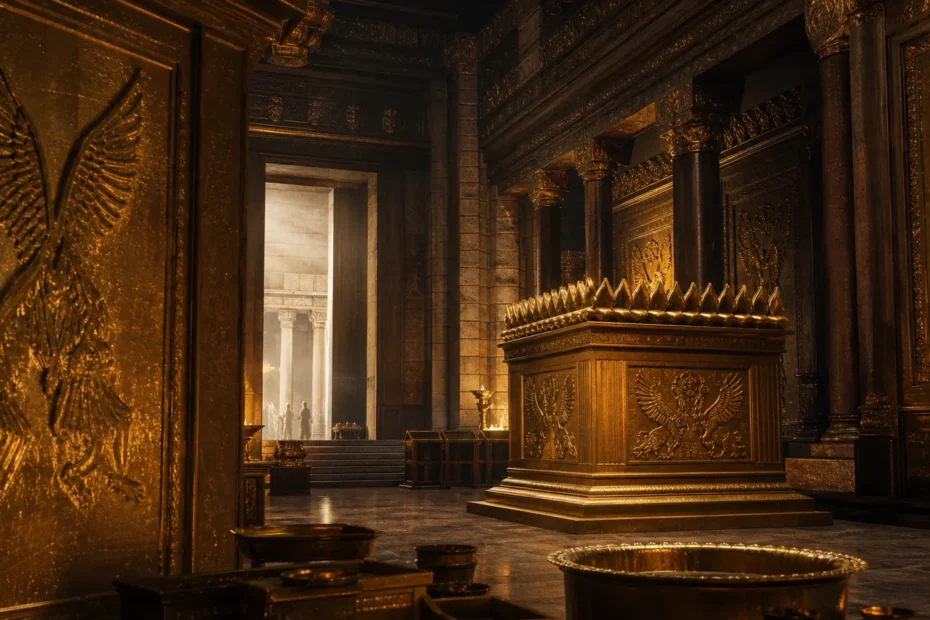
Compare gold in Solomon's Temple through scripture, archaeology, and tradition, and see where evidence supports, limits, or complicates the story.
- Read temple gold as scripture, historical context, and later tradition.
- Archaeology can frame the period but cannot verify every biblical detail.
- Avoid treating sacred descriptions as a modern inventory sheet.
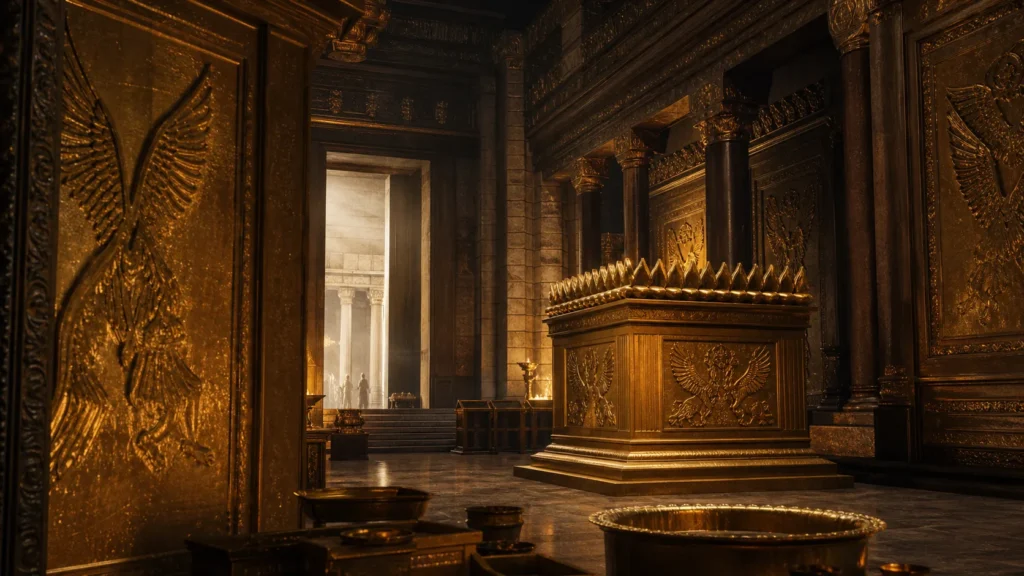
Gold in Solomon’s Temple is one of the Bible’s most vivid images of sacred wealth. Scripture describes a gold-covered sanctuary, while archaeology supplies context for First Temple-period Jerusalem but cannot verify the biblical inventory item by item.
Gold in Solomon’s Temple is one of the Bible’s most vivid images of sacred wealth. The careful way to read it is not as a modern inventory sheet, but as a layered claim: scripture describes a gold-covered sanctuary, archaeology gives context for First Temple-period Jerusalem, and later tradition expands the temple’s meaning far beyond what can be verified materially.
This guide separates those layers. It explains where the biblical text places gold, what historians can and cannot confirm, and why the temple’s gold still matters in discussions of ancient power, worship, and symbolism.
TL;DR
- The Hebrew Bible describes extensive gold overlay inside Solomon’s Temple, especially in the inner sanctuary, doors, altar, cherubim, and sacred vessels.
- Direct archaeological proof for the temple’s gold fittings is not available; the site is politically and religiously sensitive, and the First Temple was destroyed by Babylonian forces.
- The strongest historical approach is to distinguish scriptural description from archaeological context and later interpretive tradition.
- Gold functioned as more than decoration: it signaled holiness, royal patronage, durability, and separation from ordinary space.
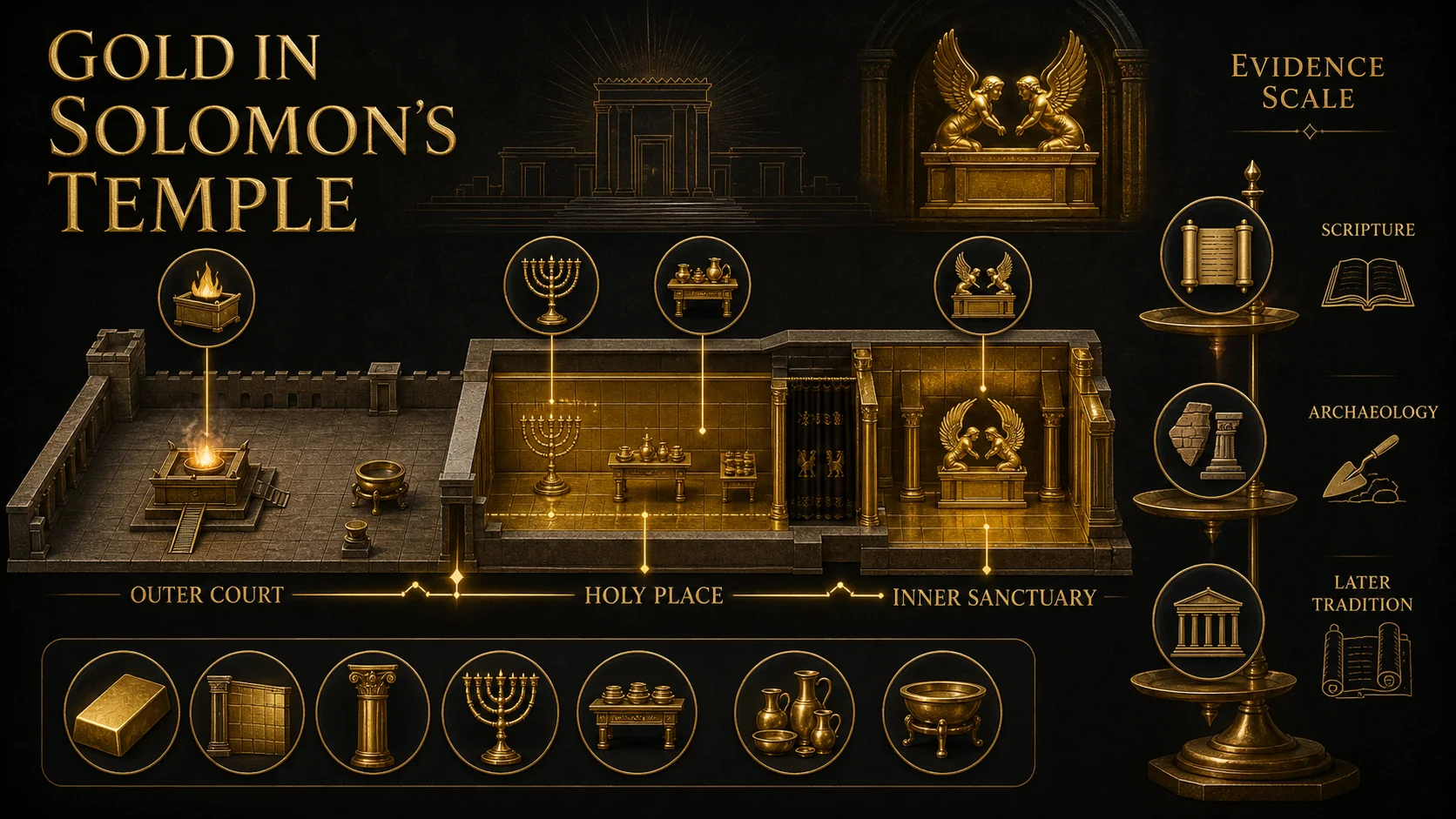
What the Bible Says About Gold in Solomon’s Temple
The main descriptions come from 1 Kings 6, 2 Chronicles 3, and related passages about temple furnishings. These texts present Solomon’s Temple as a cedar-lined building whose sacred interior was overlaid with gold.
In that scriptural account, gold is concentrated where holiness increases. The inner shrine, the altar associated with the shrine, carved cherubim, doors, and sacred vessels receive the strongest emphasis.
The language is not modest. Kings describes the interior as overlaid with gold, while Chronicles adds more detail about gold work, cherubim, lampstands, basins, and other temple objects.
That does not mean we can calculate a reliable modern weight for all the gold. Ancient descriptions often use temple wealth to communicate status, sanctity, and royal legitimacy as well as material detail.
Temple-Space Guide: Where Gold Appears
| Temple area or object | Gold described in scripture | How to read the claim |
|---|---|---|
| Holy of Holies / inner shrine | Gold overlay on the most sacred room | Central scriptural claim; direct physical confirmation is unavailable. |
| Cedar altar near the shrine | Gold overlay | Fits the broader ancient Near Eastern pattern of precious materials in royal temples. |
| Cherubim | Large figures associated with the inner sanctuary | Theological and royal imagery; later art often visualizes them beyond the text. |
| Doors and carved surfaces | Gold over carved woodwork | Likely intended to signal a fully transformed sacred interior, not ordinary architecture. |
| Lampstands, basins, bowls, and utensils | Gold or pure gold objects in temple service | Specific quantities vary by passage and tradition; avoid treating later harmonizations as excavation data. |
A Credibility Check for the Main Claims
History-Claim Credibility Widget
Strong as scripture
The Bible repeatedly presents the temple interior and furnishings as gold-covered or gold-made.
Plausible as context
Elite temples and palaces in the ancient Near East commonly used precious metals to project divine and royal authority.
Weak as physical proof
No surviving gold panel or object can be securely identified as coming from Solomon’s Temple.
This distinction matters because the Temple Mount is not an ordinary archaeological site. Modern excavation is restricted by religious, political, and preservation concerns, and the building was destroyed in antiquity.
General reference works such as Britannica’s Temple of Jerusalem overview summarize the First Temple as the sanctuary associated with Solomon and destroyed by Babylonian forces in 587/586 BCE. That broad historical frame is much firmer than any claim about surviving gold fittings.
Why Gold Was Used in a Sacred Building
Gold was not selected merely because it was expensive. In ancient religious architecture, gold could communicate separation, permanence, brightness, and royal patronage.
For Solomon’s Temple, the material had at least four likely meanings:
- Holiness: gold marked spaces and objects removed from everyday use.
- Kingship: the temple was tied to royal building authority and state identity.
- Durability: gold resists corrosion, making it symbolically suitable for divine service.
- Light: polished gold surfaces would have amplified lamp and oil light inside a dark, enclosed sanctuary.
Readers interested in the broader cultural role of ancient precious metal networks can compare this temple material culture with GoldConsul’s guides to gold trade in ancient times, gold mining in ancient Mesopotamia, and ancient gold mining.
Scripture, Archaeology, and Later Tradition Are Not the Same Source
A careful article on gold in Solomon’s Temple should not flatten all evidence into one category. The sources behave differently.
Scriptural description
The biblical passages are the primary source for the temple’s gold program. They are indispensable for understanding how ancient Israelite and later Jewish tradition remembered the First Temple.
They are not the same thing as a museum inventory recovered from a sealed excavation layer. Their theological and literary purpose should be respected rather than ignored.
Archaeological context
Archaeology can illuminate First Temple-period Jerusalem, regional architecture, inscriptions, seals, administrative practices, and cultic landscapes. It cannot currently show a verified gold-plated wall panel from Solomon’s sanctuary.
Accessible archaeological summaries such as the Biblical Archaeology Society’s overview of Solomon emphasize the difficulty of tying material remains directly to Solomon’s specific building projects. That caution is important for any claim about temple gold.
Later tradition
Later Jewish, Christian, and Islamic traditions gave Solomon and the temple enormous symbolic weight. Those traditions are historically important, but they often answer religious and cultural questions rather than archaeological ones.
For comparison, GoldConsul’s article on gold in medieval myths and legends shows how gold can move from material object to moral, royal, and mystical symbol across centuries.
How Much Gold Was in Solomon’s Temple?
The honest answer is: the biblical texts describe a lavish amount, but a precise modern total is not recoverable with confidence.
Some readers try to add up every biblical number, convert ancient talents into modern kilograms, and publish a single headline figure. That method looks precise, but it depends on assumptions about textual transmission, ancient weight standards, whether figures are literal or rhetorical, and which passages are being combined.
A better approach is to ask what the text is trying to convey. It portrays the temple as the richest and most sacred building in the kingdom, with gold concentrated inside the holy zones rather than spread evenly through the whole complex.
For background on gold’s physical properties and why it was prized across cultures, see GoldConsul’s explainer on gold as an element and the practical guide to gold’s density.
What Happened to the Temple Gold?
The biblical history of Jerusalem reports temple plundering before the final Babylonian destruction. The broader historical frame is that Babylonian campaigns against Judah culminated in the destruction of Jerusalem and the First Temple in the early sixth century BCE.
That means the gold described in the temple narratives would not be expected to survive in place. Precious metal was portable, recyclable, and politically valuable. Conquerors did not usually leave gold panels and vessels untouched for future archaeologists.
This is one reason absence of surviving gold is not, by itself, proof that no gold was ever used. It is also why responsible writing should avoid claiming that the temple’s gold has been physically recovered.
Editorial Perspective
GoldConsul Editorial Perspective
The best reading treats Solomon’s Temple as a meeting point of text, memory, architecture, and power. The gold matters because it shows how ancient writers imagined the boundary between ordinary wealth and sacred service. The weakness comes when modern retellings turn that imagination into unsupported treasure claims.
Knowledge Gap
What We Still Do Not Know
We do not have a direct archaeological inventory of Solomon’s Temple. We also cannot determine from surviving evidence exactly how thick the gold overlay was, how much total gold was used, or which later temple traditions preserve early architectural memory versus later interpretation.
Bottom Line
Gold in Solomon’s Temple is best understood as a high-confidence scriptural theme and a lower-confidence archaeological claim. The Bible clearly presents the temple as a gold-rich sacred interior; archaeology can contextualize First Temple-period Jerusalem but cannot currently verify the gold fittings themselves.
That careful distinction does not weaken the subject. It makes the temple more interesting: gold served as a language of holiness, monarchy, memory, and loss.
FAQ: Gold in Solomon’s Temple
Was Solomon’s Temple really covered in gold?
The biblical text describes extensive gold overlay inside the temple, especially in the inner sanctuary and on sacred objects. Archaeology has not recovered direct physical remains of those gold-covered surfaces.
Can historians prove how much gold was used?
No. Ancient texts include lavish descriptions and some numbers, but converting them into a precise modern total requires assumptions that cannot be independently verified.
Has any gold from Solomon’s Temple been found?
No object can be securely identified as gold from Solomon’s Temple. Claims of recovered temple treasure should be treated cautiously unless backed by strong provenance and peer-reviewed evidence.
Why would a temple use so much gold?
Gold signaled sacred separation, royal support, permanence, and visual brilliance. In a dim interior lit by lamps, gold would also have intensified reflected light.
Is the biblical description the same as archaeological evidence?
No. The biblical description is the primary textual witness. Archaeology provides context for the period, but it does not presently confirm the temple’s gold program directly.
 When you purchase a service or a product through our links, we sometimes earn a commission, at no extra cost to you.