

Compare where to store gold, including home safes, bank boxes, private vaults, and allocated storage, with insurance and access tradeoffs. in practical context.
- Home safes offer access, but theft, fire, and insurance limits matter.
- Bank boxes and private vaults reduce home risk, but access and ownership terms differ.
- Split storage can reduce single-location risk when holdings are meaningful.

Where to store gold depends on the size of the holding, how quickly you need access, how much insurance certainty you want, and whether the metal is clearly identifiable as yours.
The wrong storage choice can quietly undo the reason you bought physical gold in the first place. A home safe can concentrate theft risk. A bank safe deposit box can create false confidence about insurance. A vault account can look secure while the contract still leaves you with only a general claim.
TL;DR
- Small access reserve: a discreet, properly installed home safe can work if you keep records and avoid telling people what you own.
- Bank safe deposit box: useful for some documents and valuables, but gold in the box is not automatically FDIC-insured.
- Private vault: often better for larger bullion holdings where insurance, audits, and custody terms matter more than immediate access.
- Allocated storage: usually stronger than unallocated storage because specific metal is assigned to you, but the contract still matters.
- Split storage: often the most practical answer when one location would create too much concentration risk.
Start with the useful version first. The rest of this guide adds the evidence, edge cases, and stronger checks.
Choose storage by balancing access, theft risk, insurance, documentation, privacy, and resale logistics. The safest answer changes as the value and concentration of the holding grow.
A small documented item may fit a rated home safe. A larger holding may justify insured allocated vault storage with clear ownership and withdrawal terms.
A bank box is not automatically insured, and a private vault is only as strong as its contract, audits, legal ownership structure, access rules, and insurance.
Start with Gold Made Simple to move from basic gold terms to buying, testing, investing, and storage without the jargon.
Best Place to Store Gold: Short Answer
For a small amount of gold you may want to access quickly, home storage can be reasonable if your security setup is serious and your household risk is low.
For a larger long-term holding, professional storage deserves comparison. A private vault or allocated custody arrangement can reduce home theft concentration, improve documentation, and make insurance easier to evaluate.
For many owners, the best answer is not one location. A split setup can keep a modest amount accessible while storing the larger portion with stronger custody controls.
Gold Storage Options Compared
The table below is a practical starting point. It does not rank every provider; it shows the tradeoffs you should compare before deciding where to store gold.
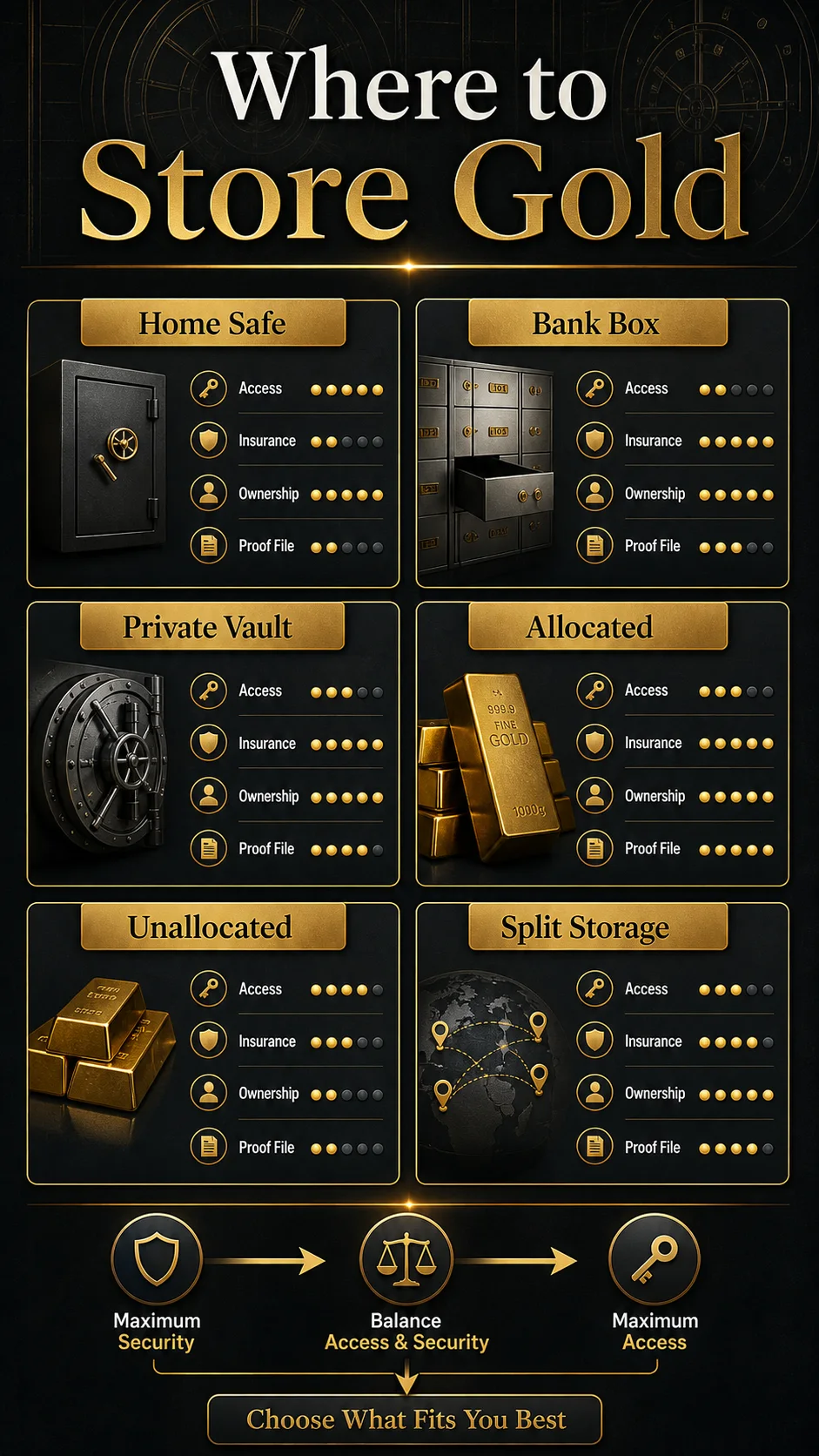
| Storage option | Best fit | Main strength | Main weakness | Insurance and proof question |
|---|---|---|---|---|
| Home safe | Small access reserve, frequent access, privacy-focused owners | Immediate control and no custodian | Theft, fire, household disclosure, and concentrated location risk | Does your policy cover bullion at home, and can you prove what was lost? |
| Bank safe deposit box | Moderate valuables where bank-hour access is acceptable | Better physical security than many homes | Not a bank deposit, limited access, lease restrictions, disputed contents risk | Does your insurance cover off-premises gold in a rented box? |
| Private vault | Larger bullion holdings and long-term storage | Professional custody, stronger processes, clearer inventory controls | Fees, provider diligence, jurisdiction, withdrawal procedures | Is coverage for your benefit, and are audits and inventory records clear? |
| Allocated storage | Owners who want specific metal assigned to them | Better ownership quality than a general claim | More expensive and not always fully segregated | Do records identify bars or coins assigned to you? |
| Unallocated storage | Short-term exposure or convenience-focused accounts | Lower friction and often lower cost | More counterparty and redemption risk | Do you own metal, or only a claim against the provider? |
| Split storage | Owners who want access without keeping everything in one place | Reduces single-location failure risk | More administration and documentation | Are all locations documented, insured, and known to the right person? |
Home Storage: Best for Access, Weakest for Concentrated Risk
Home storage gives you the most direct control. There is no custodian, no bank-hour limitation, and no waiting period if you need to access the metal.
The tradeoff is concentration. If too much gold sits at one address, a burglary, fire, flood, household dispute, or careless disclosure can create a loss that is hard to reverse.
Home storage works best when:
- The amount is modest relative to your net worth.
- The safe is properly rated, installed, concealed, and difficult to remove.
- Very few people know the gold exists.
- Your insurance position is written down, not assumed.
- You keep photos, invoices, and an inventory outside the safe.
If you are deciding between a home safe and professional storage, read GoldConsul’s detailed comparison of home safe vs private vault for gold.
Reader-supported tools
Home storage tools for small gold holdings
For small amounts kept at home, the useful goal is organization, documentation and basic fire or water protection.
As an Amazon Associate, GoldConsul may earn from qualifying purchases.
SentrySafe HD4100 Fireproof and Waterproof Safe
Best for: Keeping documents, receipts and small valuables organized at home.
Caveat: A small home safe is not a substitute for insured professional vaulting for larger holdings.
LOCKCURX Graded Coin Storage Box
Best for: Organizing slabbed NGC or PCGS coins in one portable case.
Caveat: It is useful for organization, but it is not an insurance or theft-protection solution.
Use note: Small home safes are not a replacement for insured vault storage, especially for concentrated bullion value.
Bank Safe Deposit Box: Secure Location, Limited Protection
A safe deposit box can reduce casual home-theft risk, but it is not the same as an insured bank account. The box contents are not bank deposits.
The FDIC explains that deposit insurance protects eligible deposits, not the contents of safe deposit boxes. That distinction matters if you store gold coins, bars, jewelry, cash, or important documents in a box.
Bank box leases can also limit the bank’s responsibility for contents. Access can depend on branch hours, estate procedures, unpaid fees, court orders, or bank policy.
For the insurance details, see GoldConsul’s focused guide: Is Gold Insured in a Safe Deposit Box?
Private Vault: Better for Larger Bullion Holdings
Private vaulting can make sense once the value of your gold is large enough that keeping all of it at home feels imprudent.
The main advantage is not just stronger doors. It is the professional custody process: intake records, audits, insurance terms, controlled access, and documented withdrawal procedures.
Compare private vaults by:
- Jurisdiction and legal ownership structure.
- Whether storage is allocated, pooled allocated, or unallocated.
- Insurance scope, exclusions, deductibles, and named beneficiaries.
- Independent audits and inventory reconciliation.
- Withdrawal rules, shipping options, and liquidation procedures.
- Annual fees, minimums, and transaction costs.
If you are comparing non-bank storage in Europe, start with GoldConsul’s page on the best gold vaults for private storage by European countries.
Allocated vs Unallocated Storage: The Ownership Question
Allocated storage generally means specific bars or coins are assigned to you. Unallocated storage usually means you have a claim for a quantity of gold, not necessarily ownership of identifiable metal.
This difference is easy to ignore when markets are calm. It becomes much more important during provider stress, redemption delays, estate administration, or disputes about what you actually owned.
Allocated does not automatically mean perfect protection. You still need to know whether the metal is segregated, pooled, audited, insured, and withdrawable. For the deeper distinction, read Allocated vs Unallocated Gold Storage.
Split Storage Strategy
Split storage is often the most practical middle ground. You keep a limited amount accessible and store the larger portion somewhere with stronger controls.
A simple example is to keep a small emergency reserve in a discreet home safe, store the main bullion position in allocated vault custody, and keep digital copies of invoices and inventory records in a separate secure location.
Proof File Checklist
Storage is only half the job. If you cannot prove what you owned, where it was stored, and what coverage applied, a loss or estate event becomes much harder to resolve.
Keep a gold proof file with:
- Purchase invoices and dealer confirmations.
- Photos or video of bars, coins, packaging, and serial numbers where applicable.
- Weights, fineness, refiner or mint details, and bar numbers.
- Safe deposit box lease or vault storage contract.
- Insurance policy, schedule, endorsements, exclusions, and coverage limits.
- Appraisals if required by your insurer.
- Estate instructions that tell the right person where records are held.
Decision Matrix: Which Storage Option Fits You?
| Owner situation | Likely best fit | Why |
|---|---|---|
| First-time buyer with a few coins | Small home safe plus proof file | Low complexity and direct access, as long as discretion and documentation are strong. |
| Moderate holding, no need for instant access | Split storage or bank box with separate insurance | Reduces home concentration risk, but insurance must be confirmed in writing. |
| Larger bullion stack | Private vault or allocated custody | Better fit for audit trails, inventory controls, and professional storage terms. |
| Investor comparing providers | Allocated storage after contract review | Ownership quality matters more than the lowest annual fee. |
| Family or estate-planning concern | Documented storage with clear access instructions | Heirs need proof, access steps, and a way to identify the metal. |
The GoldConsul Editorial Perspective
Gold storage is not an afterthought. It is part of the investment. The best setup is the one that preserves ownership quality, reduces avoidable loss risk, and still lets the right person access the metal when access matters.
Knowledge Gap: Security Is Not the Same as Ownership Quality
Many storage guides focus only on theft. That is too narrow.
- Security: can someone steal or damage the gold?
- Insurance: will a policy actually respond if something happens?
- Ownership: is the metal legally identifiable as yours?
- Access: can you or your heirs retrieve it under real-world conditions?
- Documentation: can you prove what existed before a loss?
The strongest storage plan answers all five questions, not just the first one.
GoldBroker and Professional Storage Context
If your goal is physical bullion ownership with professional storage options, GoldBroker is one provider to include in your comparison process. Compare custody structure, jurisdiction, insurance, fees, withdrawal rules, and whether the storage model gives you the ownership quality you want.
Provider Comparison Rule
Do not choose a storage provider by annual fee alone. Compare legal ownership, bar documentation, insurance, audits, jurisdiction, withdrawal rights, and what happens if the provider has financial stress.
Affiliate disclosure: GoldConsul may earn a commission if you use some external partner links, at no extra cost to you.Useful Starting Points
If you are still building your first gold plan, GoldConsul’s free gold guide for beginners can help you compare coins, bars, premiums, storage, and resale before you buy.
For external background, review the FDIC deposit insurance FAQ for what deposit insurance does and does not cover. For professional market context, the LBMA and World Gold Council are useful starting points for understanding institutional gold-market standards and terminology.
FAQ: Where to Store Gold
Is it safe to store gold at home?
It can be safe for a small amount if the safe is serious, discreet, properly installed, and supported by insurance and documentation. It becomes riskier when too much gold is concentrated at one address.
Is gold in a safe deposit box insured?
Not automatically. FDIC insurance does not cover gold in a safe deposit box, and bank leases often limit responsibility for contents. You need separate insurance confirmation.
Is a private vault better than a bank safe deposit box?
For larger bullion holdings, a private vault may offer clearer custody, audit, insurance, and withdrawal terms. It still requires careful provider and contract review.
Should I use allocated or unallocated gold storage?
Allocated storage is usually stronger for long-term physical ownership because specific metal is assigned to you. Unallocated storage can be cheaper or easier to trade, but it usually carries more counterparty risk.
Should I split my gold between multiple locations?
For many owners, yes. Split storage can preserve access while reducing the risk that one theft, fire, bank access issue, or provider problem affects the entire holding.
Bottom Line
The best place to store gold is the place that matches your holding size, access needs, insurance position, documentation quality, and ownership goals.
For small holdings, a home safe may be enough. For larger holdings, professional vaulting or allocated custody deserves serious comparison. For many owners, a split setup is the most resilient answer.
 When you purchase a service or a product through our links, we sometimes earn a commission, at no extra cost to you.