
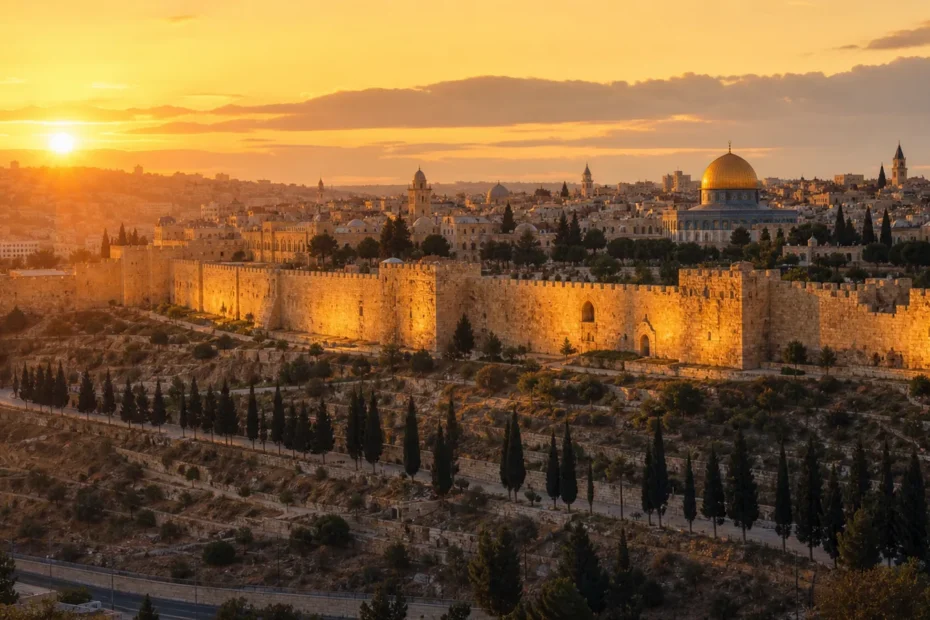
See how Jerusalem became linked with golden imagery through Temple memory, sacred light, pilgrimage, coins, architecture, and religious symbolism.
- Read Jerusalem's gold symbolism through faith, empire, and memory.
- Separate Temple history, coins, architecture, and pilgrimage claims.
- Use archaeological limits before turning symbolism into certainty.
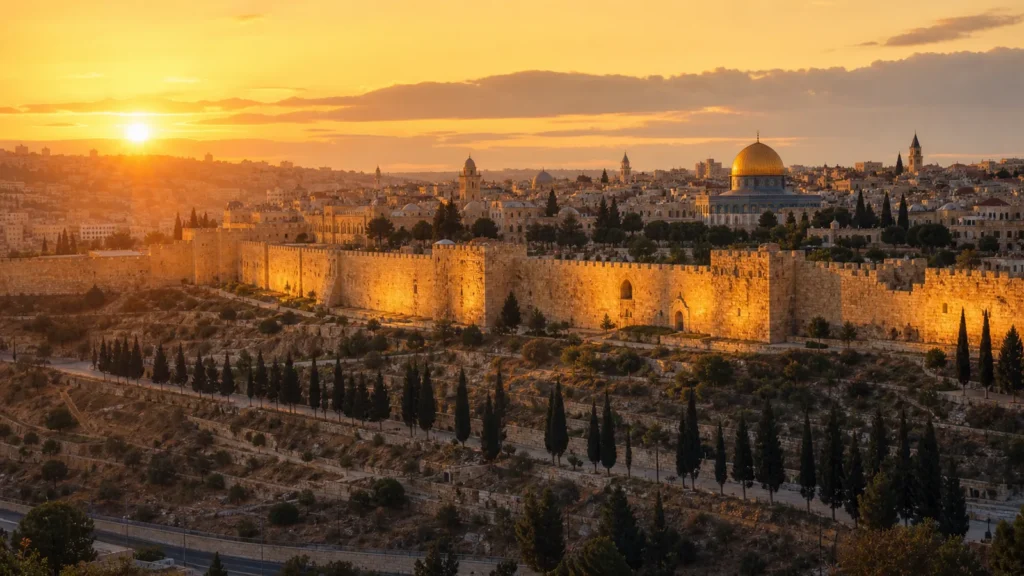
Jerusalem is called a golden city for more than one reason. The phrase points to sunlight on pale limestone, but it also carries centuries of religious longing, royal memory, sacred art, coins, pilgrimage, and contested cultural inheritance. That richness needs careful handling.
Jerusalem is called a golden city for more than one reason. The phrase points to sunlight on pale limestone, but it also carries centuries of religious longing, royal memory, sacred art, coins, pilgrimage, and contested cultural inheritance.
That richness needs careful handling. Gold in Jerusalem is not a single story owned by one period or one community. It appears in Jewish Temple memory, Christian pilgrimage and liturgy, Islamic architecture and patronage, imperial coinage, museum objects, and modern songs that turn the city’s light into a symbol of belonging.
TL;DR: The Golden City of Jerusalem
- Jerusalem’s “golden” identity combines real light on stone with symbolic gold in faith, art, power, and memory.
- Gold mattered in Temple traditions, liturgical objects, coins, manuscripts, domes, gifts, and pilgrimage economies.
- The city’s sacred status is shared and contested across Judaism, Christianity, and Islam, so simple treasure-hunt narratives miss the point.
- Physical gold survives unevenly because objects were reused, looted, melted, buried, donated, and reinterpreted over time.
- The strongest reading treats Jerusalem’s gold as a language of holiness, sovereignty, beauty, and longing rather than only material wealth.
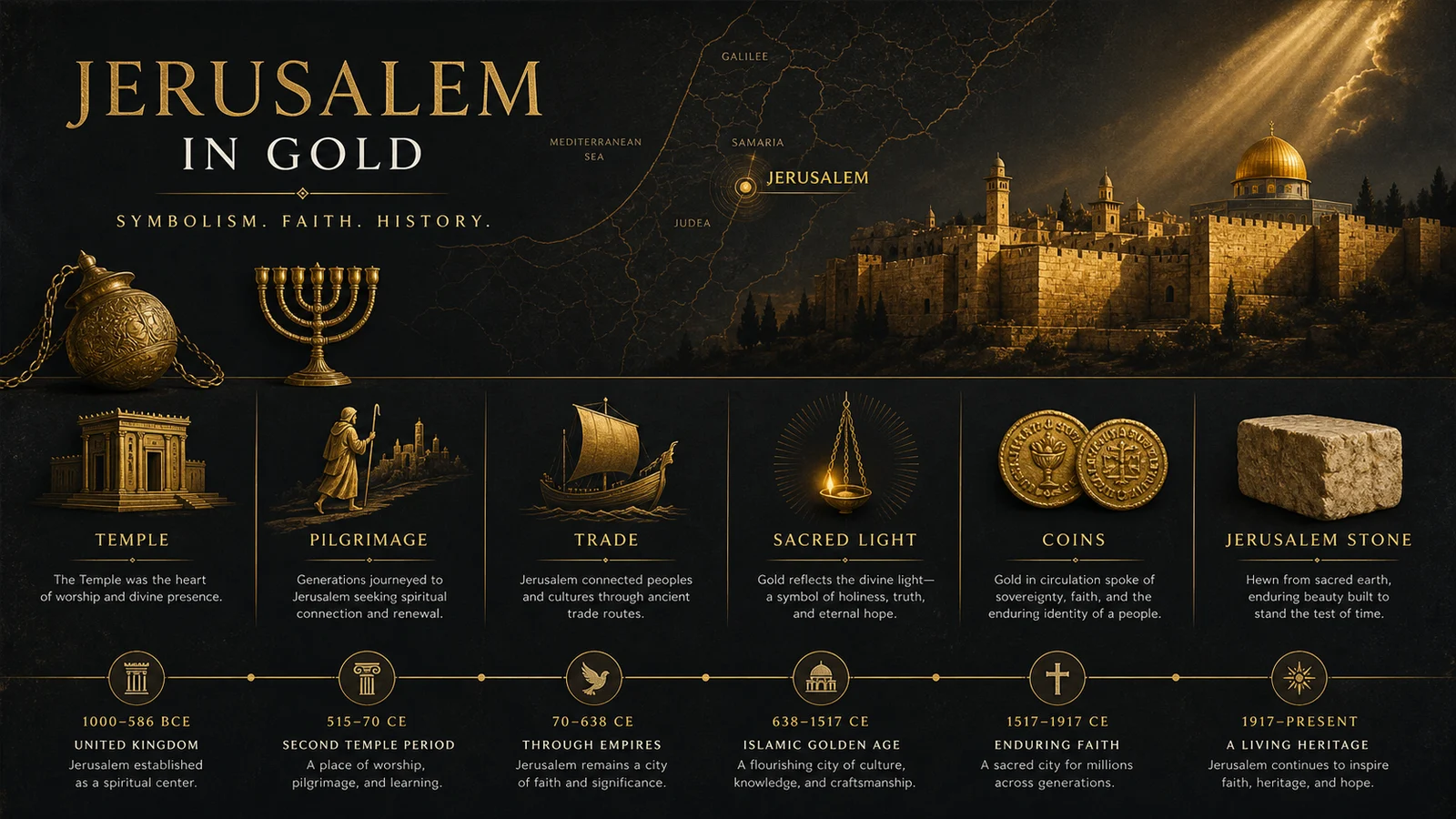
Why Jerusalem Became the Golden City
The most immediate explanation is visual. Jerusalem stone is a pale local limestone that can shift from cream to amber under low sun. At sunrise and sunset, the city can look as if it has been washed in gold.
But the phrase “Golden City” also works because Jerusalem has long been imagined as more than a built place. For many readers, it is a sacred center, a promised destination, a lost home, a heavenly image, or a city whose stones carry memory.
The UNESCO World Heritage listing for the Old City of Jerusalem and its Walls emphasizes the city’s exceptional religious and historical significance. That context is essential: Jerusalem’s golden aura comes from layered meaning, not from a literal abundance of gold in ordinary life.
Jerusalem Gold Symbolism and History Table
| Theme | Gold Connection | Historical Nuance |
|---|---|---|
| Temple memory | Biblical descriptions associate gold with sacred vessels, inner sanctity, and divine honor. | Texts, archaeology, and later imagination must be separated carefully. |
| Sacred light | Gold leaf, lamps, mosaics, and domes turn light into religious experience. | The symbolism differs across Jewish, Christian, and Islamic settings. |
| Royal authority | Gold signals kingship, tribute, regalia, and imperial legitimacy. | Jerusalem was ruled by many powers, so “golden” authority was repeatedly redefined. |
| Coins and trade | Gold coins and precious objects moved through pilgrimage, taxation, tribute, and commerce. | Most everyday transactions used humbler money, credit, barter, or local obligations. |
| Pilgrimage | Visitors brought donations, commissioned objects, and carried home tokens of memory. | Pilgrimage economies mixed devotion, hospitality, politics, and trade. |
| Modern memory | “Jerusalem of Gold” became a powerful cultural phrase in modern Hebrew song and public imagination. | Modern symbolism can be moving and politically charged at the same time. |
Temple Gold: Sacred Wealth and Memory
Gold is central to many biblical descriptions of sacred space. The Temple tradition associates gold with vessels, lampstands, ornament, offering, and the idea that the most honored materials belonged near the divine presence.
GoldConsul’s article on gold in Solomon’s Temple gives useful background on why Temple gold still shapes modern imagination. The key caution is that textual grandeur, archaeological evidence, and later devotional retelling are not the same kind of proof.
That caution does not reduce the symbolism. In ancient religious language, gold could express incorruptibility, beauty, holiness, royal gift, and separation from ordinary use. A sacred object made of gold was not simply expensive; it was set apart.
History Claim Credibility Check
Use this filter when reading claims about Jerusalem treasure, Temple gold, or buried sacred objects. Strong claims should pass most of these checks.
Gold Across Three Religious Traditions
Jerusalem is sacred to Judaism, Christianity, and Islam, but not in identical ways. That difference matters because gold symbolism changes with theology, ritual, architecture, and memory.
In Jewish tradition, gold often points toward Temple sanctity, priestly service, menorah imagery, covenant memory, and the hope attached to Jerusalem. It can also serve as a warning when wealth becomes idolatry, a tension explored in GoldConsul’s article on the Golden Calf.
In Christian Jerusalem, gold appears in icons, reliquaries, chalices, mosaics, manuscript illumination, and pilgrimage gifts. It can represent heavenly light, resurrection hope, and reverence for places associated with the life of Jesus.
In Islamic Jerusalem, the Dome of the Rock gives the city’s golden image one of its most recognizable forms. Its dome is not merely decorative in public perception; it has become a visual shorthand for sacred presence, patronage, and Jerusalem’s place in Islamic memory.
The Encyclopaedia Britannica overview of Jerusalem is a useful neutral starting point for the city’s long and multi-religious history.
Architecture: When Stone Looks Like Gold
Jerusalem’s golden reputation is partly architectural. The city’s stone surface responds dramatically to light, especially along walls, towers, domes, and terraces. This is why photographs can make the city look gilded even when no gold is present.
Architecture also frames memory. A golden dome, a stone wall, a church lamp, or a polished chalice can become a point where material, ritual, and identity meet. The eye reads these surfaces as more than surfaces.
Readers interested in how gold and sacred meaning overlap in older cultures may also find GoldConsul’s guide to gold in ancient religions helpful. Jerusalem belongs to that wider history, but it is not reducible to a generic “ancient gold” theme.
Coins, Pilgrims, and Portable Memory
Gold coins and precious objects reached Jerusalem through many channels: tribute, taxation, imperial administration, pilgrimage, trade, gifts, and conflict. The city was never isolated from larger Mediterranean, Near Eastern, Byzantine, Islamic, Crusader, Ottoman, and modern networks.
Coins are especially useful because they compress authority into small objects. A coin can carry a ruler’s claim, a religious motif, a minting standard, and a trade function at the same time. GoldConsul’s guide to the most valuable gold coins in history explains why metal content is only one part of a coin’s cultural value.
For Jerusalem, the harder question is not whether gold passed through the city. It did. The harder question is what kind of evidence we have for each period and whether that evidence shows daily life, elite display, state finance, sacred donation, or later collecting.
The Metropolitan Museum of Art’s Jerusalem 1000-1400 exhibition materials show how objects, manuscripts, pilgrimage, and trade linked Jerusalem to a far wider medieval world.
What Popular Accounts Often Get Wrong
Popular writing about Jerusalem’s gold often slides into treasure language. That can be entertaining, but it easily flattens history into rumors of hidden wealth, lost Temple vessels, or spectacular hoards.
The better approach is to ask what kind of gold is being discussed. Is it physical metal, gold leaf, a coin, a dome, a poetic image, a ritual object, a royal claim, or a metaphor for longing?
Another mistake is treating the city as one continuous owner of one continuous tradition. Jerusalem’s history includes destruction, rebuilding, conquest, patronage, migration, devotion, conflict, scholarship, trade, and reuse. Gold objects moved through that history; they did not freeze it.
Knowledge Gap: Symbol Is Not Evidence
The main gap in many accounts is the jump from symbolic gold to factual gold. A golden dome, a biblical image, or a song lyric can reveal meaning, but it does not automatically prove a buried treasure or a specific historical quantity of metal.
The strongest interpretation keeps the categories separate: physical gold, artistic gold, architectural glow, sacred symbolism, and modern cultural memory.
How to Read Jerusalem’s Golden Legacy
A practical reading starts with the object or phrase in front of you. If it is a coin, ask about mint, weight, ruler, inscription, and provenance. If it is a sacred object, ask about ritual function and later reuse. If it is architecture, ask how light, patronage, and public memory shape the viewer’s response.
That habit also protects against overclaiming. Gold is dense, durable, and alluring, but history is not measured only in ounces. A gilded manuscript page may tell us more about devotion than wealth. A coin may tell us more about authority than abundance.
For readers focused on authenticity rather than symbolism, GoldConsul’s practical guide to testing gold coins explains why provenance and verification matter when precious metal objects enter the market.
Editorial Perspective
The GoldConsul Editorial Perspective
Jerusalem’s gold is most meaningful when we resist making it only material or only metaphor. The city is golden because light, faith, power, art, memory, and actual precious metal have all gathered around it.
Bottom Line
The Golden City of Jerusalem is not a simple treasure story. It is a layered cultural image built from stone, sunlight, sacred objects, coins, domes, pilgrimage, scripture, song, and historical memory.
Gold matters because it gives visible form to ideas that are otherwise difficult to hold: holiness, sovereignty, beauty, permanence, longing, and risk. Read with that nuance, Jerusalem’s golden identity becomes richer than legend and more durable than spectacle.
FAQ: Golden City of Jerusalem
Why is Jerusalem called the Golden City?
The phrase comes from both appearance and symbolism. Jerusalem’s pale stone can glow gold in low sunlight, while the city’s religious traditions connect gold with holiness, royal memory, sacred art, and longing.
Was ancient Jerusalem full of gold?
No. Gold was important in elite, royal, and sacred contexts, but ordinary life relied on far more modest materials and forms of exchange. Surviving gold evidence should not be treated as proof of broad everyday wealth.
What does gold symbolize in Jerusalem’s religious history?
Gold can symbolize holiness, divine light, kingship, offering, permanence, and sacred separation. Its exact meaning depends on the tradition, object, building, and historical period being discussed.
Is the Dome of the Rock why Jerusalem looks golden today?
It is one major visual reason, but not the only one. The Dome of the Rock is globally recognizable, while Jerusalem stone, sunset light, city walls, lamps, and religious art also contribute to the golden image.
Are stories about lost Temple gold reliable?
Some stories preserve important cultural memory, but specific treasure claims need careful evidence. Look for documented archaeology, clear provenance, credible publication, and a distinction between scripture, legend, and material finds.
 When you purchase a service or a product through our links, we sometimes earn a commission, at no extra cost to you.