
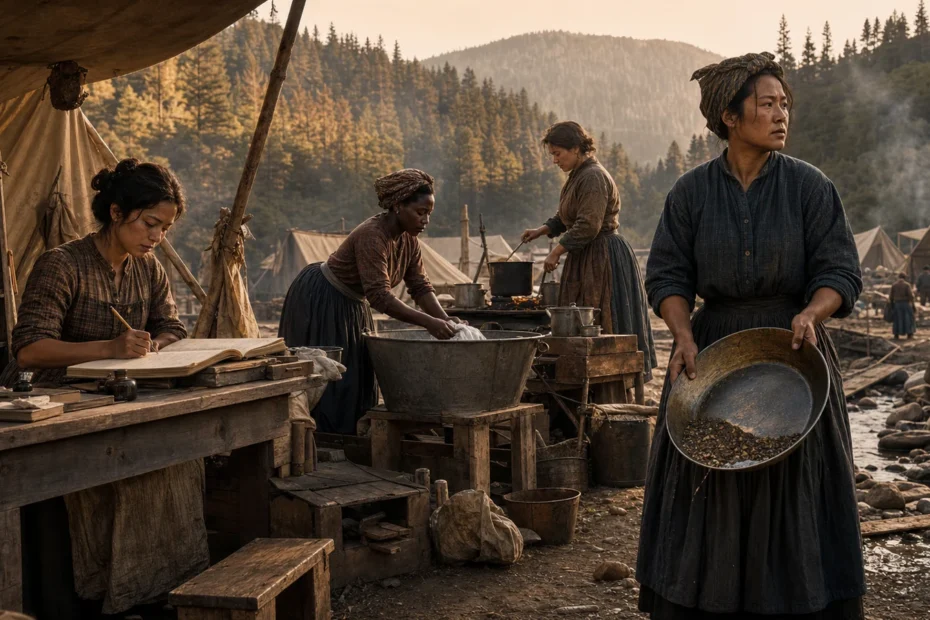
See how women shaped the Gold Rush through businesses, families, labor, migration, entrepreneurship, survival, and roles often missed in simple accounts.
- Women mined, traded, washed, cooked, nursed, kept books, and ran businesses.
- Race, class, law, and capital shaped opportunity more than myth suggests.
- Look for evidence beyond frontier stereotypes and decorative side stories.
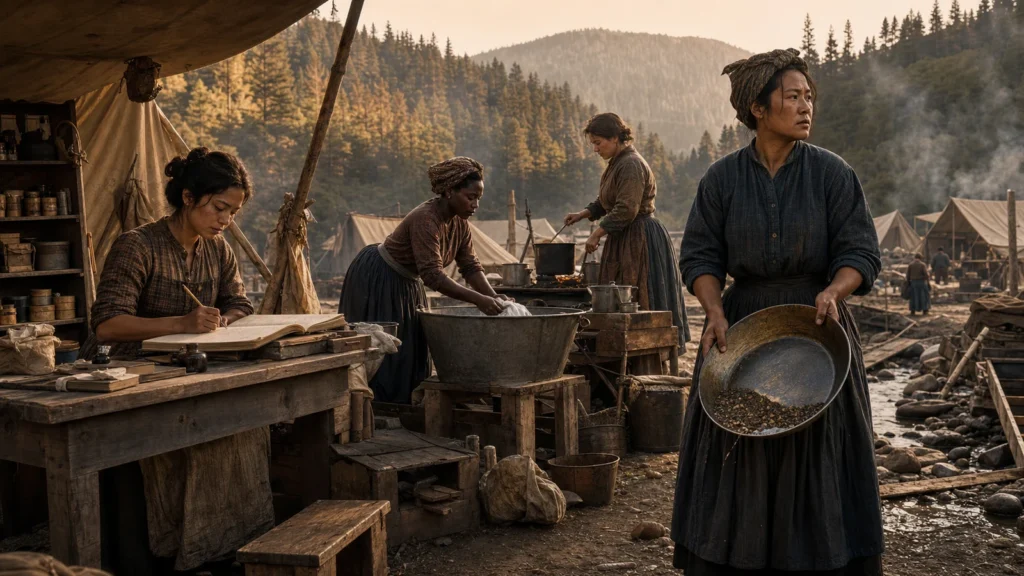
Women in the Gold Rush were not a decorative footnote to a story about men with pans. The evidence points to a harder, more practical picture: women mined, cooked, washed, nursed, kept books, ran boarding houses, sold goods, raised children, and navigated legal and racial limits in unstable boomtowns. Their opportunities were real, but they were uneven.
Women in the Gold Rush were not a decorative footnote to a story about men with pans. The evidence points to a harder, more practical picture: women mined, cooked, washed, nursed, kept books, ran boarding houses, sold goods, raised children, and navigated legal and racial limits in unstable boomtowns.
Their opportunities were real, but they were uneven. A white woman with capital, literacy, or family protection could turn scarcity into leverage. An Indigenous, Mexican, Chinese, Black, or poor woman often faced a narrower and more dangerous set of choices.
TL;DR: Women in the Gold Rush
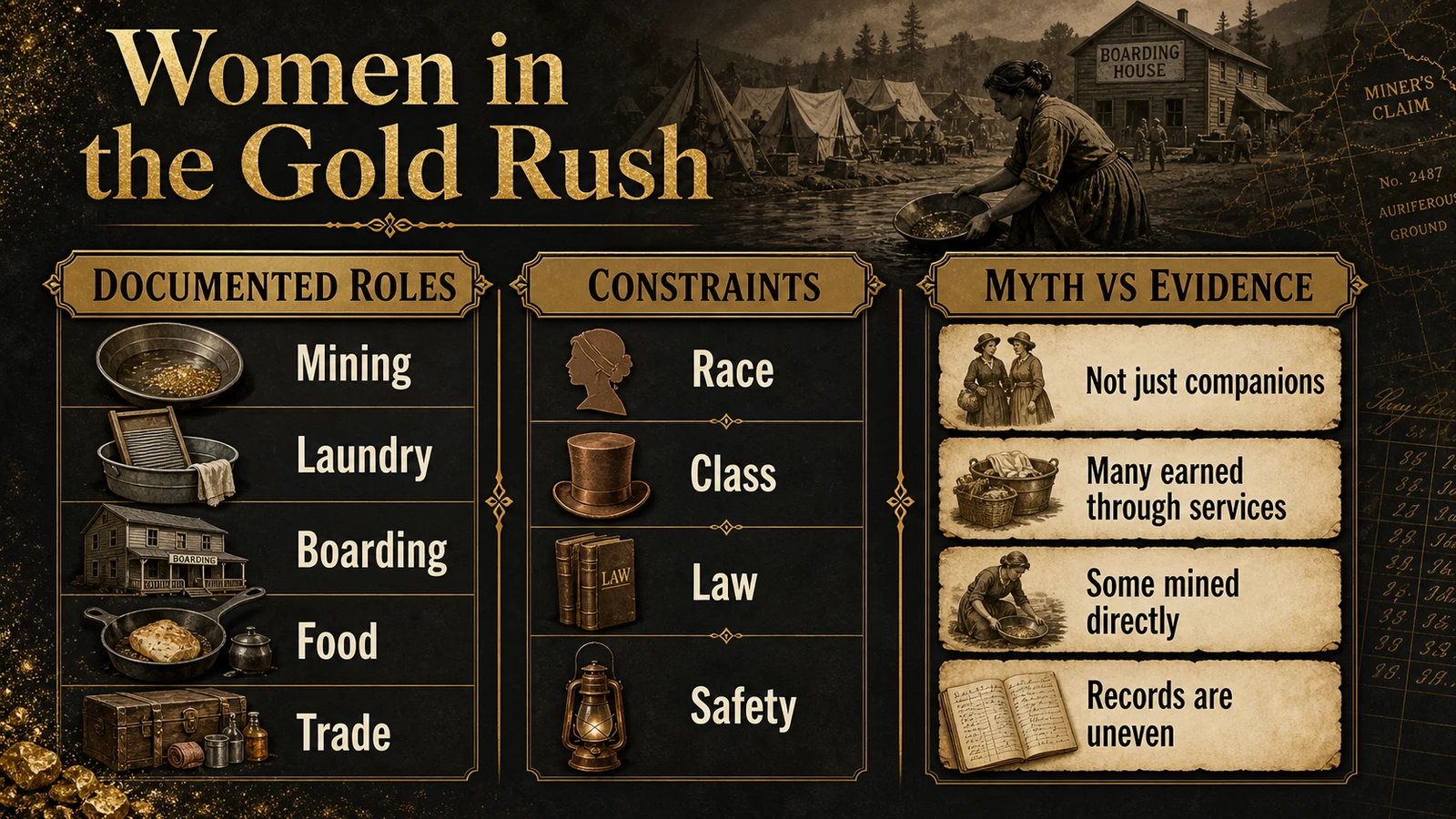
- Women worked across mining-camp economies, especially laundry, food, lodging, sewing, storekeeping, nursing, and direct mining.
- The best documented cases often come from literate Anglo-American women, so the archive is not a neutral sample.
- Race, class, marital status, violence, property law, and migration routes shaped what women could safely do.
- Service work could be more reliable than mining because miners paid high prices for scarce labor and domestic infrastructure.
- The romantic “gold rush woman” myth hides the central point: women helped build the economy that made mining camps function.
Start With the Evidence, Not the Legend
The familiar Gold Rush image is a lone prospector kneeling over a pan. That image is incomplete. The camps needed water hauled, clothes washed, meals cooked, ledgers kept, wounds treated, claims supplied, children cared for, and rooms rented.
Those tasks created a market. In many camps, scarce services could command prices that made more sense than chasing uncertain flakes in a stream.
Primary accounts help correct the picture. The Library of Congress collection California as I Saw It preserves first-person narratives from early California, including accounts by women who saw mining communities up close. Louise Amelia Knapp Smith Clappe’s Shirley letters are especially useful because they describe life in Feather River mining communities rather than a later romantic memory.
What Women Actually Did
Women in the Gold Rush did not fit one job category. Some came as wives or daughters, some traveled as single wage earners, some were already in California as Californios or Indigenous residents, and some arrived from Latin America, China, Europe, or the eastern United States.
The work fell into several practical buckets.
| Role | Why it mattered | Reality check |
|---|---|---|
| Laundry and sewing | Miners needed clean shirts, mending, and basic domestic services in muddy camps. | Profitable when demand was high, but physically hard and exposed to weather, disease, and harassment. |
| Boarding and food | Meals and beds turned temporary camps into functioning settlements. | Required capital, supplies, stamina, and some protection from theft or violence. |
| Storekeeping and trade | Supplies often made steadier money than uncertain placer mining. | Credit risk, transport costs, fires, and price swings could erase gains. |
| Mining and claim work | Some women panned, worked claims, or supported family mining operations directly. | The archive records fewer women miners than service workers, but absence of records is not proof of absence. |
| Care work and teaching | Illness, injury, childbirth, and children did not stop because a camp was temporary. | Care labor was essential but often undercounted in economic histories. |
This is why a related GoldConsul article on Gold Rush mining techniques tells only part of the story. Tools mattered, but so did the food, clothing, credit, housing, and services around the tools.
The Mining-Camp Economy Rewarded Scarcity
Gold mining was uncertain. A miner could work for weeks and find little. A washerwoman, cook, or boarding-house operator could price a necessary service in a market where workers were overwhelmingly male and domestic infrastructure was thin.
That does not mean women had easy money. It means some women identified a more reliable economic gap than digging.
Think of the camp as a rough supply chain. The miner needed tools, clothes, food, credit, shelter, transport, and information before any gold could be recovered. Women who controlled one of those links could earn from the rush without depending entirely on ore.
That same logic appears in many gold economies. In GoldConsul’s guide to Gold Rush towns, the town itself matters because services, law, lodging, and trade often outlasted the richest early diggings.
Race and Class Shaped the Choices
The phrase “women in the Gold Rush” can flatten major differences. A middle-class white migrant woman writing letters home did not face the same risks as an Indigenous woman displaced by mining, a Mexican Californio woman living through conquest and legal change, a Chinese immigrant woman facing exclusion and racism, or a Black woman building security under hostile conditions.
Foreign miners taxes, local violence, court access, language, and racialized policing affected who could hold a claim, collect debts, travel safely, or protect property. A California State Library foreign miners tax license, digitized through Santa Clara University, is a useful reminder that mining law and taxation were not neutral background rules.
Class mattered too. Women with cash, literacy, family networks, or transport could open a boarding house or store. Women without those assets had fewer margins for failure.
Editorial Perspective
The most useful way to read Gold Rush women’s history is economic first and sentimental second. Scarcity created opportunities, but those opportunities were filtered through race, class, law, violence, and the uneven survival of records.
Myths vs. Evidence
Myth: Women were mostly absent
Women were fewer than men, especially in the early rush years, but fewer does not mean irrelevant. A small group can have outsized economic influence when it controls scarce labor and services.
Myth: Women were mainly wives waiting in camp
Some women traveled with husbands and families. Others worked, invested, managed rooms, sold meals, mined, taught, nursed, or operated businesses. Family status shaped work; it did not erase it.
Myth: Direct mining was the only “real” Gold Rush work
A camp could not function on panning alone. The surrounding service economy was not secondary in practical terms. It was the operating system of the mining frontier.
Myth: Success stories represent everyone
Surviving memoirs often favor literate, mobile, and comparatively privileged women. That is evidence, but it is not the whole population.
A Practical Timeline
| Period | What changed | Why it matters for women |
|---|---|---|
| 1848 | Gold discovery at Sutter’s Mill triggers local and regional movement. | Existing Californio and Indigenous communities are affected before most eastern migrants arrive. |
| 1849-1850 | Mass migration creates male-heavy camps and severe service shortages. | Laundry, food, lodging, and trade become high-demand work. |
| 1851-1853 | Camps grow more settled; early easy diggings decline in many places. | Boarding houses, stores, schools, and family businesses become more visible. |
| Mid-1850s onward | Mining becomes more capital-intensive in many districts. | Direct access narrows for many small operators, while town economies continue to mature. |
For readers comparing regions, GoldConsul’s articles on the Witwatersrand Gold Rush and the South African Gold Rush show the same broad pattern in another form: once mining scales up, capital, labor systems, and law often matter as much as discovery.
How to Read Gold Rush Sources Carefully
Gold Rush women’s history has a source problem. Diaries, letters, court records, tax records, newspapers, and photographs survive unevenly. Some women left detailed writing; others appear only in hostile descriptions, account books, census entries, or not at all.
Eliza Farnham’s California, in-doors and out is valuable because it discusses California life, mining, and the position of women from a woman’s perspective. But it is still one observer’s view, shaped by class, reform politics, and personal experience.
That is the practical rule: use the sources, but do not let one source stand in for everyone.
Knowledge Gap
The biggest gap is not whether women participated. They did. The harder question is how to reconstruct the lives of women who were less likely to leave diaries, publish letters, own property in their own names, or be described fairly by newspapers and officials.
Bottom Line
Women in the Gold Rush were miners, workers, entrepreneurs, caregivers, migrants, and residents of contested mining societies. Their work was often practical, exhausting, and economically central.
The strongest reading is neither heroic myth nor dismissal. Women helped build the camps that made gold extraction possible, but their choices were constrained by law, violence, race, capital, and the records that happened to survive.
For broader context on the metal itself, see GoldConsul’s guides to when gold was discovered, gold ore, and gold extraction processes.
FAQ: Women in the Gold Rush
Did women actually mine during the Gold Rush?
Yes, some women mined directly by panning, working family claims, or helping with claim labor. The archive records fewer women miners than men, but direct mining was only one part of Gold Rush work.
How did many women make money in mining camps?
Many earned through laundry, cooking, boarding, sewing, nursing, teaching, storekeeping, and other services. In male-heavy camps, these services could be scarce and valuable.
Were women in the Gold Rush mostly wealthy?
No. Some had capital or family support, but many worked under difficult conditions. Wealth, literacy, race, marital status, and access to transport strongly affected opportunity.
Why are some groups of women harder to find in the records?
Published diaries and letters often came from literate and comparatively privileged women. Indigenous, Mexican, Chinese, Black, poor, and non-English-speaking women were more likely to be under-recorded or recorded through biased official sources.
What is the biggest myth about women in the Gold Rush?
The biggest myth is that women were peripheral. They were fewer than men in many early camps, but they provided labor, services, capital, and community infrastructure that mining settlements depended on.
 When you purchase a service or a product through our links, we sometimes earn a commission, at no extra cost to you.