
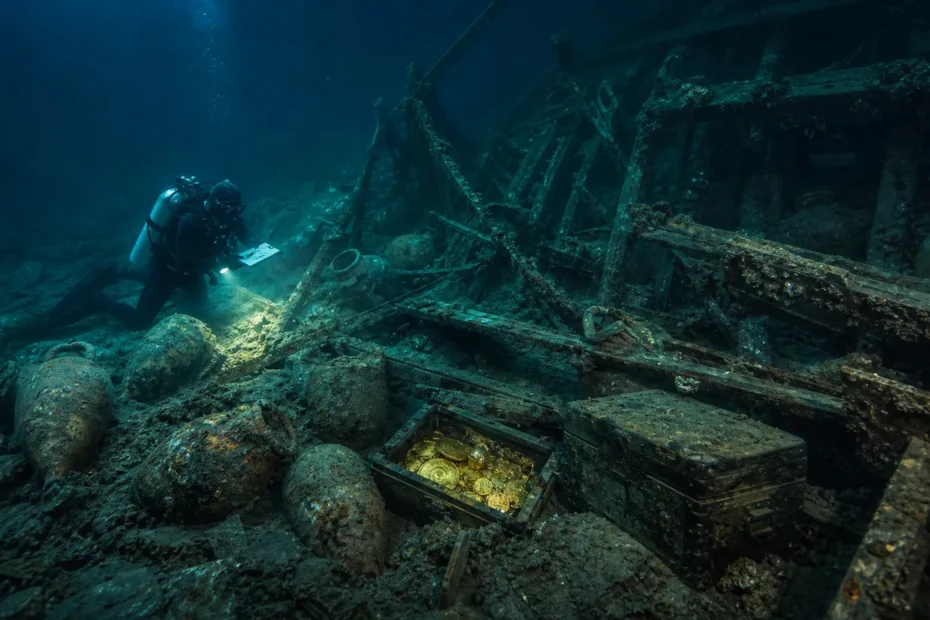
Review gold shipwrecks and underwater treasures through real cases, salvage law, archaeology, ethics, provenance, and how to judge treasure claims.
- Check ownership law before assuming any wreck is finders-keepers.
- Treat wrecks as archaeological sites, not just metal recovery targets.
- Use documented cases to filter treasure claims and salvage headlines.
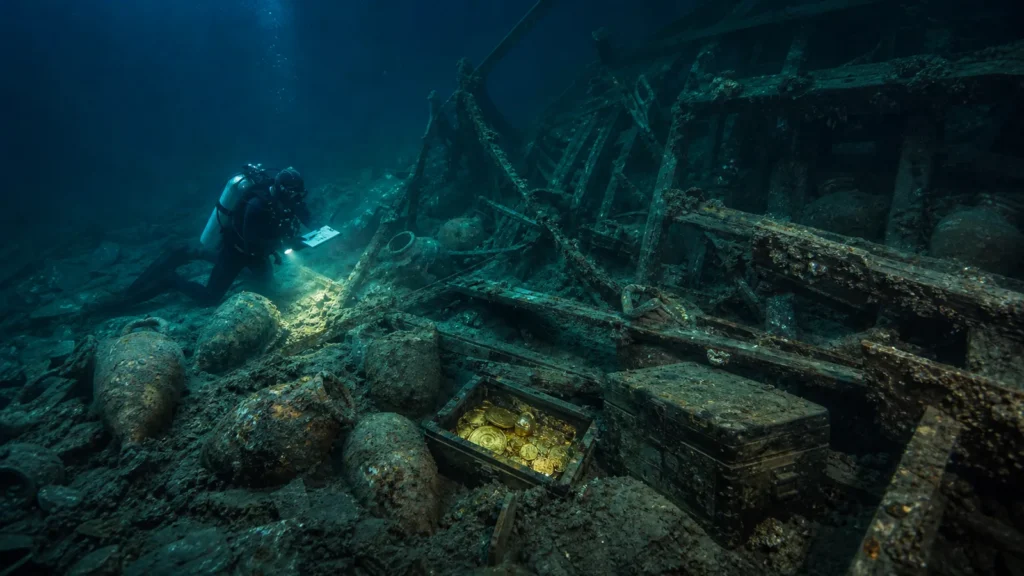
Gold shipwrecks make good headlines, but the serious story is rarely a simple hunt for lost treasure. A wreck can be a gravesite, a legal dispute, a fragile archaeological record, and only sometimes a source of recoverable gold.
Gold shipwrecks make good headlines, but the serious story is rarely a simple hunt for lost treasure. A wreck can be a gravesite, a legal dispute, a fragile archaeological record, and only sometimes a source of recoverable gold.
This guide looks at shipwreck gold through the practical lens that matters most: what was found, who may lawfully control it, what archaeologists can learn from it, and why responsible handling often matters more than the market value of the metal.
TL;DR: Gold Shipwrecks and Underwater Treasures
- Most valuable shipwrecks are not finders-keepers situations; ownership can involve national heritage law, admiralty courts, sovereign immunity, permits, and conservation duties.
- Archaeological context often matters more than the gold itself because coin positions, cargo layout, hull remains, and personal objects can reconstruct trade, war, migration, and daily life.
- Famous cases such as the 1715 Spanish fleet, the Nuestra Senora de Atocha, and the Nuestra Senora de las Mercedes show how different the legal outcomes can be.
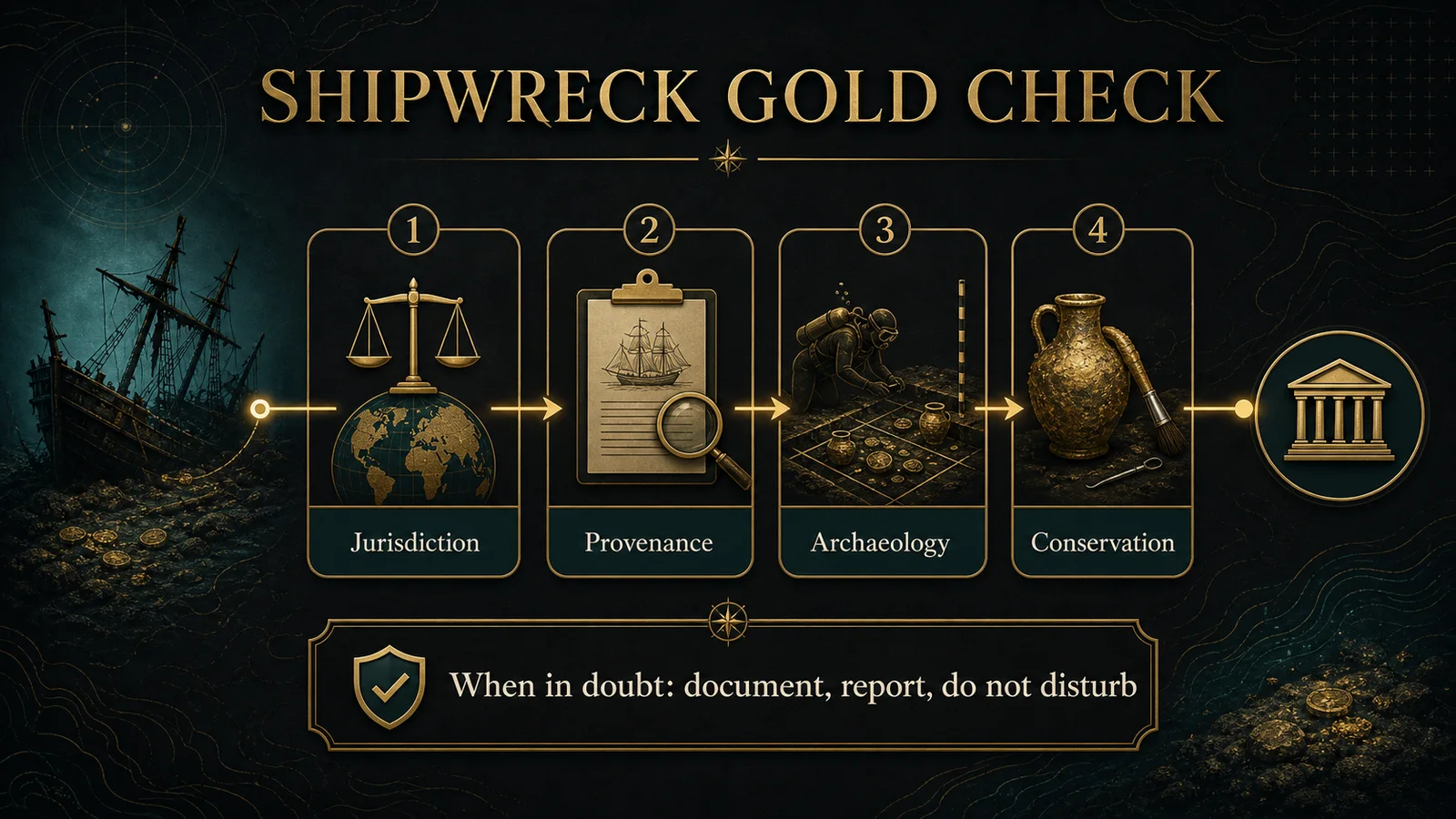
- If you find or suspect a submerged artifact, document the location safely, do not disturb it, and contact the relevant heritage authority.
Why Shipwreck Gold Is Different From Ordinary Bullion
A modern gold coin bought from a dealer is mainly a question of authenticity, price, storage, and resale. A gold coin from a wreck is different because its meaning comes from context: where it lay, what cargo surrounded it, what ship carried it, and which community or government has a claim.
That is why a shipwreck story should not be judged only by melt value. The same gold escudo or bar may help identify a trade route, a military voyage, a colonial mint connection, or a disaster sequence that a loose object can no longer explain.
For readers interested in the wider economic background, GoldConsul’s guide to gold trade and economy in ancient times gives useful context for why gold moved across seas long before modern bullion markets existed.
The Legal Baseline: Do Not Assume Finders Keepers
Shipwreck law depends on location, age, identity, cargo, permits, and the laws of the country or state with jurisdiction. A wreck in state waters may be handled differently from one in international waters, and a naval vessel can raise sovereign immunity issues even centuries after sinking.
The UNESCO 2001 Convention on the Protection of the Underwater Cultural Heritage defines underwater cultural heritage broadly and treats in-place preservation as a central principle. The United States has its own patchwork of federal, state, and maritime rules, while agencies such as NOAA’s Maritime Heritage Program emphasize protection of historic shipwrecks as archaeological resources.
Florida is a useful example because the public often associates the state with treasure fleets. The Florida Division of Historical Resources explains that state law governs archaeological and historical resources on state-owned submerged lands and that permits may be required for exploration or recovery in state waters; its underwater archaeology FAQ also warns against removing artifacts without authorization.
Shipwreck Gold Case and Timeline Table
The table below is not a ranking of “best treasures.” It is a comparison of what each case teaches about law, archaeology, and the limits of popular treasure narratives.
| Date / Case | Gold or Treasure Link | Legal / Archaeological Lesson |
|---|---|---|
| 1715 Spanish Treasure Fleet | Spanish colonial coins and precious cargo lost off Florida after a hurricane. | A famous treasure story can still sit inside modern permit, reporting, and heritage-control systems. |
| 1622 Nuestra Senora de Atocha | Gold, silver, emeralds, and artifacts from a Spanish galleon found after long searches. | Salvage history, court decisions, and artifact dispersal remain debated by archaeologists and historians. |
| 1804 Nuestra Senora de las Mercedes | Large cargo of silver and gold coins recovered by Odyssey Marine Exploration. | The Spanish Ministry of Culture records the court-ordered return of the cultural property to Spain in 2012. |
| Modern sanctuary wrecks | Often no major gold cargo at all, but high historical value. | NOAA treats many wrecks as protected maritime heritage rather than extractive opportunities. |
What Archaeologists Look For Before Gold
A careful underwater archaeology project starts with mapping, documentation, site stability, and research questions. Gold is just one material class among hull timbers, ballast, ceramics, weapons, personal objects, food remains, rigging, and environmental data.
- Provenance: Can the object be tied to a documented wreck, excavation unit, or recovery permit?
- Stratigraphy: Was it found in a layer that helps reconstruct the wrecking event?
- Association: Did it sit with other cargo, personal belongings, or ship structure?
- Conservation need: Will removal damage the artifact, the site, or the evidence around it?
- Public value: Can the find be studied, published, displayed, or digitally documented?
This is also why casual metal detecting, souvenir collection, and unreported removal can destroy information. A coin lifted without context becomes a commodity; the same coin recorded in place can become historical evidence.
Credibility Check for Shipwreck Gold Claims
- Does the story name the wreck, jurisdiction, permit holder, and reporting authority?
- Are photos tied to an excavation record, museum catalog, court filing, or official agency statement?
- Does the article separate estimated cargo value from recovered, verified, conserved artifacts?
- Does it explain what happened to the objects after recovery?
Practical Legality and Ethics Checklist
If you encounter a possible shipwreck artifact while diving, fishing, magnet fishing, boating, or beachcombing near a known wreck area, treat it as a legal and conservation issue before treating it as property.
- Do not disturb the object. Moving it can damage both the artifact and the evidence around it.
- Record non-invasive details. Note location, depth, date, photos, and visible surroundings if it is safe and lawful to do so.
- Check the jurisdiction. State waters, federal waters, national parks, marine sanctuaries, tribal lands, and foreign waters may all have different rules.
- Contact the relevant authority. This may be a state historic preservation office, park service, NOAA office, coast guard, police agency, or museum archaeology program.
- Avoid buying undocumented wreck gold. Provenance gaps can create legal, ethical, and resale problems.
- Separate educational interest from investment interest. Wreck gold is not a normal bullion allocation.
For ordinary bullion buying and verification, use a different framework. GoldConsul’s guides to gold and silver bullion, testing gold coins, and testing gold purity are more relevant than shipwreck case law.
Common Myths About Underwater Treasure
Myth: Every old shipwreck contains gold
Most shipwrecks did not carry large treasure cargoes. Many were fishing vessels, merchant ships, military craft, passenger vessels, or local working boats with little or no precious metal aboard.
Myth: International waters mean no rules
International waters do not erase every legal claim. Vessel identity, sovereign status, cultural heritage conventions, flag-state interests, court jurisdiction, and national laws can still matter.
Myth: Melt value is the main value
Melt value may matter for ordinary bullion, but historic wreck material can carry archaeological, cultural, legal, and conservation value that is not captured by spot price. That is especially true for coins with mint marks, cargo records, or site context.
For a broader look at how gold is identified outside treasure narratives, see GoldConsul’s explanation of gold’s symbol, Au, and atomic number 79.
Editorial Perspective
The most responsible way to write about gold shipwrecks is to slow the story down. A headline about “millions in treasure” often hides the harder questions: Was recovery permitted? Was the site recorded? Were human remains or memorial concerns involved? Did artifacts enter a public collection, a private sale, or a legal dispute?
GoldConsul’s view is simple: shipwreck gold should be treated first as cultural evidence and only second as metal. That does not mean every recovery is unethical, but it does mean any serious claim needs transparent documentation and a lawful chain of custody.
Knowledge Gap
Public coverage often leaves out what happens after discovery. Conservation can take years, court cases can outlast the initial excitement, and site reports may be harder to find than auction headlines.
The biggest knowledge gap for readers is provenance. Without a clear route from seabed to lab, archive, museum, court, or permitted custodian, a gold artifact’s story is incomplete.
When Shipwreck Gold Does and Does Not Belong in a Collection
Some legally recovered coins from historic wrecks circulate with documentation, but buyers should be cautious. A certificate is only useful if it identifies a legitimate recovery, a traceable source, and any restrictions on resale or export.
Collectors should avoid vague claims such as “shipwreck era,” “treasure coast style,” or “from a Spanish wreck” when no records support them. If the goal is gold exposure, modern bullion is cleaner, easier to authenticate, and less likely to raise cultural-property issues.
For readers thinking about practical ownership rather than historical artifacts, start with GoldConsul’s free gold guide for beginners and storage overview on where to store gold.
Bottom Line
Gold shipwrecks and underwater treasures are fascinating because they sit at the intersection of history, law, science, and value. The gold may be beautiful, but the real test is whether the recovery preserves knowledge instead of stripping it away.
A responsible reader should ask four questions before believing or buying a shipwreck gold story: Who had authority? What documentation exists? What archaeological context was preserved? Where did the artifact go after recovery?
FAQ: Gold Shipwrecks and Underwater Treasures
Can you legally keep gold found in a shipwreck?
Do not assume so. The answer depends on jurisdiction, permits, wreck identity, sovereign claims, heritage law, and court decisions. In many places, removing artifacts without authorization can be illegal.
Why do archaeologists object to some treasure salvage?
The concern is not only ownership. Removing valuable objects without systematic recording can destroy site context, which is often the evidence needed to understand the wreck and its people.
Are shipwreck coins good investments?
They are usually specialist collectibles, not simple bullion investments. Authentication, provenance, conservation history, legal title, and collector demand matter more than gold content alone.
What should a diver do after spotting a possible artifact?
Leave it in place, document only what can be recorded safely and lawfully, and report it to the relevant heritage or public authority. Do not clean, move, sell, or post exact sensitive coordinates publicly.
What makes a shipwreck gold claim credible?
Credible claims identify the wreck, location context, permit or court status, recovery team, conservation process, and final custody. Vague treasure language without documentation is a red flag.
 When you purchase a service or a product through our links, we sometimes earn a commission, at no extra cost to you.