
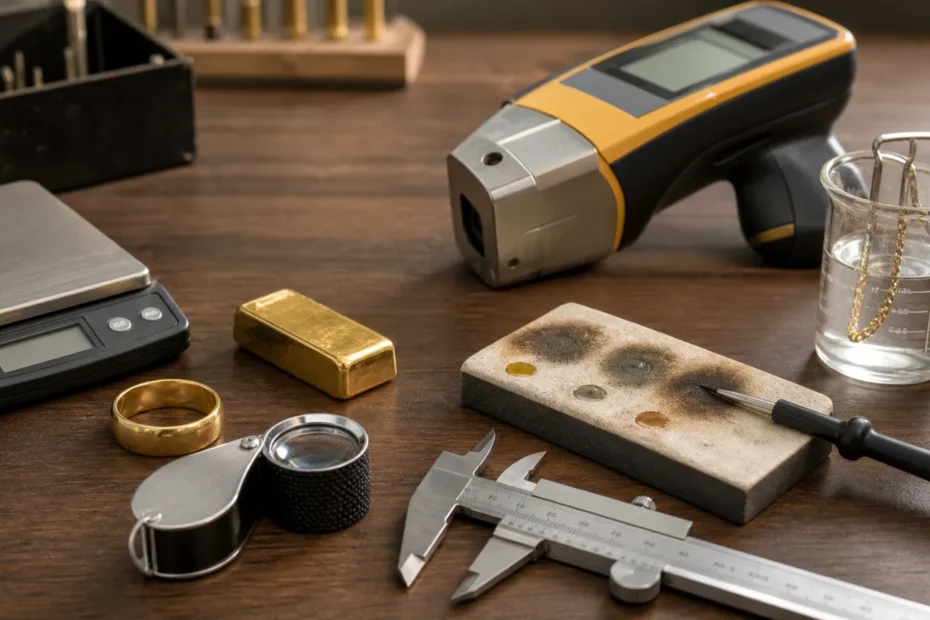
Compare gold purity tests, including hallmarks, magnet, density, acid, electronic testers, XRF, and assay, and learn when each method can mislead.
- Start with hallmarks and weight, but treat them as screening clues.
- Acid and electronic tests can help, yet XRF or assay is stronger for high-value items.
- Match the test method to the risk: jewelry, coins, bars, and resale need different proof.
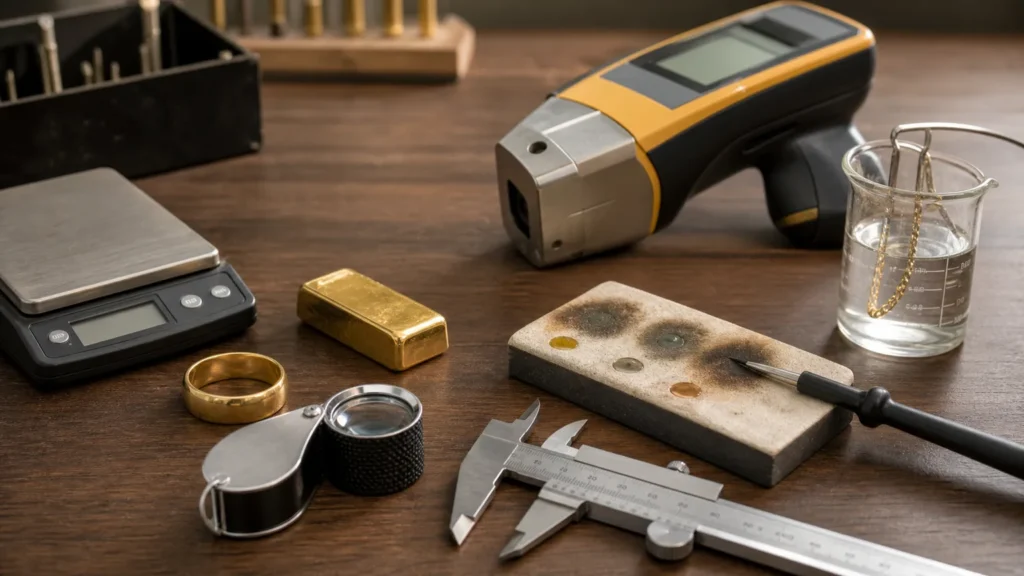
Testing gold purity is not one test. It is a sequence of checks that starts with the easiest clues and moves toward professional confirmation when the item is valuable, suspicious, or being bought for resale.
The practical goal is simple: identify whether the item is likely solid gold, estimate its karat or fineness, and decide whether a non-destructive professional test is worth the cost. A stamp can be useful, but it is not proof by itself.
- Start with hallmarks, weight, magnet response, and obvious plating clues, but do not treat any home test as final proof.
- Density testing can separate many fakes from solid gold, but stones, hollow pieces, solder, and mixed alloys can distort the result.
- Acid testing is useful and cheap, yet it can scratch jewelry and only tests the exposed area unless the piece is filed.
- XRF testing is the best non-destructive professional screen for most jewelry, coins, bars, and scrap lots.
- For high-value bullion, legal disputes, or refinery settlement, use a qualified assay or recognized testing lab.
Start with the useful version first. The rest of this guide adds the evidence, edge cases, and stronger checks.
Karat is a 24-part purity scale. 24K is very high-purity gold, 18K is 75% gold, and 14K is about 58.5% gold by mass.
A 10 gram 18K item contains about 7.5 grams of fine gold before allowing for stones, non-gold parts, solder, or measurement uncertainty.
A hallmark is useful evidence, not final proof. Plating, mixed components, counterfeit marks, and surface-only tests can produce a misleading result.
Start with Gold Made Simple to move from basic gold terms to buying, testing, investing, and storage without the jargon.
What Gold Purity Means
Gold purity describes how much gold is in the metal compared with other alloy metals. Karat expresses purity out of 24 parts, so 24K is nearly pure gold, 18K is 75% gold, 14K is 58.5% gold, and 10K is 41.7% gold.
Fineness expresses the same idea in parts per thousand. For example, 750 means 75.0% gold, 585 means 58.5% gold, and 999 means 99.9% gold. Bullion markets often use fineness more than jewelry language, while retail jewelry often uses karat marks.
If you want a quick conversion while checking a mark, use the Gold Purity Calculator. For bullion context, the gold and silver bullion guide explains why bars and coins usually list fineness rather than only karat.
Start With Hallmarks and Maker Marks
A hallmark or quality stamp is the first thing to inspect because it is fast and non-destructive. Look inside rings, on clasps, near bracelet end caps, on pendant bails, or on the edge of bars and coins.
Common marks include 10K, 14K, 18K, 22K, 24K, 375, 585, 750, 916, 995, 999, and 999.9. You may also see maker marks, assay office symbols, serial numbers, country marks, or plating terms such as GP, GF, HGE, RGP, or vermeil.
Hallmarks have limits. A stamp can be fake, added later, worn down, or located on only one component of a piece. A clasp may be solid gold while the chain is plated, or a marked case may contain non-gold springs, stones, filler, solder, or steel pins.
For regulatory background, the U.S. jewelry rules in 16 CFR Part 23 explain quality marking and deceptive precious-metal claims. In the UK, the London Assay Office describes how hallmarking identifies metal content through official marks.
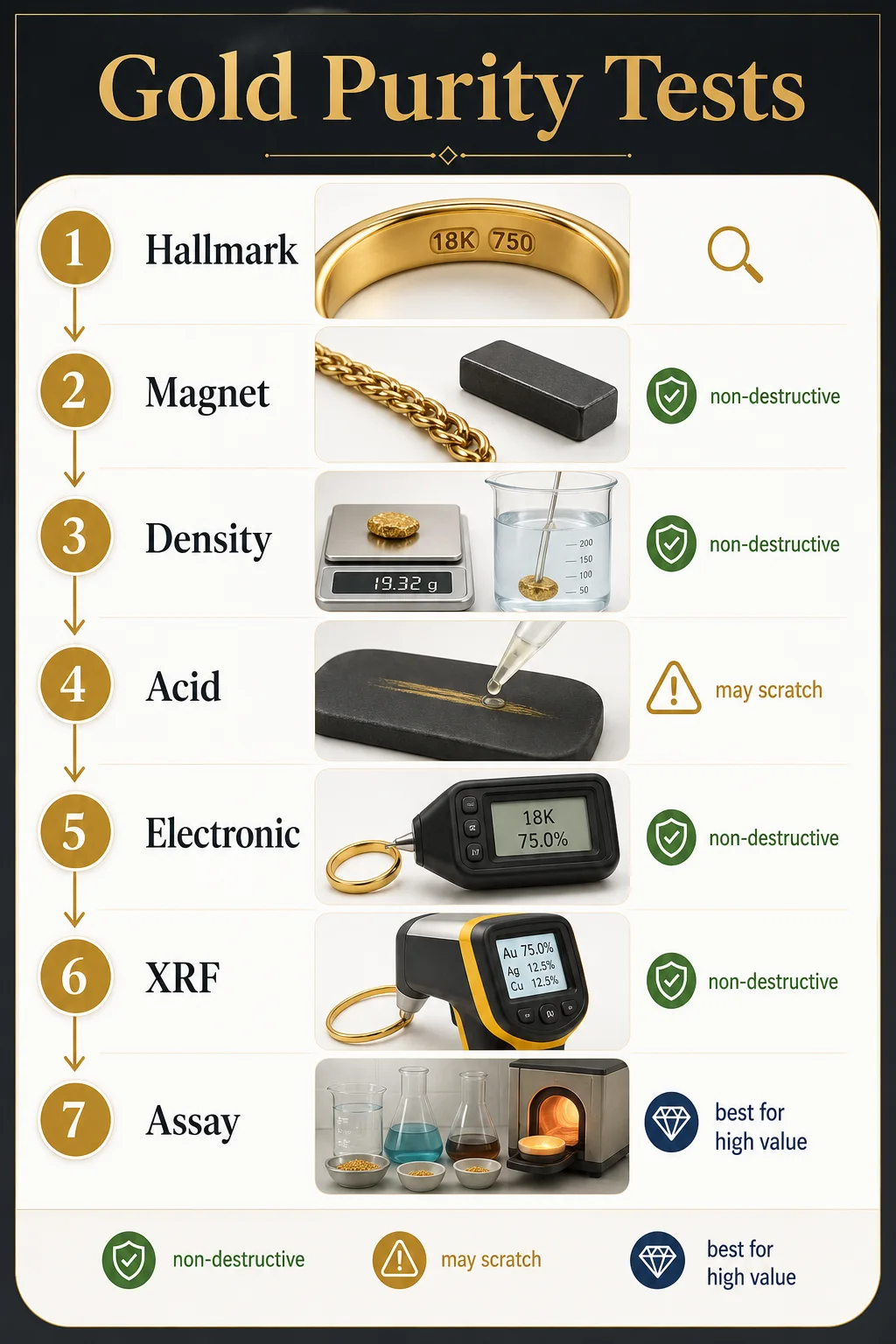
Gold Purity Test Comparison
| Test | Best use | What it tells you | Risk | Reliability |
|---|---|---|---|---|
| Hallmark inspection | First screen for jewelry and bullion | Claimed karat, fineness, maker, or assay mark | None | Useful clue, not proof |
| Magnet test | Fast fake screening | Whether strongly magnetic base metals are present | Low, but avoid scratching | Low by itself |
| Density or specific gravity | Solid, simple shapes without stones | Whether weight and volume match gold alloy expectations | Low if handled carefully | Medium to high for suitable pieces |
| Acid test | Scrap gold and lower-value jewelry | Approximate karat at the tested surface | May scratch or damage finish | Good when used correctly |
| Electronic tester | Quick jewelry counter checks | Estimated karat from conductivity or surface response | Low | Medium, depends on calibration |
| XRF analyzer | Professional non-destructive testing | Surface composition and alloy percentages | Very low when operated professionally | High, but surface-biased |
| Fire assay or lab assay | High-value bullion, settlement, disputes | Definitive gold content of the sampled material | Usually destructive or sample-consuming | Highest when properly sampled |
Reader-supported tools
Useful tools before you trust a gold purity claim
These tools fit the first screening stage of a gold purity check. Use them to reduce obvious risk before paying for a professional assay.
As an Amazon Associate, GoldConsul may earn from qualifying purchases.
GTE Jewelry Testing Kit
Best for: Quick home screening for 10K, 14K, 18K, 22K and 24K gold claims.
Caveat: Acid testing can mark surfaces, so avoid destructive testing on valuable or finished pieces.
Gold, Silver, Platinum and Diamond Appraisal Kit
Best for: A broader home kit for jewelry checks when you want multiple test tools in one set.
Caveat: Use it as a screening kit, not a final assay for high-value bullion or rare jewelry.
New Personal Coin Scale Pro
Best for: Checking coin and small-bar weight in grams, pennyweight and troy ounces.
Caveat: Weight is only one signal; it should be paired with size, magnet, ping or professional checks.
Use note: Home tests reduce risk, but they do not replace assay or professional verification for high-value bullion.
How to Use Each Gold Test
Magnet test
Pure gold is not magnetic, and most common gold jewelry alloys should not jump to a strong magnet. If a ring, chain, or bar snaps to a magnet, treat it as a major warning sign.
The magnet test cannot prove real gold. Many counterfeit metals are also non-magnetic, and small steel parts inside jewelry can create a partial response. Use it as a rejection test, not a purity test. For a deeper explanation, see Does Gold Stick to Magnets? and Is White Gold Magnetic?.
Density and specific gravity
Gold is dense, so weighing an item and measuring its water displacement can expose many plated or base-metal fakes. The method works best for plain coins, bars, nuggets, and solid jewelry without stones or hollow sections.
Do not use density results blindly. A 14K alloy is less dense than pure gold, a hollow chain can look wrong even when genuine, and tungsten-filled counterfeits can be difficult because tungsten is close to gold in density.
A simple approach is to weigh the dry item, suspend it in water without touching the container, note the apparent weight change, and calculate specific gravity. If the number is far from the expected range for the claimed karat, investigate further before buying.
For a separate size-to-weight plausibility check on a simple solid shape, try the gold weight calculator. It estimates mass from dimensions; it does not measure specific gravity or establish purity.
Acid test
An acid test uses a test stone and karat-specific acid solutions. You rub a small streak of metal on the stone, apply acid, and compare how the streak reacts against known standards.
The advantage is cost. The drawback is damage risk and surface bias. A plated piece may pass lightly at the surface unless the tester files through plating, but filing creates a visible mark. Acid is also hazardous and should not be used casually around stones, pearls, enamel, antique finishes, or sentimental jewelry.
Electronic gold tester
Electronic testers estimate karat from electrical behavior at the surface. They are convenient for shop counters and quick sorting, especially when the operator uses fresh gel, clean contacts, and regular calibration.
They can be fooled by plating, unusual alloys, dirty surfaces, and curved contact points. Treat an electronic result as a useful second opinion, not as a final assay certificate.
XRF testing
XRF, or X-ray fluorescence, reads the elemental composition near the surface without cutting the item. For most modern jewelry, coins, bars, and scrap lots, it is the best professional screening method because it is fast and non-destructive.
XRF still has limits. It sees the surface better than the core, so heavy plating, diffusion layers, or filled bars may require multiple readings, drilling, ultrasound, density testing, or a formal assay. For investment-grade bars, market standards such as the LBMA Good Delivery framework are relevant because accepted bars depend on recognized refiners, weights, markings, and fineness controls.
Professional assay
A professional assay is the right tool when the answer must be defensible. It is appropriate for large scrap lots, inherited collections, disputed purity, refinery settlement, and high-value bullion.
Assay quality depends on sampling. If a mixed lot is sampled poorly, even a good lab can return a result that does not represent the whole lot. Ask how the sample will be taken, whether the test is destructive, and what documentation you will receive.
When to Use Which Test
- Buying a small used ring: inspect hallmarks, check magnet response, compare weight and wear, then ask a jeweler for XRF if the price is meaningful.
- Checking a marked 18K chain: inspect every component, including clasp and links, because mixed parts are common.
- Testing a coin or bar: use weight, dimensions, magnet response, density, and XRF. Do not rely on one stamp or one handheld reading.
- Sorting scrap: acid and electronic tests can separate groups, but XRF or assay is better before settlement.
- Testing antique or delicate jewelry: avoid acid and filing unless a specialist confirms that damage is acceptable.
If the item is jewelry rather than bullion, purity is only part of the value. Condition, workmanship, stones, brand, and resale channel matter. The 22K gold jewelry guide explains why higher purity can also mean softer wear characteristics.
Buyer Checklist Before You Trust a Gold Purity Claim
- Confirm the stamp matches the seller’s claim: 585 for 14K, 750 for 18K, 916 for 22K, or 999/999.9 for fine gold.
- Check whether every component is gold, especially clasps, jump rings, watch backs, charms, and soldered repairs.
- Look for plating clues: color loss on edges, green or dark base metal, GP/GF/HGE/RGP marks, or unusually low weight.
- Use a magnet only to catch obvious problems, not to prove purity.
- Use density testing only when the shape is simple and there are no stones, hollow spaces, or trapped air.
- Ask for XRF testing before paying a high premium for jewelry, coins, bars, or a private-party lot.
- For major bullion purchases, buy from a reputable dealer and keep invoices, serial numbers, packaging, and test records.
For plated and filled pieces, do not confuse surface appearance with gold content. The guides on gold-plated jewelry turning green, gold-plated jewelry and water, and testing rose gold authenticity show why base metal, plating thickness, and alloy color can mislead quick visual checks.
Common Mistakes That Lead to Bad Results
The biggest mistake is expecting one home test to settle everything. A non-magnetic item can still be fake, a stamped item can still be plated, and an acid test can still miss a filled core.
The second mistake is testing the wrong part. A clasp, pendant bail, coin rim, repair area, or solder joint may not represent the whole item. Test multiple locations when the value justifies it.
The third mistake is ignoring the economics. If a seller offers a supposedly high-purity gold item far below melt value, the test result needs to be stronger than a stamp and a story. For bars and larger purchases, read the step-by-step gold bar buying guide before committing.
The safest testing mindset is progressive skepticism. Cheap checks are useful because they tell you when to stop, not because they prove the item is good. The more money at stake, the more you should move toward documented, non-destructive professional testing or a formal assay.
Most online gold-testing advice overstates the magnet test and underexplains surface bias. The hard question is not only “is it gold?” but “does the tested surface represent the whole object?” That is why layered testing matters.
FAQ: Testing Gold Purity
What is the most accurate way to test gold purity?
A professional assay is the most definitive method when sampling is done correctly. For non-destructive screening, XRF is usually the strongest practical option for jewelry, coins, bars, and scrap lots.
Can I test gold purity at home?
You can perform basic screens at home, including hallmark inspection, magnet response, weight checks, and sometimes density testing. Home testing can identify red flags, but it should not replace XRF or assay for valuable items.
Does vinegar prove gold is real?
No. Vinegar can react with some base metals, but it is not a reliable purity test and can damage finishes or stones. Use established gold-testing methods instead.
Is acid testing bad for gold jewelry?
Acid testing can leave scratches or require filing through the surface, especially when checking for plating. It is better suited to scrap or pieces where a small mark is acceptable.
Can XRF detect gold plating?
XRF can often identify surface plating, but it is surface-biased. Thick plating or filled objects may require multiple readings, density testing, drilling, ultrasound, or assay to confirm the core.
What does 750 mean on gold?
750 means the item is 750 parts gold per 1,000, or 75.0% gold. That corresponds to 18K gold.
Bottom Line
Testing gold purity is a layered process. Use hallmarks, magnet response, density, acid, electronic testing, XRF, and assay according to the item, the risk of damage, and the amount of money involved.
For low-value items, a careful sequence of home checks may be enough to decide whether to walk away. For valuable jewelry, coins, bars, or estate lots, pay for professional testing before you trust the purity claim.
Use these guides when a simple test is not enough.
Home checks can reduce uncertainty, but they do not replace documentation, density checks, XRF, assay, or professional verification for meaningful value.
 When you purchase a service or a product through our links, we sometimes earn a commission, at no extra cost to you.