
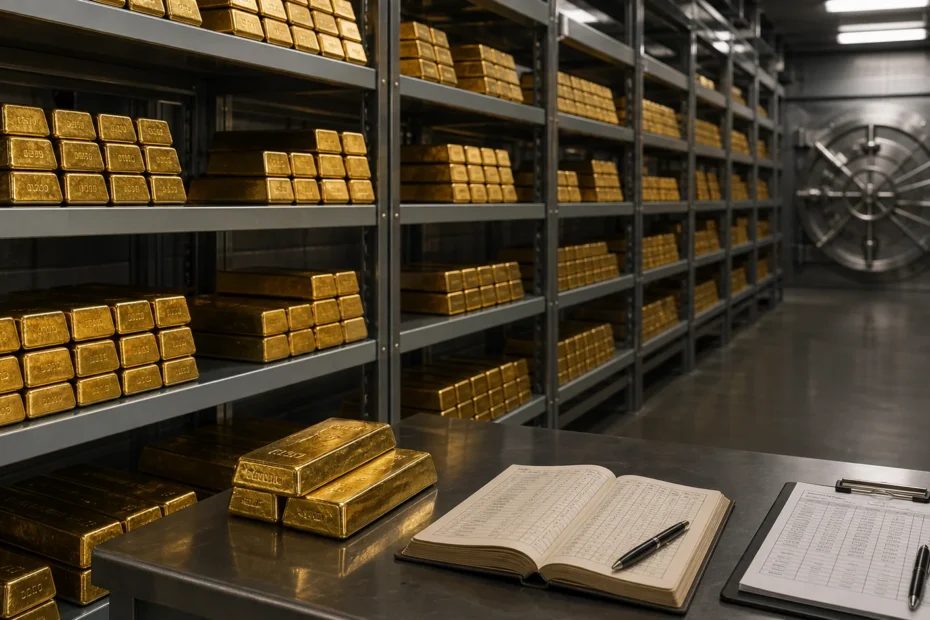
See how much gold the U.S. has, where it is stored, and how book value, market value, Fort Knox, and audit claims should be checked with current data.
- The U.S. Treasury reports about 8,133.53 tonnes of official gold holdings.
- Fort Knox is the largest location, but West Point, Denver, and Fed vault categories also matter.
- Book value is not market value; use current spot price to estimate today’s dollar value.
The U.S. Treasury reported 261,498,926.241 fine troy ounces of U.S. government gold reserves on May 31, 2026. That equals about 8,133.53 metric tonnes, making the United States the largest official gold holder in global reserve tables.
- The official U.S. gold reserve figure is measured in fine troy ounces, not spendable dollars.
- Fort Knox is the largest reported storage location, but it does not hold all U.S. gold.
- The official Treasury book value is about $11,041,059,957.90, based on statutory valuation near $42.22 per fine troy ounce.
- Market value is different: multiply the reported ounces by the current gold spot price to estimate it.
- Audit and transparency claims should separate monthly Treasury reporting from physical bar-by-bar verification.
U.S. gold reserves are often discussed as if they were a single pile of bullion inside Fort Knox. The real picture is more specific: the Treasury reports official gold holdings by location, facility type, form, fine troy ounces, and book value.
That distinction matters because “how much gold does the U.S. have?” can mean physical quantity, reported tonnes, statutory accounting value, or a changing market-value estimate. Those are related, but they are not the same answer.
How much gold does the U.S. have?
The current Treasury snapshot used for this refresh reports 261,498,926.241 fine troy ounces of U.S. government gold reserves. Converted at 31.1034768 grams per troy ounce, that is about 8,133.53 metric tonnes.
For international comparison, the World Gold Council gold reserves by country dataset consistently places the United States at the top of official gold reserve rankings, ahead of other large holders such as Germany, Italy, France, Russia, and China.
Where U.S. gold reserves are stored
The reported U.S. gold reserve total is spread across several categories. Fort Knox is the best-known location, but West Point, Denver, and Federal Reserve Bank custody locations also appear in Treasury data.
| Location | Facility category | Form | Fine troy ounces | Book value |
|---|---|---|---|---|
| Denver, CO | Mint Held Gold – Deep Storage | Gold Bullion | 43,853,707.279 | $1,851,599,995.81 |
| Fort Knox, KY | Mint Held Gold – Deep Storage | Gold Bullion | 147,341,858.382 | $6,221,097,412.78 |
| West Point, NY | Mint Held Gold – Deep Storage | Gold Bullion | 54,067,331.379 | $2,282,841,677.17 |
| All Locations- Coins, blanks, miscellaneous | Mint Held Gold – Working Stock | Gold Coins | 2,783,218.656 | $117,513,614.74 |
| Federal Reserve Banks – NY Vault | Federal Reserve Bank Held Gold | Gold Bullion | 13,376,987.724 | $564,805,851.07 |
| Federal Reserve Banks – Display | Federal Reserve Bank Held Gold | Gold Bullion | 1,993.321 | $84,162.40 |
| Federal Reserve Banks – NY Vault | Federal Reserve Bank Held Gold | Gold Coins | 73,452.066 | $3,101,307.82 |
| Federal Reserve Banks – Display | Federal Reserve Bank Held Gold | Gold Coins | 377.434 | $15,936.11 |
Fort Knox is the largest line item, but readers should avoid the shortcut that “U.S. gold equals Fort Knox.” The Treasury table separates Mint-held deep storage, working stock, and Federal Reserve Bank-held gold.
Book value vs. market value
The official Treasury book value is not a live market valuation. The May 31, 2026 snapshot reports a combined book value of about $11,041,059,957.90, which reflects statutory accounting near $42.22 per fine troy ounce.
Market value is much higher when the gold spot price is far above that statutory price. To estimate it, use this simple formula:
- Reported fine troy ounces: 261,498,926.241
- Formula: reported ounces × current gold spot price
- Best practice: check a live benchmark or spot-price source, then show the date and price used.
For current price context, use GoldConsul’s live gold price page or compare benchmark information from the LBMA precious metal prices.
Why the U.S. still holds so much gold
Gold no longer backs the dollar in the way it did under the gold standard or the Bretton Woods system. The Gold Reserve Act of 1934 and later monetary changes reshaped how U.S. gold connected to the dollar and the international monetary system.
Today, official gold holdings function more like a reserve asset, confidence signal, and historical balance-sheet anchor than a day-to-day payment tool. They are part of the wider context behind central bank gold, foreign exchange reserves, monetary gold, and global reserve diversification.
Gold audits, verification, and transparency
Audit discussions around U.S. gold reserves can become misleading when they mix different questions. A monthly Treasury status report is not the same thing as a public, independent, bar-by-bar physical audit. A custody statement is not the same as market valuation. A Fort Knox rumor is not a substitute for official reserve reporting.
A useful verification framework asks four separate questions:
- Quantity: how many fine troy ounces are reported?
- Location: which facility or custody category holds them?
- Valuation: is the figure book value or market value?
- Assurance: what inspection, audit, or reporting process supports the claim?
This is also where wording matters. “Official gold holdings,” “gold bullion reserves,” “monetary gold,” “gold custody,” and “gold reserve verification” are not just synonyms; they point to different parts of the reserve question.
When a post claims the U.S. gold reserve is “worth” a specific amount, pause and check what kind of value is being used.
How U.S. gold reserves compare globally
The U.S. remains the largest official gold holder, but the more interesting trend is how other central banks think about gold today. The World Gold Council’s 2026 Central Bank Gold Reserves Survey reports continued interest in gold as a reserve asset, especially where central banks want diversification, crisis protection, and assets without direct credit risk.
That does not mean every country is following the same strategy. Some central banks hold large legacy gold positions. Others have been adding gold in recent years. Some emphasize liquidity and reserve composition, while others emphasize geopolitical independence or domestic-market signaling.
What this number does and does not prove
The U.S. gold reserve total is important, but it does not prove that the dollar is gold-backed, that gold can solve public debt, or that the Treasury could instantly convert reserves into policy cash without consequences.
It does prove something narrower and more useful: the United States reports the world’s largest official gold holdings, and those holdings still matter in discussions about monetary history, central bank reserves, gold market psychology, and confidence in reserve assets.
Sources and further reading
Use primary and high-authority sources when checking reserve claims. They answer different parts of the question: reported quantity, global rankings, gold price benchmarks, and monetary history.
FAQ: U.S. gold reserves
How much gold does the U.S. have?
The U.S. Treasury reported 261,498,926.241 fine troy ounces on May 31, 2026, equal to about 8,133.53 metric tonnes.
Does Fort Knox hold all U.S. gold?
No. Fort Knox is the largest reported location, but the Treasury also reports gold at West Point, Denver, Federal Reserve Bank locations, and working-stock categories.
Why is the official book value only about $11.04 billion?
The book value is based on statutory accounting near $42.22 per fine troy ounce. It is not a live market valuation.
How do I estimate the market value of U.S. gold reserves?
Multiply the reported fine troy ounces by the current gold spot price. Always show the date and price used because the estimate changes with the market.
Is U.S. gold still backing the dollar?
No. Gold is no longer redeemable against the dollar as it was under earlier monetary systems. Today it functions as an official reserve asset and historical balance-sheet anchor.
Bottom line
The U.S. has about 8,133.53 metric tonnes of official gold reserves based on the latest Treasury snapshot used here. The smarter question is not only “how much,” but also where it is stored, how it is valued, what reporting supports it, and how that compares with the way central banks use gold today.
 When you purchase a service or a product through our links, we sometimes earn a commission, at no extra cost to you.