
Understand gold without the jargon.
Start with a clear answer, see one practical example, then learn where the simple rule stops working. Use this path for gold basics, prices, buying, testing, investing, and storage.
Gold Made Simple is GoldConsul’s beginner learning path. Every guide starts with plain language and a concrete example, then adds the evidence, limitations, and professional checks needed when money or safety is involved.
Four layers make a difficult topic easier.
Simple explanations are useful only when they remain accurate. Each guide separates the basic rule from the situation where that rule can mislead.
Get the direct answer before market language, chemistry, or product detail.
Connect the idea to grams, karats, premiums, tests, or storage choices.
Learn why one price, stamp, test, or headline is rarely final proof.
Move into documentation, primary sources, and professional checks when value rises.
Choose the question you are trying to answer.
You do not need to learn everything about gold at once. Start with the lane closest to your decision.
1. Understand gold
Learn what gold is, how purity works, why white gold is different, and how nature concentrates gold into deposits.
 Gold basicsWhat is gold?Separate the chemical element from alloys, plating, and finished products.Read the simple guide →
 Purity basicsWhat do 14K and 18K mean?Turn 14K, 18K, 24K, 585, 750, and 999 into understandable gold shares.Read the simple guide →
 Alloy basicsWhat is white gold?See how gold, alloy metals, and rhodium create white-gold jewelry.Read the simple guide →
 Geology basicsHow is gold formed?Connect cosmic gold atoms with veins, ore deposits, grade, and mining reality.Read the simple guide →
2. Understand price and investing
Separate the displayed market benchmark from product costs, market drivers, and fund structure.
 Price basicsSpot price vs retail priceUnderstand spot, retail ask, dealer bid, premium, spread, and round-trip cost.Read the simple guide →
 Market basicsWhy does gold go up?See how rates, currencies, risk, flows, central banks, and supply interact.Read the simple guide →
 ETF basicsHow does a gold ETF work?Understand what fund shares track and why they are not the same as a personal gold bar.Read the simple guide →
3. Buy and verify
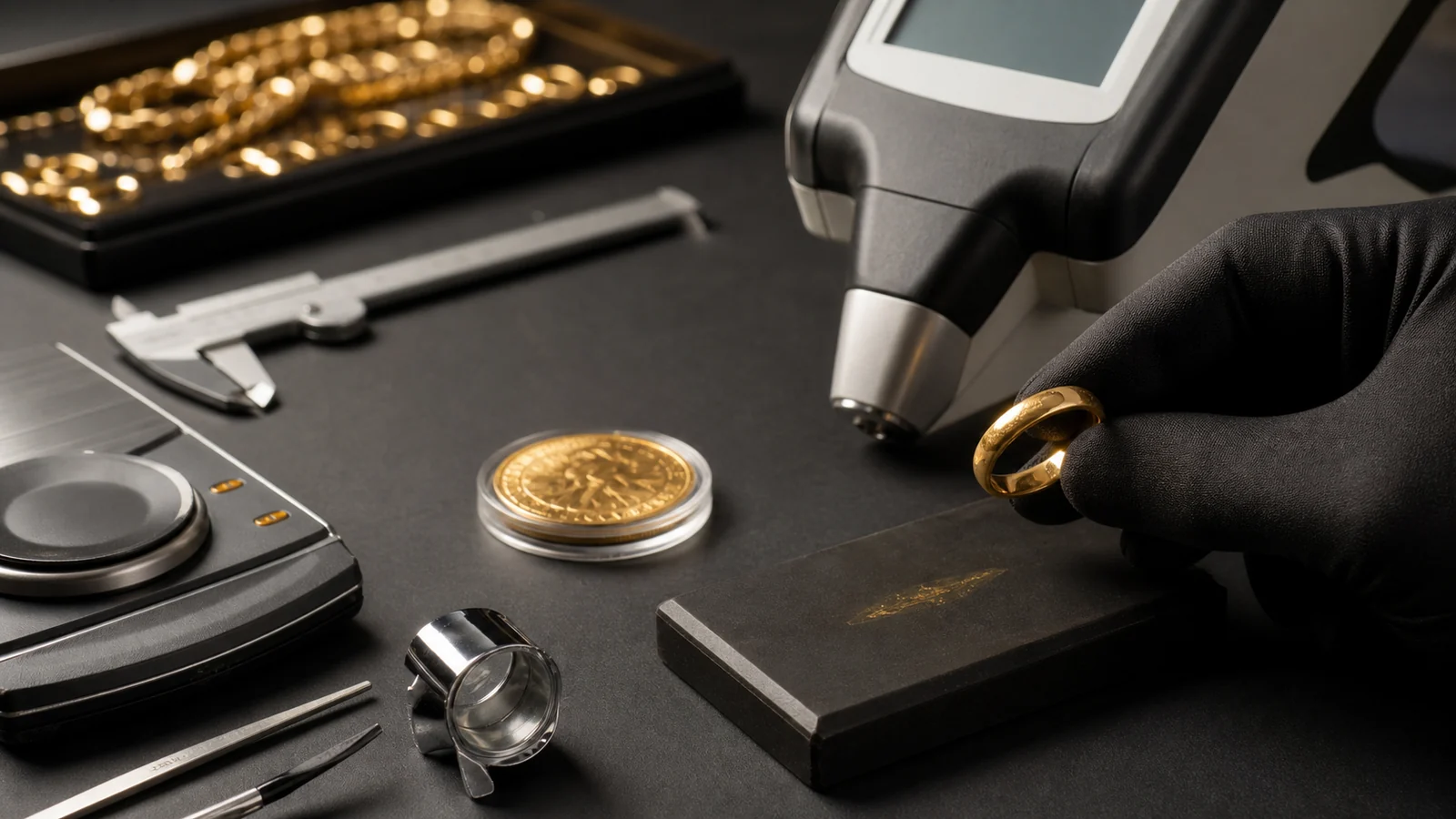
Choose between common bullion formats and avoid trusting one authenticity clue.

4. Store gold safely
Match access, documentation, insurance, privacy, and custody to the value you need to protect.

Gold vocabulary in five minutes.
These definitions cover the terms that cause the most confusion when people first compare gold products and prices.
| Term | Plain-English meaning | Important limit |
|---|---|---|
| Spot price | A market reference price for gold. | It is not automatically the price you pay or receive. |
| Premium | The amount paid above the metal benchmark. | Compare resale bids and total cost, not only the purchase premium. |
| Karat | A 24-part gold-purity scale. | A stamp is evidence, not independent proof. |
| Fineness | Gold content expressed in parts per thousand. | Construction, stones, solder, and non-gold parts can affect an item. |
| Bullion | Gold valued mainly for standardized metal content. | Dealer, product, custody, authenticity, and resale terms still matter. |
| Allocated storage | Specific metal is held for the customer under defined ownership terms. | Verify the contract, audits, insurance, access, and withdrawal rules. |
Simple answers still need strong evidence.
GoldConsul uses official specifications, market standards, scientific references, and product documentation. Current prices, laws, taxes, and commercial terms must still be checked at the time of a decision.
FAQ: Gold explained simply
What is gold?
Gold is chemical element 79, symbol Au. Pure gold contains gold atoms, while most jewelry combines gold with other metals to improve hardness or change color.
What do 14K, 18K, and 24K mean?
Karat measures gold purity in 24 parts. 14K is about 58.5% gold, 18K is 75% gold, and commercial 24K products are very high-purity gold with exact fineness stated separately.
Why is the retail gold price higher than spot?
Spot is a market benchmark. Retail products can add refining, fabrication, minting, dealer margin, payment cost, shipping, insurance, taxes, and storage.
Are gold bars better than gold coins?
Bars can have lower premiums, while established coins may be easier to recognize, divide, and resell. The better choice depends on total cost, dealer buyback, storage, and resale plans.
Can one home test prove gold is real?
No. Home tests are screening tools. Valuable items should be checked with several methods and supported by documentation, reputable counterparties, XRF, ultrasound, or assay when appropriate.