
Learn how gold worked in the Carolingian Empire through rare coins, church treasure, royal prestige, reforms and a mostly silver-based economy.
- Carolingian gold was prestigious but not the core of ordinary money.
- Silver reform changed where gold sat in the value hierarchy.
- Look at gifts, church treasuries, diplomacy, and rare coinage together.
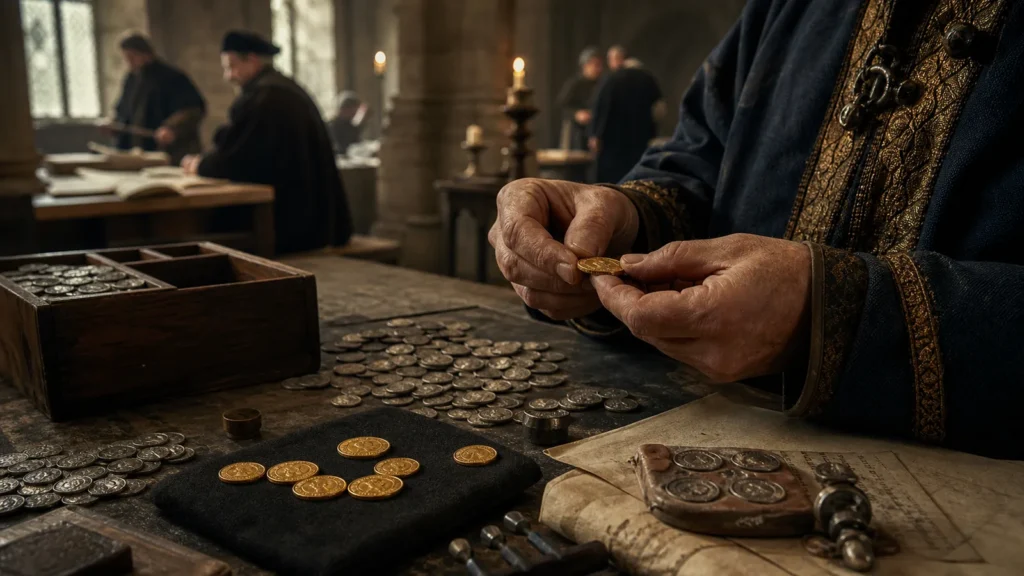
Gold in the Carolingian Empire is easy to picture as a room full of royal treasure. The historical reality is more useful: gold was prestigious, politically charged, and often visible in gifts, church objects, diplomacy, and rare coinage, while ordinary monetary life moved increasingly toward silver. That shift matters because the Carolingian world helped set patterns that later medieval Europe inherited.
Gold in the Carolingian Empire is easy to picture as a room full of royal treasure. The historical reality is more useful: gold was prestigious, politically charged, and often visible in gifts, church objects, diplomacy, and rare coinage, while ordinary monetary life moved increasingly toward silver.
That shift matters because the Carolingian world helped set patterns that later medieval Europe inherited. Charlemagne’s empire did not make gold disappear, but it changed where gold sat in the hierarchy of value.
TL;DR: Gold in the Carolingian Empire
- Carolingian rulers inherited a late antique and Merovingian world where gold still carried imperial prestige.
- By the eighth century, silver deniers became the practical backbone of Carolingian coinage.
- Gold remained powerful in elite display, church treasuries, diplomacy, and exceptional coins.
- Charlemagne’s reforms mattered less because they created a “gold economy” and more because they clarified a silver-based monetary order.
- The evidence is uneven: surviving coins, capitularies, museum objects, and later scholarship must be read together.
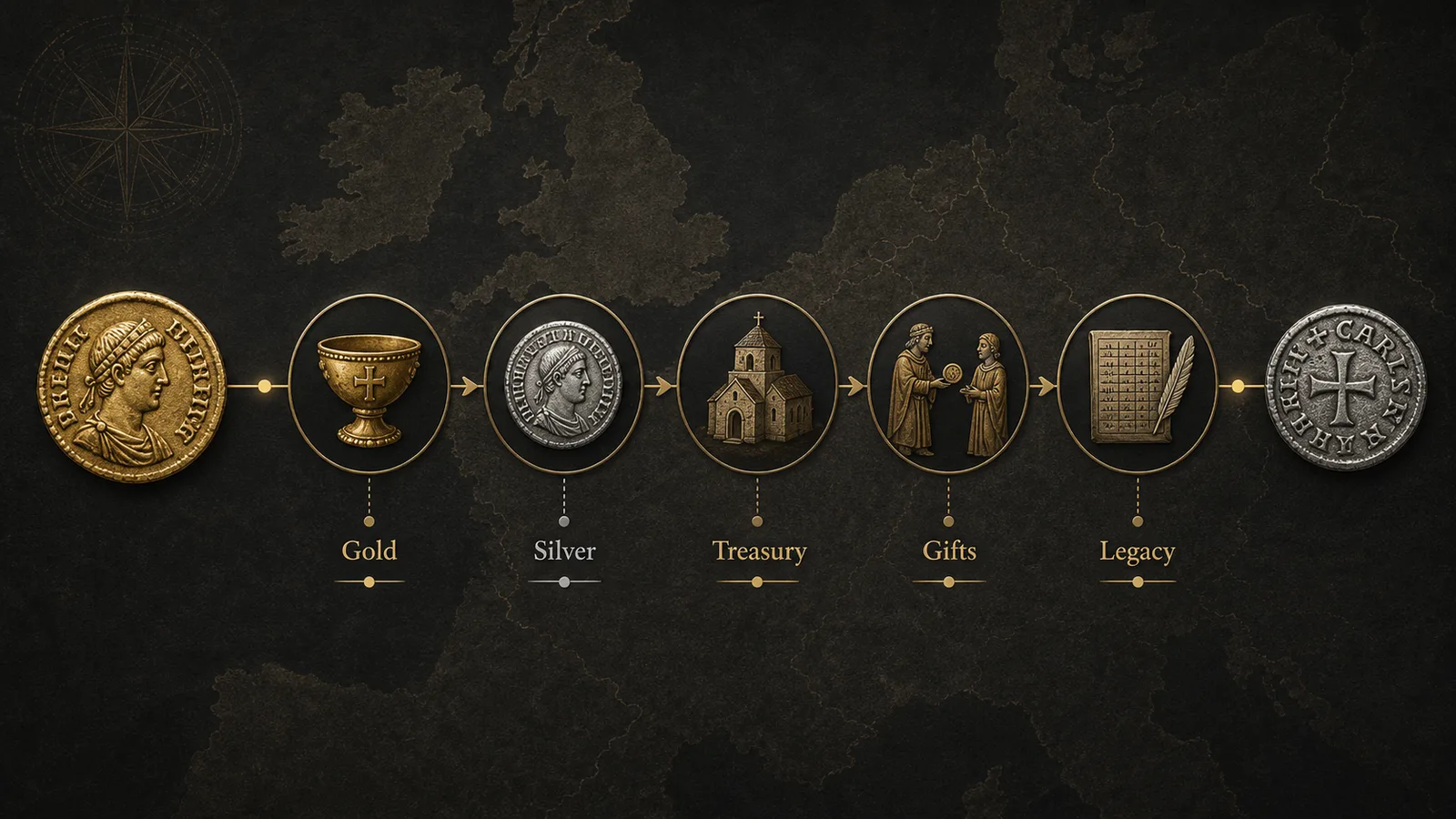
The Short Version: Gold Was Prestige, Silver Was System
The Carolingian Empire, especially under Charlemagne, is often remembered for conquest, administration, reform, and cultural revival. In monetary history, its most important development was the consolidation of a silver coinage system rather than a broad gold currency.
The older Merovingian world had used gold tremisses more visibly. By the Carolingian period, the practical coin of the realm was the silver denier, a point summarized well in Britannica’s overview of Charlemagne and the Carolingian coinages.
This does not mean gold became irrelevant. It means gold moved into narrower channels: royal display, liturgical objects, diplomatic gifts, elite hoards, and rare or exceptional coin issues.
Why the Carolingian Gold Story Is Often Misread
The phrase “Carolingian treasure” can make the period sound like a gold-rich fantasy. The better reading is more balanced: the empire had access to gold, valued gold deeply, and used gold carefully, but its fiscal and commercial machinery relied heavily on silver.
That distinction also helps separate Carolingian history from broader articles on gold in the Middle Ages. The Carolingian period sits near the transition point between late antique gold prestige and the silver-heavy coinage of much of medieval western Europe.
History Claim Credibility Check
Claim: “The Carolingian Empire ran on gold.”
Credibility: Low if meant literally, moderate if meant symbolically.
The strongest evidence points to a silver coinage system for routine monetary use, while gold remained important for authority, ceremony, gifts, and rare coins. A surviving British Museum gold coin associated with Charlemagne is valuable evidence precisely because such pieces are unusual, not because they show everyday circulation.
Evidence Timeline: From Gold Tremissis to Silver Denier
| Period | Gold’s Role | Monetary Signal | What to Trust |
|---|---|---|---|
| Late Roman to early Merovingian inheritance | Gold solidus and tremissis traditions still mattered. | Gold was tied to imperial prestige and high-value payment. | Coin finds, museum catalogues, and comparative numismatics. |
| Mid-8th century under Pippin III | Gold receded from regular Frankish coinage. | The silver denier became more central. | Coinage studies and legal reforms. |
| Charlemagne, 768-814 | Gold stayed exceptional and ceremonial. | Silver reform tightened weight, authority, and mint control. | Surviving deniers, capitularies, and modern scholarship. |
| After 814 | Gold retained prestige in treasuries and cross-cultural exchange. | Silver pennies shaped much of later medieval western Europe. | Regional coinage evidence and later monetary continuity. |
Charlemagne’s Reform Was Not a Gold Revival
Charlemagne’s monetary legacy is best understood through silver. The denier was small, countable, and suited to a political system that needed recognisable royal money across a large and uneven empire.
Cambridge’s chapter on money and price movements in the Carolingian economy notes the technical importance of denier weight reforms and the relationship between gold and silver values. That is the real engine of the story: standards, trust, and administrative reach.
Gold was still a measure of high value, but silver was the coin most people were likely to encounter in transactions, dues, tolls, payments, and local markets. A similar distinction appears in later medieval contexts, where symbolic gold could coexist with practical silver and billon currencies.
Where Gold Actually Appeared
Gold in the Carolingian Empire was concentrated where visibility mattered most. It appeared in objects and settings where scarcity strengthened authority.
- Royal gifts: Gold reinforced hierarchy when kings rewarded loyalty or negotiated with high-status allies.
- Church treasuries: Gold vessels, reliquaries, and decoration linked wealth with sacred legitimacy.
- Diplomacy: Gold was useful in exchanges with Byzantine, Islamic, and other elite political cultures.
- Exceptional coinage: Rare gold pieces could project imperial imagery even when silver dominated routine coinage.
- Hoarded wealth: Gold retained compact value, especially where mobility and political uncertainty mattered.
This is why Carolingian gold belongs in the same conversation as gold in medieval religion and gold in medieval myths and legends, but with a stricter evidence filter. Symbolic power is not the same as monetary volume.
Evidence Table: What Each Source Can and Cannot Prove
| Evidence Type | Useful For | Main Limitation |
|---|---|---|
| Surviving gold coins | Proving that gold coinage existed in exceptional contexts. | Survival is selective and does not prove common circulation. |
| Silver denier finds | Showing the practical spread of Carolingian monetary reform. | Coin finds vary sharply by region and excavation history. |
| Capitularies and regulations | Revealing official intent, standards, and enforcement goals. | Law does not always equal local practice. |
| Church and elite objects | Showing gold’s symbolic and sacred value. | They represent elite display, not the whole economy. |
Gold, Power, and the Carolingian Church
The Carolingian project depended heavily on the church. Gold helped make that partnership visible through altar vessels, reliquaries, book covers, and gifts to major religious houses.
These objects were not just decoration. They signaled order, legitimacy, and sacred authority in a world where political power was performed through ritual as much as through law.
For readers comparing religious uses across eras, the Carolingian case is narrower than gold in ancient religions. Ancient temples often sat inside gold-rich tribute systems; Carolingian churches held gold as concentrated sacred wealth within a more silver-based western economy.
The Byzantine and Islamic Context
Western Europe did not exist in isolation. Byzantine gold coinage and Islamic gold dinars remained important reference points in the wider Mediterranean and Near Eastern economy.
That contrast made Carolingian choices more meaningful. The Frankish empire could project Roman and Christian authority, but its routine coinage did not simply copy the old imperial gold standard.
Gold therefore worked as a bridge metal. It connected the Carolingian court to older Roman prestige and to neighboring gold-using political cultures, even as domestic monetary practice leaned toward silver.
Editorial Perspective
Our view: The most credible reading is not that Carolingian Europe lacked gold. It is that gold became a higher-status and more selective form of value while silver carried the administrative and transactional load. That distinction keeps the article out of both romantic treasure storytelling and overly narrow coin-only history.
Knowledge Gap
What remains uncertain: We do not have a perfect map of how gold moved through every Carolingian region, household, monastery, and diplomatic route.
Surviving evidence favors elite and institutional contexts. That means historians can describe gold’s prestige with confidence, but they must be careful when estimating how often ordinary people saw or used it.
How to Read Carolingian Gold Claims
Use a simple filter when you see claims about Carolingian gold:
- If the claim is about prestige, gold is usually central.
- If the claim is about daily coinage, silver deserves first attention.
- If the claim is based on one spectacular object, ask whether it represents a norm or an exception.
- If the claim compares Carolingian Europe with Byzantium or the Islamic world, check whether it separates symbolism from circulation.
This same evidence discipline is useful for adjacent topics such as testing gold coins and historical bans on gold, where strong claims often depend on context.
Bottom Line
Gold in the Carolingian Empire was not ordinary pocket money. It was a prestige metal, a diplomatic language, a sacred material, and an occasional medium for exceptional coinage.
The empire’s deeper monetary legacy was silver. By strengthening the denier system, Carolingian rulers helped shape the accounting and coinage habits of medieval western Europe long after their political empire fragmented.
FAQ: Gold in the Carolingian Empire
Did the Carolingian Empire use gold coins?
Yes, but gold coins were exceptional rather than the normal everyday currency. Surviving examples are important because they show prestige and imperial messaging, not mass circulation.
What coin was most important under Charlemagne?
The silver denier was the key practical coin. Carolingian monetary reform is usually remembered for silver standardization rather than for a broad revival of gold coinage.
Why did gold become less common in western European coinage?
Several forces mattered, including changing trade routes, regional metal supply, institutional preferences, and the practical usefulness of silver for smaller payments. The shift was gradual and uneven.
Was Charlemagne trying to copy the Roman gold solidus?
Charlemagne used Roman imperial symbolism, especially after his coronation in 800, but his routine monetary system was not a simple return to the Roman gold solidus standard.
Why does Carolingian gold still matter today?
It shows how a society can treat gold as a supreme symbol of authority while relying on another metal for most monetary operations. That separation between prestige value and transactional use is a recurring theme in gold history.
 When you purchase a service or a product through our links, we sometimes earn a commission, at no extra cost to you.