
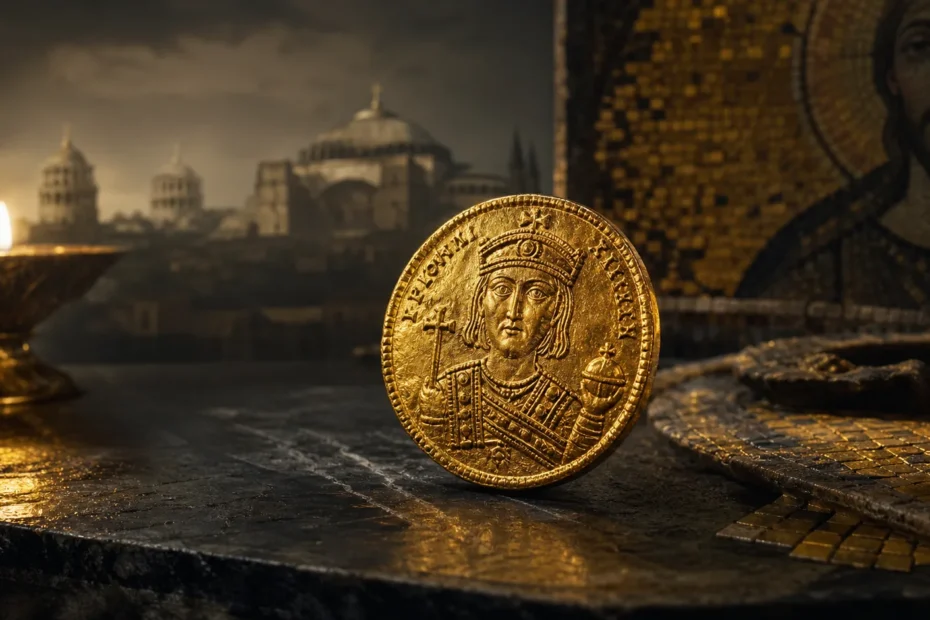
See how Byzantine gold shaped coinage, trade, sacred art, imperial power and the solidus—and what changed as the empire weakened.
- Byzantine gold worked through coinage, diplomacy, worship, and court image.
- The solidus mattered because people trusted its weight and purity.
- Watch how wars, taxes, and trade shocks strained that gold system.
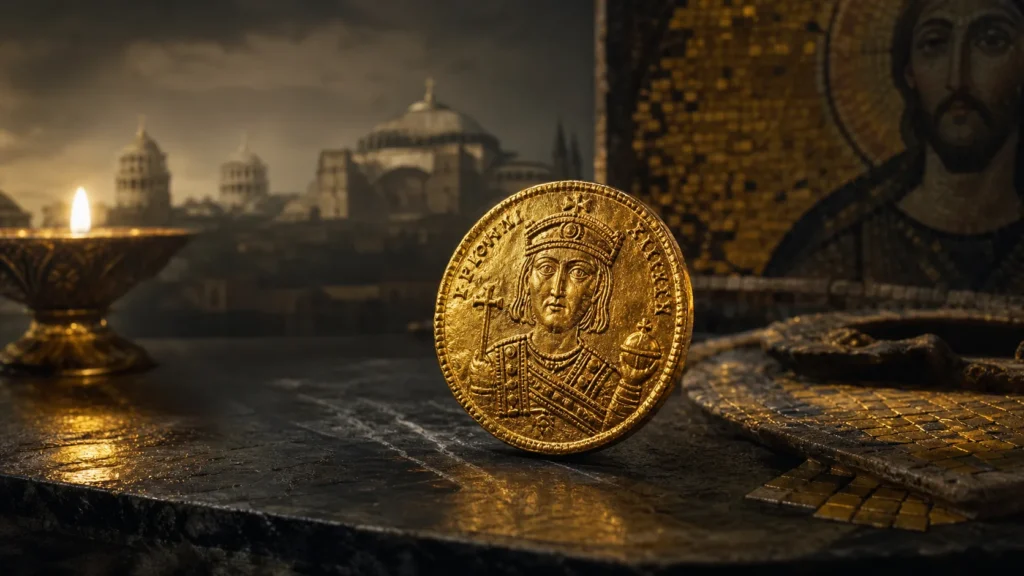
Gold in the Byzantine Empire was never just a precious metal. It was money, diplomacy, theology, military logistics, court theater, and visual language compressed into coins, mosaics, vessels, and gifts. The empire’s achievement was not that it had endless gold.
Gold in the Byzantine Empire was never just a precious metal. It was money, diplomacy, theology, military logistics, court theater, and visual language compressed into coins, mosaics, vessels, and gifts.
The empire’s achievement was not that it had endless gold. The more interesting point is that Byzantine rulers learned how to make gold feel reliable, sacred, and imperial even when wars, taxes, trade shocks, and territorial losses strained the system.
TL;DR: Gold in the Byzantine Empire
- The solidus, also called the nomisma in Greek usage, gave Byzantium a durable gold currency for centuries.
- Gold supported trade and taxes, but it also projected authority through portraits, crosses, Christ images, and imperial ceremony.
- Byzantine gold art was not mere decoration; mosaics, icons, reliquaries, and liturgical objects framed gold as sacred light.
- The empire’s gold story changed over time, especially after military losses, fiscal pressure, and later coinage reform.
- The legacy is strongest where coinage, trade, art, and religion overlap rather than in any simple claim that Byzantium was always wealthy.
Why Byzantine Gold Still Matters
The Byzantine Empire inherited the eastern Roman state, its tax machinery, its cities, and its habit of expressing power through precious metal. Constantinople sat between the Black Sea, Aegean, Balkans, Anatolia, Levant, and Mediterranean, which made gold useful as both a store of value and a political signal.
For readers coming from a broader history angle, GoldConsul’s guide to gold in the Middle Ages gives the western medieval background. Byzantium is different because it preserved a Roman-style gold coin tradition much longer than many neighboring western kingdoms.
That difference is why the Byzantine solidus became more than a local coin. It was a unit that soldiers, merchants, tax officials, foreign courts, and church institutions could understand across cultural borders.
History Claim Credibility Check
Claim: “Byzantium was rich because it had unlimited gold.”
Credibility: Low if read literally, stronger if reframed as institutional control.
The better evidence points to disciplined coinage, taxation, mint control, trade position, and ceremonial use. Byzantine gold mattered because the state made it legible and trusted, not because gold was effortless to obtain.
The Solidus: A Coin That Carried an Empire
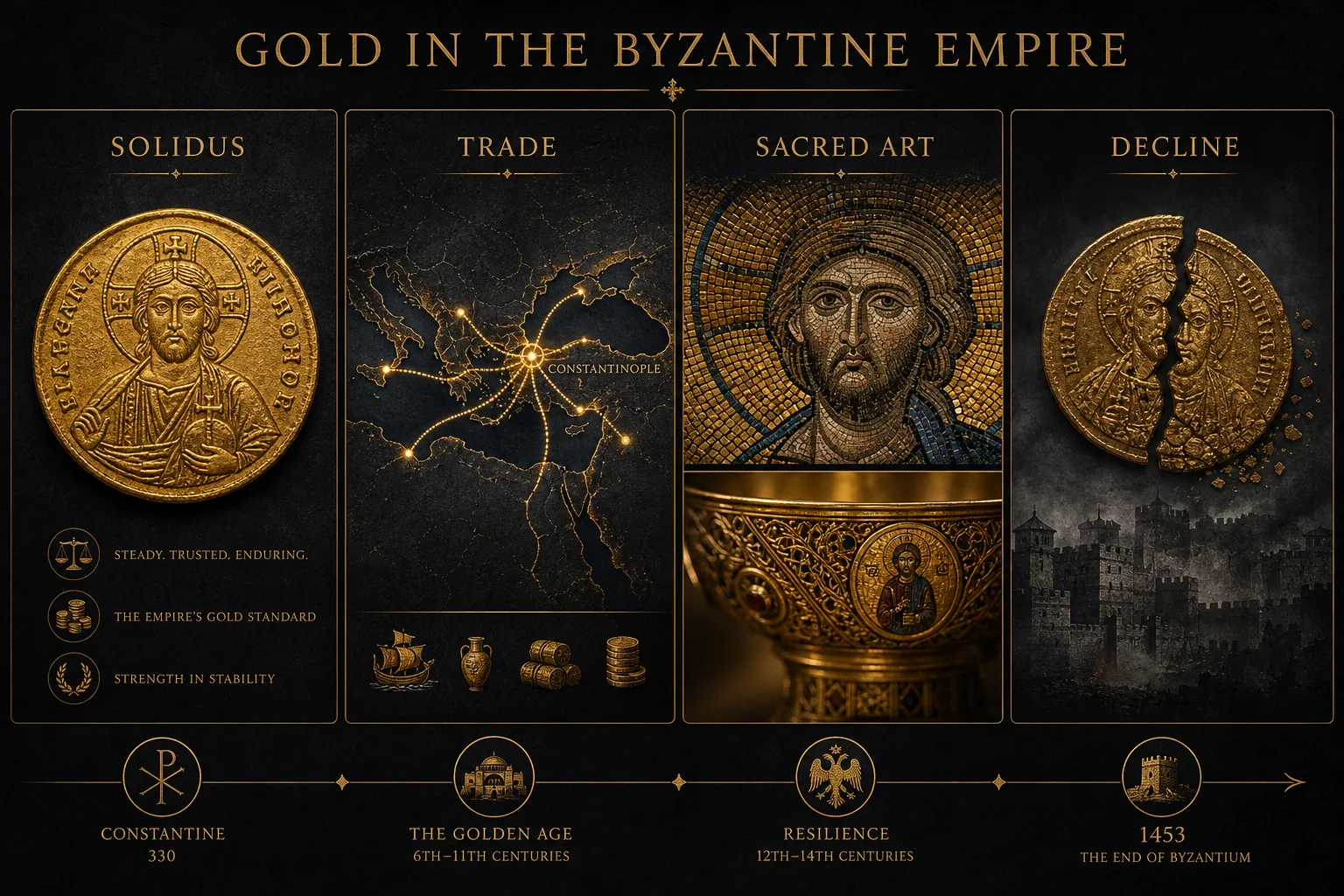
The gold solidus was introduced under Constantine and became the backbone of eastern Roman and Byzantine high-value money. In Greek-speaking Byzantine contexts it was commonly called the nomisma, and its reputation rested on weight, fineness, and official authority.
Museum objects make this concrete. The Metropolitan Museum of Art describes a solidus of Justinian II as part of a gold coin tradition that set an artistic and monetary standard across much of Byzantine history. The British Museum’s record for a solidus of Heraclius lists a Constantinople-minted gold coin weighing 4.45 grams, a useful reminder that these were standardized objects, not vague symbols of wealth.
| Solidus Feature | What It Meant | Why It Mattered |
|---|---|---|
| Gold content and weight discipline | A high-value coin whose trust depended on consistency. | Supported taxes, salaries, military payments, and cross-border exchange. |
| Imperial portrait | The ruler’s image traveled with the currency. | Turned money into portable political messaging. |
| Christian symbols | Crosses, angels, and later Christ imagery framed rule as divinely sanctioned. | Linked coinage to legitimacy, not just commerce. |
| Wide recognition | Foreign merchants and courts recognized Byzantine gold. | Helped Byzantium transact beyond its borders. |
This is also why Byzantine gold belongs beside broader discussions of gold trade and economy in ancient times. The empire inherited old Mediterranean exchange habits, then gave them a durable late antique and medieval monetary form.
Trade, Taxes, and the Constantinople Advantage
Gold did not move through Byzantium by magic. It moved through taxation, tribute, army pay, merchant settlement, diplomatic gifts, church endowments, dowries, and luxury exchange.
Constantinople mattered because it was both capital and choke point. Goods from the Black Sea, Balkans, Anatolia, Syria, Egypt, and maritime Mediterranean routes could pass through imperial markets, customs systems, and elite demand.
World History Encyclopedia’s overview of trade in the Byzantine Empire notes the importance of the gold nomisma for tax payments and commerce. That fiscal role is easy to miss if we look only at glittering mosaics and museum treasure.
Byzantine trade also sat in tension with geopolitics. War with Persia, the Arab conquests, competition with Italian maritime cities, and crusader disruption all changed the flows of metal, grain, silk, spices, and tax revenue.
Gold in Byzantine Art: Light, Not Just Luxury
Byzantine artists used gold with a theological purpose. In mosaics and icons, gold was often a visual language for sacred space, heavenly light, and imperial holiness.
The effect is clearest in church settings. The Metropolitan Museum of Art’s essay on Hagia Sophia describes the sixth-century church and notes early gold decoration in the dome. That detail matters because Byzantine gold was meant to shape perception: light shimmered, surfaces changed with movement, and the worshipper encountered gold as atmosphere.
This is why Byzantine gold art should not be reduced to “expensive decoration.” Gold backgrounds could flatten earthly space and suggest a timeless sacred realm. Gold vessels and reliquaries could make liturgy visible. Gold thread and ornament could bind court display to religious hierarchy.
| Artifact Type | Gold’s Role | Interpretive Caution |
|---|---|---|
| Solidus and nomisma | Currency, tax unit, ruler image, religious message. | Surviving coins may overrepresent official ideology. |
| Gold mosaics | Sacred light, divine space, imperial patronage. | Many famous examples were altered, covered, restored, or lost. |
| Liturgical vessels and reliquaries | Material honor for worship and relics. | Treasure survival often depends on later looting, burial, or reuse. |
| Jewelry and court objects | Rank, gift exchange, protection, and identity. | Elite objects reveal elite behavior more than daily life. |
For a neighboring religious comparison, GoldConsul’s article on gold in medieval religion shows how Christian institutions across medieval societies used precious metal to signal devotion, authority, and sacred presence.
Religion and Coinage: When Christ Appeared on Gold
One of the most important Byzantine coinage shifts was not only economic but religious. Under Justinian II, Christ appeared on gold coinage, making the coin a compact theological and political statement.
That decision changed the balance of imagery. Earlier coins had already used Christian symbols, but placing Christ on the coin intensified the claim that imperial authority operated under divine kingship.
The nuance matters. Byzantine coins did not simply become church art, and church art did not simply become imperial propaganda. The same gold surface could speak to taxes, soldiers, merchants, doctrine, legitimacy, and worship at once.
Editorial Perspective
The strongest reading of Byzantine gold is interdisciplinary. A coin catalogue can tell us weight and mint; an art history source can explain sacred imagery; an economic history source can explain taxes and trade. Treating one lens as the whole story makes Byzantium look either richer, poorer, more pious, or more commercial than it really was.
The Long Arc: From Constantine to the Fall of Constantinople
Byzantine gold history is not one unbroken line of stability. The early solidus was remarkably durable, but later centuries brought debasement, reform, fragmentation, and reduced imperial capacity.
The late empire still used gold as an image of legitimacy, but its political and fiscal base was narrower. By the time Constantinople fell in 1453, the old universal reach of Byzantine gold had already faded.
| Period | Gold Signal | Historical Meaning |
|---|---|---|
| 4th century | Constantinian solidus tradition strengthens eastern Roman gold currency. | Gold coinage becomes a durable state instrument. |
| 6th century | Justinianic court, church building, and coinage project imperial confidence. | Gold supports both fiscal power and sacred spectacle. |
| 7th century | War and territorial losses pressure the system. | Gold remains prestigious, but the resource base changes. |
| 8th-9th centuries | Iconoclasm and image debates affect religious visual culture. | Gold art cannot be separated from theology and politics. |
| 11th-12th centuries | Coinage pressure and later reform lead toward the hyperpyron. | The old solidus-centered order changes under fiscal stress. |
| 1204-1453 | Crusader conquest, recovery, and contraction reshape imperial finances. | Byzantine gold remains symbolic, but no longer commands the same reach. |
What Byzantium Inherited and What It Passed On
Byzantium inherited Roman coinage habits, Christianized imperial symbolism, and Mediterranean luxury networks. It passed on a model of gold as controlled money, sacred surface, and court language.
Western medieval rulers understood the prestige of Byzantine gold even when their own coinage systems developed differently. GoldConsul’s article on gold in the Carolingian Empire is a useful contrast because Carolingian routine coinage leaned toward silver while gold remained exceptional and prestigious.
The same contrast appears in broader medieval social history. In gold in medieval society, gold often signals hierarchy, liturgy, and stored wealth rather than mass-market money.
Knowledge Gap: What We Still Cannot Say Cleanly
The evidence for Byzantine gold is rich but uneven. Coins survive in large numbers compared with textiles, vessels, and lost church furnishings. Famous monuments can dominate the story even when provincial practice was more varied.
That means careful interpretation should separate mint evidence, written sources, surviving art, archaeological context, and later restoration history. A single surviving gold object rarely proves how ordinary Byzantines experienced gold.
How to Read Byzantine Gold Without Oversimplifying It
- Start with function: ask whether the object was money, ornament, liturgical equipment, diplomatic gift, or treasury reserve.
- Check the date: early, middle, and late Byzantine gold tell different stories.
- Separate metal from message: gold content matters, but imagery and placement often matter just as much.
- Look for context: a coin found in a hoard, a museum tray, or a pendant setting may mean different things.
- Avoid the treasure trap: Byzantine gold is historically valuable because it connects systems, not just because it is shiny.
That approach also helps with adjacent topics such as gold in ancient religions, where precious metal is often best read as a bridge between material wealth and sacred meaning.
Bottom Line
Gold in the Byzantine Empire mattered because it linked credibility, authority, trade, and sacred vision. The solidus made imperial trust portable; mosaics and liturgical gold made divine order visible; diplomatic and commercial use carried Byzantine prestige far beyond Constantinople.
The legacy is not a simple story of permanent wealth. It is the story of a state that made gold do several jobs at once, then left a record that still requires careful reading across coinage, art, religion, and economic history.
FAQ: Gold in the Byzantine Empire
What was the main Byzantine gold coin?
The main high-value gold coin was the solidus, known in Greek contexts as the nomisma. It was prized because it carried official authority, recognizable imagery, and a reputation for consistency.
Was Byzantine gold only used by the rich?
Gold was concentrated in state, church, military, diplomatic, and elite contexts. Ordinary exchange often relied on lower-value coinage and goods, but gold still affected daily life indirectly through taxes, pay, prices, and state finance.
Why did Byzantine coins include Christian imagery?
Christian imagery helped present imperial power as divinely sanctioned. Crosses, angels, and images of Christ turned coinage into a public statement about legitimacy as well as a medium of payment.
How was gold used in Byzantine art?
Gold appeared in mosaics, icons, vessels, reliquaries, jewelry, textiles, and court objects. In religious settings, gold often suggested heavenly light and sacred presence rather than ordinary luxury.
Did Byzantine gold decline over time?
Yes, but not in a simple straight line. The early solidus was remarkably stable, while later centuries brought fiscal pressure, coinage changes, debasement, reform, territorial loss, and reduced imperial reach.
 When you purchase a service or a product through our links, we sometimes earn a commission, at no extra cost to you.