

Compare major gold heists through verified cases, custody failures, laundering risk, victim impact, provenance and practical storage lessons.
- Use famous heists to study security gaps, provenance, and legal fallout.
- Check whether recovered gold can be identified, traced, or lawfully sold.
- Treat heist stories as risk lessons, not glamorous ownership shortcuts.

The most important gold heists were usually failures of access control, custody and provenance—not proof that gold becomes untraceable. Brink’s-Mat, Hatton Garden and the Big Maple Leaf case show different risks: insider knowledge, many private victims, laundering pressure and the possible destruction of cultural property.
Gold heists attract attention because the metal looks simple: dense, portable, recognizable, and valuable. The reality is less romantic. Large gold crimes usually leave long trails through insurance records, refinery networks, informants, assay paperwork, and criminal proceeds cases.
This rewrite looks at great gold heists of history as case studies in custody failure, laundering risk, and cultural loss. It does not explain how to commit a crime. It explains why famous heists rarely end as cleanly as popular retellings suggest.
- The most famous gold heists were rarely about cleverness alone; most depended on insider knowledge, weak custody controls, or slow escalation.
- Gold is liquid, but not invisible. Melting, refining, and reselling can create evidence through purity, weight, timing, and suspicious paperwork.
- Victims are not abstract: safe deposit clients, insurers, museums, workers, and public collections carry the losses.
- The best lesson for investors is provenance discipline: receipts, reputable dealers, insured storage, and documented chain of custody matter.
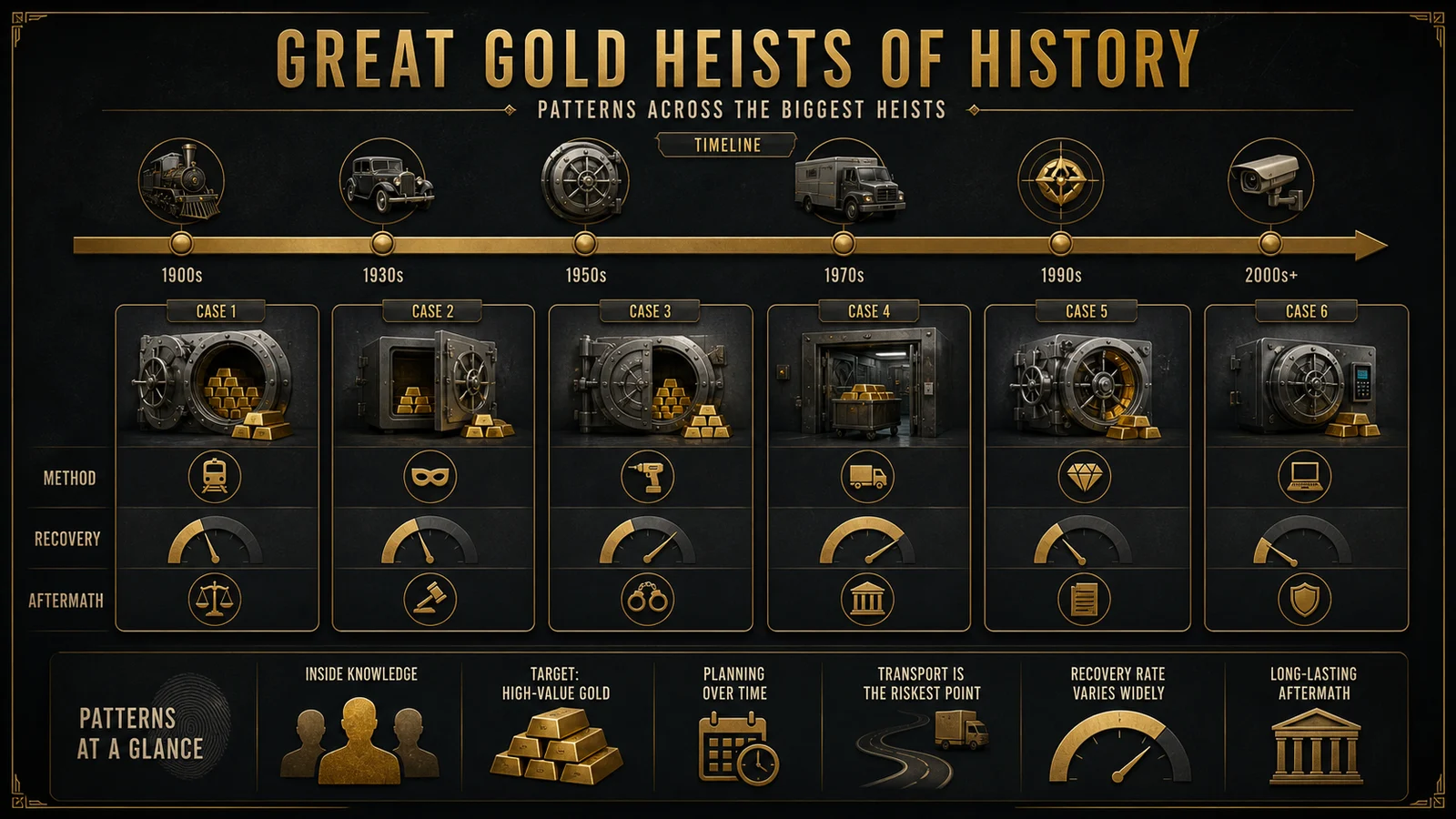
Great Gold Heists of History: A Case Timeline
The table below separates the folklore from the practical lessons. Values are usually reported at the time of the crime, so they should not be compared as if they were current market values.
| Case | Date and place | What was taken | Why it mattered | Aftermath |
|---|---|---|---|---|
| Great Brink’s Robbery | January 17, 1950, Boston | Cash, checks, money orders, and securities rather than bullion | The FBI called it one of the era’s defining robbery investigations, with a haul reported at more than $2.7 million. | Years of investigation, informants, charges, and convictions turned the “perfect crime” narrative into a procedural case study. |
| Brink’s-Mat | November 26, 1983, near Heathrow Airport | Gold bullion, diamonds, and cash, widely reported at about GBP 26 million at the time | The scale of the bullion created a laundering problem that rippled through the UK gold and jewelry trade. | Part of the gold was recovered, but the larger legacy was organized-crime finance, corruption risk, and provenance scrutiny. |
| Hatton Garden safe deposit burglary | April 2015, London | Cash, jewelry, gold, gems, and valuables from private safe deposit boxes | The case showed how private storage failures can harm many individual owners, not just one institution. | Convictions and proceeds-of-crime recovery followed, but recovery was incomplete and ownership disputes were complex. |
| Big Maple Leaf theft | March 27, 2017, Bode Museum, Berlin | A 100 kg, 999.99 fine gold coin issued by the Royal Canadian Mint | The object was both bullion and cultural property, making the loss larger than metal value alone. | The coin has not been returned publicly; authorities and museums treated destruction or melting as a serious risk. |
Legality and Ethics: Why These Stories Need Careful Framing
Gold heists should not be treated as adventure tales with victims edited out. Robbery, burglary, handling stolen goods, money laundering, insurance fraud, and conspiracy can all appear around the same event, depending on the facts and jurisdiction.
The ethical issue is equally direct: stolen gold is not “found” gold. A melted bar, recut jewel, or undocumented coin can carry losses for a depositor, museum, insurer, worker, or family estate. That is why serious gold buyers care about provenance as much as purity.
For ordinary collectors, the practical boundary is simple. Buy from reputable dealers, keep invoices, avoid suspicious discounts, and treat unclear ownership history as a red flag. If you are comparing bullion formats, start with the basics in what gold and silver bullion means and then move to storage decisions.
Case Study 1: The Great Brink’s Robbery
The Great Brink’s Robbery is often included in gold-heist lists even though the stolen property was mainly cash and negotiable instruments, not bullion. It belongs here because it shaped the modern template for high-value secure-facility crime: reconnaissance, disguise, timing, inside knowledge suspicions, and a long investigation.
The FBI history of the Brink’s case records a January 17, 1950 robbery in Boston involving more than $2.7 million in cash, checks, money orders, and securities. The important lesson for gold readers is not the loot type. It is the gap between the public myth of a flawless heist and the eventual investigative grind.
Gold creates an even harder disposal problem than cash in some situations. Large bullion has weight, markings, serial records, assay expectations, and a smaller professional resale universe. That is why the escape is only the first part of a precious-metals crime.
Case Study 2: Brink’s-Mat and the Laundering Problem
Brink’s-Mat is the bullion case that still hangs over British crime history. The robbers reportedly expected one type of haul and encountered a much larger store of gold, diamonds, and cash.
The aftermath matters more than the break-in. Moving tonnes of gold into spendable wealth required handlers, fences, smelting, false paperwork, and financial channels. That changed the case from a warehouse robbery into a long proceeds-of-crime and corruption story.
For investors, Brink’s-Mat is a reminder that “gold is gold” is too loose a phrase. Gold also has history. Chain of custody, dealer reputation, and documented buyback paths are part of the value proposition, especially when comparing how to buy gold bars with smaller coins or jewelry.
GoldConsul treats these cases as custody and provenance lessons, not as entertainment scripts. The most useful takeaway is not that criminals were bold; it is that weak controls, undocumented resale channels, and casual ownership records create real losses for honest owners.
Case Study 3: Hatton Garden and Private Storage Risk
The 2015 Hatton Garden burglary is often remembered for age, tools, and London crime folklore. That framing can obscure the human damage. Safe deposit boxes can hold family jewelry, business inventory, records, cash, and sentimental items that insurance may not fully replace.
The UK’s Crown Prosecution Service has published records on monies recovered from participants in the Hatton Garden heist, which underlines a hard truth: recovery is not the same as restoration. Even when courts and confiscation orders follow, victims can wait years and still face gaps.
If you store physical gold, the Hatton Garden lesson is practical. Review insurance limits, access controls, inventory photos, and proof of purchase before something goes wrong. Our guide to where to store gold covers the tradeoff between home safes, bank boxes, and private vaults in more detail.
Case Study 4: The Big Maple Leaf at the Bode Museum
The Big Maple Leaf theft is different because the stolen object was not just bullion. It was a 100 kg, 999.99 fine gold coin with cultural, numismatic, and public-display value.
Stiftung Preussischer Kulturbesitz described the 2017 theft from the Bode Museum after a security staff member discovered the coin missing. LBMA records also describe the coin as one of the six 100 kg, 999.99 fineness Gold Maple Leaf coins made by the Royal Canadian Mint.
This case shows why melt value is an incomplete measure. Once a unique or rare object is destroyed, society loses design, context, provenance, and public access. The same logic applies on a smaller scale when antique jewelry is stripped for metal without regard to craftsmanship or history.
Public accounts often focus on the entry method and the headline value. They rarely quantify the hidden costs: insurance litigation, museum security upgrades, provenance checks, police time, court recovery actions, and the permanent cultural loss when identifiable objects are melted.
What Gold Heists Teach Buyers and Collectors
Most readers will never handle institutional bullion, but the lessons scale down. A coin, bar, or inherited piece can become harder to sell if its paperwork is weak or its origin is unclear.
- Keep the paper trail: invoices, assay certificates, serial numbers, and storage receipts should live somewhere safer than an email inbox alone.
- Prefer boring counterparties: established dealers, transparent premiums, clear buyback policies, and verifiable addresses beat exciting discounts.
- Separate purity from provenance: real gold can still be stolen, encumbered, or ethically problematic.
- Document storage: photos, inventory lists, insurance schedules, and access logs matter after a loss.
- Know when to walk away: pressure, cash-only terms, missing receipts, and vague estate stories are not minor details.
For a deeper ownership framework, compare this with ethical gold, testing gold coins, and today’s gold market context. Heist history is most useful when it improves everyday judgment.
History Claim Credibility Check
Claim: The Great Brink’s Robbery was one of history’s largest gold heists.
What the evidence supports: The 1950 Boston robbery was a landmark high-value theft and investigation.
Correction: The haul was cash, checks, money orders and securities—not gold bullion. It belongs in comparison, but should not be mislabeled.
Bottom Line
The great gold heists of history are not clean stories of clever thieves and glittering treasure. They are records of access failures, laundering pressure, victim losses, and long legal consequences.
Gold’s appeal is exactly why controls matter. The more portable and trusted an asset is, the more important documentation, storage discipline, and ethical ownership become.
FAQ: Great Gold Heists of History
What was the biggest gold heist in history?
By common historical reputation, Brink’s-Mat is one of the most significant bullion heists because it involved a huge quantity of gold and had long laundering consequences. Rankings vary because reports use different dates, currencies, and inflation methods.
Was the Great Brink’s Robbery a gold heist?
Not strictly. The 1950 Brink’s case involved cash, checks, money orders, and securities rather than gold bullion, but it is often discussed alongside gold heists because it shaped high-value robbery history.
Why is stolen gold hard to recover?
Gold can be melted, recast, mixed, and moved through informal markets. That does not make it untraceable, but it can make recovery slow and incomplete.
What should gold buyers learn from these cases?
Documentation matters. Buyers should keep receipts, use reputable sellers, avoid suspicious discounts, and understand storage and insurance terms before purchasing physical gold.
Is it legal to buy gold with no paperwork?
Laws vary by country and transaction type, but lack of paperwork increases resale, tax, insurance, and stolen-property risk. For meaningful purchases, documented provenance is the safer standard.
 When you purchase a service or a product through our links, we sometimes earn a commission, at no extra cost to you.