
Review lost gold mines through history, folklore, maps, geology and evidence checks while separating real mining records from treasure legends.
- Treat lost-mine stories as evidence questions, not treasure maps.
- Check records, geology, and ownership before trusting a dramatic legend.
- Many tales grow stronger as folklore while the mining evidence stays weak.
Some lost-gold-mine legends began in real mining districts, but a plausible landscape is not proof of a hidden mine. The strongest cases combine documented mining, credible geology and more than one independent record. Unproven maps, changing locations and stories copied from a single teller belong to folklore until verifiable evidence appears.
Lost gold mines fascinate people because they promise a rare mix of frontier history, secret geography, and instant transformation. The problem is that most stories become stronger as folklore long after they become weaker as evidence.
That is why this topic should not be written as a simple treasure roundup. It connects more naturally to El Dorado, gold ore, how to identify gold ore, and real mining-history pages such as gold mines in Georgia.
The strongest way to cover lost gold mines is to separate mining history from storytelling. Some legends grow out of real districts. Others survive mostly because mystery sells better than documentation.
TL;DR
- Most lost-gold-mine legends sit on a spectrum between real mining history and pure folklore.
- The Lost Dutchman is the best-known case because it combines a real gold region with decades of legend-building.
- A story becomes more plausible when it has a real district, real witnesses, and records that do not rely on one repeated teller.
- Maps without provenance, miracle-rich retellings, and no solid location chain are major warning signs.
- The best reader question is not “could treasure exist?” but “what category of evidence does this legend actually have?”
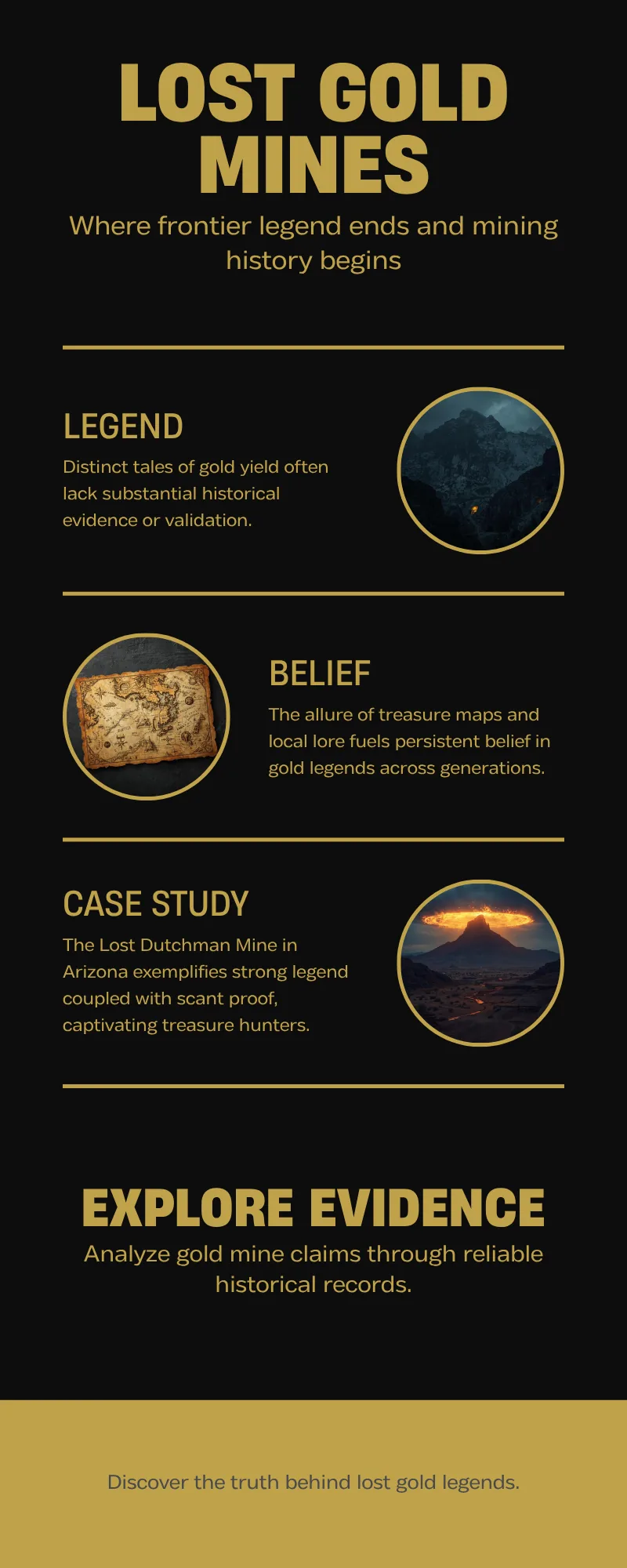
What Most Readers Miss
The biggest mistake is treating all lost-gold-mine stories as if they belong in one bucket. Some are legends built on real mining terrain. Some are embellished memory. Some are almost entirely narrative machinery.
Real district:
There was actual mining nearby, which gives the legend a stronger foundation.
Weak chain:
The story survives, but the location and witness trail keep breaking down.
Pure folklore:
The legend is culturally durable even when the evidence is structurally thin.
Why Lost Gold Mine Legends Spread So Easily
Lost mines are powerful stories because they promise that wealth exists just beyond the known map. They turn missing information into possibility instead of final absence.
Folklore Thursday’s discussion of lost-mine legends is useful here because it frames these stories as part of a much older get-rich-quick imagination. That is also why they overlap with mythic pages like gold in medieval myths and legends even when the setting is frontier North America.
- A hidden mine sounds more plausible than magically created treasure.
- A partial map keeps the story alive without requiring full proof.
- A real death, disappearance, or district rumor gives the legend emotional weight.
- Each retelling can add one more clue without resolving the core mystery.
The Three Main Types of Lost Gold Mine Story
Once you separate the stories by evidence type, the subject becomes easier to read. Not every case deserves the same level of historical confidence.
Chart 1: Lost-Gold-Mine Legends by Evidence Class
Interpretation: the strongest stories usually begin in real mining terrain, but they still weaken fast when the location chain collapses.
| Legend class | What it usually contains | How to read it |
|---|---|---|
| Real district, inflated legend | Known mining region, local memory, shifting story details | Most plausible foundation, but not proof of a hidden bonanza |
| Partly grounded, weakly documented | Named people, repeated clues, broken documentary chain | Interesting but unstable; often sustained by repetition |
| Mostly folklore | Maps, curses, impossible directions, dramatic retellings | Best read as cultural narrative rather than mining evidence |
The Lost Dutchman Is the Best-Known Case for a Reason
The Lost Dutchman Mine dominates this subject because it sits in a real mineralized landscape and never fully detached from Arizona mining history. That gives the legend more staying power than stories floating in purely invented terrain.
Lost Dutchman State Park and the Superstition Mountain Lost Dutchman Museum both matter here because they show how the legend became institutionalized in public memory. That does not prove the mine exists. It proves the story is anchored in a real place, which is different.
Reader rule
When a lost-mine story has a museum, a state-park identity, and a real district behind it, treat that as proof of legend depth, not proof of buried gold.
Other Famous Stories Usually Rely More on Narrative Than on Mining Record
Once you move beyond the Lost Dutchman, many cases become much looser. Some stories borrow from real prospecting culture but depend heavily on disappearing witnesses, inherited clues, or treasure maps that gain detail over time instead of losing it.
DesertUSA’s lost-gold-mine material is useful because it preserves how these legends circulate in regional treasure culture. The value of that source is not that it proves the treasure. The value is that it documents how the storytelling system works.
This is also why pages about gold mining methods and gold ore matter. Real mines leave geological and operational fingerprints that pure legend often cannot supply.
Chart 2: Why Some Legends Feel Stronger Than Others
Interpretation: the more a story depends on maps, curses, and one repeating witness line, the more it shifts toward folklore.
| Signal | Historically stronger case | Historically weaker case |
|---|---|---|
| Location | Inside a known mining district | Vague frontier wilderness |
| Witness chain | Multiple records or independent references | One repeated teller or inherited tale |
| Geology | Mineralized terrain and plausible mining conditions | No clear district logic |
| Legend style | Details stay limited and consistent | New clues appear every generation |
Geology Matters More Than Treasure-Hunt Drama
Many lost-mine stories become distorted because readers focus on maps and disappearances while ignoring whether the land itself supports the claim. A legend set in real ore-bearing country is still not proven, but it starts from firmer ground.
That is why practical pages like how to identify gold ore matter more than most treasure videos admit. Real mines come from real mineral systems. They do not appear just because a story sounds persistent.
- Real district history raises plausibility but never closes the case.
- Geological fit is stronger than emotional storytelling.
- Maps without provenance should be treated as entertainment first.
- A curse may strengthen folklore, but it weakens historical confidence.
How to Judge a Lost Gold Mine Claim
The strongest reader service on this topic is not another list of famous legends. It is a usable filter for deciding which stories deserve historical seriousness.
Chart 3: Practical Screening Framework for Lost-Mine Claims
Interpretation: once a claim fails both geology and documentation, it moves out of mining history and into folklore preservation.
| Question | If yes | If no |
|---|---|---|
| Is there a real mining district nearby? | The legend begins with a plausible historical base | The story weakens immediately |
| Are there independent records? | The case deserves closer historical reading | The tale may be surviving on repetition alone |
| Do the directions stay stable across versions? | The story may preserve older memory | Later embellishment is likely |
| Does the legend need miracles to work? | Read carefully but stay skeptical | You may still have a grounded frontier legend |
Helpful Reading Filter
If you want to read lost-gold-mine stories without getting trapped by hype, move through them in this order.
1. District:
Find out whether the story begins in a real mining landscape.
2. Record:
Check whether more than one source preserves the claim independently.
3. Drift:
Watch how much the story expands as it gets retold.
Why the Legends Keep Surviving Even Without Resolution
Lost gold mine stories survive because unresolved wealth is narratively stronger than confirmed disappointment. A proven empty canyon ends the story. A partially documented rumor keeps it alive for another generation.
Legends of America’s Arizona lost-mine material helps here as a cultural source because it shows how these stories are preserved and marketed inside regional memory. That preservation matters even when the mine itself remains unproven.
The GoldConsul Editorial Perspective
The right way to read lost gold mines is neither full belief nor lazy dismissal. The serious question is what kind of evidence the story has and whether the legend is riding on real mining history or mostly on frontier desire.
Knowledge Gap: persistence is not proof
Many readers assume a legend that survives for a century must hide a core truth. Sometimes it does. Often it survives because the story structure is too good to die.
- Real mining geography can keep a legend plausible without proving it.
- Institutional memory can preserve the story without authenticating the mine.
- Repetition strengthens fame faster than it strengthens evidence.
Video walkthrough: this Lost Dutchman episode works because it shows the strongest modern case study in the category – a real district, a durable legend, and a long-running evidence problem.
History Claim Credibility Check
Claim: A treasure map proves the Lost Dutchman or another famous mine exists.
What the evidence supports: The Superstition Mountains sit within a real Arizona mining landscape, and the legend has a documented cultural history.
What remains unproven: No map or testimony chain has produced independently verified evidence for the legendary mine as described.
Bottom Line
Lost gold mines are best understood as a borderland between real mining history and durable folklore. Some legends begin in genuine mineral districts and then grow far beyond the evidence that first supported them.
If readers want the strongest version of the subject, they should stop asking only where the treasure is. They should ask what kind of historical case the legend actually has.
FAQ: Lost Gold Mines
Are lost gold mines real or just folklore?
Some legends grow out of real mining districts, so they are not invented from nothing. But many survive with much stronger folklore than evidence.
Why is the Lost Dutchman Mine so famous?
Because it combines a real Arizona mining landscape with a long-running mystery tradition, repeated witness stories, and a strong public-memory culture.
What makes a lost mine story historically stronger?
A real mining district, plausible geology, and more than one independent record all make a story stronger than a legend built only on maps and retellings.
Do treasure maps usually prove anything?
No. Without clear provenance, a map is usually part of the legend system rather than reliable proof of a mine location.
What is the best way to read lost gold mine legends?
Separate mining history from storytelling. Ask what evidence exists, how stable the story is, and whether the geology supports the claim.
 When you purchase a service or a product through our links, we sometimes earn a commission, at no extra cost to you.