
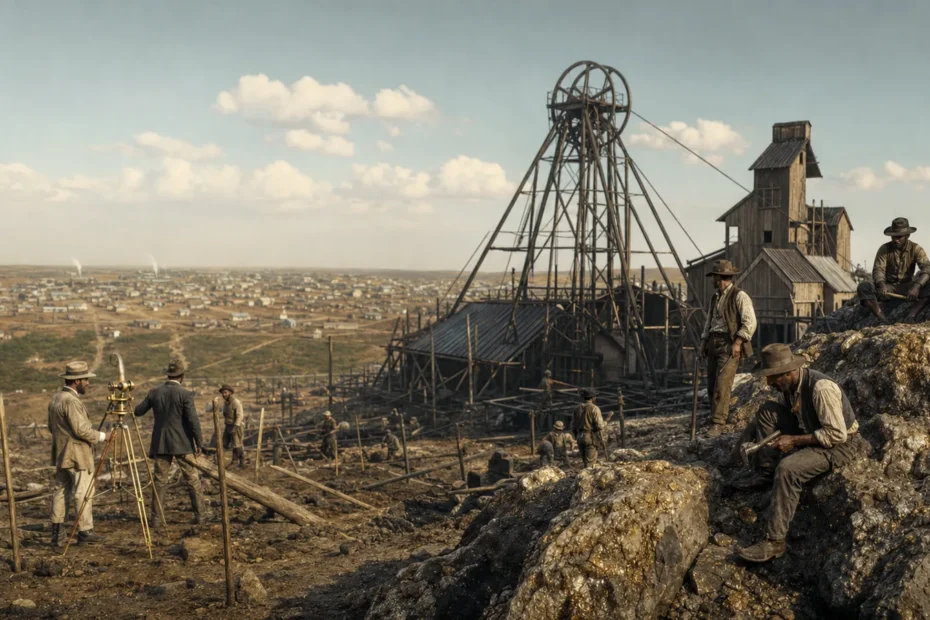
Follow South Africa's gold rushes from Eersteling and Pilgrim's Rest to Barberton and the 1886 Witwatersrand industrial turning point.
- South Africa had distinct gold rushes before the 1886 Witwatersrand breakthrough.
- Pilgrim's Rest and Barberton began as frontier fields; the Rand became an industrial system.
- Use this national timeline first, then open the focused Witwatersrand deep-dive.
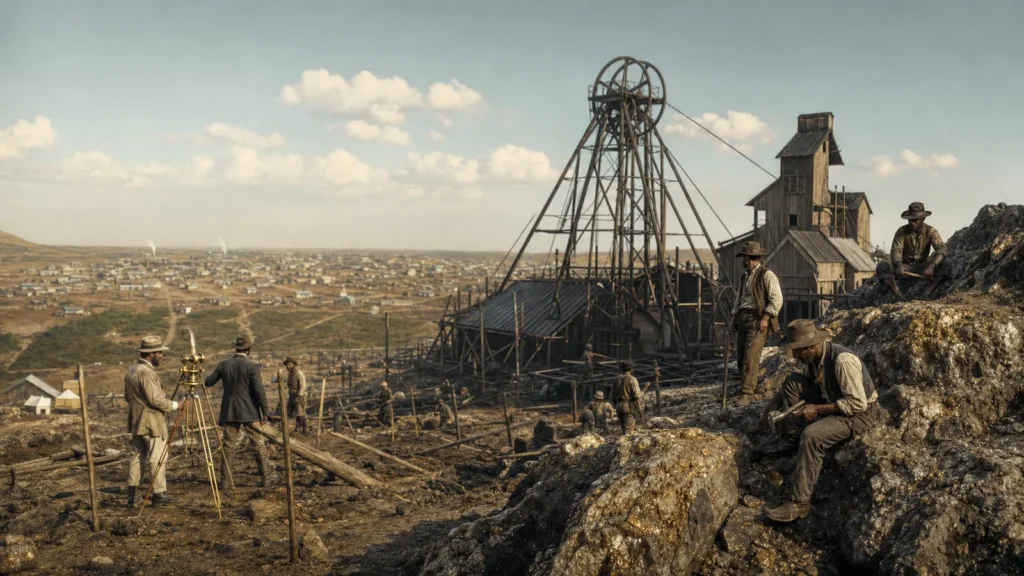
The South African gold rush did not begin with one 1886 discovery. The modern sequence started with recorded finds near Eersteling in 1871, moved into the major alluvial rush at Pilgrim’s Rest in 1873, expanded through the Barberton field in the 1880s, and changed scale after the Witwatersrand breakthrough in 1886. The earlier fields looked more like frontier rushes; the Rand became a deep, capital-intensive industrial system.
- South Africa had multiple rushes, not one national discovery moment.
- Pilgrim’s Rest drew prospectors to alluvial stream deposits in the 1870s.
- Barberton combined an 1880s rush town with longer-lived reef mining.
- Witwatersrand dwarfed the earlier fields and built Johannesburg around deep mining.
- This page is the national overview; the dedicated Rand guide covers Johannesburg, labor and industrial power in depth.
Popular summaries often use “South African Gold Rush” as another name for the Witwatersrand Gold Rush. That shortcut misses the earlier eastern Transvaal fields and makes the country’s mining transition look more sudden than it was.
A better history follows the sequence from scattered finds and alluvial diggings to quartz reefs, large companies, deep shafts and an economy organized around mineral extraction.
This national sequence sits inside the broader Gold History timeline, where rushes are separated from ancient mining, coinage and later monetary systems.
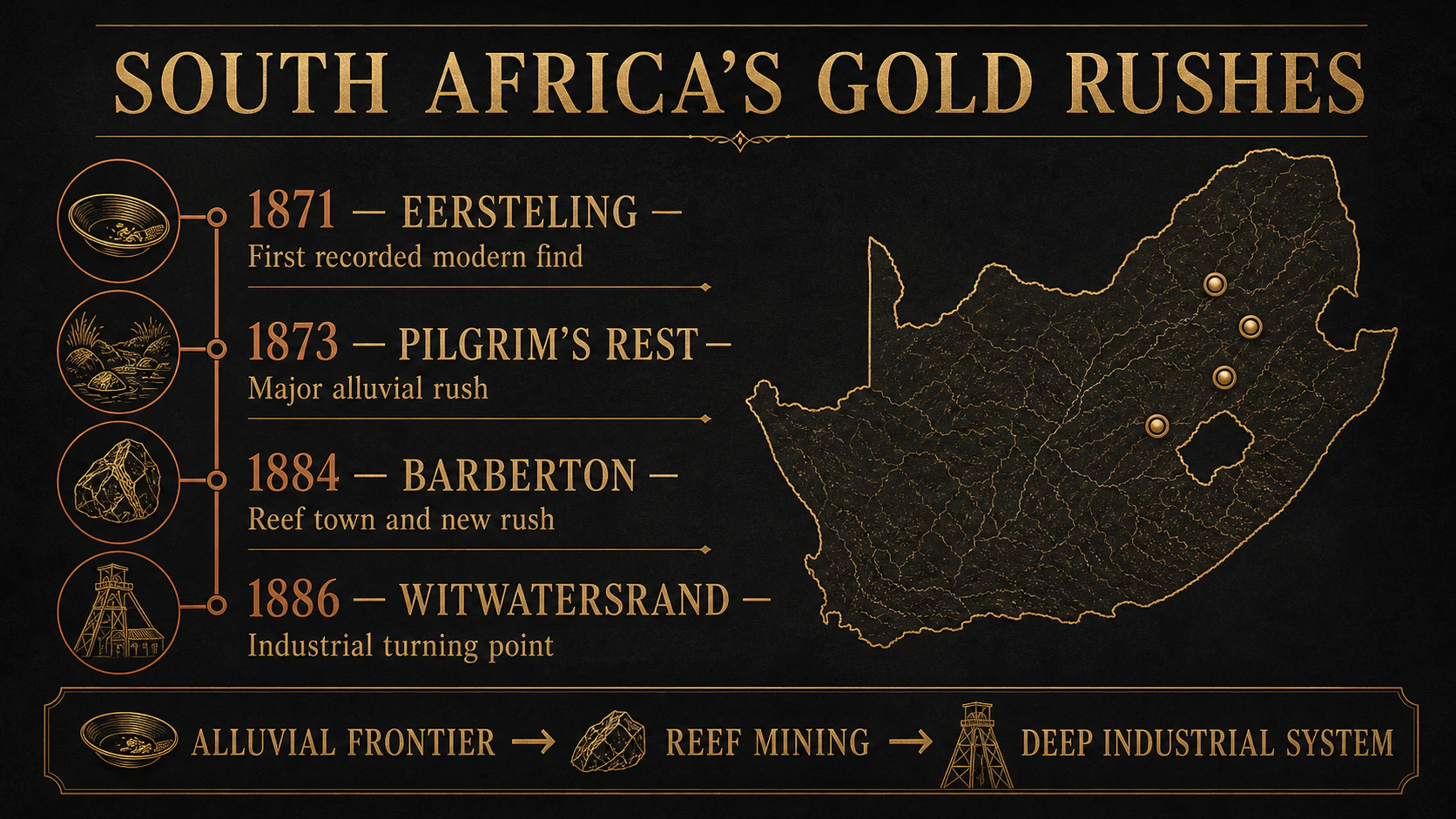
The national timeline in four stops
First recorded modern find in the national geological survey’s sequence.
A major alluvial rush built around creeks, claims and a digger settlement.
A new rush town grew around discoveries in the De Kaap valley and surrounding reefs.
Extensive conglomerate reefs changed mining scale, finance and urban development.
The South African Department of Mineral Resources and Energy’s national report on gold deposits places the modern sequence at Eersteling in 1871, Pilgrim’s Rest in 1872, Kaapsehoop in 1874, Barberton in 1882 and Langlaagte on the Witwatersrand in 1886. Local histories may use a discovery, proclamation or town-founding date, so apparently different dates do not always describe the same event.
Eersteling and the northern finds
Eersteling, near present-day Polokwane, belongs at the start of the documented modern sequence even though it did not produce the country’s most famous rush town. Its importance is chronological: it shows that organized modern prospecting preceded both Pilgrim’s Rest and the Rand.
It also sets an evidence rule for the entire topic. “Gold was found” can refer to a trace, a payable occurrence, an officially proclaimed field or a discovery large enough to reorganize an economy. Those claims need different proof.
This modern-era story should also be kept separate from older southern African mining and trade. Our guide to gold mining in ancient Africa deals with evidence from earlier regions and periods rather than projecting nineteenth-century borders backward.
Pilgrim’s Rest: the alluvial frontier rush
The Pilgrim’s Rest story looks closest to the classic image of a gold rush. Prospectors worked streams and banks with pans, cradles and sluice boxes, registered claims and built a settlement around a field that could initially be entered without the capital required by later deep mines.
Mpumalanga Museums dates the first major South African rush to 1873, when payable gold near the Sabie area drew miners to Mac Mac and Pilgrim’s Creek. Its account records roughly 1,500 diggers working about 4,000 claims by the end of that year.
Those numbers describe a genuine rush, but the field did not remain an open digger economy. As alluvial returns changed, rights were consolidated and organized companies gained control. Pilgrim’s Rest therefore shows the transition from individual claims to corporate mining before Witwatersrand accelerated it.
Barberton: from rush town to reef mining
Barberton became the next major center. Its historical identity rests on the 1880s discoveries in the De Kaap valley, the rapid arrival of fortune seekers and the development of reefs that supported longer-lived mines.
South African History Online’s Barberton record dates the town’s naming to July 1884 after the Barber cousins’ discovery. It also distinguishes the rush settlement from mines such as Sheba, New Consort, Fairview and Agnes that became part of the area’s continuing mining history.
Barberton is the hinge between frontier prospecting and the industrial future. It had alluvial excitement, but reef geology, crushing and organized mine ownership increasingly mattered. When the Rand opened, many prospectors and investors moved again.
Why 1886 changed the scale
The Witwatersrand discovery was not simply the fourth stop in a similar chain. The deposit’s extent and low-grade conglomerate reefs created an industrial problem: success required crushing large volumes of rock, recovering fine gold, pumping water and following reefs at depth.
The South African Government’s history calls the 1886 goldfield discovery a turning point. The Minerals Council’s institutional history shows how quickly organized mining followed, with a Chamber of Mines predecessor formed in Johannesburg in 1887 and a formal chamber in 1889.
That is why this national overview stops before repeating the full Rand story. Read our focused guide to the Witwatersrand Gold Rush for the Main Reef, Johannesburg, mining houses, migrant labor, racialized control, imperial conflict and acid mine drainage.
This national overview
- Compares the major rush sequence.
- Explains Pilgrim’s Rest and Barberton.
- Shows the transition in mining form.
- Ends with the 1886 national turning point.
The Witwatersrand deep-dive
- Explains conglomerate reef geology.
- Tracks Johannesburg’s rapid growth.
- Examines finance and labor systems.
- Connects mining to politics and environmental legacy.
Alluvial frontier versus industrial reef system
| Feature | Pilgrim’s Rest | Barberton | Witwatersrand |
|---|---|---|---|
| Main historical image | Creek diggings, pans, claims and a rush settlement. | Rush town followed by durable reef mines. | Large reef belt, deep shafts and a permanent industrial city. |
| Entry barrier | Relatively accessible during the early alluvial phase. | Rising technical and capital needs as reef mining expanded. | Rapidly favored companies, engineering and large finance. |
| Settlement effect | Historic mining town tied to a regional field. | Regional mining center with long-lived operations. | Johannesburg became the country’s dominant mining-finance metropolis. |
| Best reader question | What did an early South African digger rush look like? | How did a rush town become a reef-mining district? | How did one deposit reshape national labor, finance and power? |
For wider comparison with California, Australia, Klondike and other regions, use the Gold Rush history hub. The techniques themselves are separated in our guide to gold rush mining methods.
Labor, politics and environmental costs
The national story cannot end with discovery dates. Goldfields required land, water, transport, food, housing and labor. As mining grew deeper, companies recruited across southern Africa and built labor-control systems that were neither neutral nor temporary.
The Rand’s political weight intensified conflict over the Transvaal, foreign residents and British imperial power. The mineral revolution affected taxation, railways, finance and the balance between regional governments. Gold wealth was never only a mine-site story.
Environmental costs also accumulated. Mine dumps, disturbed land and polluted water outlasted many operations. South Africa’s Department of Water and Sanitation material on acid mine drainage describes the continuing challenge in the Witwatersrand basins.
History Claim Credibility Check
Claim: “The South African Gold Rush began in 1886.”
1886 marks the decisive Witwatersrand industrial breakthrough.
Eersteling, Pilgrim’s Rest and Barberton came earlier.
South Africa had earlier rushes; the Rand transformed their national scale.
Knowledge Gap: discovery dates describe different acts
A local date may refer to the first trace, first payable result, first recorded claim, government proclamation or naming of a town. Rather than forcing one date to win, identify the act and source behind it. That is why the infographic uses a readable national sequence while the article preserves local distinctions.
Video context: why Rand geology was different
This Geological Society of South Africa lecture focuses on the origin of Witwatersrand gold. It helps explain why the final stop in the national sequence became a deep industrial system rather than another short alluvial camp.
The GoldConsul Editorial Perspective
Calling every South African gold event “the Witwatersrand rush” makes the history easier to remember but less useful. Pilgrim’s Rest shows the alluvial digger frontier, Barberton shows the move toward reef districts, and the Rand shows what happened when geology demanded a permanent industrial and financial system.
Bottom line
South Africa’s modern gold-rush history is a chain, not a single strike. Recorded finds at Eersteling and the rush at Pilgrim’s Rest came before Barberton; Witwatersrand then changed the scale so dramatically that it came to stand for the whole national story.
Use this page for the sequence. Use the dedicated Witwatersrand guide for the industrial system it created.
FAQ: South African gold rushes
When did the South African Gold Rush begin?
The national modern sequence includes an 1871 recorded find at Eersteling and a major rush at Pilgrim’s Rest in 1873. The much larger Witwatersrand rush began in 1886.
Was Pilgrim’s Rest before the Witwatersrand?
Yes. Pilgrim’s Rest became a major alluvial field in the 1870s, more than a decade before the 1886 Main Reef discoveries near Johannesburg.
Why is Barberton important?
Barberton was an important 1880s rush town and reef-mining district. It shows the transition from frontier prospecting toward longer-lived company mining before Witwatersrand dominated attention.
Why was the Witwatersrand different?
Its vast gold-bearing conglomerate reefs required crushing, deep shafts, engineering, finance and organized labor. It became an industrial system rather than remaining a small-digger rush.
Did the rushes only create wealth?
No. They also reshaped land, labor, migration, politics and water systems. Long-term effects include racialized labor control, mine dumps, polluted water and acid mine drainage.
 When you purchase a service or a product through our links, we sometimes earn a commission, at no extra cost to you.