
El Dorado was not simply a lost city of gold. Learn the Muisca ceremony, Spanish searches, and how a ritual became a lasting treasure myth over time.
- El Dorado began as a Muisca investiture ritual, not a proven golden city.
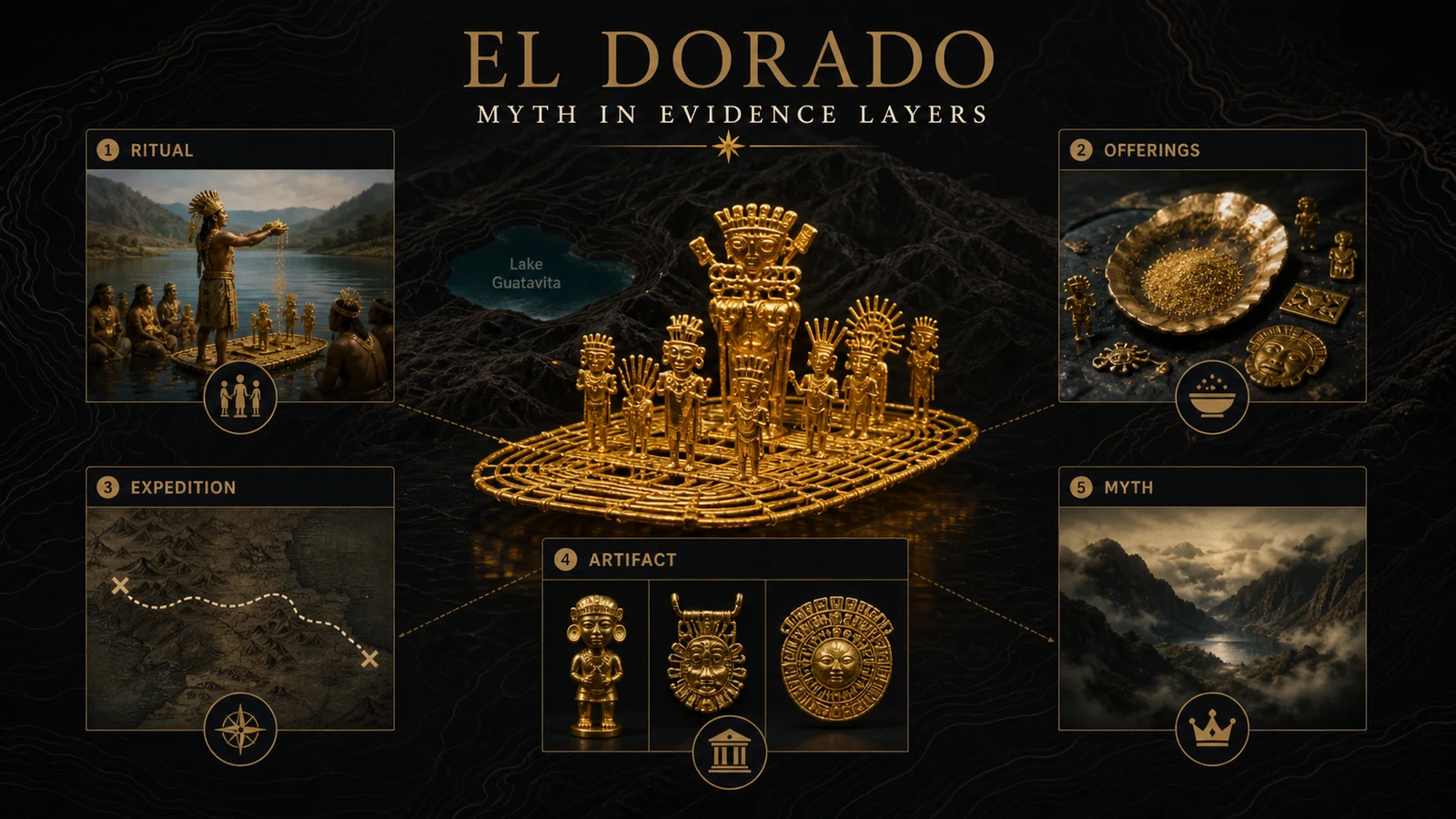
- Lake Guatavita, the Zipa, and the Muisca Raft explain the strongest evidence.
- Spanish expeditions turned a sacred gold ritual into a colonial treasure myth.
No reliable evidence proves that El Dorado was a literal golden city. The most credible core of the story is a Muisca ritual in which a new Zipa, or ruler, was associated with gold dust, offerings, water, and political legitimacy.
El Dorado was not originally a mapped city of gold. The stronger historical reading starts with a Muisca investiture ritual near Lake Guatavita, then follows how Spanish reports, treasure searches, and later storytelling turned that ritual into a global lost-city legend.
- The name changed meaning. El Dorado began closer to “the gilded one” than “the golden city.”
- Lake Guatavita matters. The lake anchors the best-known ritual tradition and later treasure-draining attempts.
- The Muisca Raft is key evidence. It visualizes a ritual scene better than any fantasy map can.
- The myth grew through search pressure. Conquistadors and later explorers made reports bigger as treasure expectations rose.
What El Dorado actually meant.
Modern retellings usually begin with a hidden city, but the older idea was more specific. El Dorado referred to a gilded ruler, a ceremonial image that later expanded into a place, a kingdom, and finally a promise of impossible wealth.
That shift matters because it changes the question. Instead of asking where the golden city is, a better starting point is why gold appeared in Muisca ritual and why Spanish observers converted a sacred ceremony into a treasure destination.
- Use “gilded ruler” when you are describing the ritual origin.
- Use “lost city” only for the later treasure myth.
- Check whether a source names Lake Guatavita, the Zipa, or the Muisca Raft before treating the claim as evidence-based.
The gilded ruler
The most grounded version centers on a ruler covered or associated with gold, not on buildings made from gold.
Lake Guatavita
The lake became the focal location because the ritual tradition and later search attempts were attached to it.
The city of gold
The city version grew as reports traveled through colonial ambition, hearsay, maps, and later popular culture.
The Muisca world behind the legend.
The Muisca lived in the highlands of what is now Colombia, in a region where gold objects carried religious, political, and social meaning. Gold was not only a store of wealth; it was a material used to express status, ritual order, and connections between human authority and sacred forces.
This is why the phrase “city of gold” can mislead readers. A society can use gold powerfully without building a literal golden capital. For a broader comparison of how societies attach meaning to precious metals, see GoldConsul’s guide to gold in ancient religions.
- Political signal: gold could mark authority, rank, and public ceremony.
- Ritual material: gold objects and offerings could connect people, water, and sacred forces.
- Not a modern treasury: ritual gold should not be read as hidden bullion waiting to be recovered.
Lake Guatavita and the Zipa investiture ritual.
Lake Guatavita is the key geographic entity in the El Dorado story. In the most familiar reconstruction, the investiture of a new Zipa involved a ceremonial raft, gold dust, and votive offerings placed into the water.
That does not mean every detail survived unchanged. The story reached later readers through colonial accounts, local traditions, archaeological interpretation, and museum objects, so the safest approach is to separate the ritual pattern from later treasure claims.
- More reliable: named places, named objects, museum records, and consistent ritual context.
- Less reliable: vague claims about a hidden city, unnamed treasure maps, or “new discovery” headlines.
- Best next step: compare the claim with the Muisca Raft, Lake Guatavita, and independent source notes.
| Element | What it helps explain | What it does not prove |
|---|---|---|
| Lake Guatavita | Why one location became central to the legend. | That a complete golden city existed under or near the lake. |
| Zipa investiture | Why a ruler, gold, water, and public ceremony are linked. | That every later expedition report was accurate. |
| Votive offerings | Why gold objects could be placed in water for religious reasons. | That all goldwork was hidden treasure intended for recovery. |
| Muisca Raft | How a ritual scene can be represented in goldwork. | That it is a literal map to a city. |
Myth vs. evidence: how to read El Dorado responsibly.
The story becomes clearer when each claim is matched with the type of evidence that can support it.
There was a ritual tradition behind El Dorado.
Goldwork, Lake Guatavita traditions, and the Muisca Raft make the ritual explanation much stronger than a pure fantasy reading.
There was a literal golden city waiting to be found.
The city version is a later expansion. It reflects colonial treasure expectations more than archaeological proof.
The Muisca Raft shows a ceremonial scene.
Smarthistory’s discussion of the Muisca Raft explains why the object is central to interpreting the ritual context.
Treasure searches do not equal proof.
Repeated attempts to drain or search Lake Guatavita show how powerful the legend became, not that the legend was fully true.
How Spanish expeditions turned ritual into treasure geography.
Once Spanish conquistadors heard accounts of gold rituals and highland wealth, El Dorado became a moving target. Gonzalo Jimenez de Quesada’s entry into the Muisca region in the 1530s helped connect European treasure expectations with stories from the Colombian highlands.
From there, El Dorado was no longer just a ritual image. It became a destination that explorers could chase, relocate, and enlarge whenever the previous location failed to deliver the expected riches.
- The ritual became a report of exceptional wealth.
- The report became a place that could be searched.
- The place became mobile whenever one expedition failed.
- The search tradition became a durable myth of hidden abundance.
Muisca ritual context develops.
Gold, lakes, offerings, and rulership are connected within local ceremonial systems.
Spanish expeditions enter Muisca territory.
Quesada and other conquistadors encounter highland wealth and hear stories that become attached to El Dorado.
The search expands.
El Dorado shifts across maps and rumors as explorers look beyond Colombia into wider South American interiors.
The legend becomes cultural shorthand.
El Dorado now means the promise of hidden wealth, whether in history, literature, film, or popular imagination.
The Muisca Raft is the clearest visual clue.
The Muisca Raft matters because it turns an abstract legend into a specific ceremonial scene. The object is usually interpreted as a representation of a ruler and attendants on a raft, which aligns with the Lake Guatavita ritual tradition.
The Smarthistory analysis of the Muisca Raft is especially useful because it treats the object as cultural and ritual evidence, not as a treasure-hunt prop. The British Museum collection also helps readers compare how Muisca goldwork is documented in museum contexts.
What archaeology can and cannot prove.
Archaeology can support the existence of Muisca goldwork, ceremonial objects, and ritual uses of gold. It can also show why lakes, offerings, and rulership belong in the same historical conversation.
It cannot automatically prove every colonial report or later story about a golden city. For readers, the practical rule is simple: give more weight to objects, places, and documented traditions than to treasure-map versions of the story.
History Claim Credibility Check
Claim: El Dorado was a literal city built from gold.
What the evidence supports: A Muisca investiture tradition, ritual gold offerings, Lake Guatavita and the Muisca Raft provide a real historical core.
What remains unproven: Archaeology has not verified a golden city. Spanish expeditions expanded a ruler-and-ritual story into a mobile treasure geography.
How to judge an El Dorado claim.
If a documentary, article, or video claims El Dorado was “found,” check what kind of claim is actually being made.
- Does the claim point to a ritual, an artifact, a lake, a region, or a literal city?
- Does it cite a source you can inspect, or only repeat the phrase “city of gold”?
- Does it separate Muisca evidence from later colonial treasure stories?
Ask what is being claimed.
A ritual origin, an artifact, a lake tradition, and a city discovery are different levels of claim.
Look for named evidence.
Lake Guatavita, the Muisca Raft, museum collections, and named colonial actors are stronger than vague treasure language.
Separate gold from proof.
Gold objects can prove ritual importance without proving a hidden city made of gold.
Why the myth lasted.
El Dorado survived because it combines several powerful ideas: sacred gold, hidden geography, colonial ambition, and the human hope that wealth exists just beyond the known map. That mix makes the legend easy to retell even when the evidence points to a more specific origin.
It also sits inside a wider pattern of gold stories. GoldConsul’s guides to gold facts and myths, gold in Greek mythology, and the gold rush era show how gold can turn practical history into cultural expectation.
What to read next.
Use these related guides to compare El Dorado with other ways gold shaped trade, religion, migration, and belief.
Sources and further reading.
For stronger verification, compare El Dorado claims against sources that separate artifacts, geography, and later storytelling.
National Geographic
Useful overview of how the El Dorado legend developed and why the search endured.
Open sourceSmarthistory
Clear art-history context for the Muisca Raft and its ritual interpretation.
Open sourceBritish Museum
Collection context for Muisca goldwork and related South American gold objects.
Open sourceWorld History Encyclopedia
Accessible background on El Dorado’s colonial search tradition and later myth growth.
Open sourceFAQ: El Dorado history and myth.
Was El Dorado a real place?
El Dorado was connected to real places and real Muisca traditions, especially Lake Guatavita. The evidence does not prove a literal city made of gold.
What did El Dorado originally mean?
It most likely referred to a gilded ruler or ceremonial figure before later stories turned it into a city, kingdom, or hidden treasure region.
Why is Lake Guatavita important?
Lake Guatavita anchors the best-known ritual tradition behind El Dorado. It became important because gold offerings, water, and rulership were tied together in the story.
What is the Muisca Raft?
The Muisca Raft is a goldwork object often interpreted as showing a ceremonial raft scene with a ruler and attendants. It is one of the strongest visual clues for the ritual origin of El Dorado.
Who was Gonzalo Jimenez de Quesada?
Quesada was a Spanish conquistador whose 1530s expedition entered Muisca territory. His role matters because Spanish encounters helped move local ritual traditions into European treasure narratives.
Why did people keep searching for El Dorado?
The story promised more wealth than previous searches had found. When one location failed, the myth could move to another region, which kept the search alive.
Bottom line.
El Dorado is most useful when read as a layered history, not a simple treasure hunt. The strongest evidence points to Muisca ritual, Lake Guatavita, and goldwork such as the Muisca Raft; the golden city belongs mostly to the later myth that grew around those facts.
 When you purchase a service or a product through our links, we sometimes earn a commission, at no extra cost to you.