
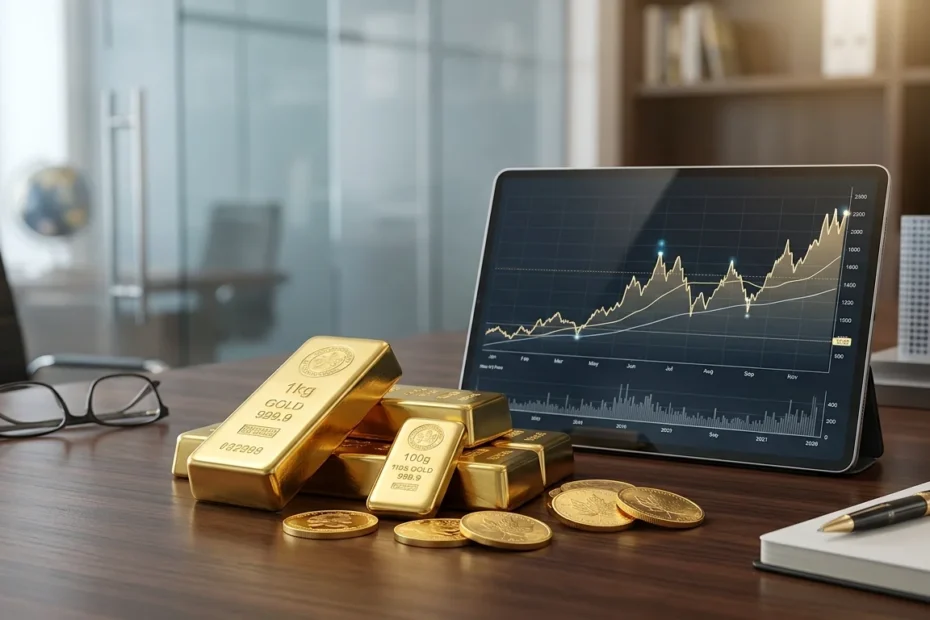
A useful gold price outlook is not a single target number. It is a scenario map with trigger conditions, probability ranges, and clear actions when the data shifts.
Most forecast articles miss this and leave readers with either false certainty or no plan. This guide fixes that gap with a practical framework you can actually execute.
If you are new to the macro side, first review our primer on gold price factors and the live reference at gold today.
TL;DR
- Gold outlook quality depends on scenarios, not one-point forecasts.
- The biggest macro drivers remain real yields, USD direction, and central-bank demand quality.
- Use three paths: base case, stress-upside case, and reflation-downside case.
- The right investor question is not “Where is gold next year?” but “What do I do if trigger X appears?”
- A staged plan beats all-in timing calls for most households.
What Most Investors Miss
The common mistake is treating a bank forecast headline as a strategy. Price targets can be directionally helpful, but your result depends on entry discipline, position sizing, and decision rules when assumptions fail.
The GoldConsul Editorial Perspective
Good outlook writing should reduce decision stress, not increase it. The real edge is not guessing one final number, but pre-committing what to do across plausible macro paths.
What the Best Institutional Outlooks Are Actually Saying
Recent institutional notes are broadly constructive on gold, but not for the same reasons. Some emphasize central-bank buying persistence, others highlight real-yield dynamics, while others focus on geopolitical risk premiums and reserve diversification flows.
For transparent framing, compare the World Gold Council outlook with analyst expectation dispersion in the LBMA Forecast Survey. Treat both as scenario inputs, not guaranteed paths.
Chart 1: Scenario Path Map (Line/Range Style)
Interpretation: The base case is often range-bound to modest upside, but tail scenarios can dominate portfolio outcomes. This is why trigger rules matter more than point estimates.
The Three Drivers You Should Track Weekly
1) Real yields: Gold usually performs better when real yields fall or are expected to fall. A sustained move higher in real yields can pressure gold even if geopolitical headlines stay loud.
2) U.S. dollar regime: A stronger USD can create valuation pressure for global buyers. A softer dollar often improves demand conditions at the margin.
3) Official-sector demand quality: Central-bank purchases can underpin structural demand, but pace and consistency matter. Strong narrative with weak flow data should be treated cautiously.
To connect this with portfolio construction, see our guides on gold vs crypto and what bullion is.
Chart 2: From Spot Move to Real Investor Outcome (Waterfall)
+12%
-1.8%
-0.7%
+9.5%
+12%
-3.8%
-2.2%
+6.0%
Interpretation: Execution quality can consume half the headline upside. Your process matters almost as much as your macro thesis.
What most readers miss (Knowledge Gap)
Forecast articles often imply that if the macro call is right, the result is right. In real portfolios, that is false because implementation frictions create a second outcome layer.
- Vehicle choice gap: physical bullion, ETF, and miner equities can diverge sharply.
- Liquidity gap: urgency changes realized pricing.
- Behavior gap: investors often chase after upside and cut near drawdown lows.
Chart 3: Decision Matrix by Investor Profile (Heatmap)
Interpretation: The best vehicle depends on objective and behavior profile. Outlook quality improves when you map forecast logic to investor constraints.
Practical 90-Day Action Plan
If you are comparing strategic hedges, our reads on gold vs real estate in recession and ethical gold help refine allocation quality beyond raw return chasing.
Video Walkthrough: Turning Outlook Into Rules
Video walkthrough: This short institutional clip summarizes why analysts are constructive on gold and where the assumptions can change.
Bottom Line
The best gold price outlook is a decision system. You do not need perfect prediction accuracy to get better outcomes, but you do need disciplined scenario logic and execution rules.
Use base, bull, and bear triggers. Size positions to survive volatility, and update the plan as macro evidence changes.
FAQ: Gold Price Outlook
Is the gold price outlook for 2026 bullish?
What matters most for gold over the next 12 months?
Should I buy physical gold or ETFs for this outlook?
Can gold fall even if the long-term outlook is positive?
How often should I update my gold outlook plan?
 When you purchase a service or a product through our links, we sometimes earn a commission, at no extra cost to you.