
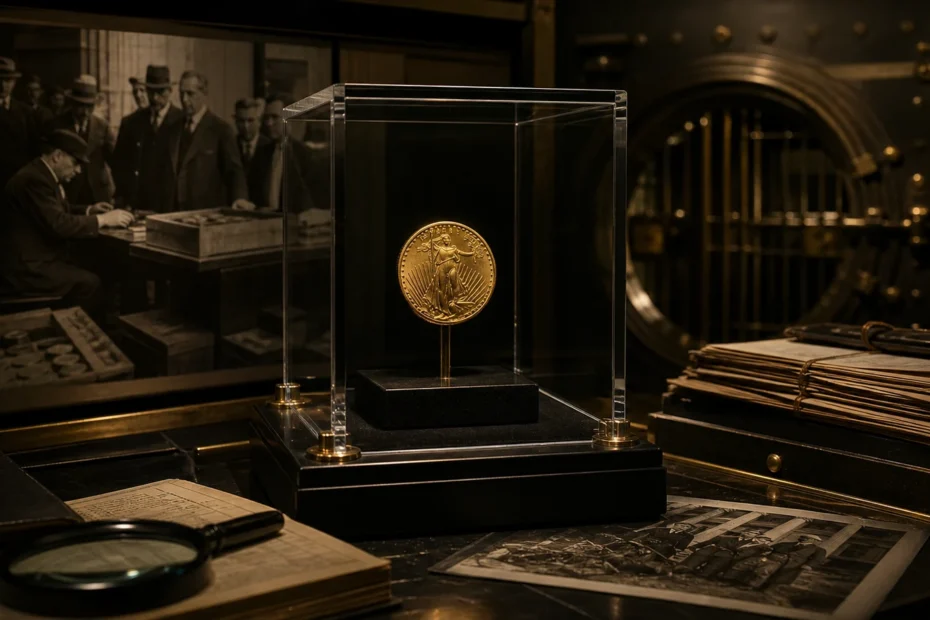
Understand the 1933 Double Eagle: 445,500 struck, none issued, surviving coins, the unique private-ownership case, and record value.
- The famous “1933 gold coin” is the Saint-Gaudens $20 Double Eagle: 445,500 were struck but none were released normally.
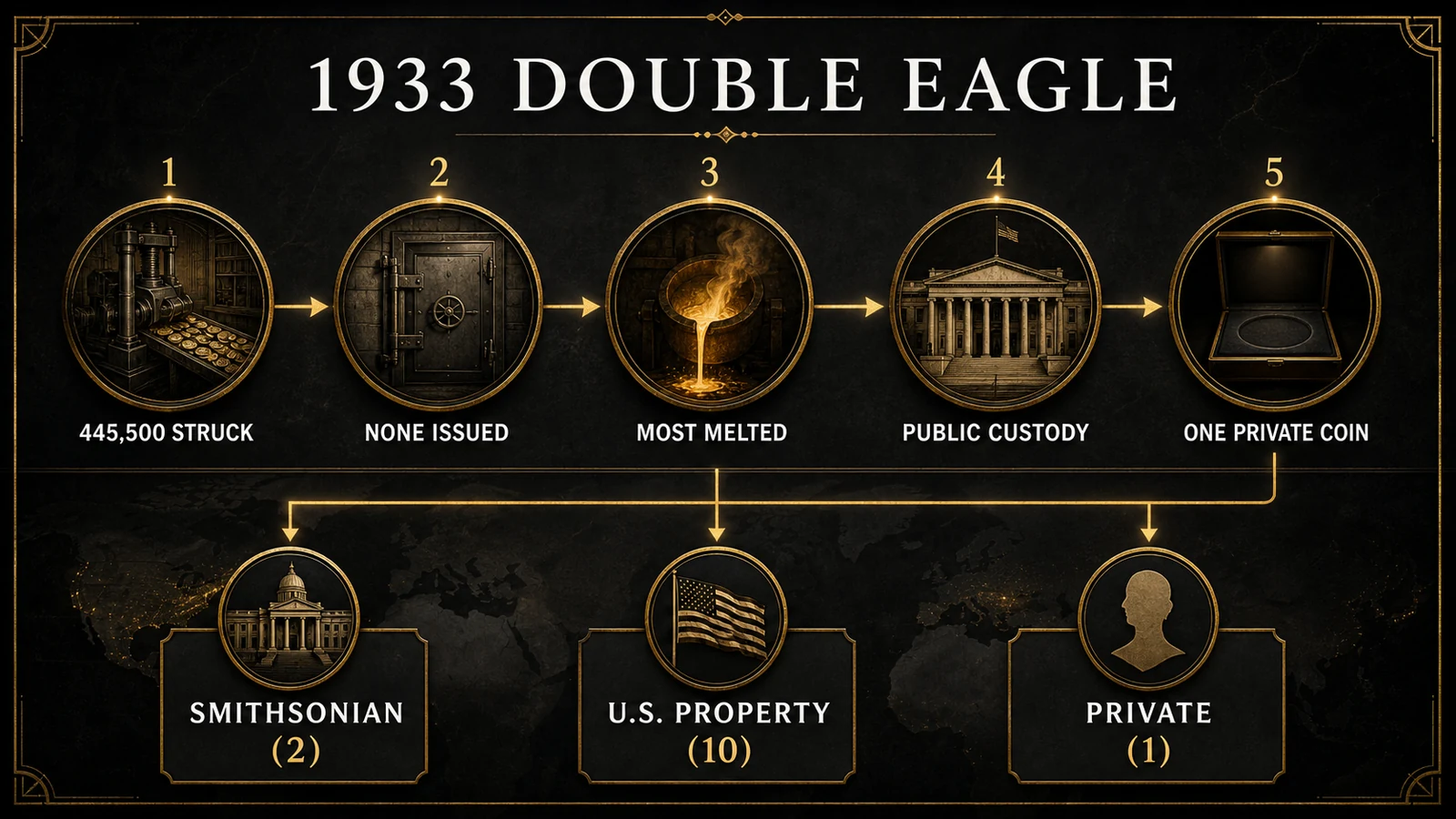
- Two are held by the Smithsonian; ten recovered Langbord coins remain U.S. property; one monetized coin is legal for private ownership.
- Its record value comes from unique legal provenance and history—not from its gold content alone.
- 445,500 struck is the mintage, not the surviving population.
- No 1933 Double Eagle was released through normal public issuance.
- Two specimens went lawfully to the national collection.
- A 2002 settlement allowed one recovered coin to be monetized and privately owned.
- A purported example needs legal provenance and top-tier authentication before value is discussed.
Rarity plus a unique chain of title
The 1933 Double Eagle sits at the intersection of art, monetary policy, government property, litigation, and collecting. That combination makes a simple “how much gold is in it?” calculation almost irrelevant to its market value.
What the coin is
The Double Eagle was a U.S. $20 gold coin. Augustus Saint-Gaudens designed the celebrated type introduced in 1907, with Liberty on the obverse and an eagle on the reverse.
The 1933 pieces were struck at the Philadelphia Mint during the collapse of the domestic gold-coin system. Mint records cited by the U.S. Mint state that 445,500 were produced but none were issued or released to the public as legal tender through the normal process.
| Number | What it describes | Why it matters |
|---|---|---|
| 445,500 | Pieces struck in 1933 | Production count, not surviving or collectible population |
| 2 | Specimens transferred lawfully to the national collection | Held by the Smithsonian |
| 10 | Langbord-family pieces recovered in 2004 | Litigation resolved in favor of the U.S.; preserved as national numismatic treasures |
| 1 | The recovered Farouk-associated coin monetized under settlement | The unique 1933 Double Eagle authorized for private ownership |
Why “struck” does not mean “issued”
A mint can manufacture coins before they are released. In 1933, gold-payment restrictions and policy changes halted normal distribution, and the pieces were ordered melted.
The legal distinction is central: ordinary older Double Eagles entered commerce, while the 1933 production did not. A genuine-looking coin without a lawful chain of title is not equivalent to the monetized private example.
The two Smithsonian coins
The U.S. Mint lawfully transferred two pieces for the national collection. The Smithsonian identifies them as the two legally held public specimens and preserves them within the National Numismatic Collection.
These museum coins are not a private-market population. Their existence explains why “only one legal coin exists” needs the qualifier “in private ownership.”
The recovered coin and the 2002 monetization
A specimen surfaced in 1996 and was seized during a planned sale. After years of litigation, the government and claimant reached a settlement that allowed this specific coin to be sold.
The Mint officially monetized it by adding $20 to the transaction, creating a Certificate of Transfer and authorizing private ownership. It sold in 2002 for about $7.6 million including the buyer’s premium and later sold again in 2021 for a widely reported $18.8725 million.
Auction results are historical transactions, not automatic appraisals. The price reflects the singular lawful provenance, publicity, condition, buyer competition, and sale terms at that date.
The Langbord ten
In 2004, the Langbord family submitted ten coins to the Mint for authentication. The government retained them, litigation followed, and a jury found for the government.
The U.S. Mint’s 2017 account says the litigation was resolved in the government’s favor and the pieces remain property of the United States. Unlike pieces recovered in earlier decades and melted, these ten are preserved.
How many survive?
The securely documented present groups are the two Smithsonian coins, the ten government-held Langbord coins, and the one monetized private coin. Historical accounts also describe pieces recovered and destroyed before these groups.
Claims of another survivor require extraordinary evidence. A replica, fantasy piece, altered date, plated token, or image does not become a multimillion-dollar coin because it carries “1933.”
- Does the claim identify the exact denomination and Saint-Gaudens type?
- Does it separate mintage, surviving examples, and legally ownable examples?
- Is the chain of custody supported by original documents?
- Has a leading grading or authentication service examined the physical coin?
- Has qualified counsel reviewed title and potential government claims?
- Are auction prices dated and stated with or without buyer premium?
Why metal value is the wrong valuation model
An ordinary bullion product is valued mainly from fine-gold content plus premium. The 1933 Double Eagle is valued as a unique legal and cultural object whose metal content is only a tiny part of price.
For ordinary pre-1933 coins, the balance varies by date, mint, grade, damage, and demand. Compare selling a 1900 Half Eagle, Gold Eagle weights, and the meaning of a $100 gold coin.
Three branches of present-day provenance
These branches explain why an otherwise genuine coin cannot simply be inserted into the private market. A newly surfaced object would raise authentication, title, forfeiture, and custody questions before auction value.
Design, specifications, and condition still matter
The Saint-Gaudens design gives the coin artistic significance independent of the 1933 legal story. Specialists compare relief, dies, surfaces, edge, metal, mass, diameter, strike, and documented handling to known originals.
Condition affects auction presentation, but normal grading logic is not enough. A beautifully preserved object with no lawful provenance would not become equivalent to the monetized coin, while the documented private coin retains unique status even as market tastes change.
Museum images and object records are useful comparison material, but photographs cannot authenticate a coin. Lighting, compression, replicas, alterations, and counterfeit dies can create convincing online appearances.
What to do if someone offers you one
- Do not pay, clean, scratch, test, transport, consign, or publicize the piece.
- Photograph the object and every accompanying document without asserting authenticity.
- Record the seller’s identity, representations, and claimed chain of custody.
- Contact a leading U.S. coin authentication service and an attorney experienced in cultural property, forfeiture, and numismatics.
- Require written title analysis, not a seller’s promise that possession proves ownership.
- Notify relevant authorities through counsel if the circumstances suggest government property or fraud.
- Treat urgency, secrecy, cash-only demands, and “unknown estate find” stories as severe red flags.
Replica and counterfeit risk
Souvenir copies and gold-plated replicas may be sold legally when clearly marked and represented. The problem begins when a replica is offered as an original or an altered date is used to imply rarity.
Weight, diameter, metal analysis, dies, surface, edge, and provenance all matter. A home magnet or acid test cannot establish the legal identity of a 1933 Double Eagle and could damage an object.
Use the layered gold-testing guide for ordinary items, and understand gold weight standards before comparing bullion with numismatic pieces.
Value: record sale versus current value
The 2021 sale is the clearest public market observation for the only privately ownable coin. It does not guarantee a higher or lower future price, and there is no second lawful private example to create a normal price series.
Insurance value, auction estimate, reserve, hammer price, buyer’s premium, and net seller proceeds are different numbers. Any current valuation would require the exact coin, current market, sale venue, terms, and buyer depth.
The rarest fact is not that some pieces escaped melting. It is that only one specific coin acquired an explicit legal route into private ownership. Authenticity without lawful title is not the same asset.
For this coin, provenance comes before grade and price. Anyone offered a supposed specimen should pause the transaction and assemble numismatic, documentary, and legal expertise before taking possession or making public claims.
Watch: Why This 1933 Double Eagle Coin Will be Worth Millions
This Smithsonian Channel segment provides a concise visual introduction to the coin’s fame. Use the Mint, Smithsonian, court, and Justice Department records above for the legal details.
Video: Smithsonian Channel. YouTube oEmbed availability validated July 17, 2026.
Bottom Line
The 1933 Double Eagle is valuable because of an extraordinary combination of non-issuance, survival, art, litigation, and unique lawful private provenance. Keep the populations separate: two Smithsonian coins, ten U.S.-owned recovered coins, and one privately ownable monetized coin.
FAQ: 1933 Gold Coin and Double Eagle
How many 1933 Double Eagles were struck?
The U.S. Mint reports 445,500, but they were not normally issued and most were melted.
How many can be privately owned?
The U.S. government authorized one specifically monetized specimen for private ownership.
Where are the other known surviving coins?
Two are at the Smithsonian and ten recovered Langbord coins remain U.S. property.
What did the private coin sell for?
It sold for about $7.6 million in 2002 and a reported $18.8725 million in 2021, both dated auction outcomes.
Is a 1933 replica valuable?
Usually it is a souvenir or novelty item unless it has independent maker, material, or collector value; it is not the famous original.
Sources and verification
Use these primary and specialist sources to verify the claims, rules, specifications, and market definitions. Access rules, prices, and product terms can change.
- U.S. Mint — 2002 sale of the 1933 Double Eagle
- U.S. Mint — 1933 Double Eagles display and litigation history
- Smithsonian — 1933 twenty-dollar coin record
- Smithsonian — American rarities
- U.S. Department of Justice — Langbord forfeiture jury release
- Third Circuit — Langbord opinion
- PCGS CoinFacts — 1933 Double Eagle
- U.S. Mint — Saint-Gaudens Double Eagle background
- National Archives — Gold-hoarding investigation records, 1933–1935
- American Numismatic Association — Authentication and collecting resources
 When you purchase a service or a product through our links, we sometimes earn a commission, at no extra cost to you.