

See how gold ETFs hold bullion, create shares, track NAV, charge fees, and differ from physical gold—including liquidity and custody risks.
- A physically backed gold ETF holds bullion through a trust or fund while investors trade shares on an exchange.
- Authorized participants create and redeem large baskets, helping the share price stay close to net asset value.
- Fees, spreads, custody structure, taxes and redemption rules make ETF ownership different from holding coins or bars.

- Retail investors trade shares; the trust owns allocated bullion under its governing documents.
- Creation and redemption arbitrage normally limits large premiums or discounts to NAV.
- Your real cost includes the expense ratio, bid–ask spread, brokerage costs and tracking difference.
- Physical, futures, miner and leveraged gold funds are materially different products.
- Small shareholders generally cannot exchange a few shares for a gold bar.
Start with the useful version first. The rest of this guide adds the evidence, edge cases, and stronger checks.
A gold ETF lets you buy exchange-traded shares designed to follow a gold-related benchmark. You own fund shares, not a personally identified bar stored in your name.
If you invest $1,000, your result follows the share price after the fund’s fees, trading spread, and any tracking difference from its benchmark.
Fund structures differ. Physical backing, custody, derivatives, share creation, redemption rights, taxes, and counterparty exposure must be checked in the prospectus.
Start with Gold Made Simple to move from basic gold terms to buying, testing, investing, and storage without the jargon.
The mechanism matters more than the label
A gold ETF is a wrapper. To judge one, follow the ownership chain from the exchange to the fund or trust, then to its custodian and bullion. The phrase “backed by gold” is useful only when the prospectus explains what is held, where it is held, how shares are created and who can redeem them.
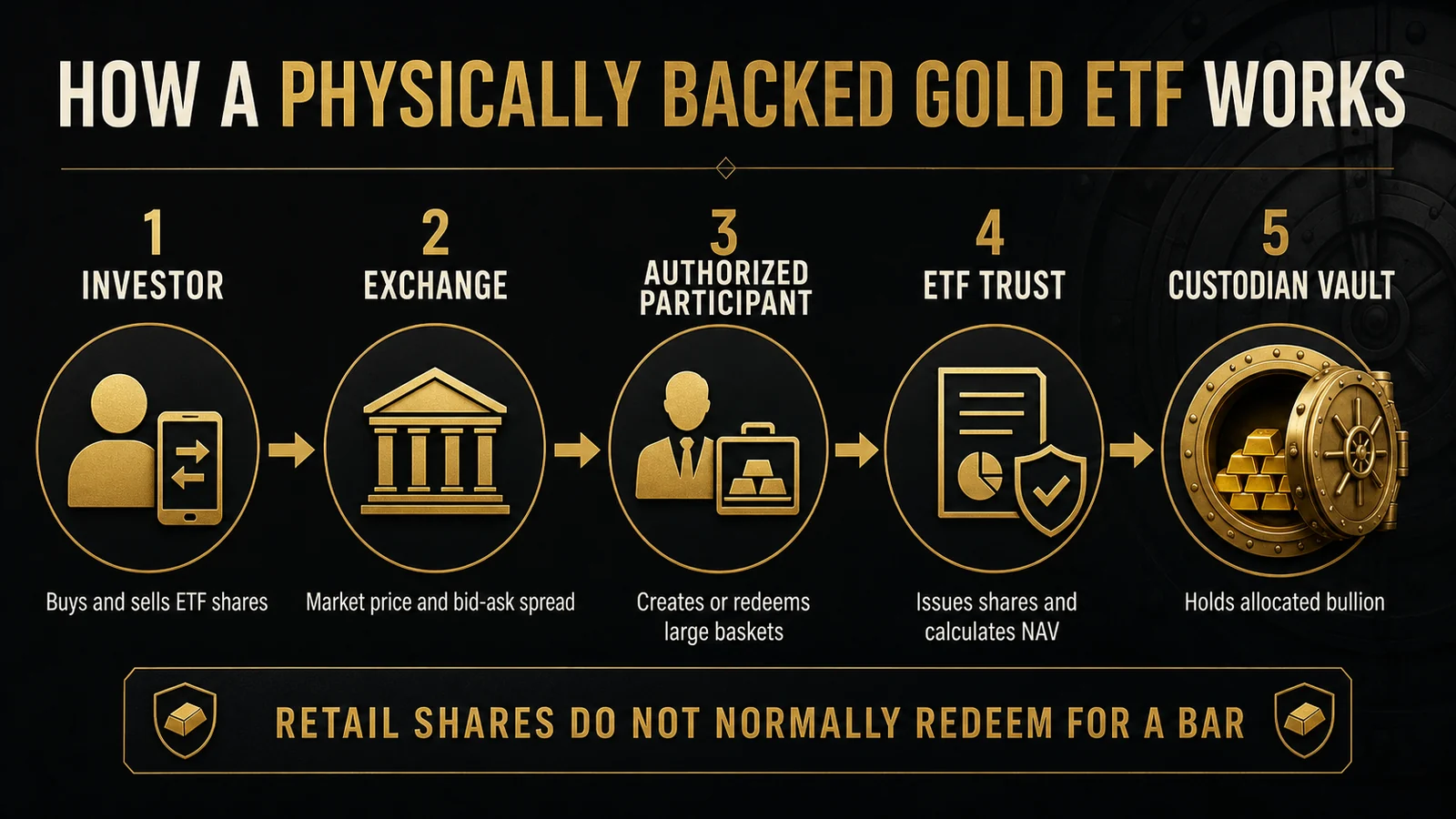
How a physically backed gold ETF works
You place an order through a brokerage account and receive ETF shares. Those shares trade with other investors throughout the exchange session. The issuer publishes holdings and an indicative or end-of-day net asset value, while market makers quote bids and offers.
Behind that retail market, authorized participants can assemble or break apart large creation units. Depending on the product, the transaction may use gold, cash or both. If shares trade meaningfully above the value of the underlying assets, an authorized participant can create shares and sell them; if shares trade below, it can buy shares and redeem a basket. This arbitrage mechanism is designed to pull price toward NAV, though it is not a guarantee during every market condition.
| Participant | Primary job | What the retail investor should verify |
|---|---|---|
| Sponsor or manager | Operates the product under its documents and publishes fees and holdings. | Objective, legal structure, expense, disclosures and termination provisions. |
| Trustee or fund board | Performs governance duties defined by the structure. | Who owes which duty; a grantor trust is not identical to an investment-company ETF. |
| Custodian and subcustodians | Hold bullion and maintain custody records. | Allocated status, bar lists, vault locations, audit language and subcustody risk. |
| Authorized participants | Create and redeem large baskets. | Retail investors normally do not have this privilege. |
| Exchange and market makers | Provide the secondary market. | Trading volume, spread, premium or discount and order type. |
A share represents a fractional beneficial interest in the vehicle, not title to a particular numbered bar. The published ounces of gold per share can decline gradually because the trust sells or accrues a small amount of gold to pay its expenses. That is one reason long-run share performance can trail the metal’s benchmark even when operations work as intended.
Large London Good Delivery bars are far bigger than retail coins. The LBMA Good Delivery Rules define standards relevant to wholesale bars. A retail account balance therefore should not be pictured as a shelf of one-ounce bars with each investor’s name attached.
Physical ETF, futures fund or gold-miner ETF?
| Product | Main exposure | Key extra risk | Typical use |
|---|---|---|---|
| Physically backed gold product | Bullion less expenses | Custody, structure and tracking | Liquid metal-price allocation |
| Gold futures fund | Futures contracts | Roll yield, collateral and derivatives | Tactical or regulated futures exposure |
| Gold-miner ETF | Mining-company equities | Operations, management, jurisdiction and equity-market risk | Leveraged business exposure to the gold industry |
| Leveraged or inverse product | Daily multiple or inverse return | Path dependence and daily reset | Short-term trading, not a simple long-term gold holding |
Read the objective before comparing fees. A miner fund with a low expense ratio is not a cheaper substitute for bullion exposure. For the broader allocation menu, see how to invest in gold, how to buy gold coins and how to buy gold bars.
NAV is the vehicle’s assets minus liabilities divided by shares outstanding. The exchange price is what buyers and sellers agree at that moment. A premium means the share trades above NAV; a discount means it trades below. Intraday estimates can lag or use different timestamps when gold and the stock exchange trade in different venues.
The SEC’s Investor.gov ETF bulletin explains that ETF shares can trade at premiums or discounts and that authorized participants handle creations and redemptions. Use limit orders in less-liquid conditions rather than assuming the last price is executable.
The four-part cost calculation
Assume a 0.25% annual expense, a 0.10% round-trip bid–ask spread and no commission. If you hold for one year and enter and exit near NAV, the simplified cost is about $25 + $10 = $35. A 0.40% unfavorable premium/discount move would add roughly $40, making market execution more important than a small headline fee difference.
This is an illustration, not a forecast. Actual fees accrue daily, spreads change, taxes differ and the gold price can move far more than these costs.
Tracking difference is the realized gap between the product and its benchmark over a defined period. It captures more than the stated expense ratio. Compare like time windows and account for the benchmark’s pricing time.
Gold ETF due-diligence checklist
- Confirm the product holds physical bullion rather than futures or mining shares.
- Read the prospectus for sponsor, trustee, custodian and subcustodian roles.
- Find the expense ratio and compare realized tracking difference.
- Review average spread, volume, assets and premium/discount history.
- Check whether a current bar list and audited holdings are published.
- Understand creation units and the minimum redemption route.
- Verify fund-specific tax treatment in your jurisdiction and account type.
- Use the current gold market reference only as a timestamped input, not as a promise of execution.
Risks that “backed by gold” does not eliminate
The gold price can fall. The product can track imperfectly, trade away from NAV or experience wider spreads during stress. Custody chains may use subcustodians, and governing documents allocate responsibilities and liability in ways a short marketing page cannot summarize. A large, transparent vehicle reduces some operational uncertainty; it does not make the structure risk-free.
Physically backed products should also be separated from gold-backed cryptocurrencies, whose token, blockchain, issuer and redemption layers create a different chain of claims.
How to read a gold ETF prospectus efficiently
Start with the investment objective and principal risks, then search the document for “custodian,” “subcustodian,” “allocated,” “redemption,” “insurance,” “termination” and “tax.” These sections show where a simple exposure claim becomes a legal arrangement. Marketing pages can summarize the arrangement, but the filed document governs it.
Check whether holdings are published as a total only or as a detailed bar list, how frequently the list is updated and whether independent assurance is described. A bar list is evidence of transparency, not a personal warehouse receipt. Also note whether cash, receivables or other assets can appear alongside gold.
Then read the product’s exceptional-event language. Market closure, vault disruption, settlement failure or unavailable benchmark pricing may change ordinary creation, redemption or valuation. These clauses are unlikely to define normal days, but they explain the boundary of the promise.
Trading execution can matter more than a tiny fee difference
The most liquid part of the session is often when the underlying gold market and the share market are both active. Avoid assuming the opening print represents fair value after overnight news. A limit order states the worst price you will accept; a market order prioritizes execution and can fill across a wider spread.
For a small, long-term allocation, a few basis points of annual fee matter over years. For a short holding period or a thin product, entry and exit spread can dominate. Compare total ownership cost over your expected horizon rather than awarding the cheapest expense ratio automatically.
Many comparisons rank products by fee alone. They rarely quantify spread, tracking difference, tax, securities-lending policy, bar-list transparency or the investor’s intended holding period. A ten-basis-point fee advantage can be overwhelmed by poor execution or a product that does not match the intended exposure.
A gold ETF is best understood as efficient access, not simplified ownership. Its strength is the exchange-traded wrapper; its limitation is the same wrapper. Investors should choose it because that legal and operational structure serves their goal, not because “paper gold” and physical gold are assumed to be interchangeable.
This article is educational and not personalized investment, legal or tax advice. Gold products can lose value. U.S. and non-U.S. tax treatment varies by vehicle, account and investor; consult the current prospectus and a qualified professional.
Watch the mechanism: This concise exchange-education video visualizes the ETF mechanism discussed above.
Bottom Line
A physically backed gold ETF connects wholesale bullion custody to exchange-traded shares through authorized participants and creation units. Judge it on exposure, total cost, liquidity, custody transparency, tax treatment and redemption reality—not on the word “gold” in its name.
FAQ: How Gold ETFs Work
Do gold ETFs actually own gold?
Physically backed products generally hold bullion under their governing documents. Other gold-labeled funds may hold futures or mining shares, so verify the objective and holdings.
Can I exchange gold ETF shares for a gold bar?
Ordinary retail shareholders generally cannot redeem a small number of shares for a bar. Authorized participants transact in large creation units under product-specific rules.
Why does a gold ETF not match gold perfectly?
Expenses, cash balances, benchmark timing, trading spreads and operational differences create tracking difference.
Can a gold ETF trade below its gold value?
Yes. The market price can trade at a premium or discount to NAV, especially when markets are volatile or underlying and exchange trading hours differ.
Is a gold ETF safer than physical gold?
It solves some storage and transaction problems but adds fund, custody, market and legal-structure risks. The better choice depends on the purpose of the holding.
Sources and verification
This guide relies on regulator, issuer, mint and specialist market sources. Product terms, prices and regulations can change, so recheck the dated primary source before acting.
- Investor.gov — Exchange-Traded Funds — Official SEC investor explanation of authorized participants, creation, redemption, trading, premiums and discounts.
- SPDR Gold Shares — GLD — Official trust documents, holdings, NAV, sponsor fee, custody and bar-list access.
- iShares Gold Trust — IAU — Official fund page for objective, expense, holdings, premium/discount and prospectus.
- World Gold Council — Gold ETF Holdings and Flows — Current global physically backed gold ETF holdings and flows.
- World Gold Council — Physically Backed Gold ETFs Do Not Lend Their Gold — Clarifies the difference between share lending and trust-level gold lending.
- CFA Institute — ETF Mechanics and Applications — Professional reference for creation/redemption, costs, pricing and ETF risks.
- LBMA — Good Delivery Rules — Standards relevant to large bullion bars held in London-market custody.
- IRS Publication 550 — Official U.S. tax reference; readers should verify fund-specific treatment and personal circumstances.
- SEC EDGAR — SPDR Gold Trust — Regulatory filings for the trust and its risk disclosures.
- BSEIndia — How Gold ETFs Work — Educational video selected for a concise visual explanation of the ETF mechanism.
 When you purchase a service or a product through our links, we sometimes earn a commission, at no extra cost to you.