

Compare gold and real estate in recessions by liquidity, leverage, income, costs, drawdowns, and recovery—without assuming one always wins.
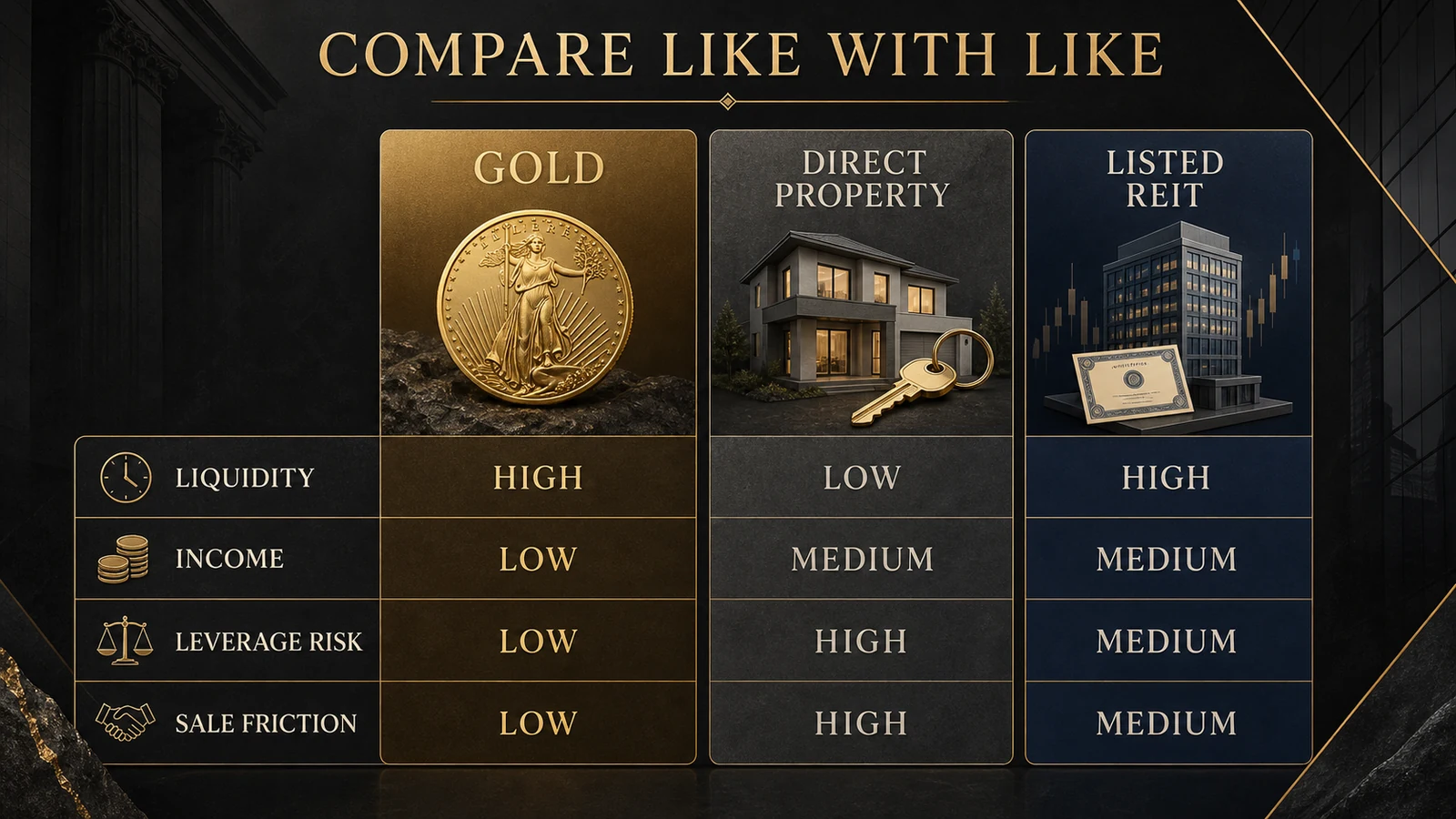
- Gold offers faster liquidity and no tenant or mortgage obligation; direct property can produce income but is slow and costly to sell.
- Leverage can amplify property equity gains and losses, while physical-gold premiums and spreads reduce realizable returns.
- Compare the same capital, horizon, cash flows, debt, taxes, and exit costs—and distinguish direct property from listed REITs.

- Gold, direct property, and REITs are three different instruments.
- Property leverage magnifies equity outcomes and forced-sale risk.
- Gold has no income; property income is not free after vacancy, tax, insurance, repairs, and management.
- Daily gold prices can look more volatile than infrequently appraised property, but property’s smoother chart is not instant liquidity.
- Compare net cash flows and realizable sale proceeds over the same horizon.
A recession comparison is a balance-sheet test
“Gold beat housing” and “property pays rent” can both be true under selected dates and assumptions. The first question is what the reader owns, how it is financed, and when cash may be needed.
First separate the three assets
| Asset | Price and liquidity | Income | Financing and operations |
|---|---|---|---|
| Physical gold | Global reference price; retail sale includes spread and logistics | None | No mortgage; storage and insurance remain |
| Direct property | Local, negotiated, slow, high-friction sale | Rent or housing service | Mortgage, tax, insurance, maintenance, vacancy, management |
| Listed equity REIT | Exchange-traded and can reprice quickly | Distributions from property businesses | Corporate leverage, sector and equity-market risk |
A listed REIT is not a liquid slice of one house. It is a security in an operating property company and can trade with equity-market volatility.
Liquidity: the recession advantage gold often has
Recognizable bullion can usually be sold in portions without selling the whole holding. The owner still faces dealer spreads, verification, shipping, market hours, and payment timing.
A property sale can take weeks or months and may require repairs, staging, legal work, financing approval, and price negotiation. NBER research on forced sales shows that distress and local illiquidity can produce material discounts.
Leverage: property’s accelerator and fault line
A mortgage lets an investor control a large asset with smaller equity. That can amplify gains on equity, but the debt balance and payment continue when the market value or rent falls.
NBER work on household leverage and recession dynamics shows why liquidity constraints and debt can deepen stress. A fixed rate protects the payment from rising market rates, not from vacancy, unemployment, repair, tax, or insurance shocks.
Income: property’s advantage, after costs
Gold does not pay rent. Direct property can produce cash flow, but gross rent is not return.
Net operating income = collected rent − vacancy allowance − property tax − insurance − maintenance − management − owner-paid utilities and operating costs. Cash flow to equity then subtracts debt service and capital expenditures.
Tax treatment varies, and depreciation is an accounting and tax concept—not cash available to repair a roof.
In recession, tenant quality, employment, lease duration, local supply, and regulation matter more than a national home-price headline. Residential, office, industrial, hotel, and retail properties can behave very differently.
Gold’s costs are smaller but not zero
Physical gold carries an acquisition premium, potential tax, shipping, storage, insurance, and a sell-back spread. An ETF carries a fee and structural terms.
A comparison that uses spot gold but a fully rented property overstates gold’s liquidity and understates property’s operating burden. Use realizable proceeds for both.
Why home-price indexes can hide stress
The Case-Shiller national index measures repeat-sale prices and is useful for market direction. It does not show the exact value, condition, debt, rent, sale time, or transaction cost of one property.
Housing trades infrequently, so reported prices can appear smoother than daily securities or gold. Smooth observation is not the same as low economic risk.
Recessions are not one template
A housing-led credit crisis differs from a short pandemic recession, an inflation shock, or an industrial downturn. Interest rates, unemployment, lending standards, construction supply, and policy responses change the result.
Gold may benefit from falling real yields and risk aversion, then reverse as liquidity returns. Property may lag the recession, stay supported by limited supply, or decline sharply in overleveraged local markets.
Worked comparison: same equity, different obligations
Assume $100,000 of equity is used either for gold or as a 25% down payment on a $400,000 rental. The property investor controls four times the equity value but also carries the loan and operating costs.
| Illustrative shock | Gold holding | Leveraged property equity |
|---|---|---|
| Asset price falls 10% | About $10,000 price loss before gold costs | About $40,000 property-value loss before debt paydown and sale costs |
| Income during hold | None | Rent may offset costs if collected |
| Need 20% cash | Sell part of the holding | Refinance, borrow, or sell an indivisible asset/interest |
| Forced exit | Dealer spread and logistics | Brokerage, legal, repair, negotiation, and possible distress discount |
This simplified example ignores appreciation, principal paydown, taxes, rent, vacancy, capex, and transaction costs. Its purpose is to reveal leverage and indivisibility, not predict returns.
Decision framework by mission
Before reallocating in a recession
- Define direct property, primary residence, REIT, physical gold, or gold fund precisely.
- Use the same starting capital, currency, horizon, and tax boundary.
- Include mortgage balance, rate, maturity, covenants, and required payments.
- Use collected rent and subtract vacancy, operating costs, capex, and management.
- Subtract gold premium, spread, storage, insurance, and fund fees.
- Estimate realistic sale time and net proceeds under both normal and forced conditions.
- Stress-test unemployment, vacancy, repair, yield, dollar, and price shocks.
- Keep emergency liquidity separate from a long-horizon allocation debate.
For related frameworks, see gold as a recession safe haven, gold versus crypto, the current gold outlook, gold ETF mechanics, and gold price history.
Public comparisons often use a liquid, unleveraged gold price against an illiquid, leveraged property with estimated rent and smoothed valuation. Until leverage, cash flow, sale friction, and vehicle are normalized, the performance chart is not decision-ready.
Do not choose the asset with the better slogan. Choose the balance sheet that can survive the recession: enough liquidity, manageable debt, realistic operating costs, diversified exposure, and no forced sale at the wrong time.
This comparison is educational and not personalized investment, property, tax, or legal advice. Property and gold can lose value, leverage can magnify losses, and local rules materially affect outcomes.
Watch: Is Gold Now a Better Investment Than Housing?
This comparison video is a useful prompt for asking whether current gold and housing valuations change the trade-off. Apply the cash-flow, leverage, and liquidity checks above before accepting its conclusion.
Video: Economics Help. YouTube oEmbed availability validated July 17, 2026.
Bottom Line
Gold tends to offer recession liquidity and low operating burden; direct real estate can offer utility, income, and leverage at the cost of concentration and sale friction. Neither always wins, and listed REITs belong in a separate comparison.
FAQ: Gold vs Real Estate in a Recession
Is gold always better than real estate in a recession?
No. Outcomes depend on the recession, rates, local property market, leverage, rent, costs, gold flows, and the investor’s cash needs.
Does real estate protect against inflation better than gold?
Sometimes, but rent reset, debt structure, taxes, insurance, maintenance, and valuation matter. Gold’s inflation relationship also varies by horizon.
Are REITs the same as owning property?
No. REITs are liquid securities in property businesses and can reprice quickly with equity markets and corporate leverage.
Why is leverage so important in the comparison?
A mortgage magnifies the effect of a property-value change on the investor’s equity and creates fixed payment obligations during stress.
Can gold provide income during a recession?
Gold itself pays no interest or rent. Selling part of a holding creates cash but reduces the position and may incur spread and tax.
Sources and verification
Use the primary documents below to verify rules, data, definitions, and evidence. Product terms, market conditions, and research conclusions can change.
- FRED — S&P Cotality Case-Shiller U.S. National Home Price Index
- NBER — Liquidity vs wealth in household debt obligations
- NBER — Household leverage and the recession
- NBER — Forced sales and house prices
- NBER — Systemic risk and the refinancing ratchet effect
- NBER — Gold returns
- Federal Reserve — Financial Accounts of the United States
- SEC Investor.gov — Real estate investment trusts
- Nareit — What is a REIT?
- World Gold Council — Gold as a strategic asset
 When you purchase a service or a product through our links, we sometimes earn a commission, at no extra cost to you.