
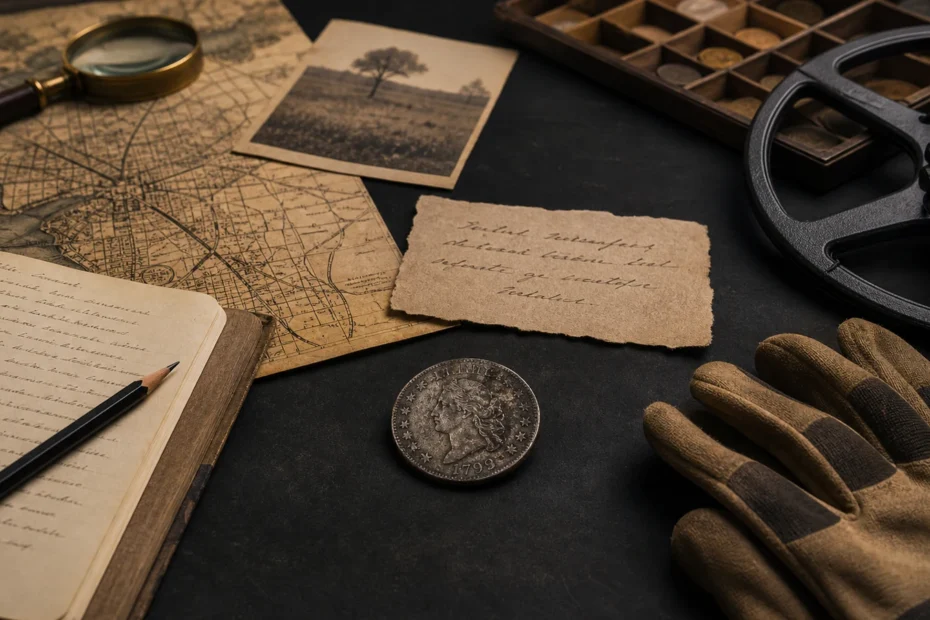
Find old coins legally using private permission, historical maps, coin rolls, estates, shows, and location-specific detecting rules.
- The best search starts with legal access and historical research, not a list of supposedly secret locations.
- Private land needs written permission; federal, state, county, city, beach, and park rules vary sharply.
- Old coins can also be found through rolls, estate sales, coin shows, inherited collections, and dealer junk boxes.
- “Public” does not automatically mean detecting or collecting is allowed.
- Private property needs the owner’s permission and a clear agreement about finds.
- National parks prohibit metal detectors; BLM and Forest Service rules protect archaeological context and differ by place.
- Historical maps are for research, not proof of access.
- Coin rolls, estate sales, shows, dealers, and family collections are legal alternatives with less land-access risk.
Permission first, location second
There are two different intents behind this question: acquiring old coins and recovering lost coins. The safest strategy is to decide which one you mean before buying equipment or driving to a historic site.
Seven lawful paths to old coins
| Path | What you may find | Primary check | Main risk |
|---|---|---|---|
| Pocket change and coin rolls | Older circulating cents, nickels, silver-era finds, varieties | Bank policy and accurate identification | Assuming age equals value |
| Estate sales and auctions | Accumulations, albums, inherited pieces | Provenance, grade, fees, return terms | Overpaying for unverified claims |
| Coin shows and dealers | Certified and raw U.S. coins | Dealer reputation and comparable sales | Confusing asking price with market value |
| Family collections | Documented local history and mixed accumulations | Ownership and careful inventory | Cleaning or separating items prematurely |
| Private-land detecting | Lost change around former gathering places | Written owner permission and state law | Trespass or disputed ownership |
| Local parks or beaches | Modern losses and sometimes older coins | Current municipal or managing-agency rules | Seasonal, zone, digging, or removal restrictions |
| Federal land | Limited recreational detecting in some contexts | Agency, unit, map, closure, and artifact rules | Protected archaeological or historic material |
Start with land status, not a detector
Land can be privately owned, municipal, county, state, tribal, federal, leased, subject to an easement, or managed under a special agreement. A map pin or open gate does not establish permission.
National Park Service rules prohibit possessing or using metal detectors in park areas. BLM guidance allows some detecting, but says modern money may be collected while coins and artifacts more than 100 years old may not be collected from public lands.
Forest Service guidance distinguishes recent lost items from archaeological resources and deliberate treasure trove. A coin can be protected because of its context even when coins are not categorically protected in every situation.
The permission ladder
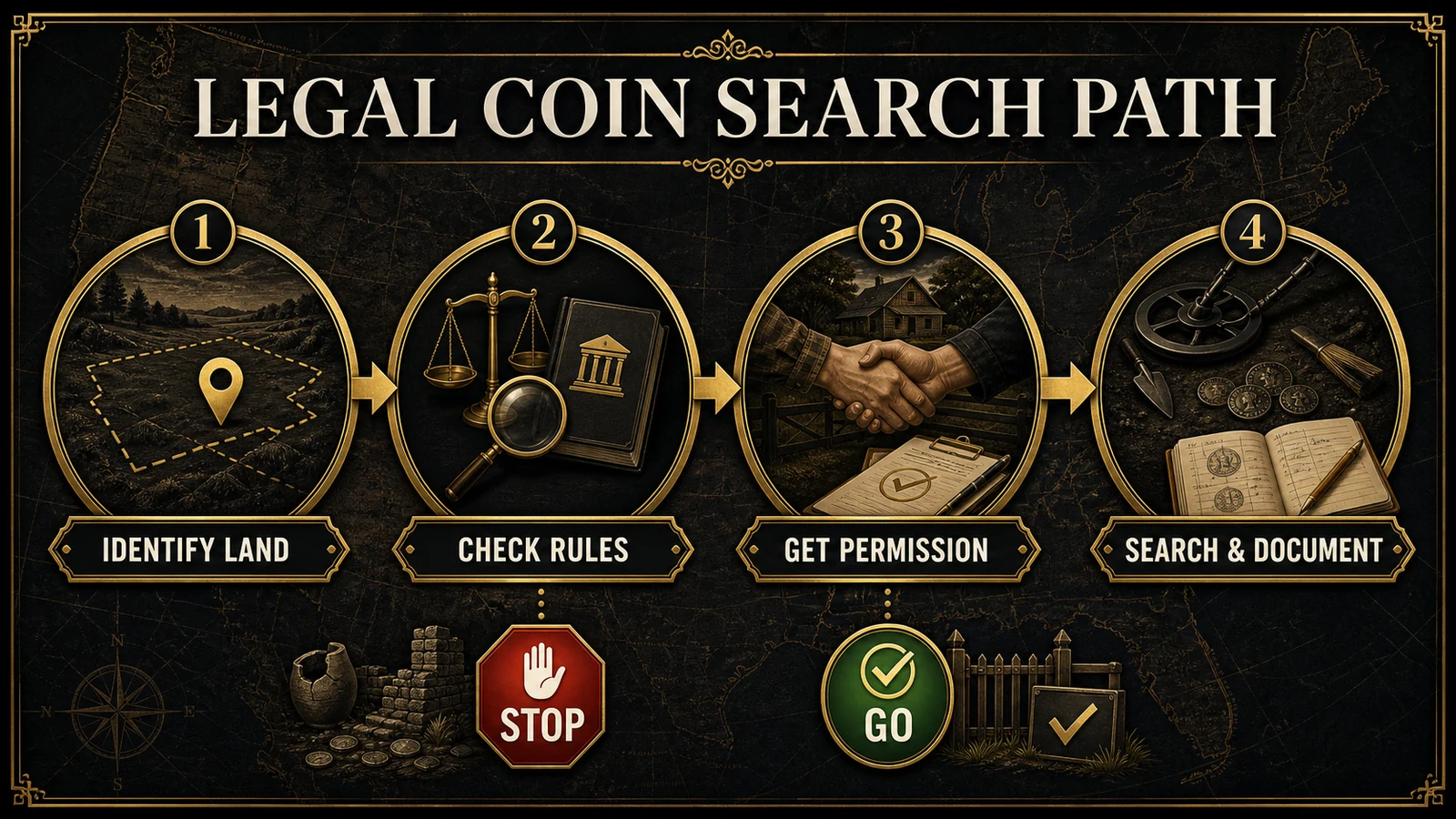
- Identify the parcel and the legal owner; do not rely on a mapping app alone.
- Identify every managing agency and the specific unit, not just “federal land” or “city park.”
- Read current written rules for detectors, digging tools, holes, beaches, trails, historic zones, and removal.
- Ask the office or landowner for clarification when the rule is silent or ambiguous.
- For private land, obtain written permission that states dates, area, hole repair, liability, and how finds are handled.
- Avoid cemeteries, burials, tribal land, battlefields, ruins, protected sites, and any visible archaeological feature.
- Document the authorization and carry it in the field.
- Stop, leave the object in place, photograph context without disturbing it, and notify the appropriate authority if it may be significant.
Use historical maps without turning them into a treasure map
The Library of Congress Sanborn collection maps buildings, streets, commercial uses, and urban change across thousands of communities. Old aerial photographs, plat maps, newspapers, directories, and fair records can show where people once gathered.
Research can identify a former school, picnic ground, store, house, fair entrance, or transit stop. It does not give legal access, and it does not justify entering an abandoned-looking property.
Private property: put the agreement in writing
A friendly verbal yes can become a dispute when a valuable or sentimental object appears. A short written agreement should name the parties, parcel, date, allowed tools, restoration standard, and how finds are divided or offered back to the owner.
Do not promise that the land has treasure. Explain that you will remove trash, fill plugs, respect crops and livestock, avoid utilities and structures, and leave when asked.
Parks, schools, beaches, and curb strips
These locations are controlled by local rules that can change by city, zone, season, event, or maintenance condition. Some allow surface searching but not digging; others prohibit detectors or require a permit.
A “curb strip” may belong to a city, adjacent owner, utility, or other authority, and the public right-of-way does not automatically authorize excavation. Verify ownership and rules before treating it as open ground.
Old coins without digging
Coin roll hunting lets a collector search circulating coins, although bank availability and return policies vary. Estate sales, antique shops, flea markets, and dealer junk boxes can also yield overlooked pieces, but every purchase still needs identification and price comparison.
At a coin show, ask whether a coin is certified, cleaned, damaged, altered, or sold as-is. Learn how to tell if gold is real and use professional authentication for a potentially valuable piece.
What to do when you find a coin
Record the location, depth, nearby objects, and permission terms. Do not rub, polish, acid-test, or aggressively clean an old coin; surface alteration can destroy evidence and collector value.
A common date can still be useful in its context. A rare-looking date can still be counterfeit, altered, plated, or worth less because of damage. The 1933 Double Eagle story is an extreme reminder that legal provenance can matter as much as metal and rarity.
For resale preparation, see how to sell a historic U.S. gold coin, what a $100 gold coin may mean, and Gold Eagle weight specifications.
A stop-or-go decision aid
| Situation | Decision | Reason |
|---|---|---|
| Written private permission, ordinary disturbed yard, no protected context | Proceed within the agreement | Authority and boundaries are documented |
| City park with current written permit and allowed zones | Proceed only in listed zones | Local rules control tools and removal |
| National park, battlefield, monument, ruin, cemetery, or burial context | Stop | Detection, disturbance, or removal is prohibited or ethically unacceptable |
| BLM or Forest Service land with an old object in a site context | Leave in place and contact the office | Archaeological resources and context are protected |
| Ownership, boundary, or rule is unclear | Pause and verify | Uncertainty is not permission |
Location lists are easy to publish because they omit the parcel, manager, current rule, archaeological context, and disposition of finds. Those missing details determine whether a search is lawful and responsible.
The highest-probability search is not the oldest place you can locate. It is a historically informed place where access is explicit, disturbance is allowed, protected context is absent, and the owner knows how finds will be handled.
Watch: Where Can You Metal Detect? (Beginner’s Guide to Legal Detecting)
This beginner video is useful for seeing how detectorists think about legal access. Always replace broad guidance with the current written rule for the exact property.
Video: American Detection. YouTube oEmbed availability validated July 17, 2026.
Bottom Line
Old coins turn up through both collecting channels and field recovery. Start with ownership and rules, use maps to form a hypothesis, obtain written permission, document finds, and treat historical context as something to protect—not a loophole.
FAQ: Where to Find Old Coins in the US
Can I metal detect in a national park?
No. National Park Service regulations prohibit possessing or using a metal detector in park areas.
Is public land automatically open to coin hunting?
No. The agency, unit, resource protections, closures, and local rules determine what is allowed.
Do I need permission on private land?
Yes. Obtain the owner’s permission, preferably in writing, and agree on access, restoration, and finds.
Where can I find old coins without a detector?
Check coin rolls, change, estate sales, coin shows, dealer inventory, inherited collections, and antique markets.
Should I clean an old coin I find?
Usually no. Rubbing or chemical cleaning can remove original surfaces and reduce both evidence and value.
Sources and verification
Use these primary and specialist sources to verify the claims, rules, specifications, and market definitions. Access rules, prices, and product terms can change.
- Bureau of Land Management — Can I Keep This?
- BLM — Collecting on public lands
- National Park Service — Metal detecting regulation example
- U.S. Forest Service — Metal detecting on National Forest lands
- Library of Congress — Sanborn maps collection
- Library of Congress — Searching Sanborn maps
- PCGS — Six places to legally search for coins
- American Numismatic Association — Coin collecting resources
- U.S. Mint — Coin and medal programs
- eCFR — 36 CFR 2.1 preservation of natural and cultural resources
 When you purchase a service or a product through our links, we sometimes earn a commission, at no extra cost to you.