
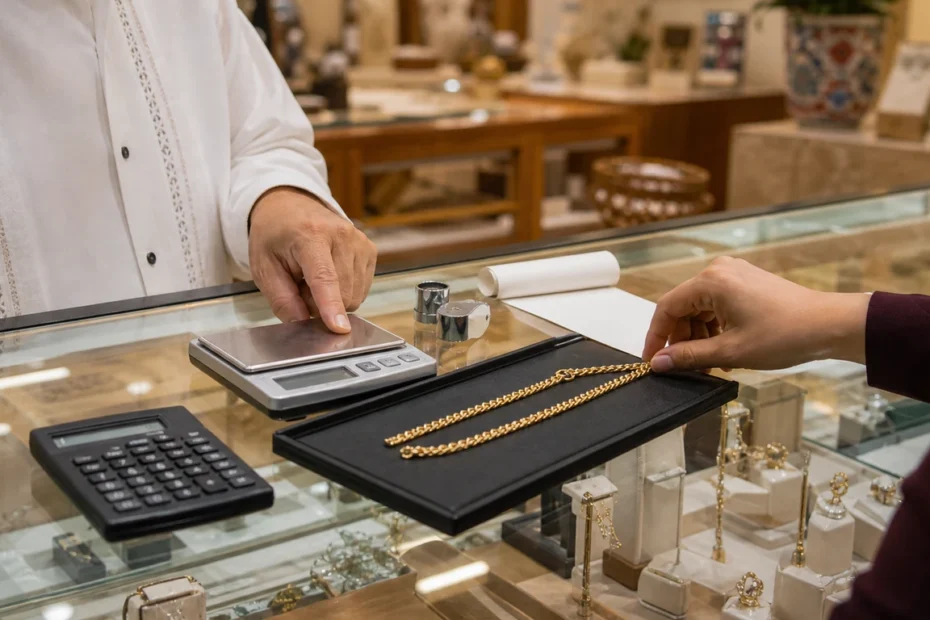
Compare Mexican gold jewelry by fine-gold grams, purity, labor, exchange fees, receipts and import costs—not the sticker price alone.
- Compare equal karat, weight, construction, workmanship, and seller terms
- Calculate the all-in price per fine-gold gram after currency fees
- Verify the hallmark, receipt, origin, return policy, and customs treatment
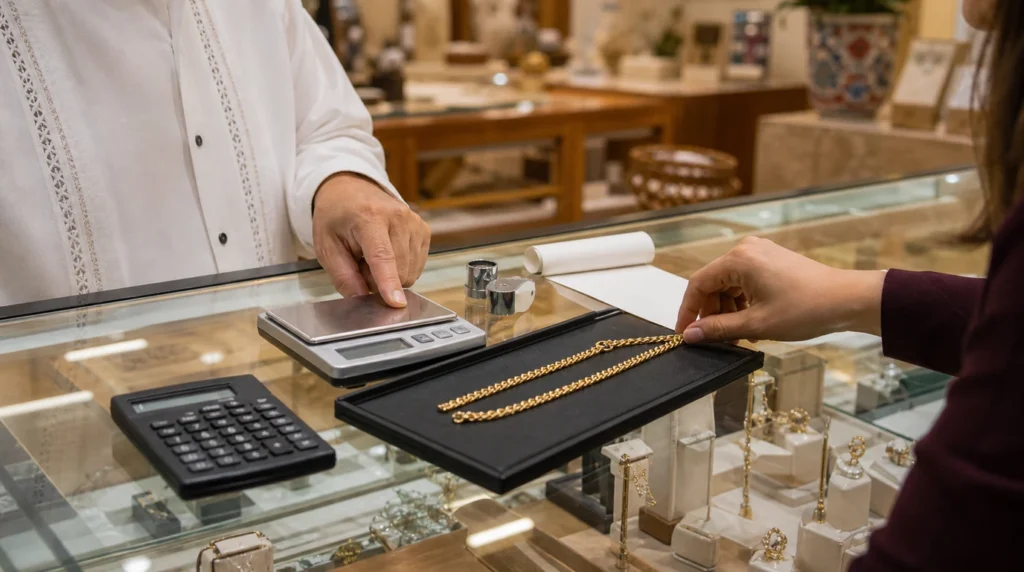
- Compare equivalent karat, weight, construction, and craftsmanship—not sticker prices alone.
- Convert gross weight into fine-gold grams before comparing two pieces.
- Look for a numeric fineness mark, country of origin, detailed receipt, and a return policy.
- Tourist-market convenience can come with wider markups and less documentation.
- Declare purchases when required and check current customs rules before returning home.
Mexico has a long jewelry-making tradition and a broad market ranging from established urban jewelers and workshops to resort stores, artisan markets, and resale counters. That variety creates real opportunities, but it also makes a simple “Mexico is cheaper” rule unreliable.
The useful question is narrower: Is this specific piece better value than a genuinely comparable alternative at home? Answering it requires four numbers—price, gross weight, karat, and all-in transaction costs—plus a basic authenticity and seller check.
Why the same-looking gold jewelry can have different prices
Gold content
A 10K, 14K, and 18K chain can look similar while containing very different amounts of fine gold. Hollow construction can also make a large-looking piece surprisingly light.
Labor and design
Local workshops may offer attractive labor economics or distinctive handmade work. Branded, intricate, stone-set, or custom pieces can command a larger craftsmanship premium.
Retail channel
Rent, commissions, tourist traffic, negotiation, inventory risk, and after-sales service all influence markup. A busy resort shop is not automatically cheaper than an online or hometown jeweler.
Transaction costs
Sales taxes, exchange-rate spreads, card foreign-transaction fees, cash conversion, shipping, insurance, and customs treatment can change the final comparison.
Start with the current bullion reference rather than a “sale” sign. GoldConsul’s spot-price versus retail-price guide explains why finished jewelry always costs more than its contained metal. The premium is not automatically bad: it pays for alloying, design, labor, retailing, warranty, and profit. The task is to decide whether that premium is reasonable for the piece and service offered.
Use price per fine-gold gram
Two pieces are comparable only after adjusting for purity. Use these formulas:
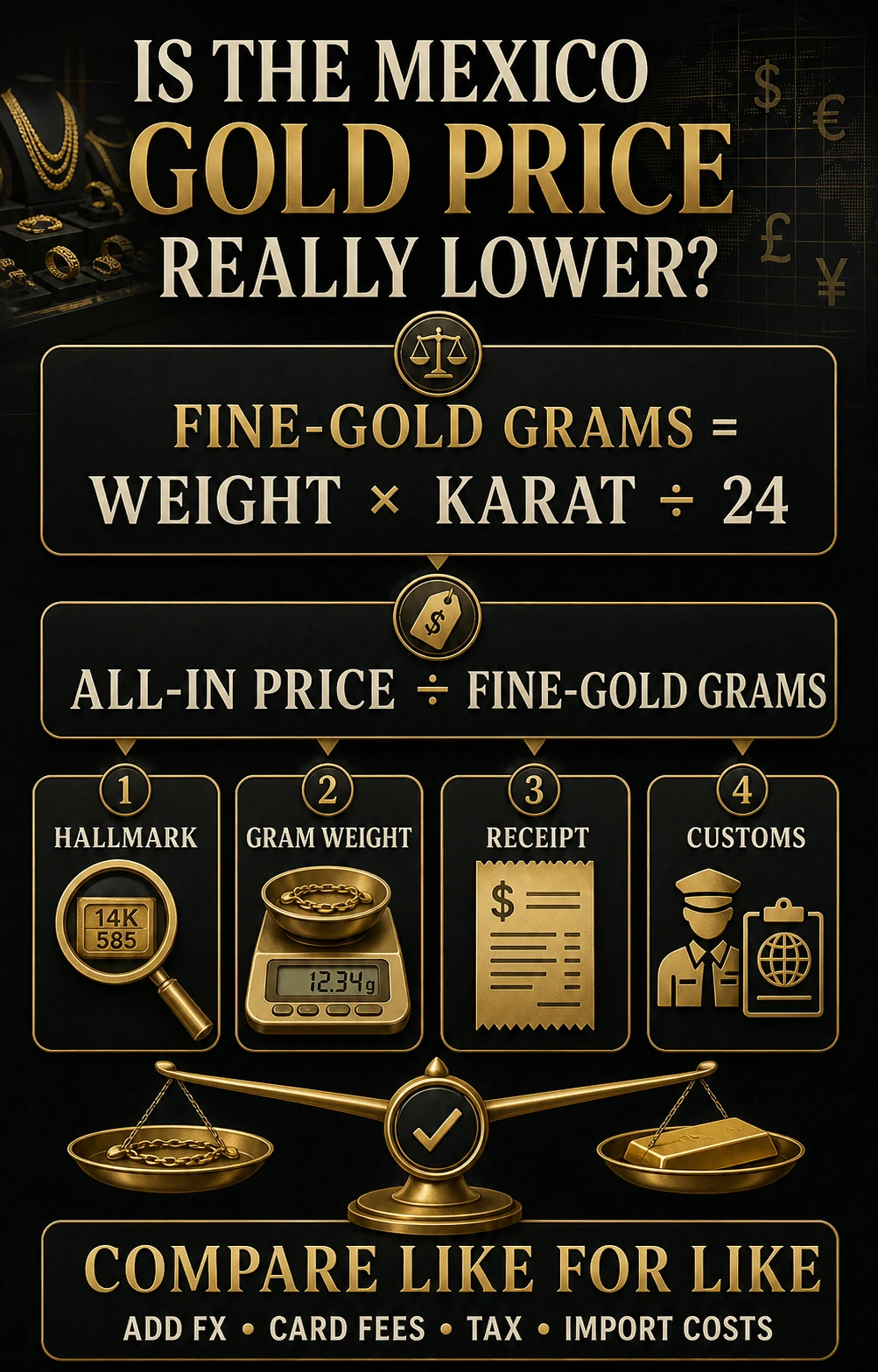
For example, a 14K piece contains 14/24, or about 58.33%, gold by mass before allowing for non-gold components such as stones. A 10-gram 14K chain therefore contains approximately 5.833 grams of fine gold if the stated weight is for the metal chain itself.
| Illustrative comparison | Mexico purchase | Home-market purchase |
|---|---|---|
| Piece | 10 g, 14K chain | 10 g, 14K chain |
| Fine-gold content | 5.833 g | 5.833 g |
| All-in price before any import charge | US$850 equivalent | US$920 |
| Price per fine-gold gram | About US$145.72 | About US$157.72 |
Illustration, not a current quote: the numbers above show the method only. Exchange rates, gold prices, taxes, fees, construction, workmanship, and customs treatment can erase or widen the apparent US$70 gap. Use the seller’s actual gram weight and your card issuer’s or currency provider’s real conversion cost.
If a seller will not provide a gram weight, you cannot make a sound metal-value comparison. GoldConsul’s gold weight estimator may help with rough planning, but a scale reading for the exact piece is stronger evidence.
Read the purity mark correctly
Common numeric marks express parts of gold per thousand. They are close equivalents, not a promise that every part of a finished item is identical.
| Mark | Approximate karat equivalent | Fine-gold share used for comparison |
|---|---|---|
| 417 | 10K | 41.7% |
| 585 | 14K | 58.5% |
| 750 | 18K | 75.0% |
Mexico’s official precious-metal jewelry standard, published through the Diario Oficial de la Federación, addresses commercial information such as numeric precious-metal content and country-of-origin disclosure. Treat that framework as a verification aid, not a reason to skip checking the exact item and documentation.
A stamp is useful but not conclusive on its own. It can be wrong, counterfeit, worn, or applied to only one component. Review our guide to testing gold purity before relying on an at-home acid or electronic test; poor technique can damage jewelry or produce misleading results.
What to ask the seller before paying
- What is the exact karat or millesimal fineness? Ask the seller to point out the mark.
- What is the gram weight? Confirm whether stones, pendants, or removable parts are included in that number.
- Is the piece solid, hollow, plated, filled, or vermeil? “Solid gold” as a material description does not always explain whether a chain is hollow inside.
- Who made it and where? Record the manufacturer or workshop and country of origin when available.
- What does the receipt state? It should identify the seller, item, purity, weight, price, date, currency, and return or warranty terms.
- Can it be independently checked? For a high-value purchase, ask whether the sale can be conditioned on prompt professional verification.
If durability matters, purity is only one variable. A higher-karat piece contains more gold but may be softer depending on design and alloy. See whether 22K gold is too soft for jewelry and our guide to 14K gold and tarnish.
Choose the retail channel deliberately
Established jewelry store
Often easier to document and revisit. Compare its written warranty, testing policy, itemized receipt, and reputation—not merely the storefront’s appearance.
Artisan or custom workshop
Can offer distinctive design and direct maker access. Put the alloy, weight range, stones, timeline, deposit, final price, and remedy for a mismatch in writing.
Tourist market or resale
May produce a good find, but comparison and recourse can be harder. Do not let urgency, cash-only pressure, or an unverified appraisal substitute for evidence.
There is no useful universal “risk score” for these categories. A careful artisan can document a piece better than a large shop, while a polished tourist store can still charge a substantial location premium. Evaluate the transaction you can prove.
Customs can change the bargain
For travelers entering the United States, the U.S. Customs and Border Protection customs-duty guidance explains declaration, personal exemptions, and duty concepts. Treatment can depend on value, trip circumstances, product classification, and origin; a purchase made in Mexico is not necessarily of Mexican origin.
Keep the original receipt and declare purchases when required. Before travel, check the current rules for your destination country with its customs authority. Do not rely on a seller’s informal statement that an item is “duty free,” and do not split or conceal a purchase to avoid reporting requirements.
A practical buy-or-walk-away decision
- Match the karat, gram weight, dimensions, construction, and stones to a genuine comparison piece.
- Convert both offers into your home currency using the rate and fees you will actually pay.
- Calculate fine-gold grams and price per fine-gold gram.
- Compare the non-metal value: workmanship, design, warranty, resizing, returns, and seller accountability.
- Add plausible travel, shipping, insurance, and customs costs.
- Buy only when the documentation and total value remain convincing without sales pressure.
For a quick bullion benchmark, check the dated reference process in Gold Today rather than treating any page as a permanently live quote.
How to inspect a hallmark
The video below offers a visual introduction to hallmark and authenticity checks. It is supplementary: neither a video nor one surface test can authenticate every alloy, plated item, clasp, solder joint, or stone-set piece.
Frequently asked questions
Is gold cheaper in Mexico than in the United States?
Sometimes a specific piece is cheaper after adjusting for purity and weight, but not universally. Compare the all-in price per fine-gold gram and then account for workmanship, fees, taxes, customs, and after-sales service.
What gold purity is common in Mexico?
You may encounter several purities, including marks corresponding to 10K, 14K, and 18K. Do not assume purity from color or location; read the mark and require it on the receipt.
How can I tell whether Mexican gold jewelry is real?
Check the numeric fineness, gram weight, construction, maker or seller, country-of-origin information, and detailed receipt. For meaningful value or uncertainty, use a qualified independent professional and an appropriate test.
Do I have to declare gold jewelry bought in Mexico?
Travelers should follow the declaration rules of the country they enter. U.S. treatment depends on facts such as total purchases, exemptions, classification, and origin, so verify current CBP guidance and retain the receipt.
Is 14K or 18K a better buy?
Neither is automatically better. 18K contains more gold; 14K can offer a different balance of price, color, and durability. Compare fine-gold content, alloy, design, construction, and intended wear.
 When you purchase a service or a product through our links, we sometimes earn a commission, at no extra cost to you.