
Learn how gold-backed cryptocurrencies work, how PAXG and XAUT differ, and what to verify before buying tokenized gold.
- A token is a claim on gold—not gold held in your hand.
- Reserve evidence and redemption terms matter more than the logo.
- Compare issuer, custody, fees, liquidity, and wallet risk before buying.

Gold-backed cryptocurrencies are transferable blockchain tokens whose issuers link each unit to a stated amount of vaulted gold. They can make gold exposure easier to divide and move, but the token is still a claim that depends on the issuer, custodian, reserve evidence, trading venue, wallet security, and redemption rules.
- “Backed by gold” is a legal and operational promise, not something a blockchain proves by itself.
- PAX Gold (PAXG) and Tether Gold (XAUT) each represent one fine troy ounce, but their reporting, access, networks, and direct-purchase terms differ.
- Small exchange purchases do not imply small physical redemptions; issuer delivery commonly requires roughly a full 400-ounce bar.
- Compare the all-in cost: premium or discount, trading fee, network fee, withdrawal fee, foreign exchange, tax, and eventual selling cost.
- Tokenized gold may fit crypto-native access; physical bullion and gold ETFs solve different custody and liquidity problems.
A gold-backed token sounds simple: put bullion in a vault and issue a digital unit against it. The difficult part is the chain of rights and institutions between a wallet balance and a real bar.
That distinction matters more than the token’s ticker. A well-designed product can track gold closely and settle around the clock, while a weak structure can leave holders exposed to an issuer, an exchange, unclear redemption rights, or thin liquidity.
What Is a Gold-Backed Cryptocurrency?
A gold-backed cryptocurrency—also called tokenized gold—is a digital token designed to represent a defined quantity or economic interest in physical gold. The token can be transferred on a supported blockchain, held in a compatible wallet, or traded on participating platforms.
It is not the same as Bitcoin. Bitcoin does not represent a claim on an issuer’s reserve, while a gold token depends on an identifiable issuer and off-chain bullion. For the broader asset comparison, see gold vs. crypto.
It is also not automatically equivalent to a gold ETF or a bar in your possession. The legal form, access route, trading hours, redemption path, fees, and custody chain differ.
How Tokenized Gold Works
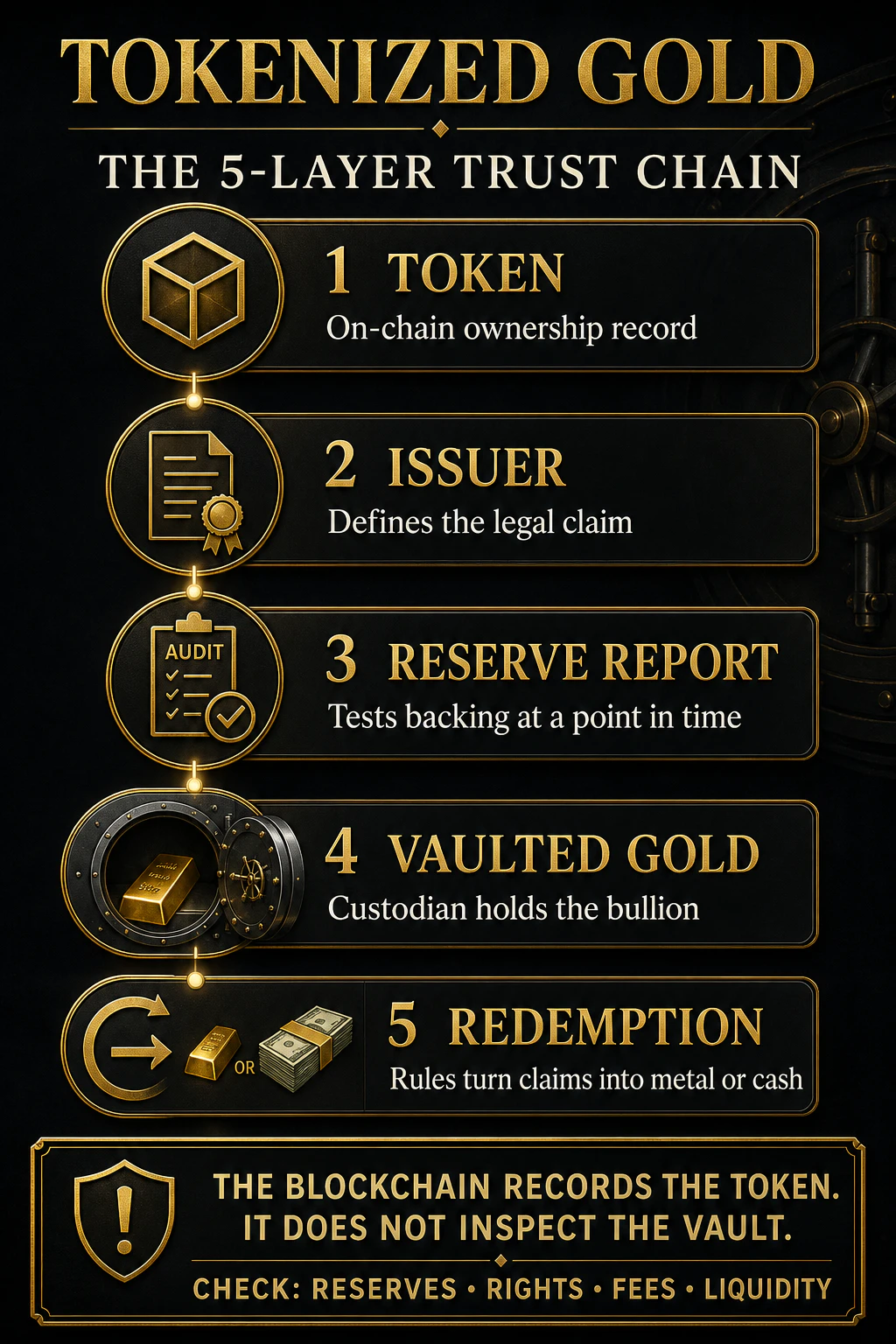
This structure can make a large, indivisible bar economically fractional. It also explains how blockchain changes parts of the gold trade without replacing vaults, legal contracts, assayers, or custodians.
Knowledge Gap: On-Chain Transparency Stops at the Vault Door
A block explorer can show token supply, transfers, contract addresses, and wallet balances. It cannot independently inspect a bar, confirm insurance, prove the issuer’s legal title, or guarantee that a redemption request will be accepted. Reserve evidence must connect the on-chain supply to identifiable off-chain assets and enforceable holder rights.
What “Backed by Gold” Must Actually Prove
Do not reduce the backing test to “the company publishes a report.” A useful review asks six separate questions:
- Unit definition: Does one token represent one fine troy ounce, one gram, or only price exposure?
- Reserve quantity: Does reported fine-gold weight cover issued or circulating tokens under the stated method?
- Allocation and title: Is the bullion allocated or pooled, and what legal interest does the holder receive?
- Custody: Who holds the metal, where is it held, and is it segregated from other assets?
- Independent examination: Who tests the reserve statement, how often, and is it a point-in-time attestation rather than continuous proof?
- Redemption: Who is eligible, what is the minimum, where can delivery occur, and which fees or compliance checks apply?
The difference between allocated and pooled claims is important beyond crypto. Our guide to allocated vs. unallocated gold storage explains why bar identification and legal ownership matter.
PAXG vs. XAUT: Current Official Terms
PAX Gold and Tether Gold are useful examples because both define one token as one fine troy ounce of London Good Delivery gold. They are not interchangeable products, and the table below is not a safety ranking.
| Check | PAX Gold (PAXG) | Tether Gold (XAUT) |
|---|---|---|
| Issuer claim | One PAXG equals one fine troy ounce and represents fractional beneficial ownership of allocated London Good Delivery bars. | One XAUT reflects an undivided specific interest in one fine troy ounce in the gold reserves. |
| Reserve reporting | Monthly PAXG attestations; reports from February 2025 onward are issued by KPMG. | Quarterly Tether Gold reserve reports with independent auditor reports from BDO Italia. |
| Direct issuer minimum | The current Paxos fee page lists a 0.03 PAXG minimum; exchange minimums and fees can differ. | The current Tether Gold FAQ lists a 50 XAUT direct-platform minimum; secondary venues may allow fractions. |
| Physical redemption | Paxos terms require at least 430 PAXG plus applicable fees for a London Good Delivery bar. | Tether Gold’s FAQ says redemption occurs in full-bar increments and normally advises depositing 430 XAUT. |
| Supported chains | Ethereum; Paxos announced PAXG support on Solana in June 2026. Verify the official contract for the chain used. | Ethereum and BNB Chain are listed in the current official FAQ. Verify the official contract before transferring. |
| Direct access boundary | Issuer purchase and redemption require a verified account and remain subject to legal and compliance restrictions. | Issuer purchase and redemption require verification; the official FAQ says U.S. persons are prohibited from using the direct service. |
Terms checked July 14, 2026. Product rules, supported networks, fees, and geographic access can change. Confirm them on the issuer’s site before acting.
The Real Cost Is More Than the Gold Price
Start with the current gold reference value, then add every layer between cash and the final wallet balance. Use the live gold price page as an input, not as the final token quote.
| Cost layer | Where it appears | Why it matters |
|---|---|---|
| Premium or discount | Token market price versus gold reference value | Thin liquidity or closed bullion markets can widen the gap. |
| Trading or issuer fee | Exchange order, dealer quote, creation, or destruction | A low headline spread can hide a separate percentage fee. |
| Network fee | Blockchain transfer | A flat gas cost weighs more heavily on small purchases. |
| Withdrawal fee | Exchange-to-wallet transfer | The venue may charge more than the network itself. |
| FX and banking | Converting local currency or receiving redemption proceeds | Currency conversion can exceed the token fee. |
| Exit and tax | Selling, redeeming, or transferring | Jurisdiction-specific tax and reporting can change the net result. |
Gold Token All-In Cost Estimator
Use current quotes from your intended venue. The default figures are a worked example, not live prices.
Total acquisition cost: $1,019.53
Upfront friction versus reference value: 1.95%
Worked Example
A 0.25-token purchase at a hypothetical $4,000 gold reference equals $1,000 of metal exposure. A 0.75% token premium raises the quote to $1,007.50; a 0.40% venue fee adds $4.03, and an $8 transfer cost brings the total to $1,019.53.
The upfront friction is therefore 1.95% before any later selling, redemption, foreign-exchange, or tax cost. This is why comparing only the token ticker price is incomplete.
Risks That Physical Gold Does Not Remove
Issuer and legal risk
The issuer defines holder rights, can change service terms, and may restrict minting or redemption under law or compliance rules.
Custody and reserve risk
Metal remains off-chain. Reports are snapshots, and their scope may not cover every operational, insurance, or insolvency question.
Venue and liquidity risk
An exchange can fail, freeze withdrawals, delist a token, or show a price that diverges from bullion value during stressed trading.
Smart-contract and chain risk
Contract bugs, unsupported forks, bridges, wrong-chain transfers, or fake contract addresses can cause permanent loss.
Wallet and key risk
Self-custody removes exchange exposure but makes private-key security, backups, phishing defense, and transaction accuracy your responsibility.
Redemption and jurisdiction risk
Owning a fraction does not guarantee affordable delivery. Eligibility, minimum bars, delivery location, sanctions, tax, and local rules still apply.
Gold exposure may be less volatile than an unbacked crypto asset, but “less crypto-price risk” is not the same as “low total risk.” A token adds technology and counterparties to the underlying movement of gold.
Tokenized Gold, Physical Bullion, or an ETF?
Choose tokenized gold when…
You need fractional, crypto-native transferability and understand wallet, issuer, venue, and redemption risk. Verify the exact contract and exit route first.
Choose physical bullion when…
Direct possession or clearly allocated metal matters more than instant digital transfer. Plan for dealer premiums, secure storage, insurance, and resale.
Choose a gold ETF when…
You want brokerage-account liquidity and regulated-market access without managing private keys. Understand fund structure, fees, trading hours, and share-redemption limits.
Learn more about how a gold ETF works and compare the practical steps for buying physical gold bars.
Eight Checks Before You Buy
Reserve-and-Redemption Checklist
- Open the issuer’s current terms—not only an exchange listing or review page.
- Confirm the official contract address and supported network from the issuer.
- Read the newest reserve report and note its date, examiner, scope, and limitations.
- Identify the custodian, vault jurisdiction, bullion standard, and holder’s legal interest.
- Check whether your country and customer type can use the issuer’s redemption service.
- Compare secondary-market liquidity, bid-ask spread, and withdrawal status on the venue you will actually use.
- Calculate total entry and exit friction, including network, withdrawal, FX, tax, and delivery costs.
- Test a small transfer before moving a material balance, then secure wallet backups offline.
Editorial Perspective: Treat Redemption as the Stress Test
A token can trade smoothly for years without most holders requesting a bar. The practical test is not whether the ticker follows gold on a normal day, but whether the published rights, reserve evidence, compliance path, minimum size, fees, and delivery route remain workable when you need to exit.
Regulation Depends on Where You Are
In the European Union, MiCA defines an asset-referenced token as a crypto-asset that seeks a stable value by referencing another value or right. Commodity-linked tokens can fall within that framework, but the availability and compliance status of a specific product or service must be checked rather than assumed.
Use the ESMA MiCA register and guidance for EU checks. Outside the EU, issuer eligibility, exchange access, tax treatment, consumer protection, and redemption rights can be different.
Technical walkthrough: This Chainlink Tech Talk shows how a token, reserve data, minting, custody, and proof-of-reserve mechanisms can connect. It is useful for understanding the architecture, not as an endorsement of any token discussed in the recording.
Bottom Line
Gold-backed cryptocurrencies can provide divisible, transferable gold exposure inside digital-asset markets. Their usefulness comes from combining a token ledger with off-chain bullion—not from making the issuer, vault, or law disappear.
Before buying tokenized gold, verify the reserve evidence, legal claim, custodian, direct-redemption path, supported contract, venue liquidity, and all-in cost. If those layers are unclear, a physical bar, coin, or gold ETF may offer a simpler risk structure for your actual goal.
FAQ: Gold-Backed Cryptocurrencies
Do gold-backed cryptocurrencies contain real gold?
The token itself is digital. A properly structured product links it to physical bullion held off-chain, but the exact ownership right, reserve method, custodian, and redemption promise come from the issuer’s legal documents.
Can I redeem a small fraction for a small gold bar?
Usually not through the main PAXG or XAUT issuer delivery routes. Both currently describe physical redemption around full London Good Delivery bars, while small holders commonly exit by selling tokens on a secondary market.
Are gold-backed cryptocurrencies stablecoins?
They are often called commodity-backed stablecoins or asset-referenced tokens, but they are not stable in dollars or euros. Their reference asset is gold, whose fiat price changes, and the token can also trade at a premium or discount.
Do PAXG or XAUT pay interest?
The underlying gold does not generate yield. Lending, staking, or DeFi programs may advertise returns, but those returns introduce separate platform, borrower, smart-contract, liquidity, and liquidation risks.
Are gold-backed tokens safer than Bitcoin?
They have different risks. A gold token aims to follow bullion rather than an unbacked crypto price, but it adds issuer, reserve, custody, compliance, and redemption dependencies that Bitcoin does not have.
 When you purchase a service or a product through our links, we sometimes earn a commission, at no extra cost to you.