

Review GoldBroker.com as an allocated bullion and private vault option, including fees, storage structure, liquidity, risks, and comparison points.
- Check allocated ownership, vault location, fees, and withdrawal rules.
- Compare storage control with liquidity and selling friction.
- Treat platform fit as a risk decision, not a shortcut to safety.

GoldBroker.com can make sense for investors who want direct physical ownership of precious metals stored outside the banking system. It is less compelling for people who want low-cost trading, small recurring buys, or instant ETF-style liquidity.
This GoldBroker.com guide is a practical decision review, not a promotion. It focuses on ownership structure, storage, fees, liquidity, and the risks a buyer should understand before using a private bullion storage platform.
TL;DR: GoldBroker.com in plain English
- GoldBroker is best understood as a private bullion ownership and storage service, not a trading app.
- The central appeal is allocated ownership in the client name, with vault storage through Malca-Amit.
- The main trade-off is cost: premiums, resale commission, annual storage fees, and possible maintenance fees matter.
- Liquidity exists, but it is not the same as selling an ETF during market hours.
- It fits larger, long-term physical bullion allocations better than small speculative positions.
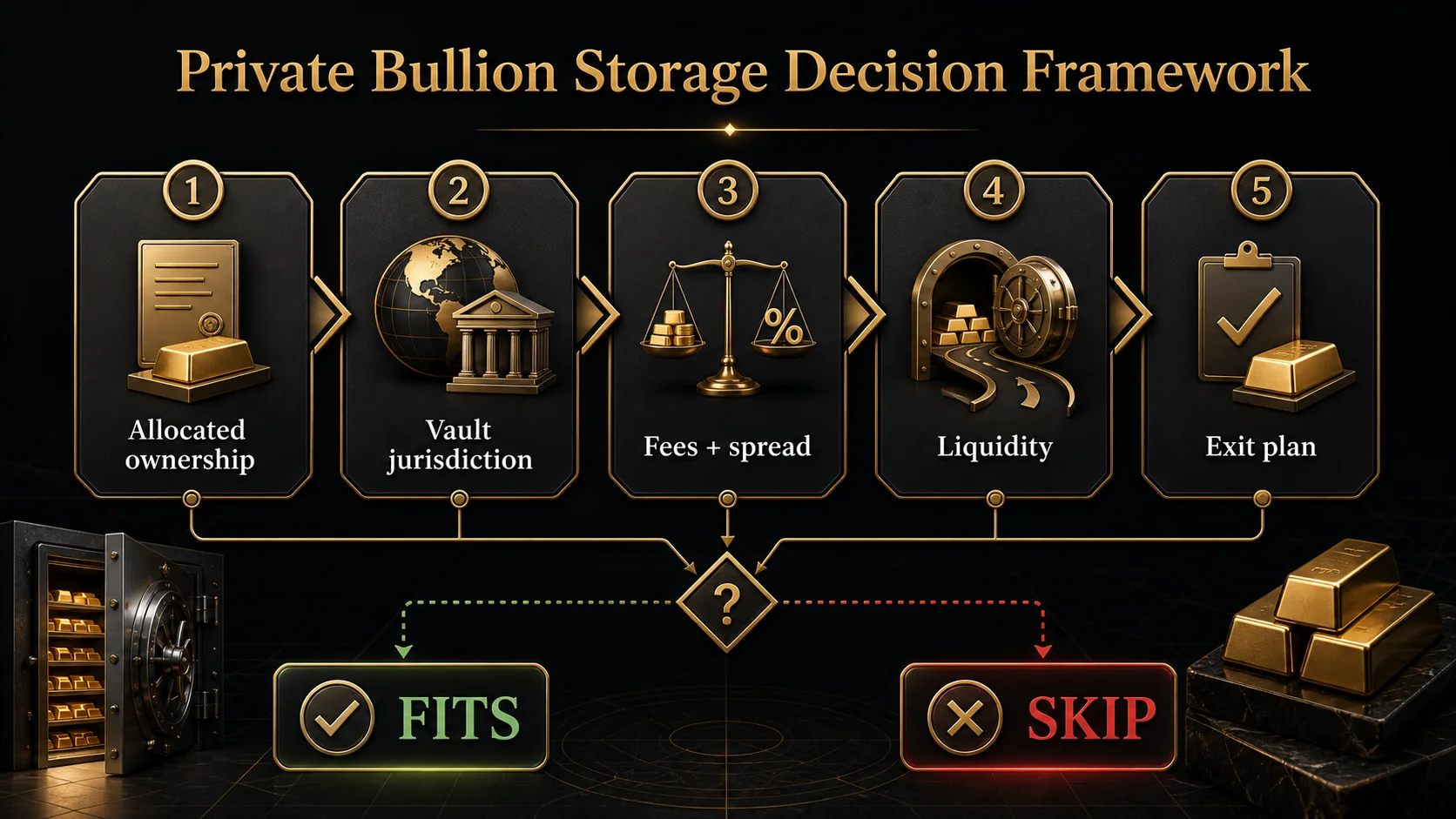
What Most Buyers Miss
The question is not only whether the gold is real. The harder question is whether the ownership records, vault agreement, fee schedule, and exit path still make sense when you want to sell or withdraw.
Can you identify what you own?
What is the all-in spread?
Who buys it back, and at what terms?
What GoldBroker.com actually does
GoldBroker is a platform for buying, storing, and selling physical precious metals, including gold, silver, platinum, and palladium. Its positioning is different from a normal online bullion shop because storage is a core part of the model.
According to GoldBroker’s own terms and rates pages, stored metals are held through Malca-Amit vaults in locations such as Zurich, Singapore, New York, and Toronto. The service emphasizes ownership in the client’s name, storage outside the banking system, and the possibility of inspection or withdrawal.
That structure makes GoldBroker relevant for readers already comparing where to store gold, whether allocated vs unallocated gold storage matters, and how private vaults compare with a home safe vs private vault for gold.
The ownership question: allocated, dedicated, and in your name
The strongest argument for GoldBroker is not that it gives gold exposure. Many products do that.
The argument is that it is built around specific physical metal held for the client, rather than an unsecured claim against a dealer or financial institution. The World Gold Council describes allocated gold as physical bars stored in vaults and allocated to a holder, with identifying details such as serial number, weight, and fineness.
That distinction matters because unallocated metal is usually a claim on a provider’s balance sheet. Allocated metal is closer to property held in custody, although the exact rights still depend on the contract, vault records, jurisdiction, and insolvency treatment.
For larger long-term holdings, this ownership model can be attractive. For small allocations, the cost and paperwork can outweigh the benefit.
Storage and jurisdiction: useful, but not magic
Private vault storage can reduce home-theft risk and make insurance simpler. It can also create new dependencies: vault access rules, travel logistics, storage agreements, local legal systems, and provider administration.
The key is to separate genuine risk reduction from vague “outside the system” language. A good vault setup should give you clear documentation, identifiable metal, insurance terms, a known storage operator, and a realistic path to inspect, sell, or withdraw.
GoldBroker’s public materials say the storage fee covers account maintenance with Malca-Amit, secure transport, customs formalities, vault storage, sealing, ownership certificates, and insurance. Readers should still verify the latest contract terms before funding an account because storage fees and operational rules can change.
Fees, spreads, and the real break-even point
The biggest mistake in private bullion storage is comparing only the gold spot price. Your real cost includes the product premium, buy/sell spread, resale commission, storage fee, account maintenance fee if applicable, and any withdrawal or inspection costs.
GoldBroker’s published rates page lists a $5,000 minimum for a first storage order, a 1% resale commission on stored metals, and annual storage fees that begin at 1.50% for gold below higher value tiers, with account maintenance fees for smaller vault balances. Those figures are useful starting points, but buyers should confirm the rate table on the order date.
| Option | Best for | Main advantage | Main trade-off |
|---|---|---|---|
| GoldBroker/private allocated storage | Larger long-term bullion holdings | Client-name custody and vault storage | Ongoing fees and slower exits |
| Home safe | Small emergency-access holdings | Immediate physical control | Theft, secrecy, and insurance limits |
| Bank safe deposit box | Documents and modest valuables | Convenient local storage | Access limits and weak default insurance |
| Gold ETF | Liquid portfolio exposure | Fast trading and tight market access | Financial product exposure, not personal bullion access |
Liquidity: available, but not instant
Gold is a deep global market, but every form of gold has its own liquidity path. A one-ounce coin in your hand, a 400-ounce wholesale bar, a vaulted kilo bar, and an ETF share do not exit the same way.
The LBMA Good Delivery system helps standardize large wholesale bars by refiner, weight, fineness, and appearance. Retail bullion investors still need to care about product format, chain of custody, assay risk, and whether the dealer or vault has a practical buyback route.
GoldBroker says it can buy back metals kept in its storage units, depending on market conditions. That is useful, but it should not be treated as identical to a guaranteed exit price.
Before buying, compare the quoted buy price with the live gold spot price and understand how product premiums might be recovered, partly recovered, or lost on resale.
Who GoldBroker fits
GoldBroker is most defensible when the investor already wants physical bullion rather than only price exposure. The buyer should also be comfortable with private storage, annual fees, account documents, and a slower operational process.
- Long-term holders who prioritize direct ownership records over lowest annual cost.
- Investors with enough bullion value for storage fees to be proportionate.
- People who want geographic vault choice and do not need daily trading.
- Buyers who understand bars, coins, premiums, and verification basics from resources such as what gold and silver bullion actually is.
Who should probably skip it
GoldBroker is not automatically wrong for smaller buyers, but it is easier for the fee stack to become heavy. A buyer who mainly wants price exposure may find a regulated, liquid market instrument more practical.
- Short-term traders who need instant entry and exit.
- Small monthly buyers who would be hurt by minimums and account fees.
- Investors who do not want to manage vault paperwork or jurisdiction risk.
- People who have not yet compared bars, coins, and dealer spreads through a guide such as how to buy gold bars.
The GoldConsul Editorial Perspective
GoldBroker is strongest when evaluated as custody infrastructure, not as a bargain-priced gold shop. If the storage model solves a real problem for you, the fees may be acceptable; if it does not, the same fees become unnecessary drag.
Buyer checklist before opening an account
Use this checklist before funding a storage order
- Confirm whether you receive product-level or bar-level identifying records.
- Compare the total buy price against spot, not only the metal weight.
- Calculate annual storage as a percentage of your intended holding size.
- Read the vault agreement, insurance language, and withdrawal procedure.
- Ask what happens if you want to sell during stressed market conditions.
- Decide in advance whether your exit path is buyback, delivery, vault pickup, or transfer.
A simple cost example
Assume an investor buys $25,000 of stored gold. If annual storage is roughly 1.50%, that is about $375 per year before considering product premium, resale commission, and any spread between buy and sell prices.
That cost may be acceptable for someone who specifically wants private allocated vault storage. It may be too much for someone who only wants a small gold allocation inside a diversified portfolio.
The practical test is this: would you still choose this structure if gold moved sideways for three years? If the answer is no, you may be paying for a feature you do not truly need.
Bottom line: GoldBroker.com guide verdict
The balanced verdict is that GoldBroker.com is a serious option for a specific investor: someone who wants physical precious metals, allocated ownership, and private vault storage, and who accepts the cost and operational friction.
It is not the simplest route to gold exposure, and it is not automatically the cheapest way to buy bullion. Treat it as a custody decision first, a bullion purchase second, and a trading decision last.
For broader context, the World Gold Council’s Retail Gold Investment Principles are a useful benchmark for transparency, fair dealing, and responsible retail bullion practices.
FAQ: GoldBroker.com guide to precious metal investments
Is GoldBroker.com a gold dealer or a storage platform?
It is both: GoldBroker facilitates precious metal purchases and offers private vault storage through its storage partner. The storage structure is the main reason to consider it over a standard bullion dealer.
Does GoldBroker offer allocated gold?
GoldBroker positions its stored bullion around direct ownership in the client’s name. Buyers should still read the current storage agreement and confirm exactly how their bars or products are recorded.
Are GoldBroker fees high?
They can be high for small balances or short holding periods. The all-in cost should include product premiums, resale commission, annual storage, maintenance fees if applicable, and exit costs.
Can I sell my stored metal back through GoldBroker?
GoldBroker says it buys back metals kept in its storage units, subject to market conditions. Before buying, ask how the buyback price is calculated relative to spot and what timing applies.
Is GoldBroker better than a gold ETF?
It depends on the job. GoldBroker may fit investors who want direct physical custody records, while ETFs usually fit investors who want liquid market exposure with simpler execution.
 When you purchase a service or a product through our links, we sometimes earn a commission, at no extra cost to you.