
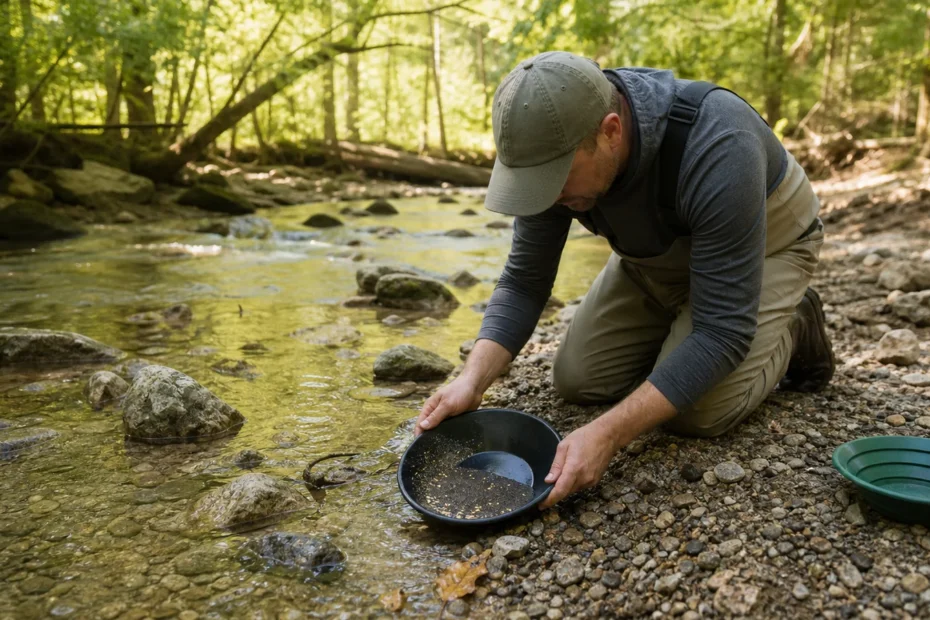
Yes, fine glacial gold occurs in Indiana. Learn how it arrived, where official guidance points, what rules apply, and what to expect.
- Indiana has fine placer gold transported from Canada by glaciers; it is not evidence of a local hard-rock gold belt.
- Indiana DNR says prospecting must follow the general license, land permission, and any property-specific permit.
- Expect tiny flakes and a learning-focused outing—not commercial yields or guaranteed nuggets.
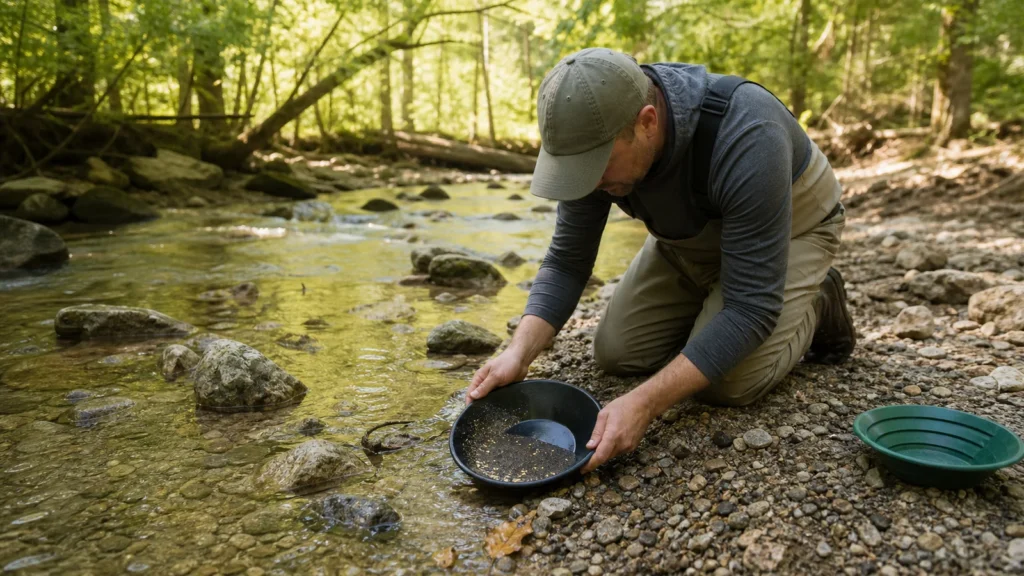
- Indiana gold is mainly tiny glacial placer gold.
- Expect flakes and specks, not reliable nuggets or commercial grades.
- The DNR general license does not create a right to enter land.
- State forests and national forests require additional contact or permission; state parks and state wildlife properties do not authorize prospecting.
- Use low-impact hand methods and verify rules for the exact waterway and property.
Real gold, modest expectations
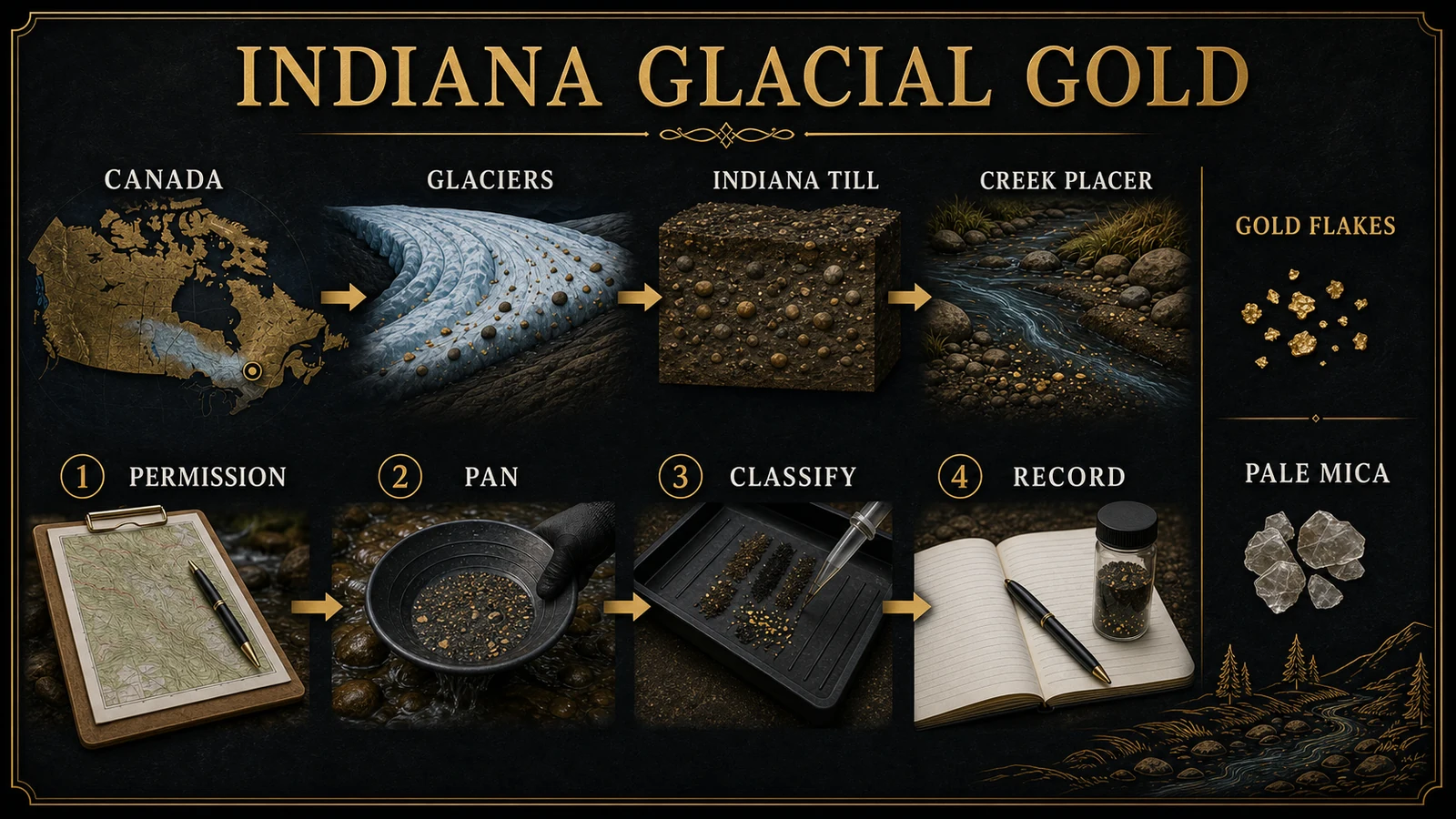
Indiana is not a classic hard-rock gold state like Nevada. Its gold story begins with glacial transport: ice sheets moved rock and sediment south from gold-bearing regions, then melting ice left unsorted till that streams later reworked.
How gold reached Indiana
Indiana DNR states plainly that gold is not naturally occurring in Indiana in the sense of a native bedrock source. Glaciers transported it from Canada, scattering small particles through deposits.
Streams can erode glacial till and concentrate heavy minerals in small traps. Because gold is dense, flakes may settle in cracks, behind larger rocks, on clay layers, or where water velocity falls—but every stream and access point is different.
| Evidence | What it means | What it does not mean |
|---|---|---|
| Gold in glacial till | Ice transported gold-bearing material into the region | A local bedrock gold vein exists |
| Fine flakes in a creek | Water reconcentrated some heavy particles | The creek will produce profitable quantities |
| Historical reports | Gold was observed in named areas | Every modern parcel is open to prospecting |
| A hobbyist video | A field method or result is illustrated | The location, yield, or legality applies to you |
Where official guidance points
Indiana’s official recreational prospecting page links to location information and geological notes rather than promising a short list of secret creeks. Historical reports often discuss southern and central counties where glacial material and suitable drainage occur.
A named county or waterway is only a geological lead. It says nothing about today’s parcel ownership, safe access, navigability status, environmental restrictions, or whether the managing property allows prospecting.
For a wider comparison, see gold prospecting in Arkansas, gold mining and prospecting in Nevada, and how to look for gold without a detector.
Indiana’s legal framework in plain language
Indiana DNR says prospectors must follow the general-license rules to pan legally. If the activity stays within those conditions, a separate Construction in a Floodway permit is generally not needed.
The general license is not permission to trespass. The DNR specifically says to get permission, notes additional requirements for state and national forests, and states that Indiana state parks and state wildlife properties do not authorize gold prospecting.
Navigable waters can have different rules. Work outside the general-license conditions may require a site-specific permit with plans, fees, and review. Verify the current brochure and property guidance immediately before a trip.
A realistic first field plan
- Read the current Indiana DNR prospecting page, rules brochure, and general-license conditions.
- Identify the parcel owner, waterway status, and managing property; obtain all required permission.
- Choose simple hand equipment: pan, classifier, small hand tools where allowed, snuffer bottle, vial, gloves, and eye protection.
- Sample small amounts from several legal locations instead of digging one large hole.
- Restore disturbed gravel and banks exactly as rules require; never undercut a bank.
- Keep notes on date, water conditions, sample location, material, and result.
- Stop if you encounter archaeological material, utilities, unstable banks, pollution, wildlife restrictions, or a posted closure.
- Treat the day as a geology and panning exercise, not an income plan.
Gold, mica, pyrite, or something else?
Fine gold keeps a rich yellow color in shade, is opaque, and tends to stay low in the pan because it is dense. A flake can flatten or bend rather than split into thin sheets.
Mica is often pale, silvery, or translucent and flashes as the pan angle changes. It forms light sheets that can move differently in water. Pyrite is harder and more angular, with a brass-like color rather than gold’s richer yellow.
Field appearance is a screening step. For a potentially meaningful sample, use appropriate professional testing and preserve the location and sample record. The gold authenticity guide explains why no single home test answers every question.
Why Indiana yields are usually small
Glacial transport breaks, disperses, and mixes material. Streams may reconcentrate particles, but the source has already been spread over a large area.
The DNR warns that you will not get rich. That is not a reason to avoid the hobby; it is a reason to measure success by learning, family recreation, field skill, and responsible access.
Sample systematically instead of chasing sparkle
A useful test is repeatable. Take similarly sized samples from several allowed micro-environments, label them, and pan each with the same method. A single bright speck says less than a pattern across multiple samples.
Look for changes in water energy and sediment size, but do not excavate banks or disturb habitat outside the general-license conditions. A natural trap can be behind a stable obstruction, in an exposed bedrock crack, or at a transition from fast to slower flow; access and environmental rules still come first.
Record negative samples too. They help distinguish a genuinely better concentration zone from luck, and they prevent repeated disturbance of unproductive ground.
Season, water, and safety change the plan
High water can conceal hazards, increase bank instability, and make small-particle recovery difficult. Low water may expose gravel but can coincide with heat stress, sensitive habitat, or property restrictions.
Check weather, stream conditions, closures, parking, and emergency communication before leaving. Work with another person when possible, wear suitable footwear and eye protection, and never enter water that is too fast, deep, cold, contaminated, or visually uncertain.
A productive-looking bar is not worth trespass, erosion, habitat damage, or a rescue. The best field decision is sometimes to document the location and return under safer, clearly permitted conditions.
Equipment: start simple
| Tool | Useful job | Common mistake |
|---|---|---|
| Gold pan | Separates dense concentrate | Expecting the pan to compensate for poor sampling |
| Classifier | Makes feed size more consistent | Discarding oversize material without checking it |
| Snuffer and vial | Collects tiny flakes | Calling every bright speck gold |
| Hand lens | Examines shape and color | Treating appearance as conclusive identification |
| Notebook or map | Preserves permission and sample context | Publishing precise private locations without consent |
When to stop or escalate
Stop if permission is uncertain, a rule is unclear, water is unsafe, a bank is unstable, equipment would exceed low-impact conditions, or the area appears archaeologically or environmentally sensitive.
Contact Indiana DNR or the property manager when your planned method differs from the brochure, when the waterway is navigable, or when a forest permit is required. Written clarification is more useful than forum advice.
To understand how placer recovery differs from industrial mining, read the gold extraction process and the realities of a gold miner’s work.
A map of reported gold occurrences is not an access map, and a glacial flake is not evidence of a nearby vein. Geology, land rights, water regulation, and expected yield are four separate questions.
Indiana gold prospecting makes sense as a careful field hobby. The strongest plan is small-scale, permission-first, documented, and honest about tiny results.
Watch: Indiana has Gold! Gold Prospecting Indiana
This field video shows that gold can be recovered in Indiana and what hobby-scale work looks like. Use it for method context, not as a substitute for official rules or property permission.
Video: Klesh. YouTube oEmbed availability validated July 17, 2026.
Bottom Line
Indiana does contain fine placer gold carried by glaciers. Follow the current DNR general license, secure property-specific access, use low-impact tools, and expect specks rather than a commercial discovery.
FAQ: Is There Gold in Indiana?
Is gold native to Indiana bedrock?
Indiana DNR says the gold found in the state was transported from Canada by glaciers rather than formed locally.
Can you pan for gold legally in Indiana?
Yes, when you comply with the DNR general license, property access, and any additional permit or waterway rules.
Can I pan in an Indiana state park?
No. Indiana DNR says state park properties do not authorize gold prospecting.
What kind of gold is found in Indiana?
Mostly very fine placer flakes and specks concentrated from glacial deposits.
Can Indiana gold prospecting make money?
It is unlikely. Official guidance says you will not get rich; treat it as recreation and field education.
Sources and verification
Use these primary and specialist sources to verify the claims, rules, specifications, and market definitions. Access rules, prices, and product terms can change.
- Indiana DNR — Recreational gold prospecting
- Indiana DNR — General licenses and exemptions
- Indiana DNR — Gold prospecting rules brochure
- Indiana government FAQ — State forest gold panning
- Indiana DNR — State forest procedures
- Indiana Geological and Water Survey — Gold and Diamonds in Indiana
- Indiana DNR — Fish and Wildlife property rules
- Indiana DNR — Rules and regulations
- U.S. Forest Service — Metal detecting on National Forest lands
- USGS — Gold statistics and information
 When you purchase a service or a product through our links, we sometimes earn a commission, at no extra cost to you.