
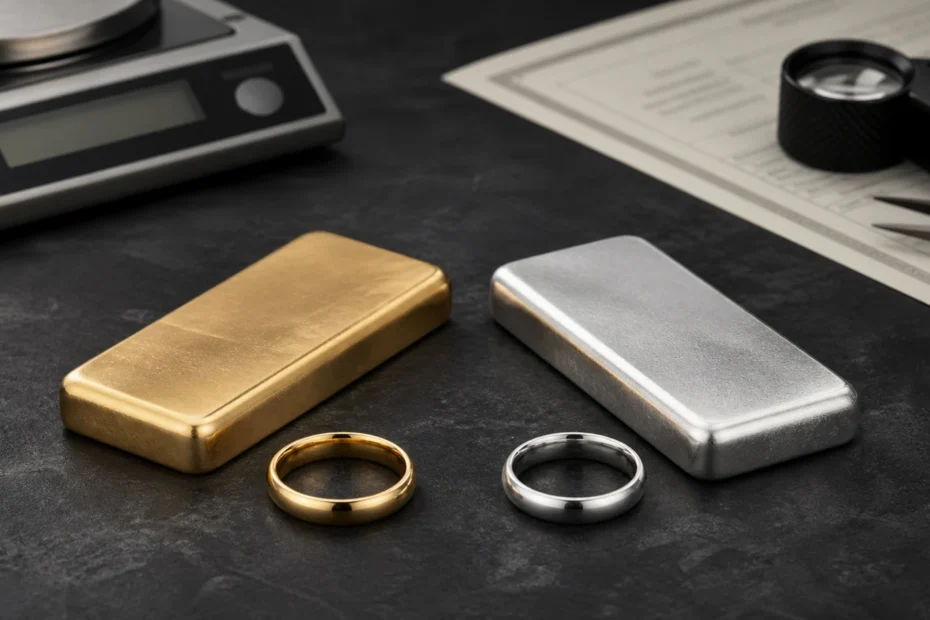
Gold currently trades above platinum per ounce, but rarity, jewelry cost, premiums, and resale tell different stories. Compare the same unit, purity, and date.
- Gold currently commands the higher benchmark price per troy ounce; that relationship has reversed during earlier market cycles.
- Platinum is geologically rarer and has tighter mine supply, but rarity alone does not set market price.
- A platinum ring can cost more than a comparable gold ring because it is dense, often 95% pure, and labor-intensive—even when platinum spot is lower.
- Gold currently has the higher benchmark price per troy ounce; verify live prices before transacting.
- Platinum is rarer in mine supply, but rarity alone does not set price.
- Physical premiums and dealer spreads differ between products and markets.
- Platinum jewelry is commonly 95% pure and dense, so an equivalent piece can be heavy and labor-intensive.
- Gold usually has broader retail recognition and resale liquidity.
One question, four different values
Spot price answers what wholesale metal trades for in a defined benchmark market. It does not answer what a coin, bar, ring or scrap lot costs or returns. The LBMA benchmark page is the right type of source for a time-stamped comparison; it is not a permanent ranking.
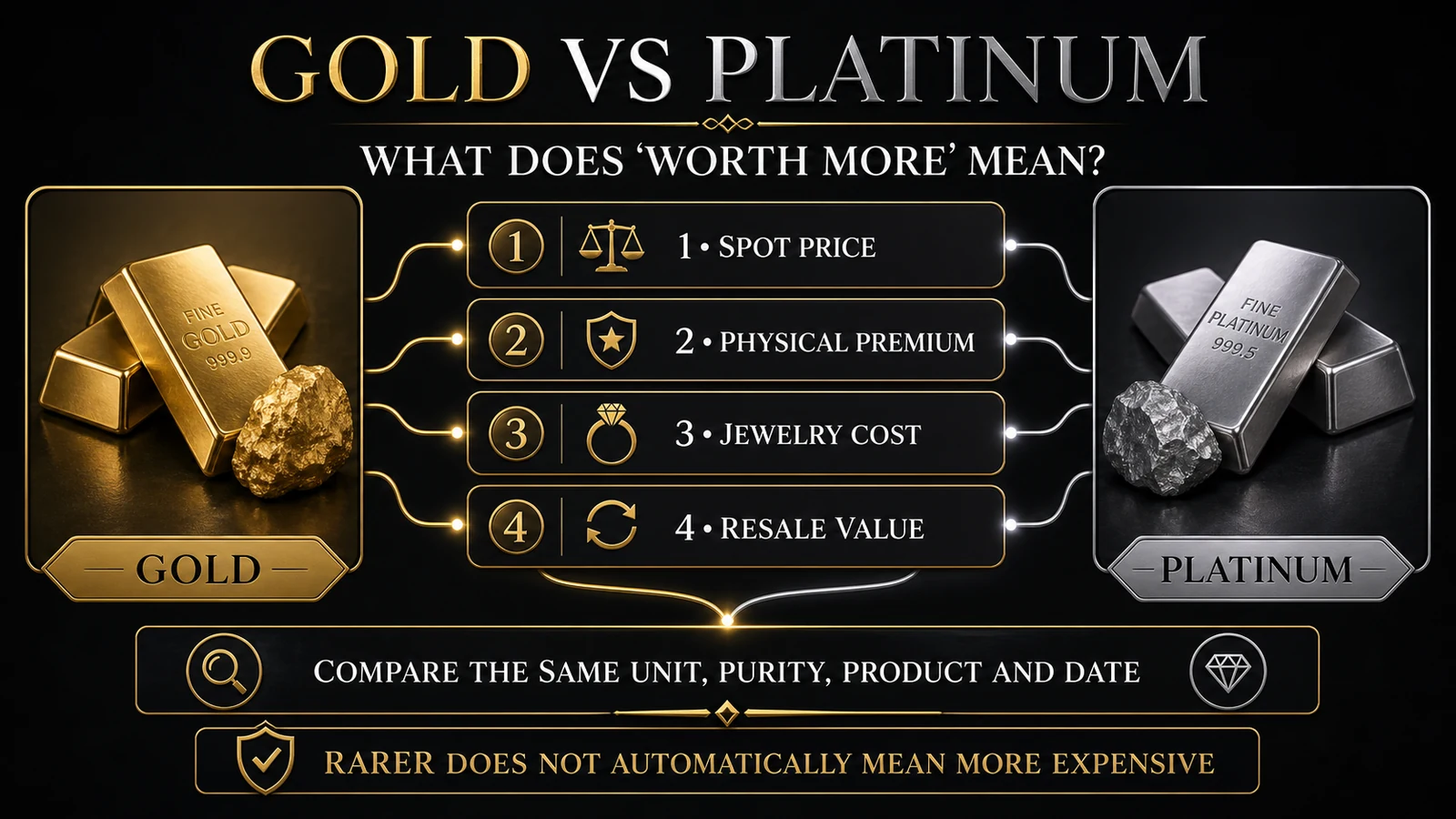
Gold versus platinum: the four-layer comparison
| Value layer | Gold | Platinum |
|---|---|---|
| Benchmark spot | Currently higher per troy ounce. | Currently lower, though the relationship has reversed historically. |
| Physical bullion | Deep global coin/bar market and generally broad dealer inventory. | Smaller product market can mean wider premiums or spreads. |
| Jewelry retail | Price depends on karat, color alloy, fabrication and possible rhodium plating. | Often high purity and greater density; specialized labor can raise the finished price. |
| Resale | Usually broad recognition and more outlets. | Fewer buyers in some locations; assay and spread matter. |
Why rarer platinum can trade below gold
Market price reflects marginal supply and demand, inventories, investment flows, substitution, recycling and macro conditions—not scarcity alone. Platinum demand is heavily industrial, especially automotive and chemical uses, so its cycle differs from gold’s monetary and investment demand.
The World Platinum Investment Council forecast a fourth consecutive 2026 market deficit in its Q1 update. That is relevant evidence of tightness, but WPIC is an industry body and a deficit does not dictate a price path or investment return.
Johnson Matthey’s 2026 PGM report also points to demand exceeding supply. Gold can still command more because its above-ground stock, central-bank role, investor base and safe-haven demand create a different market structure.
Why platinum jewelry can cost more
Platinum jewelry is often marked 950, indicating 95% platinum, while common gold jewelry may be 14K (58.5%) or 18K (75%) gold. Platinum is also denser: an otherwise similar design can require more metal by weight. Casting, finishing and repair use specialized workflows.
White gold and platinum age differently. White gold may rely on rhodium plating for a bright white finish and require periodic replating. Platinum develops a patina as surface metal moves rather than simply vanishing. Neither behavior makes one universally “better.”
Suppose two finished rings weigh 6 g, one in 18K gold and one in platinum 950. Fine-metal content would be about 4.5 g of gold versus 5.7 g of platinum. Multiply each by the same-day price per gram, then add design, manufacturing, stones, retail overhead and maintenance. This is a comparison framework, not a quote.
A one-ounce platinum coin and one-ounce gold coin contain the same troy-ounce weight of their stated fine metal, but their retail economics differ. Platinum products may be made in smaller runs and held by fewer dealers. A higher percentage premium can make platinum costlier relative to spot and a wider buy/sell spread can reduce short-term realizable value.
Check the gold-price framework, why platinum can be cheaper than gold, platinum versus gold for jewelry, and how to buy gold coins.
Why the gold–platinum relationship changes
Platinum traded above gold during parts of the 2000s, when automotive and industrial demand met constrained supply. The relationship changed as the financial crisis, diesel-emissions shifts, substitution and investment demand affected the metals differently. Gold also gained from monetary uncertainty and central-bank buying.
This history does not create a mean-reversion rule. A past premium is not evidence that platinum must return above gold. CME’s 2026 relative-value analysis uses distinct supply, demand and investment channels rather than treating the ratio as guaranteed.
Weight, volume and finished object
Platinum is denser than the gold alloys used in most jewelry. If two rings have the same external dimensions, the platinum version will usually weigh more. If they have the same weight, they cannot have exactly the same volume and construction.
A fair quote should therefore state finished weight, fineness, dimensions and included services. Comparing a light 14K white-gold ring with a heavier platinum 950 ring and assigning the entire price gap to spot value is misleading.
| Decision | Gold | Platinum |
|---|---|---|
| Bullion liquidity | More products and buyers in many markets | Smaller market can mean wider spreads |
| White jewelry | May use rhodium for a bright white finish | Naturally white, usually no rhodium layer |
| Daily wear | Alloy choice changes hardness and color | Develops a characteristic patina |
| Quote economics | Higher current spot, but 14K/18K contain less fine gold | Lower current spot can be offset by purity, density and labor |
- Record the date, currency and benchmark source.
- Normalize both metals to the same unit and fine-metal purity.
- Add product premium, shipping, tax, storage or making charges.
- Request an actual resale bid and calculate the spread.
Resale: calculate the bid, not the story
A jeweler may value a signed or desirable piece above melt, while a scrap buyer may pay only for recoverable metal after testing. Stones can be removed, discounted or excluded. Bullion dealers usually quote recognizable investment products more efficiently than unmarked jewelry.
Ask for at least two written or recorded bids made close together in time. Divide the best net bid by the same-day fine-metal reference value to see how much of theoretical metal value is realizable. That percentage is more useful than comparing original retail receipts.
This comparison is educational, not personalized investment advice. Precious-metal prices, premiums, exchange rates and tax treatment change; verify live terms and your jurisdiction before buying or selling.
Knowledge Gap and Editorial Perspective
No single global retail spread represents platinum or gold. Product availability, bar size, dealer inventory, location and tax rules can overwhelm a small spot-price difference.
Do not buy platinum merely because it is rarer, or gold merely because its spot price is higher. Decide which value layer matters, normalize the comparison, and test the exit price before committing.
Video walkthrough: This jeweler comparison gives visual context for density, color and finished-product differences beyond the spot price.
Bottom Line
Gold is currently worth more than platinum by benchmark price per troy ounce. A finished platinum product can still cost more, and the ranking can change; compare the same date, unit, purity, product and resale channel.
FAQ: Platinum vs Gold Value
Is platinum currently more expensive than gold?
No. At this July 2026 update, gold’s benchmark price per troy ounce is higher. Check live benchmarks before any transaction.
Why is platinum cheaper if it is rarer?
Price reflects demand, inventories, investment flows, industrial cycles, substitution and liquidity—not rarity alone.
Why can a platinum ring cost more than a gold ring?
Platinum jewelry is often 95% pure, dense and labor-intensive, so it may use more fine metal and cost more to fabricate.
Has platinum ever been worth more than gold?
Yes. The price relationship has reversed in past market cycles, which is why undated statements are unreliable.
Which metal has better resale value?
Gold generally has broader resale liquidity, but the actual result depends on purity, product, condition, assay, spread and buyer.
Sources and verification
- LBMA — Precious Metal Benchmark Prices — Benchmark context for gold and platinum prices; live values must be checked at transaction time.
- CME Group — Relative Value Prospects of Precious Metals in 2026 — Current-cycle comparison of gold, platinum and other precious metals.
- World Platinum Investment Council — Platinum Quarterly — Q1 2026 supply-demand analysis and forecast; commissioned by WPIC and independently researched by Metals Focus.
- Johnson Matthey — 2026 PGM Market Report — Independent industry view of constrained mine supply and 2026 platinum deficit.
- FTC — Jewelry Guides — Disclosure context for precious-metal fineness and jewelry terminology.
- TraxNYC — Gold and Platinum Difference — Visual jewelry comparison; market claims are cross-checked against benchmark and industry sources.
 When you purchase a service or a product through our links, we sometimes earn a commission, at no extra cost to you.