

Gold can trigger metal detectors, but size, shape, settings, depth, and security thresholds determine whether an alarm occurs.
- Gold is conductive and detectable even though it is not magnetic.
- Small jewelry may pass a security gate; larger gold objects are more likely to alarm.
- A detector response cannot prove purity or authenticity.

Yes, metal detectors can detect gold. Gold conducts electricity, so it produces a detectable response in an electromagnetic field even though pure gold is not magnetic. Whether a device actually alarms depends on the gold item’s mass, shape, orientation, distance, the detector type, and its sensitivity or discrimination settings.
- A gold ring, coin, bar, or nugget can be detected; a very fine chain or tiny flake may produce too little signal.
- Airport walk-through systems are tuned for security, not for identifying every small piece of jewelry.
- Hobby detectors may classify small gold in the same range as foil, pull tabs, lead, or other low-conductivity targets.
- Depth, soil mineralization, saltwater, coil position, and settings can matter more than karat alone.
- A beep does not prove an item is real gold, and no beep does not prove it is fake.
The short answer is simple, but “does gold set off metal detectors?” is really two questions. A detector may sense a gold item without crossing the alarm threshold set for a security checkpoint.
A hobby detector works differently from a walk-through gate, and a one-ounce coin is a very different target from a hollow chain link or a grain-sized nugget. The practical answer therefore depends on the situation.
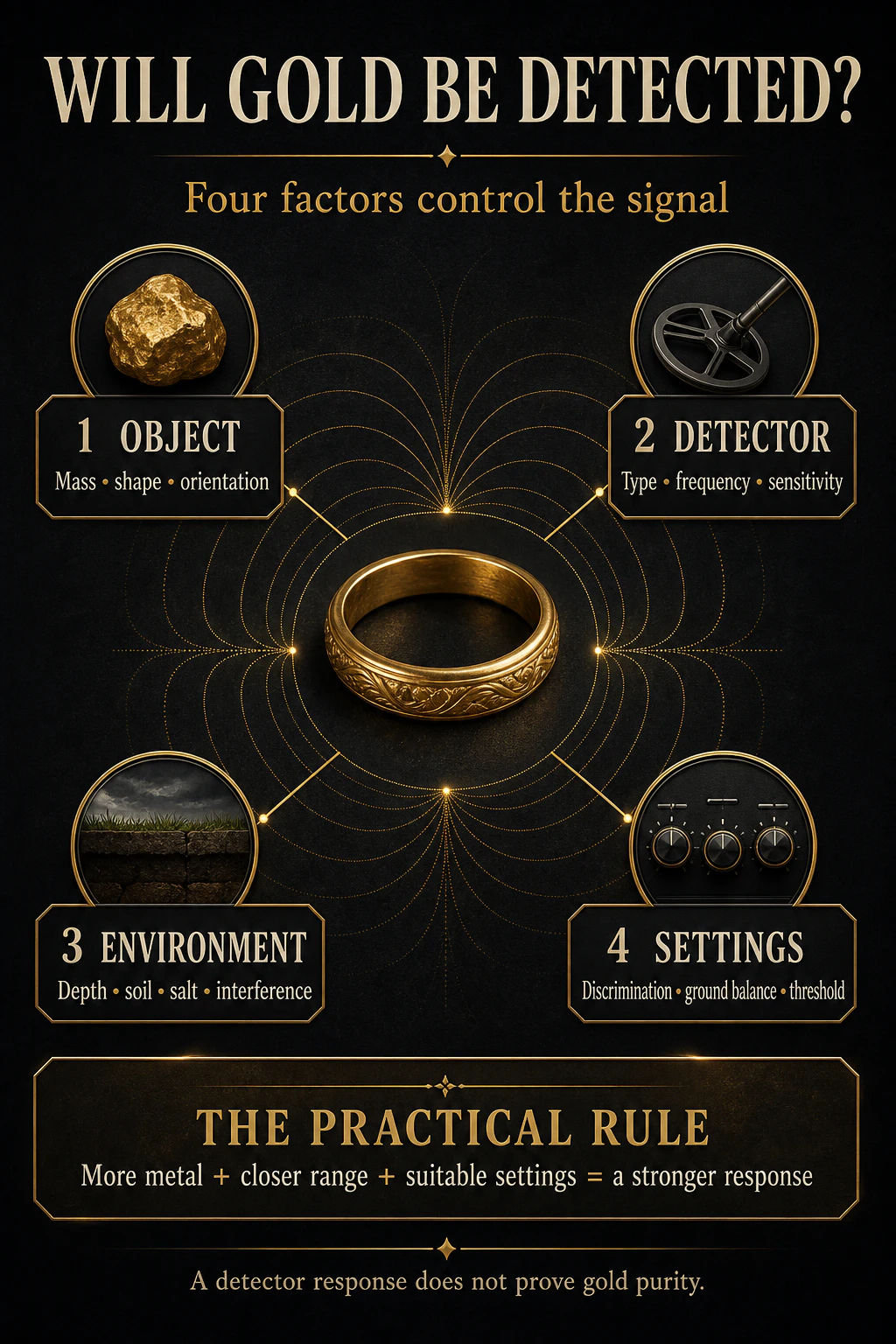
Reusable GoldConsul visual
Reuse this visual
You may reuse Gold Detection Factors: Object, Detector, Environment, and Settings in an editorial or educational article under GoldConsul’s visual reuse terms. Credit the visual, link to this source page, and keep its facts and labels unchanged.
Copy the suggested embed code
<figure>
  <a href="https://goldconsul.com/does-gold-set-off-metal-detectors/"><img src="https://goldconsul.com/wp-content/uploads/2026/07/goldconsul-gold-detection-factors-infographic-2026.webp" alt="Infographic explaining how object size, detector type, environment, and settings affect whether gold is detected" width="1024" height="1536" loading="lazy"></a>
  <figcaption>Source: <a href="https://goldconsul.com/does-gold-set-off-metal-detectors/">GoldConsul — Gold Detection Factors: Object, Detector, Environment, and Settings</a></figcaption>
</figure>Why a metal detector can detect non-magnetic gold
Search-coil metal detectors transmit a changing electromagnetic field. When that field reaches a conductive object, it drives small circulating electrical currents—called eddy currents—inside the metal.
The object then produces a secondary field that the detector’s receive system can measure. Minelab’s technical overview describes this transmit-and-return process and explains how modern detectors also use conductivity and magnetic behavior to estimate a target category in a Target ID.
This is why the fact that gold does not normally stick to a magnet does not make it invisible. Magnetism and electrical conductivity are different material properties; gold’s electrical conductivity supplies the response an induction detector can sense.
Knowledge Gap: detected does not always mean alarmed
A detector can register a weak metal response while its software deliberately suppresses the alarm. Security gates are configured to find threat-sized objects with manageable nuisance alarms, while gold-recovery detectors may be configured to report much smaller low-conductivity targets.
Gold detection changes with the type of detector
| Detector context | Primary job | What to expect from gold | Main limitation |
|---|---|---|---|
| Airport or venue walk-through gate | Flag security-relevant metal masses | Bulky jewelry, watches, coins, and bars are more likely to alarm than a small ring | Thresholds and screening procedures vary |
| Handheld security wand | Localize metal after an alert or during a targeted check | Can find jewelry when brought close to the item | Range is short and operator technique matters |
| VLF hobby detector | Locate and classify buried conductive targets | Good for many rings, coins, and shallow small targets | Small gold can overlap foil and ground noise |
| Pulse-induction prospecting detector | Find metal in difficult or mineralized ground | Often useful for nuggets and challenging soils | Target classification may be less selective |
| Industrial precious-metal loss prevention | Detect small high-value metal leaving a controlled site | Purpose-built systems can be set for tiny gold masses | Specialized installation and calibration are required |
The last row matters because it proves there is no universal “security detector” sensitivity. CEIA notes that ordinary security systems may suppress the very low signals from small non-magnetic precious-metal items, while specialized precious-metal loss-prevention detectors are built to find small quantities of gold, silver, and platinum-group metals.
Will gold jewelry set off an airport metal detector?
It can, but a small piece of jewelry often passes without an alarm. A thick bracelet, large watch, layered necklaces, heavy belt hardware, or several pieces worn together present more metal and are more likely to trigger further screening.
In the United States, the TSA travel checklist tells passengers in standard screening lanes to empty their pockets and remove bulky jewelry. TSA also advises travelers to keep valuable jewelry with them rather than in checked baggage and says private screening can be requested for valuables.
Small ring or studs
Often below the nuisance-alarm threshold, but there is no guarantee at every checkpoint.
Heavy chain or stacked jewelry
More total metal makes an alarm or secondary check more likely.
Coins or bullion
Dense, substantial objects are conspicuous to screening systems and may require an explanation or inspection.
A checkpoint may use a walk-through detector, advanced imaging technology, bag X-ray, a handheld detector, or a pat-down. Advanced imaging flags anomalies rather than identifying an item as gold, and a bag X-ray shows material density and shape rather than “setting off” the walk-through gate.
Travel rule
Do not try to hide gold from security or customs controls. Carry valuable items securely, retain purchase or ownership documentation when appropriate, and check the current rules for your departure, transit, and destination countries. Screening permission and customs declaration are separate questions.
Rings, chains, coins, bars, and nuggets do not respond equally
| Gold item | Typical response | Why the result varies |
|---|---|---|
| Solid ring | Usually a compact, repeatable hobby-detector target at close range | Band thickness, diameter, karat, orientation, and depth |
| Fine chain | Can be surprisingly weak or broken | Each link is a small electrical loop; clasps may dominate the signal |
| Gold coin | Generally stronger than delicate jewelry of the same karat | Mass, broad surface, orientation, and alloy |
| Gold bar | Strong at close range because of its substantial metal mass | Distance and security-system threshold still matter |
| Natural nugget | Ranges from clear to faint | Irregular shape, small mass, host rock, depth, and mineralized ground |
| Gold-plated item | Usually reflects the base metal more than the microscopic gold layer | Base-metal composition, hollow construction, and size |
Karat can shift a signal because jewelry alloys contain copper, silver, nickel, palladium, or other metals. Yet karat alone cannot predict the result: a heavy 14K ring can be easier to detect than a delicate 22K chain because geometry and mass dominate the available signal.
There is no universal Target ID for gold
Target ID is an estimate, not a chemical analysis. Minelab’s current FAQ states that small gold nuggets tend to produce lower conductive IDs and that the displayed number rises as the target becomes larger, but the ranges also contain foil, lead shot, iron fragments, coins, and hot rocks.
Gold rings create the same practical problem. Their IDs can overlap pull tabs, aluminum, nickels, and other common trash, so aggressive discrimination can silence the exact signal a detectorist wants to recover.
- Frequency: higher frequencies are often more responsive to small or thin low-conductivity targets, while lower frequencies can favor larger, deeper high-conductivity targets.
- Depth and orientation: distance weakens the return signal, and an edge-on ring or coin may respond differently from the same target lying flat.
- Ground: mineralization, conductive salt, hot rocks, and nearby iron can mask or distort a target.
- Coil and sweep: coil size, height, overlap, and speed affect whether a weak response is heard.
- Settings: sensitivity, ground balance, mode, threshold, and rejected ID ranges can reveal or hide gold.
Gold signal expectation tool
Select a scenario to get a qualitative expectation. This is not a probability or a guarantee; it shows which factors usually raise or lower the signal.
Three worked examples
Example 1: a thin 18K chain at an airport
The chain is conductive, but its tiny separate links may create a low total response. A walk-through gate tuned to reduce nuisance alarms may not sound, while a close handheld scan can still locate it.
Example 2: a lost 14K wedding band in dry sand
A solid ring near the surface is a favorable hobby-detector target. The operator should test a similar ring if possible, search from two directions, overlap sweeps, and avoid rejecting the pull-tab or foil range too aggressively.
Example 3: a tiny nugget in mineralized soil
The gold is detectable in principle, but ground response can be stronger than the nugget signal. A suitable prospecting detector, correct ground balance, slow coil control, and digging ambiguous low-conductivity responses improve the chance of recovery.
Checklist for finding a lost gold item
- Define the last reliable location. Reconstruct when the item was last touched, removed, or seen before widening the search.
- Get permission. Ask the landowner or site manager and follow local detecting and archaeological rules.
- Match the equipment to the site. Check that the coil and detector are suitable for wet sand, water, mineralized soil, or a trash-filled park.
- Bench-test a comparable item. Use a similar ring or chain to learn the audio and ID on that exact machine; do not assume an online number transfers.
- Lower discrimination. Accept low and mid-conductivity targets that could overlap the missing gold.
- Search in a grid. Keep the coil level, overlap sweeps, then repeat at 90 degrees to change target orientation.
- Recover carefully. Use a pinpointer or hand search near the target to avoid scratching jewelry or damaging the site.
If a detector is unavailable, the right alternative depends on the item and location. Our guide to finding gold without a metal detector explains visual, documentation, density, and professional-testing routes without pretending one household trick works everywhere.
A metal detector cannot tell you whether gold is real
A detector confirms that a conductive target is present. Brass, copper, aluminum, lead, plated jewelry, and many alloys also produce responses, and two very different objects can share a similar Target ID.
For authenticity, combine hallmarks, measured weight and dimensions, density where appropriate, and a professional method such as X-ray fluorescence or assay. Start with our guide to telling whether gold is real and the limits of common gold-purity tests.
Editorial Perspective
Use a detector response as a location clue, not a material certificate. If the question affects a valuable purchase, insurance claim, airport declaration, or legal recovery, verify the item and the applicable rules through documentation and qualified testing rather than relying on one beep.
Watch: how discrimination separates junk from targets
Minelab’s short explainer shows why conductivity-based classification can help—but can also place gold in the same broad neighborhood as unwanted targets.
Video explainer: Minelab demonstrates how a detector separates junk from promising targets—and why a conductivity ID is not a material certificate.
Bottom Line: gold is detectable, but alarms are conditional
Gold can set off a metal detector because it is electrically conductive. The most reliable expectation is not “gold always alarms” or “gold passes unnoticed,” but a factor check: more metal, closer range, favorable orientation, suitable frequency, clean ground, and permissive settings make detection more likely.
At security checkpoints, follow the officer’s instructions and remove bulky jewelry when requested. In the field, test the specific detector, keep discrimination conservative, and remember that a target ID cannot authenticate the find.
FAQ: Does Gold Set Off Metal Detectors?
Will a gold wedding ring set off an airport metal detector?
It can, but many small wedding rings fall below a walk-through gate’s alarm threshold. The outcome depends on ring mass, other metal worn nearby, system settings, and the screening procedure used at that checkpoint.
Can a metal detector find a gold chain?
Yes, but fine chains can be harder than solid rings because each link forms a small target and the clasp may produce the strongest response. Search slowly from multiple directions and use low discrimination.
Does 24K gold respond differently from 14K gold?
Alloy composition can shift the conductivity response and Target ID, but karat is only one variable. A heavier 14K object may be easier to detect than a tiny 24K object because mass, shape, depth, and orientation strongly affect signal strength.
Can a phone detect gold like a metal detector?
Not reliably. Phone “metal detector” apps generally use the magnetometer, which is most responsive to magnetic fields and ferrous objects. Gold is not ferromagnetic, and the phone lacks the transmit-and-receive search coil used by a real induction detector.
Does a metal-detector beep prove jewelry is genuine gold?
No. Many conductive base metals and plated items also beep, while some genuine small gold pieces may be missed. Authenticity requires separate evidence such as hallmarks, density, XRF analysis, or assay.
 When you purchase a service or a product through our links, we sometimes earn a commission, at no extra cost to you.