
Compare titanium and gold by hardness, density, karat alloy, scratch resistance, repairability, and ring wear before choosing a jewelry metal. safely.
- Titanium is usually harder, while gold feels heavier because of density.
- High-karat gold scratches more easily than many titanium jewelry pieces.
- Balance scratch resistance against resizing, repair, color, and comfort.
No. Titanium is usually harder and more scratch-resistant than gold, especially compared with high-karat gold. Gold is much denser and heavier for its size, but softness and weight are different properties.
- Titanium is generally harder than pure gold and many gold jewelry alloys.
- Gold feels heavier because its density is far higher than titanium’s.
- High-karat gold scratches more easily than lower-karat gold alloys.
- Titanium is difficult to resize, while gold is easier for jewelers to work.
- Choose by use case: scratch resistance, weight, repairability, color, and value.
Titanium vs Gold: The Simple Difference
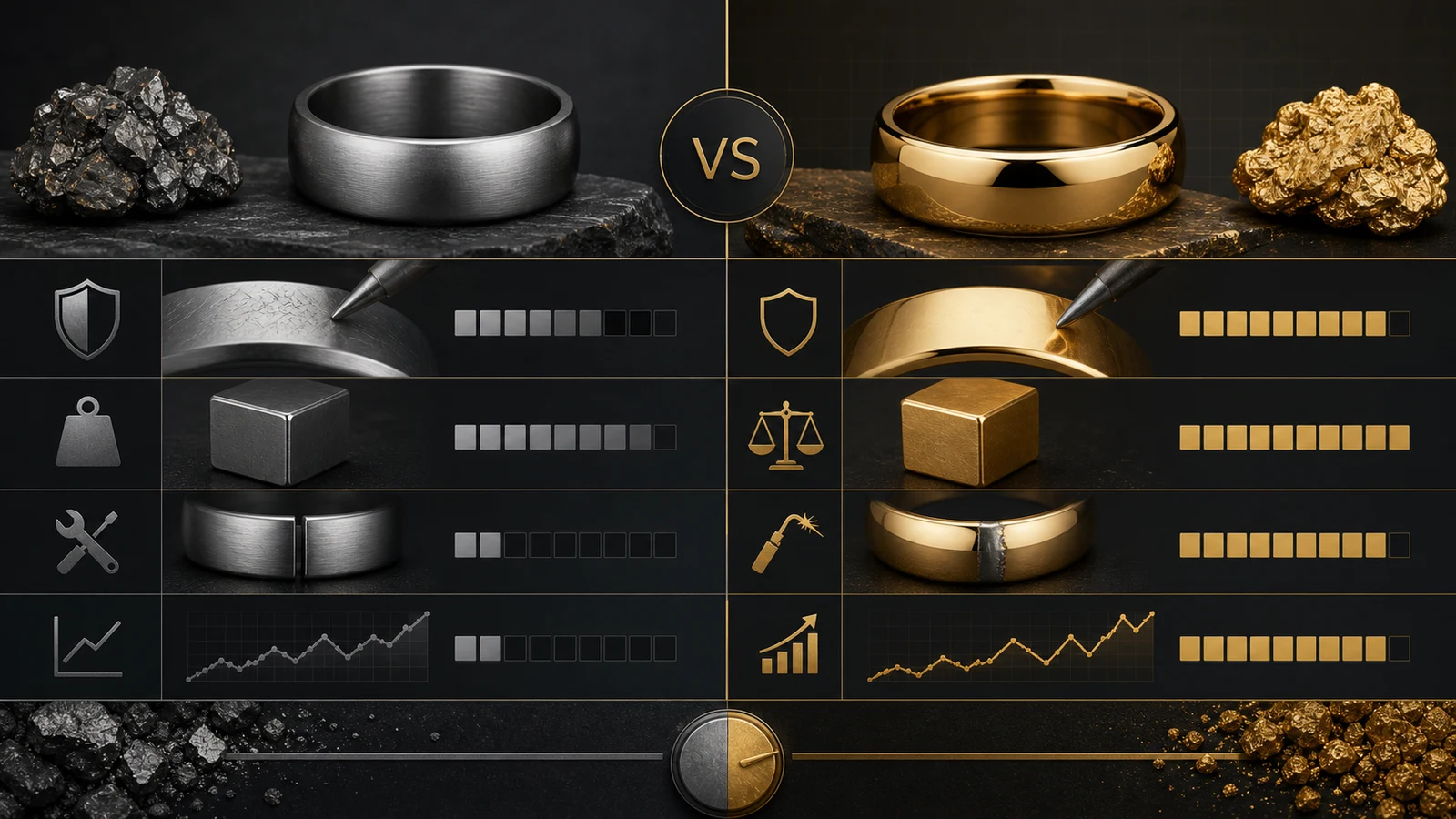
Titanium is not softer than gold in normal jewelry use. Titanium is known for a strong strength-to-weight profile and a protective oxide layer, while gold is a dense precious metal that becomes softer as karat increases.
The confusion usually comes from mixing up three different ideas: hardness, density, and value. Hardness describes resistance to scratching. Density describes how heavy a piece feels for its size. Value describes market demand, purity, craftsmanship, and resale conditions.
A titanium ring can feel light and still be harder to scratch. A gold ring can feel heavy and valuable while still picking up surface marks during daily wear.
Hardness and Density Compared
The strongest correction to make is that “harder” can mean different things depending on the test. Mohs hardness is a scratch-resistance scale used for minerals and simple comparisons. Vickers hardness is an indentation test used for metals and alloys. Both are useful, but they are not interchangeable.
| Material | Common hardness reference | Density | What it means for jewelry |
|---|---|---|---|
| Commercially pure titanium | Often around Mohs 6; Vickers varies by grade and condition | About 4.5 g/cm3 | Lightweight and generally scratch-resistant in daily wear. |
| Titanium jewelry alloys | Hardness depends on grade, heat treatment, surface finish, and coating | Usually near titanium’s low-density range | Use grade-specific data when a seller makes a technical claim. |
| Pure gold / 24K gold | Mohs about 2.5-3; AZoM describes annealed gold around 25 HV | About 19.3 g/cm3 | Very dense and valuable, but soft for everyday jewelry. |
| Gold jewelry alloys | Hardness varies by karat, alloy recipe, and work hardening | Lower than pure gold as alloy content rises | 14K and 18K are usually more practical than 24K for daily wear. |
The Royal Society of Chemistry lists titanium’s density at about 4.5 g/cm3 and gold’s density at about 19.3 g/cm3. AZoM’s gold material reference gives a useful engineering cross-check for pure gold hardness, while its titanium overview explains why titanium hardness needs grade and condition context.
Those numbers explain the practical answer. Titanium usually resists scratches better, while gold feels much heavier and carries precious-metal value. The buyer should not use weight as a hardness clue.
Why Gold Karat Matters
Pure 24K gold is soft for jewelry. It can bend or scratch more easily than lower-karat alloys, which is why everyday rings often use 14K or 18K gold instead of pure gold.
Lower-karat gold contains more alloy metals, which can improve durability. That does not make every gold alloy harder than titanium, but it explains why a 14K ring may handle wear differently from a 22K ring.
Use GoldConsul’s gold purity calculator if you want to convert karat into gold percentage, and read does 14K gold tarnish for alloy-care context.
Titanium vs 10K, 14K, 18K, 22K, and 24K Gold
Gold durability changes as the karat changes. More pure gold usually means richer color and higher gold content, but less alloy support. Lower-karat gold usually handles everyday knocks better, but it contains less gold by percentage.
| Metal choice | Gold content | Wear pattern | Best fit |
|---|---|---|---|
| Titanium | No gold content | Lightweight, scratch-resistant, harder to resize | Active wearer who wants low weight and durability |
| 10K gold | About 41.7% gold | More alloy, stronger but less rich in color | Budget durability and daily wear |
| 14K gold | About 58.3% gold | Good balance of durability, value, and color | Most everyday fine jewelry |
| 18K gold | 75% gold | Richer color, more prone to surface wear than 14K | Buyers who value higher gold content and appearance |
| 22K / 24K gold | Very high gold content | Softer, easier to dent or scratch | Cultural jewelry, investment-style pieces, or lower-impact wear |
This is why a simple titanium-versus-gold answer is not enough for a ring buyer. Titanium is often tougher against scratches, but 14K gold may be the better long-term choice if resizing, repair, traditional appearance, and resale metal value matter.
Real-World Wear Scenarios
Find Your Metal: Quick Decision Path
Choose titanium if your top priorities are low weight, scratch resistance, a modern look, and lower purchase cost. Choose gold if your top priorities are traditional fine jewelry, precious-metal value, easier repair, resizing, and long-term serviceability.
If you are undecided, start with lifestyle. A ring worn during manual work, gym activity, or frequent travel faces different wear than a ring worn mainly for formal or low-impact settings. Then consider whether resizing is likely. If the answer is yes, gold deserves extra weight in the decision.
When Titanium Is the Better Practical Choice
Titanium can be a strong choice for readers who want a lightweight, modern, durable ring and do not care about precious-metal resale value. It is also often used where low weight and corrosion resistance matter.
The tradeoff is serviceability. Titanium jewelry can be harder to resize or repair. If your finger size changes, or if you expect future engraving, soldering, or stone setting, gold is usually more flexible for a jeweler.
When Gold Is the Better Practical Choice
Gold is usually the better choice when the buyer wants traditional jewelry value, warmer color options, easy resizing, and a metal with recognized resale value. Gold also comes in many alloy styles, including yellow, white, and rose gold.
The tradeoff is surface wear. Gold jewelry, especially higher-karat gold, can develop scratches and polish marks. That is normal wear, not necessarily a quality problem.
Buyer Checklist
- Choose titanium if lightweight scratch resistance matters more than resale metal value.
- Choose gold if precious-metal value, resizing, and traditional repairability matter more.
- Compare karat before judging gold durability.
- Ask whether white gold is nickel-based or palladium-based if allergies matter.
- For valuable jewelry, keep receipts, hallmarks, and appraisal documents.
Sources and Further Reading
Related GoldConsul Guides
For connected decisions, read is gold heavier than silver, testing gold purity, is white gold magnetic, how to tell if rose gold is real, and the gold weight estimator.
How to Apply This Guide
Use the quick answer as orientation, then slow down before acting. Gold topics often combine material science, market value, legal access, or historical interpretation. A simple fact can be true and still incomplete when applied to a specific item, place, or claim.
The safest workflow is to identify the exact thing in front of you first. For jewelry, that means karat, construction, plating, wear, hallmarks, and seller disclosure. For gold value, that means weight, purity, troy-ounce conversion, spot price, and buyer payout. For prospecting or history, that means land status, source quality, artifact context, and whether a story has been simplified over time.
Evidence Ladder
| Confidence level | What it looks like | How to use it |
|---|---|---|
| General fact | A broad rule such as gold is dense, gold can be recycled, or Texas has some gold occurrences. | Use it to ask better questions, not to make a final decision. |
| Case-specific evidence | Weight, dimensions, hallmark, source record, official land status, or a clearly documented calculation. | Use it to narrow the likely answer for this exact situation. |
| Independent confirmation | Professional testing, official agency guidance, refiner documentation, museum source, or trusted benchmark data. | Use it when money, safety, legality, or resale trust is involved. |
This ladder prevents overconfidence. A single clue can be useful, but it rarely carries the whole answer. The more money or risk involved, the higher you should move on the ladder before taking action.
Common Mistakes to Avoid
- Do not treat one clue as proof when the topic needs multiple checks.
- Do not apply a general gold fact to a plated, alloyed, repaired, or unknown item without checking construction.
- Do not use historical rumors or location lists as a substitute for primary sources, permissions, or official rules.
- Do not confuse theoretical value with the amount a dealer, refiner, or buyer may actually pay.
- Do not choose a risky cleaning, testing, recovery, or prospecting method when a lower-risk verification step is available.
When to Escalate
Escalate when the answer affects a purchase, sale, heirloom, legal access, chemical safety, or a claim you plan to repeat as fact. For jewelry, that may mean a jeweler, XRF test, assay, or appraisal. For scrap and value questions, it may mean using current spot prices and comparing multiple buyers. For prospecting, it may mean checking the relevant agency or landowner before visiting a site.
For history and myth, escalation means using museum, archaeological, or academic references instead of repeating the most dramatic version of the story. Gold attracts exaggerated claims because it is valuable, symbolic, and visually persuasive. Better decisions come from matching the claim to the right evidence.
What This Guide Cannot Prove
This guide can explain the concept, show the calculation path, identify common traps, and point to stronger sources. It cannot authenticate a specific object through the screen, grant permission to prospect, guarantee a buyer payout, or settle every historical dispute.
That limitation is useful. It tells you when a quick answer is enough and when the next step should be documentation, official rules, or professional review. The goal is to make the reader more confident without making the answer sound more certain than the evidence allows.
Practical Takeaway
Simple facts help orientation, but they should not replace documentation, official rules, professional testing, or careful source checks when value, safety, legality, or resale trust is involved.
FAQ: is titanium softer than gold
Is titanium harder than gold?
Yes, titanium is generally harder and more scratch-resistant than pure gold and many gold jewelry alloys.
Why does gold feel heavier than titanium?
Gold is much denser. Pure gold has a density around 19.3 g/cm3, while titanium is about 4.5 g/cm3.
Is titanium more valuable than gold?
No. Titanium can be useful and durable, but gold usually has much higher precious-metal value.
Is titanium better than gold for rings?
It depends. Titanium is light and durable, while gold is more traditional, valuable, and easier to resize or repair.
Does gold scratch more easily than titanium?
Often yes, especially high-karat gold. Lower-karat gold alloys are usually more durable than pure gold.
Is Mohs hardness the same as Vickers hardness?
No. Mohs hardness is a scratch-resistance scale, while Vickers hardness measures indentation resistance. Both help, but they answer different material questions.
Is Mohs hardness the same as Vickers hardness?
No. Mohs hardness is a scratch-resistance scale, while Vickers hardness measures indentation resistance. Both help, but they answer different material questions.
Bottom Line
No. Titanium is usually harder and more scratch-resistant than gold, especially compared with high-karat gold. Gold is much denser and heavier for its size, but softness and weight are different properties. Use the checklist, sources, and related GoldConsul guides above to move from a quick answer to a practical decision.
 When you purchase a service or a product through our links, we sometimes earn a commission, at no extra cost to you.