
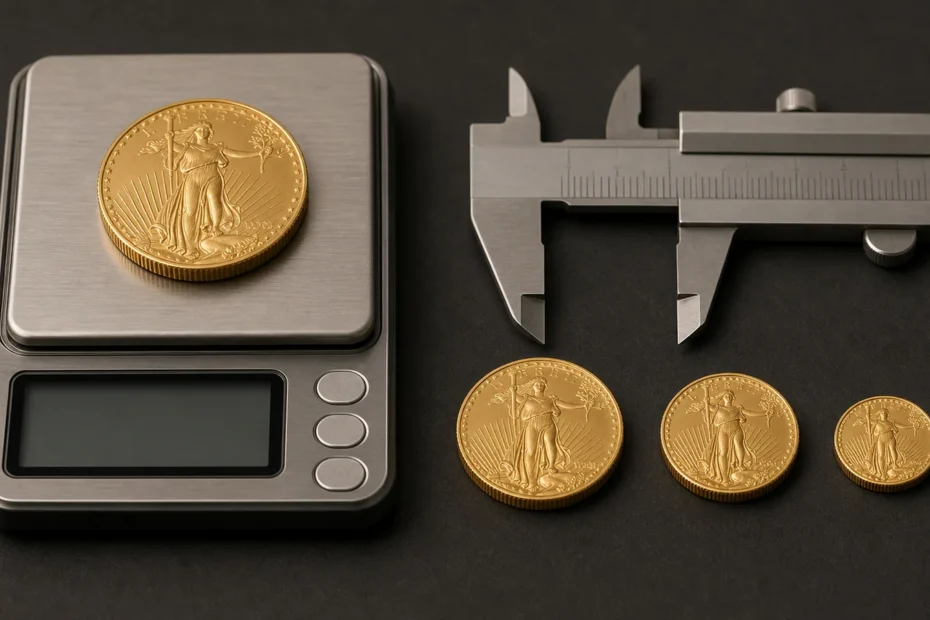
See official American Gold Eagle gross weights, fine-gold content, diameters, face values, and why a 1 oz 22K Eagle weighs 33.931 grams.
- A 1 oz American Gold Eagle has 1.0000 troy oz of fine gold but weighs 33.931 g in total because it is a 22K alloy.
- Official gross weights are 33.931 g, 16.966 g, 8.483 g and 3.393 g from the 1 oz to 1/10 oz size.
- Weight is only one screening check; verify diameter, design, edge, seller and non-destructive authentication together.
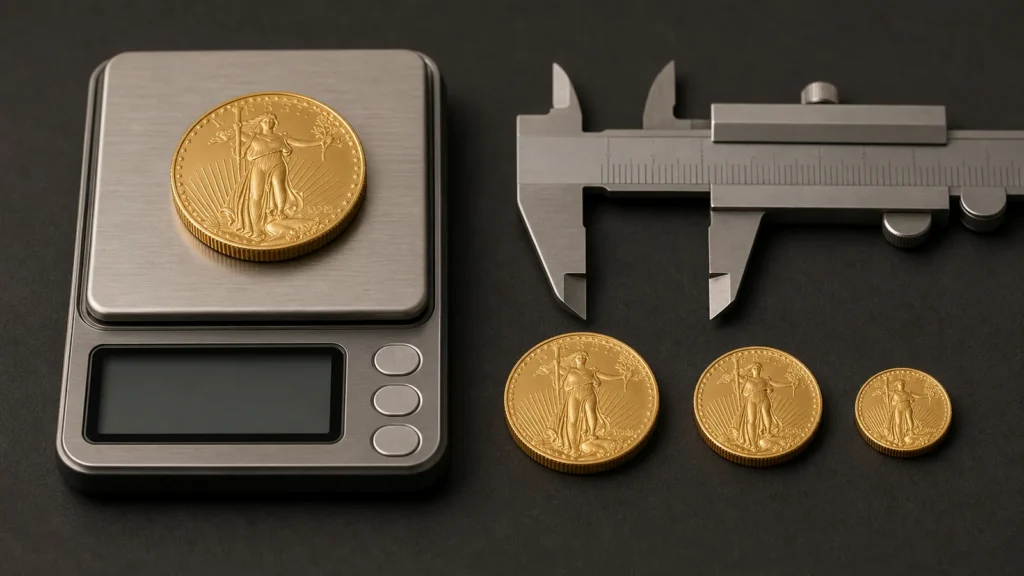
- A one-ounce Gold Eagle weighs 1.0909 troy ounces gross, or 33.931 grams.
- The coin is 91.67% gold, 3% silver and the balance copper.
- Its alloy does not reduce the stated fine gold content.
- Fractional coins contain their full labeled fine-gold amount.
- Correct weight helps screening but does not prove authenticity.
Fine weight and gross weight answer different questions
The word “one ounce” on a Gold Eagle refers to pure gold content. The physical coin weighs more than one troy ounce because silver and copper are added for durability. Confusing these two weights leads to incorrect valuations and false counterfeit alarms.
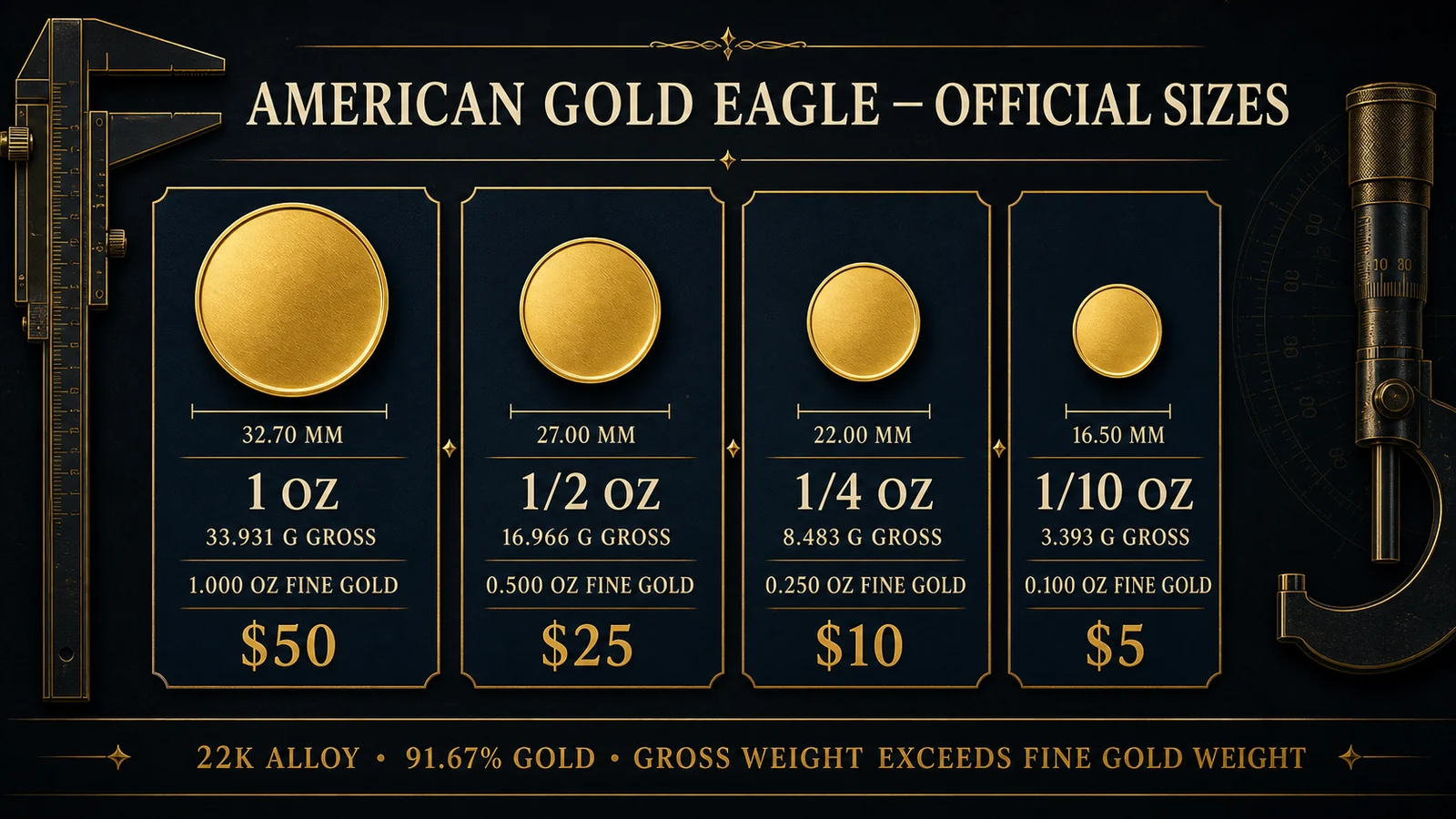
Official American Gold Eagle weights and dimensions
| Size | Fine gold content | Gross troy weight | Gross grams | Diameter | Face value |
|---|---|---|---|---|---|
| 1 oz | 1.0000 troy oz | 1.0909 troy oz | 33.931 g | 32.70 mm | $50 |
| 1/2 oz | 0.5000 troy oz | 0.5455 troy oz | 16.966 g | 27.00 mm | $25 |
| 1/4 oz | 0.2500 troy oz | about 0.2727 troy oz | 8.483 g | 22.00 mm | $10 |
| 1/10 oz | 0.1000 troy oz | about 0.1091 troy oz | 3.393 g | 16.50 mm | $5 |
These specifications come from the U.S. Mint’s American Eagle Gold Proof page and bullion program materials. Use the issuing mint’s current table as the controlling reference; displayed decimal conversions are rounded.
Why a 22K one-ounce Eagle weighs 33.931 grams
Twenty-two karat means 22 of 24 parts by mass are gold, or nominally 91.67%. To deliver one full troy ounce of fine gold inside that alloy, the mint must make the total coin heavier.
One troy ounce equals 31.1034768 grams under the standard mass conversion. Divide that fine-gold amount by the nominal gold fraction:
The official specification is 33.931 grams. The small difference reflects rounded karat notation and displayed decimals; use the Mint specification, not a home calculation, for inspection.
The alloy contains 3% silver with copper making up the remaining balance. Those metals add mass and hardness. They do not replace any portion of the promised one, one-half, one-quarter or one-tenth ounce of fine gold.
Troy ounces are not household ounces
Precious metals use the troy system. One troy ounce is about 31.1035 grams; an ordinary avoirdupois ounce is about 28.3495 grams. A kitchen scale set to “oz” may display avoirdupois ounces and create confusion even when its gram reading is reasonable.
A tube of ten 1/10-ounce Eagles contains the same one ounce of fine gold as one full-ounce Eagle, but it usually costs more in total because minting, handling and dealer costs are spread over smaller units. Fractionals offer smaller transaction sizes, which can be useful, but flexibility has a price.
Compare both percentage and dollar premium. Also request a current buyback quote. A high acquisition premium is not automatically recovered when selling. The gold coin buying guide covers dealer, payment and spread checks.
Gold Eagle versus Gold Buffalo
Both one-ounce coins contain one troy ounce of fine gold. The Gold Eagle is a 22K alloy and weighs about 33.931 grams gross. The American Buffalo is 24K, .9999 fine gold, so its gross mass is close to the one-ounce fine content. The Eagle’s higher total mass does not mean it contains more gold.
Likewise, denomination is not bullion content. The one-ounce Gold Eagle carries $50 face value, while a modern American Liberty gold coin may carry $100. See the $100 gold coin guide to avoid mixing coin programs.
Can weight prove that a Gold Eagle is real?
No. Weight is one screening input. A counterfeit may match mass while failing diameter, thickness, density, electromagnetic response or design diagnostics. A genuine coin can also show tiny measurement differences from scale error, calibration, holder weight or debris.
- Use a scale with suitable resolution and calibrate it with a known mass.
- Remove capsules only when safe and subtract any holder or packaging.
- Measure diameter and thickness with non-marring tools.
- Compare date-specific obverse and reverse details with official images.
- Check the edge and reeding; do not file, drill or acid-test a coin.
- Use a reputable dealer or professional instrument for high-value verification.
- Verify certified holders directly with the grading service.
Read testing gold coins for method limitations and buying American Gold Eagles for transaction checks. GoldConsul’s weight estimator helps convert units but cannot authenticate a coin.
Valuing an American Gold Eagle
Start with fine content, not face value or gross weight. Multiply fine ounces by a same-time gold reference, then add or subtract the actual market premium and spread. Proof and collectible editions may have numismatic value that is not explained by metal alone.
For a full-ounce bullion Eagle, the metal reference is one times spot. For a quarter-ounce coin, it is 0.25 times spot. Four quarter-ounce coins contain one ounce of fine gold, although their combined retail premium may be higher.
The Mint produces bullion coins for investment distribution and collector versions with different finishes and packaging. A proof or burnished uncirculated Eagle of the same size contains the same fine-gold quantity and follows the official physical specification, but it can trade at a collector premium.
Do not infer version from weight. Identify the finish, mint mark, year, packaging and product description. A dealer price for a proof is not a valid comparable for a common bullion coin, and a bullion buyback quote may ignore much of a collector premium.
Measurement uncertainty and sensible precision
A consumer scale displaying 0.01 g resolution is not necessarily accurate to 0.01 g. Calibration, surface level, temperature, drafts and repeatability all matter. Take several readings and treat a small mismatch as a reason to verify equipment, not immediate proof of a fake.
Diameter measurements can be affected by tool pressure and protective capsules. Thickness is especially hard to compare because relief changes across the coin face and published specifications may use maximum dimensions. Non-destructive professional instruments provide a stronger result by combining mass and geometry with electromagnetic or elemental response.
Keep the coin dry, avoid PVC-containing holders and handle it only by the edge. Storage damage may not change fine-gold content, but it can reduce collector value.
At a hypothetical spot price of $3,000, a 1/10-ounce coin has a $300 metal reference. If offered at $345, the premium is $45, or 15%. A one-ounce coin offered at $3,090 has a $90 premium, but only 3%. The smaller coin costs less in dollars while costing more per fine ounce.
Many weight tables omit whether numbers are fine or gross and round fractional specifications inconsistently. A usable table must label units, composition and source. It should also state that tolerance and authentication require more than matching a displayed decimal.
The 22K alloy is not a compromise in gold content. It is the engineering method used to place a guaranteed fine-gold quantity inside a more durable coin. Once fine and gross weight are separated, the specifications become intuitive.
This article is educational, not an appraisal. Do not damage a coin to test it. Specifications and market premiums should be verified with the U.S. Mint and reputable current market sources.
Watch the mechanism: This brief coin overview complements the official Mint specification table above.
Bottom Line
American Gold Eagles weigh more than their stated fine-gold size because they are 22K alloy. Use 33.931 g, 16.966 g, 8.483 g and 3.393 g as the official gross weights for the four sizes, and use the labeled fine ounces for metal-value calculations.
FAQ: American Gold Eagle Weight
How much does a one-ounce Gold Eagle weigh?
Its official gross weight is 1.0909 troy ounces, or 33.931 grams, and it contains exactly one troy ounce of fine gold.
Why is a one-ounce Gold Eagle heavier than one ounce?
The coin includes silver and copper for durability. The extra alloy mass sits alongside, not instead of, the full one ounce of gold.
How much does a quarter-ounce Gold Eagle weigh?
Its official gross weight is 8.483 grams and it contains 0.250 troy ounce of fine gold.
Are American Gold Eagles pure 24K gold?
No. They are 22K, nominally 91.67% gold, with 3% silver and the balance copper.
Can I authenticate a Gold Eagle by weight?
Correct weight is necessary but not sufficient. Combine it with dimensions, design, edge, provenance and qualified non-destructive testing.
Sources and verification
This guide relies on regulator, issuer, mint and specialist market sources. Product terms, prices and regulations can change, so recheck the dated primary source before acting.
- U.S. Mint — American Eagle Gold Proof Coins — Official gross weights, fine-gold content, diameters and denominations for all four sizes.
- U.S. Mint — Bullion Coin Programs — Official composition, sizes, government guarantee and Gold Buffalo comparison.
- U.S. Mint — How to Buy Bullion Coins — Official authorized-purchaser and retail-distribution explanation.
- U.S. Mint — Gold Eagles — Historical distinction between eagle denominations and modern American Eagles.
- NIST — SI Units: Mass — Authoritative unit context for grams and mass measurement.
- NGC — Verify Certification — Holder and certification verification support.
- PCGS — Cert Verification — Independent certification-number verification.
- LBMA — Precious Metal Prices — Benchmark context for value calculations; not a coin-authentication source.
- Gold Bullion Coin Act of 1985 — Legislative origin of the modern American Gold Eagle program.
- APMEX — The American Gold Eagle — Brief visual identification context; specifications remain sourced to the U.S. Mint.
 When you purchase a service or a product through our links, we sometimes earn a commission, at no extra cost to you.