
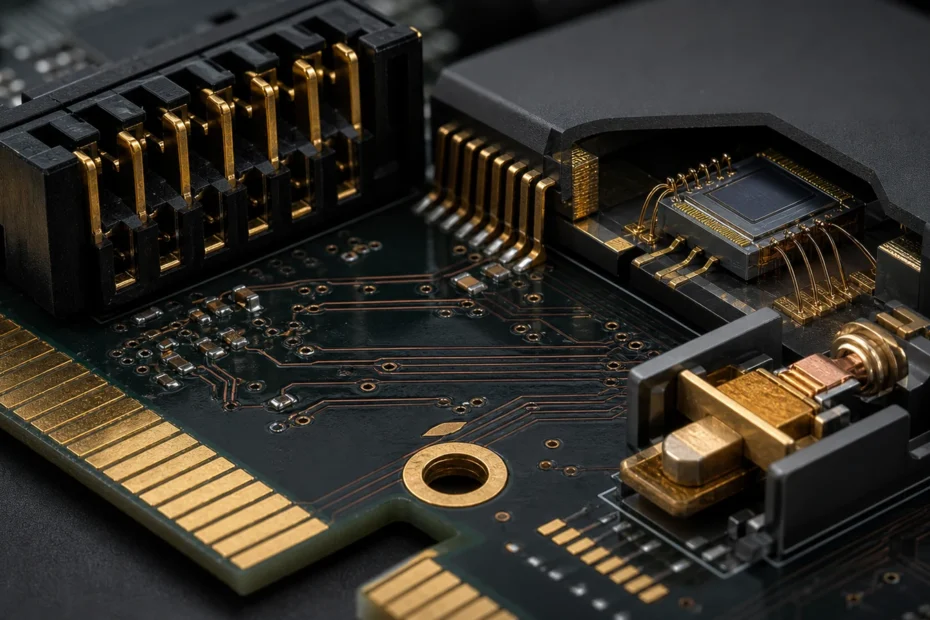
See where electronics use gold, why corrosion resistance matters, how plating and bonding wires work, and why certified recycling beats DIY recovery.
- Electronics use gold mainly as thin contact plating, connector surfaces and microscopic interconnects – not solid decorative metal.
- Gold is selected where corrosion-free, low-resistance contact reliability outweighs material cost.
- Reuse or certified recycling is safer and usually more rational than home acid recovery from a few devices.
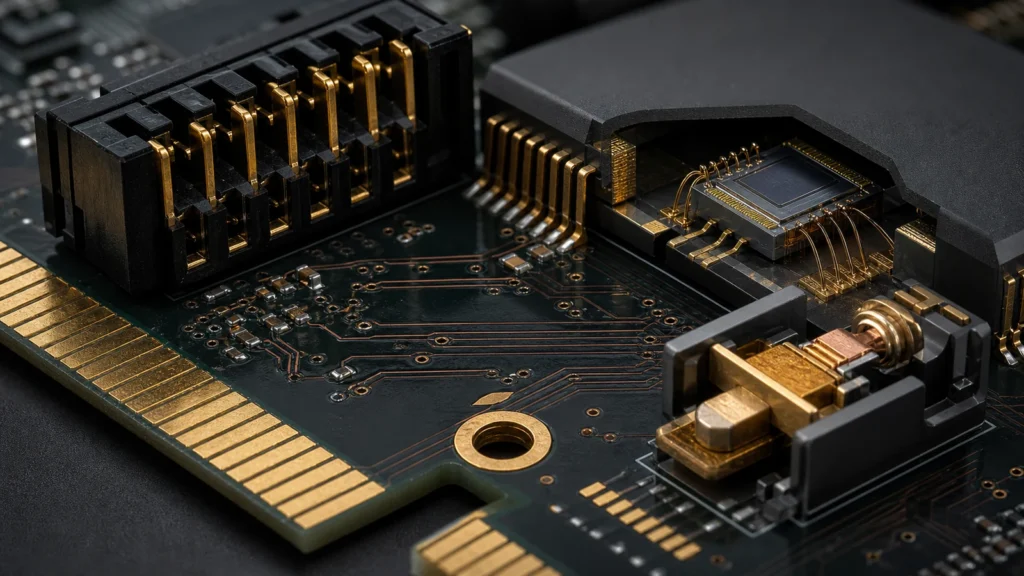
- Gold is concentrated at interfaces where a thin oxide or corrosion film could cause failure.
- Most visible gold color is a thin engineered layer, not a solid-gold component.
- Connectors, edge fingers, relays, switches, chip packages and some PCB finishes are key locations.
- There is no reliable universal “gold per phone” number across models, years and recovery methods.
- Reuse, resale and qualified recycling preserve more value and avoid hazardous home recovery.
Gold is a reliability material, not the cheapest conductor
The common explanation—“electronics use gold because it is the best conductor”—is incomplete. Silver and copper have higher bulk electrical conductivity. Gold earns its place where a tiny, stable, corrosion-resistant contact surface matters more than the cost of the thin layer.
The Royal Society of Chemistry highlights that gold conducts electricity, does not corrode and can be electroplated over copper components or drawn into fine chip wires. Those properties connect directly to real design decisions.
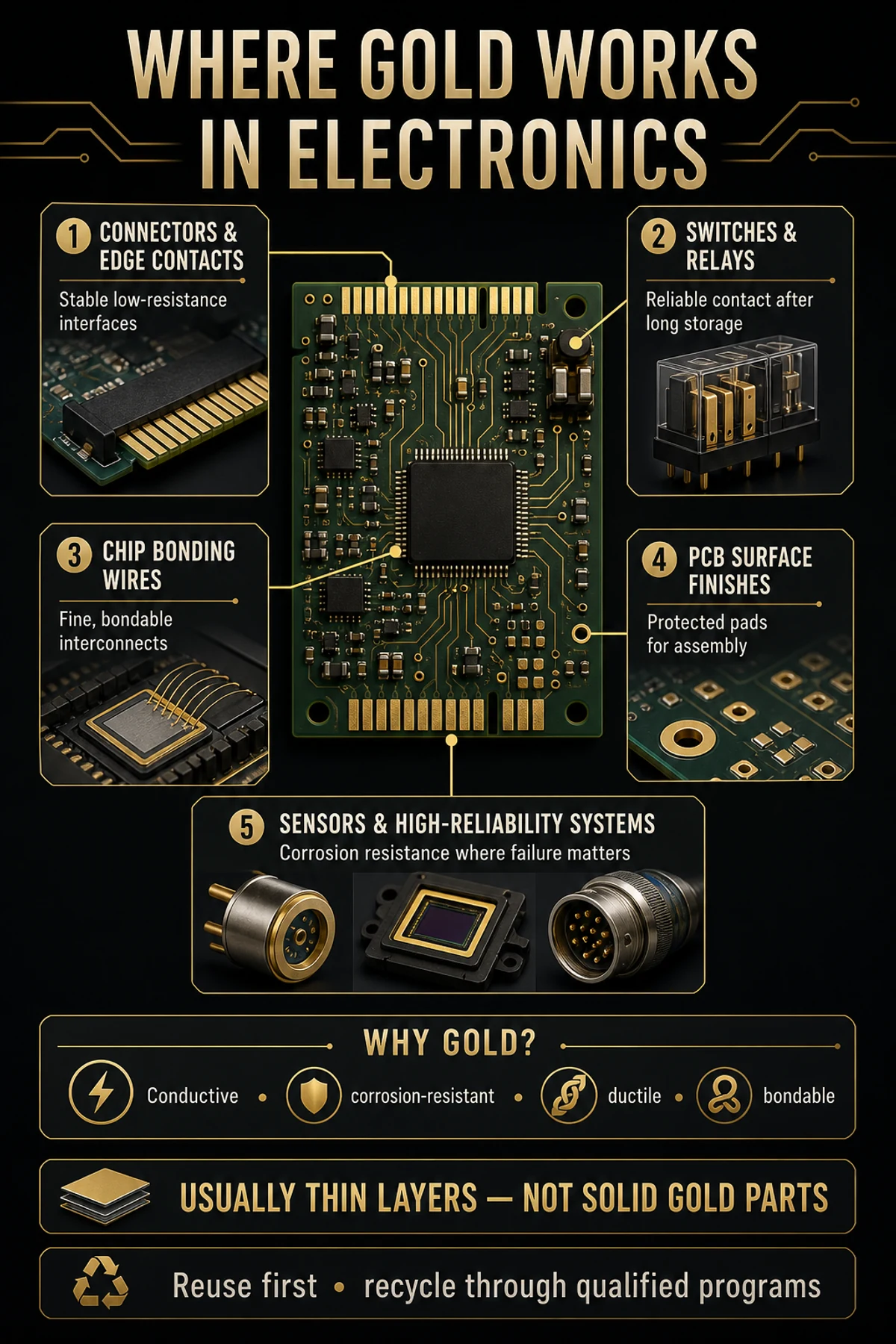
Why electronics use gold
Engineers still minimize gold use because it is expensive. The World Gold Council notes that past price increases encouraged electronics manufacturers to reduce gold per component and adopt alternatives where performance allowed. Gold survives in roles where the reliability case remains strong.
Where gold appears inside electronics
| Location | Gold’s job | What you actually see | Important limit |
|---|---|---|---|
| Card-edge fingers | Repeated plug-in contact with low and stable resistance | Hard gold or another gold-based finish over an engineered underlayer | Thin plating; board grade and thickness vary |
| Connector pins and sockets | Reliable mating surfaces in data, power and signal connections | Selective plating on the contact area, not necessarily the whole pin | Gold color does not reveal thickness or substrate |
| Switches and relays | Stable low-voltage contact after storage or cycling | Small contact spots or plated surfaces | Alloy and contact design depend on load and environment |
| Semiconductor packages | Connect chip pads to package leads or substrate | Microscopic bonding wire or bumps in some packages | Copper and aluminum have replaced gold in many cost-sensitive designs |
| PCB pads and finishes | Protect solderable pads and provide a bondable surface | Very thin immersion-gold layer in finishes such as ENIG | Much of the visible stack is nickel/copper, not gold |
| Sensors, medical, aerospace and high-reliability systems | Maintain stable interfaces where failure cost is high | Selected coatings, wires or contact materials | Specification matters more than device category alone |
Plating and PCB finishes: gold color can mislead
Gold is often deposited only where needed. On connector systems, selective plating places the noble surface on the mating zone while the rest of the conductor remains copper alloy, nickel or another substrate. Thickness can differ by performance class and expected mating cycles.
ENIG—electroless nickel immersion gold—is a common PCB surface finish. Its gold is a very thin protective layer over nickel. It helps preserve solderability and provides a flat surface, but a large gold-colored pad is not a thick gold sheet. Other finishes and hard-gold plating systems serve different assembly or wear requirements.
Bonding wires and changing package technology
Traditional semiconductor wire bonding can use very fine gold wire because it is ductile, corrosion resistant and compatible with established thermosonic bonding processes. Yet “chips contain gold wires” is not universal. Copper, palladium-coated copper and aluminum are widely used alternatives, and advanced packages may use bumps, pillars or redistribution layers instead of conventional wire bonds.
Even within the same device type, component suppliers and production years can differ. That is why a visual teardown cannot be converted directly into a precise recovered-gold claim.
How much gold is in a phone or computer?
There is no single durable answer. Gold content depends on device generation, board area, connector count, plating specification, component package mix and whether the estimate refers to contained metal or recovered yield.
The U.S. Environmental Protection Agency cites a 2006 USGS estimate that recycling one million cell phones could recover 75 pounds of gold. Divided mechanically, that is roughly 34 milligrams per phone—but it is an old population-level estimate, not a specification for a current handset, and it should not be used to price one device.
For more granular computer context, see how much gold is in a computer. The useful lesson is consistent: amounts are small, distributed and uneconomic to recover from one ordinary machine.
What should you do with gold-bearing electronics?
- Keep using it if the device is safe, supported and useful.
- Repair or refurbish when remaining product value exceeds scrap value.
- Resell or donate a functioning device after securely removing personal data.
- Sort commercial scrap by documented board/component grade if you operate a legitimate volume stream.
- Use a qualified recycler for end-of-life equipment and retain downstream documentation where required.
- Use household hazardous-waste or official collection routes when local rules treat the item or battery separately.
Back up what you need, sign out of accounts, remove activation locks and use the manufacturer or recognized data-erasure method before the device leaves your control. Batteries, screens and other components may require separate handling.
How professional gold recovery works—at a safe level of detail
Industrial recyclers first collect, identify and aggregate material. They dismantle or mechanically preprocess equipment, separate high-value fractions and send appropriate concentrates into pyrometallurgical, hydrometallurgical or integrated refining systems. Sampling and mass balance are essential because electronic scrap is heterogeneous.
The goal is not to pick visible flakes from one board. It is to manage copper, tin, nickel, precious metals, plastics, flame retardants and hazardous constituents through controlled equipment, ventilation, wastewater treatment and regulated downstream refining.
The EPA warns that open-air burning and acid baths used to recover value from electronics expose workers and communities to harmful substances. This guide intentionally does not provide extraction recipes. A laboratory paper or viral yield video is not a safe household process or a business case.
The recycling gap is bigger than gold alone
The World Health Organization, citing the Global E-waste Monitor 2024, reports that 62 million tonnes of e-waste were generated in 2022 and only 22.3% was documented as formally collected and recycled. Gold is valuable, but responsible recovery also protects workers, reduces pollution and recovers copper, silver, palladium and other materials.
Future research into selective leaching, sorbents and lower-impact separation may improve recovery. Scale-up must still prove reagent reuse, energy demand, selectivity, waste treatment, feed variability and economics—not only laboratory recovery percentage.
How to judge an electronic-scrap gold claim
A credible claim defines the feedstock before quoting a yield. “One kilogram of electronics” is meaningless if it mixes modern phone boards, server cards, connector pins, ceramic processors and low-grade household controls. The analyst should state the component category, production era, sample mass, sampling method and whether the result is contained gold or recovered product.
Then check the recovery boundary. A laboratory may report the percentage captured from a prepared leach solution, while a commercial recycler must also account for collection, dismantling, physical losses, reagents, energy, emissions controls, wastewater, residue treatment and final refining. A high percentage in one step is not the same as profitable or environmentally sound recovery of mixed devices.
Device-level gold estimates age quickly because electronics are redesigned, plating is thinned, packaging shifts and component suppliers change. Recovery studies often report selected feedstocks under controlled conditions. Neither should be generalized to every phone, computer or mixed scrap load without sampling and a defined recovery boundary.
The practical decision is usually about product value before metal value. Keep a useful device in service, recover its resale value when possible, erase data correctly and use a qualified recycling path at end of life. Visible gold color is not a reason to bring industrial chemistry into a home workspace.
Video walkthrough: Video context: professional recyclers show how gold-bearing electronics are sorted and processed at industrial scale.
Bottom Line
Gold in electronics is a precise engineering material used at contacts, connectors, selected PCB finishes and microscopic interconnects. Its corrosion resistance often matters more than its bulk conductivity. Because the gold is thin, dispersed and mixed with complex materials, reuse and professional recycling make more sense than DIY recovery.
FAQ: Gold in Electronics
Why is gold used in electronics instead of copper?
Copper conducts very well and carries most current in electronics. Gold is added selectively where a corrosion-resistant, stable contact or bond surface justifies its higher cost.
Which electronic parts contain gold?
Common locations include connector contact zones, card-edge fingers, some relay and switch contacts, selected PCB finishes and certain semiconductor bonding wires or interconnects.
Is the gold color on a circuit board real gold?
It may be a real gold-containing surface finish, but usually as a very thin layer over nickel or copper. Color alone cannot establish thickness, purity or recoverable value.
Is it profitable to recover gold from one computer?
Usually not. The amount is small and dispersed, while safe recovery requires volume, sorting, sampling, equipment, compliance and controlled refining. A functioning computer is normally worth more as a product or parts.
How should I recycle electronics that may contain gold?
Erase personal data, remove batteries when instructed and use a manufacturer take-back program, municipal collection route or qualified electronics recycler that can explain downstream handling.
Sources and verification
Use these primary and specialist references to verify the technical, legal or market framework behind the guide.
- Royal Society of Chemistry — Gold — Gold conducts electricity, resists corrosion, plates copper contacts and can form thin chip wires.
- World Gold Council — How Important Is AI for Gold Demand? — Explains electronics roles and long-term thrifting in gold use.
- US EPA — Electronics Donation and Recycling — Reuse/recycling guidance and material-recovery context.
- US EPA — Cleaning Up Electronic Waste — Warns about open burning and acid baths in unsafe informal recovery.
- WHO — Electronic Waste — Health risks and the 2022 global e-waste/recycling baseline.
- UNITAR/ITU — Global E-waste Monitor 2024 — Official global quantities and documented formal collection rate.
- LBMA — Sustainable Recycling of Electronic Scrap — Explains heterogeneous electronic scrap and professional recovery chains.
- CDC/USBM — Hydrometallurgical Treatment of Electronic Scrap — Technical context for the complexity and cost of precious-metal recovery.
- Business Insider — Gold from Old Computers — Video context for professional-scale sorting and precious-metal recovery.
 When you purchase a service or a product through our links, we sometimes earn a commission, at no extra cost to you.