
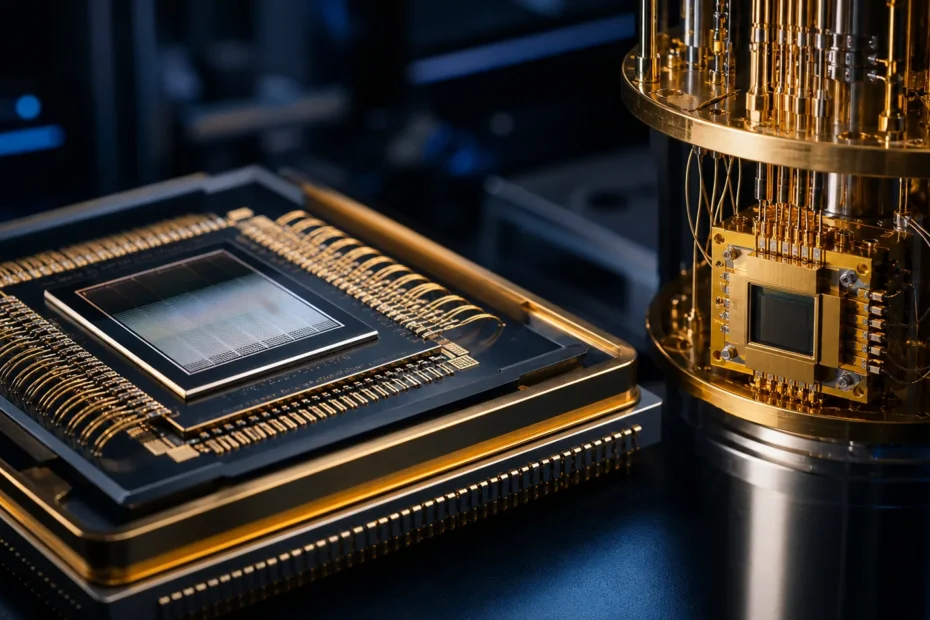
See how gold supports AI hardware, photonics, packaging, and selected quantum devices, plus where its role is often overstated.
- Gold is most valuable at small, failure-sensitive electrical and optical interfaces.
- AI demand affects supporting hardware and data centers, not the intelligence of the software itself.
- Quantum systems use gold selectively; the material choice depends on the qubit and device architecture.
Gold usually supports AI and quantum hardware as a contact, bonding wire, package finish, electrode, thin film, or nanophotonic structure; it does not perform every calculation and is not a universal qubit material. Its value comes from reliable electrical interfaces, corrosion resistance, microfabrication, and distinctive optical behavior. Mature electronics uses should be separated from experimental plasmonic and quantum research.
Artificial intelligence is software running on physical machines. Those machines include accelerators, memory, network switches, optical links, power modules, storage, and cooling systems. Quantum computing is a family of different hardware architectures, each with its own materials and operating conditions.
Gold appears in selected parts of both worlds, but usually in very small amounts. The most accurate question is not “Does AI use gold?” It is “Which component uses gold, what function does it perform, and is that design commercially deployed or still a research prototype?”
- AI servers use gold through ordinary high-performance electronics: packages, bonds, contacts, connectors, and some optical components.
- Gold improves interface reliability but silicon, copper, aluminum, solder, ceramics, and many other materials make up most of the hardware.
- Some ion-trap quantum devices use patterned gold electrodes; other qubit architectures may use little gold or use it only in packaging.
- Gold nanostructures can manipulate light in experimental photonic and plasmonic computing systems.
- AI growth may support electronics demand, while substitution and thinner gold layers limit use per component.
What Gold Does in Computing Hardware
Gold combines useful conductivity with a surface that resists oxidation. That is valuable when a microscopic connection must remain stable through heat, humidity, vibration, repeated operation, or long service life.
Manufacturers can draw gold into fine wire, plate it onto a contact, deposit it as a thin film, or pattern it into an electrode. These are localized uses. A processor is not made of gold, and an AI model does not become faster simply because gold is present somewhere in the server.
GoldConsul’s gold in electronics guide covers the general material properties. This article focuses on how those properties connect to AI infrastructure and selected quantum platforms.
Gold in AI Processors, Memory, and Advanced Packaging
An AI accelerator contains billions of transistors formed primarily in semiconductor materials. Gold does not replace that logic. It may appear at the packaging level, where the chip must connect to memory, power delivery, substrates, and the circuit board.
Some packages use gold bonding wire, gold bumps, or gold-compatible surface finishes. Other designs rely on copper pillars, solder microbumps, aluminum wire, palladium-coated copper, or direct hybrid bonding. High-end packaging is a fast-moving field, so a broad statement such as “AI chips require gold” needs a component-level qualification.
Memory chips and storage components can also use gold in selected package connections and contacts. AI servers often install more accelerators, high-bandwidth memory, networking, and power hardware than conventional servers, increasing the number of interfaces. The amount of gold per interface may still shrink as designs become denser and manufacturers reduce cost.
Data Centers, Networking, and Optical Links
AI workloads move enormous amounts of data between processors, memory, storage, and clusters. High-speed switches, transceivers, connectors, and optical modules therefore matter alongside the accelerator itself.
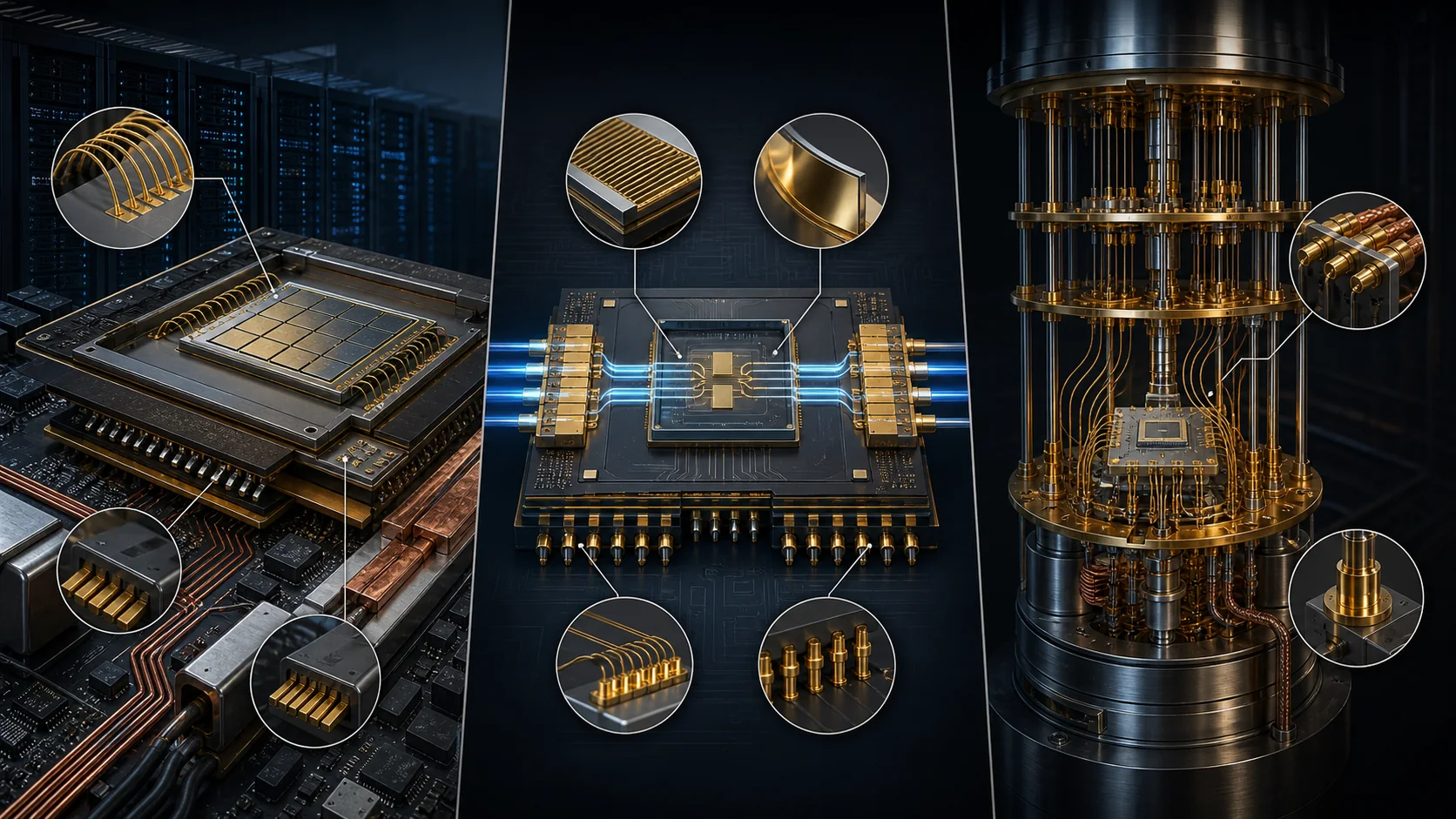
Selected network and optical components use gold contacts, package finishes, wire bonds, or thin-film structures. The same reliability logic appears in 5G and telecommunications hardware: the metal is concentrated at small interfaces where corrosion or signal failure would be costly.
The World Gold Council links AI-enabled devices and data-center expansion with demand for high-performance electronic components that use gold. It also highlights the counterforce: high gold prices encourage substitution and thinner coatings.
That balance matters more than hype. A larger data center can contain more gold-bearing components while engineering changes reduce the amount of gold in each component.
Gold in Photonic and Plasmonic AI Research
Electronic AI hardware consumes substantial energy moving data and performing repeated matrix operations. Photonic computing explores whether some operations can be carried out with light, potentially offering high bandwidth and parallelism.
Gold nanostructures support plasmonics, where light interacts with electrons at a metal-dielectric interface. Patterned gold films, antennas, nanoholes, and resonators can concentrate optical fields into very small regions. Researchers investigate these effects for modulators, detectors, sensing, optical memory, and neuromorphic systems.
Gold is not always the best photonic material. It has optical loss, can be difficult to integrate with some semiconductor processes, and may contaminate silicon fabrication lines. Aluminum, copper, transparent conducting materials, phase-change materials, silicon, silicon nitride, and other platforms can be preferable.
Nature Nanotechnology’s 2026 overview of optical computing emphasizes broader nanophotonic systems, including metal-dielectric plasmonics, phase-change behavior, and photonic-crystal approaches. The field is active, but research devices should not be counted as commercial gold demand without manufacturing evidence.
The underlying overview is available from Nature Nanotechnology.
What Most AI-and-Gold Claims Miss
The model runs on hardware whose material mix depends on architecture, package, supplier, and generation.
Contacts and bonds can be essential without making up a large share of the device.
A gold nanostructure in a paper does not prove use in commercial accelerators.
More components and less gold per component can occur at the same time.
Where Gold Appears in Quantum Computing
Quantum computing is not one machine design. Ion traps, superconducting circuits, silicon spin qubits, neutral atoms, photons, defects in solids, and topological concepts use different ways to create and control quantum states.
Gold may appear as a surface electrode, microwave conductor, wire bond, package contact, ground plane, shield, or optical nanostructure. In other systems, it is peripheral or deliberately avoided near a sensitive qubit.
A documented example comes from ion-trap research. A published multi-qubit gate device used gold electrodes approximately 10 micrometers thick on an aluminum-nitride substrate. NIST has also documented an ion trap made from gold electrodes deposited on alumina.
The device details appear in npj Quantum Information, while NIST’s ion-trap record provides a clear physical example.
Those examples prove that some ion-trap devices use gold; they do not prove that all quantum computers do. GoldConsul’s separate 2,205-word guide to the role of gold in quantum computing provides the architecture-by-architecture detail without forcing it into this broader AI article.
Architecture Comparison: Gold’s Role Is Not Universal
| Platform | Where gold may appear | What holds the quantum information | Key caution |
|---|---|---|---|
| Ion traps | Patterned trap electrodes, microwave conductors, wire bonds, package contacts | Electronic states of trapped ions | Electrode material and stack vary by design |
| Superconducting circuits | Packaging, connectors, selected bonds or normal-metal structures | Superconducting circuit states, commonly using aluminum or niobium systems | Loss and contamination near the qubit are critical |
| Silicon spin qubits | Gate electrodes, contacts, routing, or package interfaces in selected devices | Electron or nuclear spin states in semiconductor structures | Many metal stacks are possible; compatibility drives choice |
| Photonic quantum systems | Nanostructures, detectors, contacts, package and optical interfaces | Properties of individual photons | Low-loss dielectric platforms often dominate routing |
| Neutral atoms | Control electronics, lasers, connectors, and supporting hardware | Atomic states held in optical traps | Gold may support the system without being central to the atom array |
Mature Use Versus Research-Stage Claim
The GoldConsul Editorial Perspective
Ask for the hardware layer. “Gold is used in AI” is too broad to evaluate. A useful claim identifies the chip package, connector, optical element, electrode, or research structure; states the amount or geometry; and separates a laboratory result from shipped hardware.
Substitution, Thrifting, and Reliability
Gold is expensive enough that manufacturers constantly redesign around it. Copper and palladium-coated copper have taken a large share of semiconductor wire bonding. Connector plating can be made thinner or limited to the contact zone. Flip-chip and direct-bond packaging can remove some traditional wires.
Substitution stops where reliability, corrosion, process control, or qualification cost outweighs the material saving. High-end servers, aerospace systems, telecom infrastructure, and scientific equipment may tolerate a higher component cost to reduce failure risk.
The result is not “gold everywhere” or “gold is obsolete.” It is selective use at interfaces that still justify it.
Does AI Create a Major New Source of Gold Demand?
AI infrastructure can support demand for memory, processors, power electronics, optical communication, and high-reliability packaging. The World Gold Council’s Q1 2026 technology reporting associates AI infrastructure with strong high-performance chip demand and notes continued gold use in advanced modules, wireless components, satellite links, and faster optical communications.
The Q1 2026 technology data also records the countervailing pressure to reduce or replace gold in price-sensitive electronics.
But electronics accounts for only one part of global gold demand, and gold loading is difficult to infer from server shipments. Material substitution, package transitions, recycling, and the gold price itself affect consumption.
Readers should treat AI as one industrial demand factor, not as a stand-alone reason to buy gold. Broader context is available in GoldConsul’s guide to gold and technology and its overview of future gold nanotechnology.
- Layer: Is the claim about logic, memory, packaging, networking, optics, sensing, or support hardware?
- Function: Does gold conduct, connect, reflect, absorb, sense, trap, or merely coat?
- Stage: Is it a simulation, laboratory chip, pilot process, qualified component, or mass-market product?
- Alternative: Which competing material could perform the same function?
- Scale: Is gold quantity measured, or is demand inferred only from the number of devices?
Video walkthrough: Video context: IonQ explains trapped-ion quantum computing, one of the architectures in which patterned metal electrodes can play a direct hardware role.
Recycling Gold from Computing Hardware
Servers and network devices may be refurbished, resold, harvested for parts, or recycled. Gold is recovered with copper, silver, palladium, and other materials from selected boards and components.
Responsible recycling requires data destruction, battery removal, controlled dismantling, sampling, metallurgical processing, and residue management. GoldConsul’s guide to gold recovery from e-waste explains why informal burning and home chemical extraction are unsafe.
Bottom Line
Gold helps AI and quantum systems where small, stable electrical or optical interfaces matter. Its strongest established roles are in selected packages, bonds, contacts, connectors, and supporting electronics. Gold electrodes are also documented in some ion-trap quantum devices.
Experimental nanophotonics and plasmonics may create new applications, but they should not be confused with mass deployment. The most accurate analysis names the component, function, architecture, amount, and development stage before drawing a technology or market conclusion.
FAQ: Gold in AI and Quantum Computing
Do AI chips contain gold?
Some AI-related chips and modules use gold in package finishes, wire bonds, contacts, or related components. The logic itself is primarily formed in semiconductor materials, and the exact package stack varies by manufacturer and generation.
Does gold make AI calculations faster?
Not by its presence alone. Gold can support reliable and high-speed interfaces, while computational performance depends on transistor design, architecture, memory, software, networking, power, and cooling.
Are quantum computer chips made from gold?
Some quantum devices use patterned gold electrodes or gold in packaging, but qubit materials differ by architecture. Superconducting, silicon-spin, photonic, ion-trap, and neutral-atom systems do not share one universal material stack.
Why is gold useful in ion traps?
Gold can be patterned into conductive, corrosion-resistant surface electrodes that create electric and microwave fields used to confine and control ions. Other electrode materials are also possible.
Will AI significantly increase the gold price?
AI may support some electronics demand, but that does not translate directly into a gold-price forecast. Gold loading, substitution, recycling, jewelry and investment demand, central-bank activity, mine supply, and macroeconomic conditions all matter.
This article is educational and does not constitute financial or investment advice.
 When you purchase a service or a product through our links, we sometimes earn a commission, at no extra cost to you.