
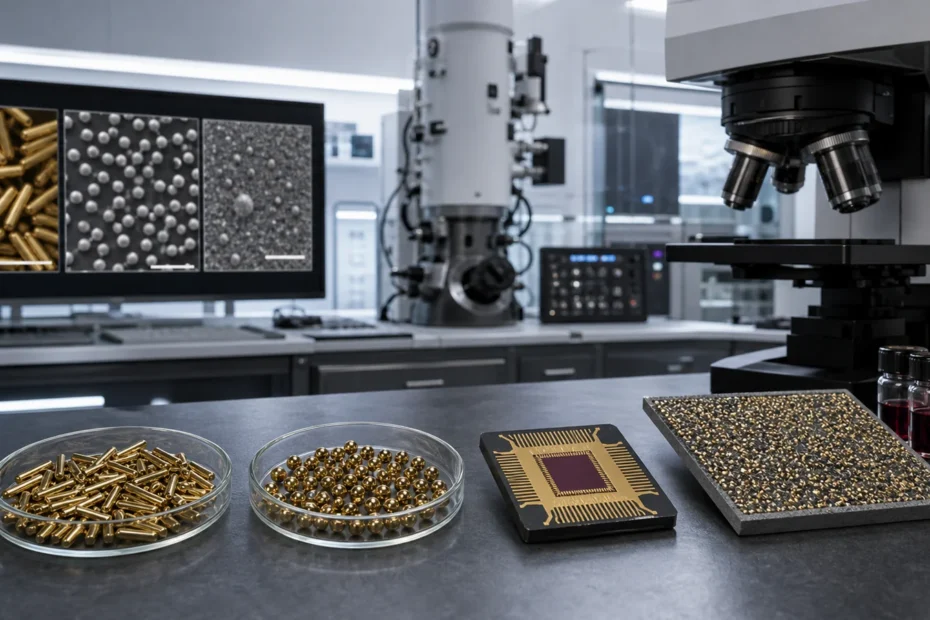
See where gold nanotechnology may grow in sensing, catalysis, electronics, energy and medicine—and what blocks scalable, responsible adoption.
- At nanoscale, gold’s optical and catalytic behavior depends on particle size, shape, surface chemistry and surrounding medium.
- Promising uses span sensors, catalysis, photonics, medicine and nanoelectronics, but each sits at a different readiness level.
- Scale-up requires reproducible batches, stable surfaces, lifecycle evidence, recovery pathways and value that justifies gold’s cost.
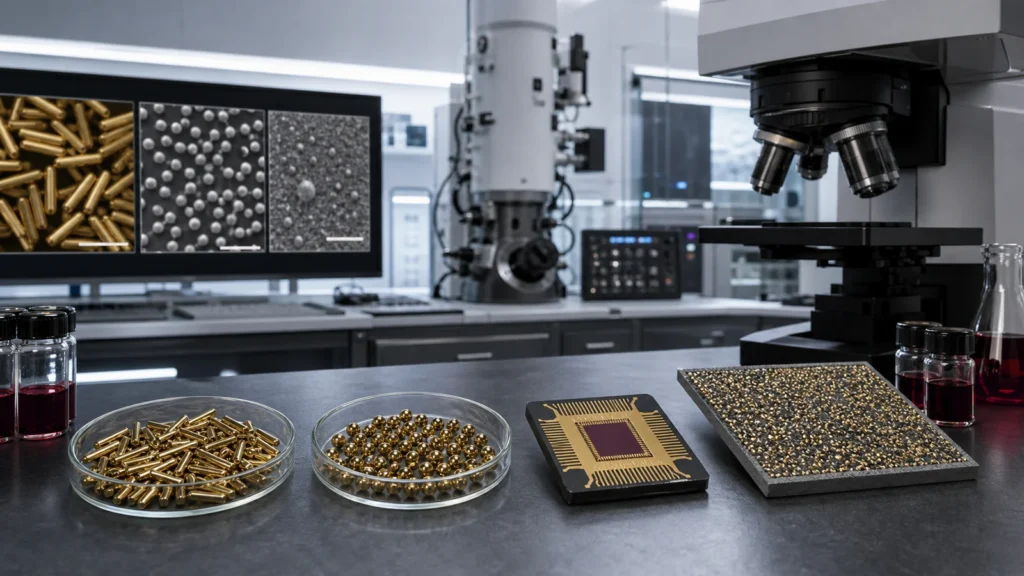
- Nanoscale gold behaves differently because surface atoms and light interactions dominate.
- Size, shape, coating and environment determine function; “gold nanoparticle” is not a specification.
- Sensing and diagnostic uses can tolerate tiny gold loadings and high value per device.
- Catalysis, electronics and energy applications face scale, durability and recovery tests.
- Judge the future by a readiness ladder, not by laboratory superlatives.
From property to product
Gold is famous as a chemically stable bulk metal. At nanometer scale, clusters and surfaces can become catalytically active, and particles can absorb or scatter selected wavelengths. The same flexibility that creates opportunities also makes performance sensitive to small manufacturing changes.
Why nanoscale gold is special
Localized surface plasmon resonance
Conduction electrons in a nanoparticle can oscillate collectively with incident light. The resonance depends on particle size, shape, spacing and surrounding refractive index. Gold nanospheres often appear red or burgundy in colloid, while rods can be tuned toward near-infrared wavelengths.
High surface-to-volume ratio
As particles shrink, a larger fraction of atoms sit at or near the surface. Supported gold nanoparticles and clusters can catalyze reactions even though bulk gold is comparatively unreactive. Supports, defects and particle size all affect activity.
Surface functionalization
Gold forms useful bonds with sulfur-containing molecules and supports layers of polymers, DNA, antibodies and other ligands. That makes it an assembly platform for sensors and delivery research. The surface coating becomes part of the functional material, not a cosmetic extra.
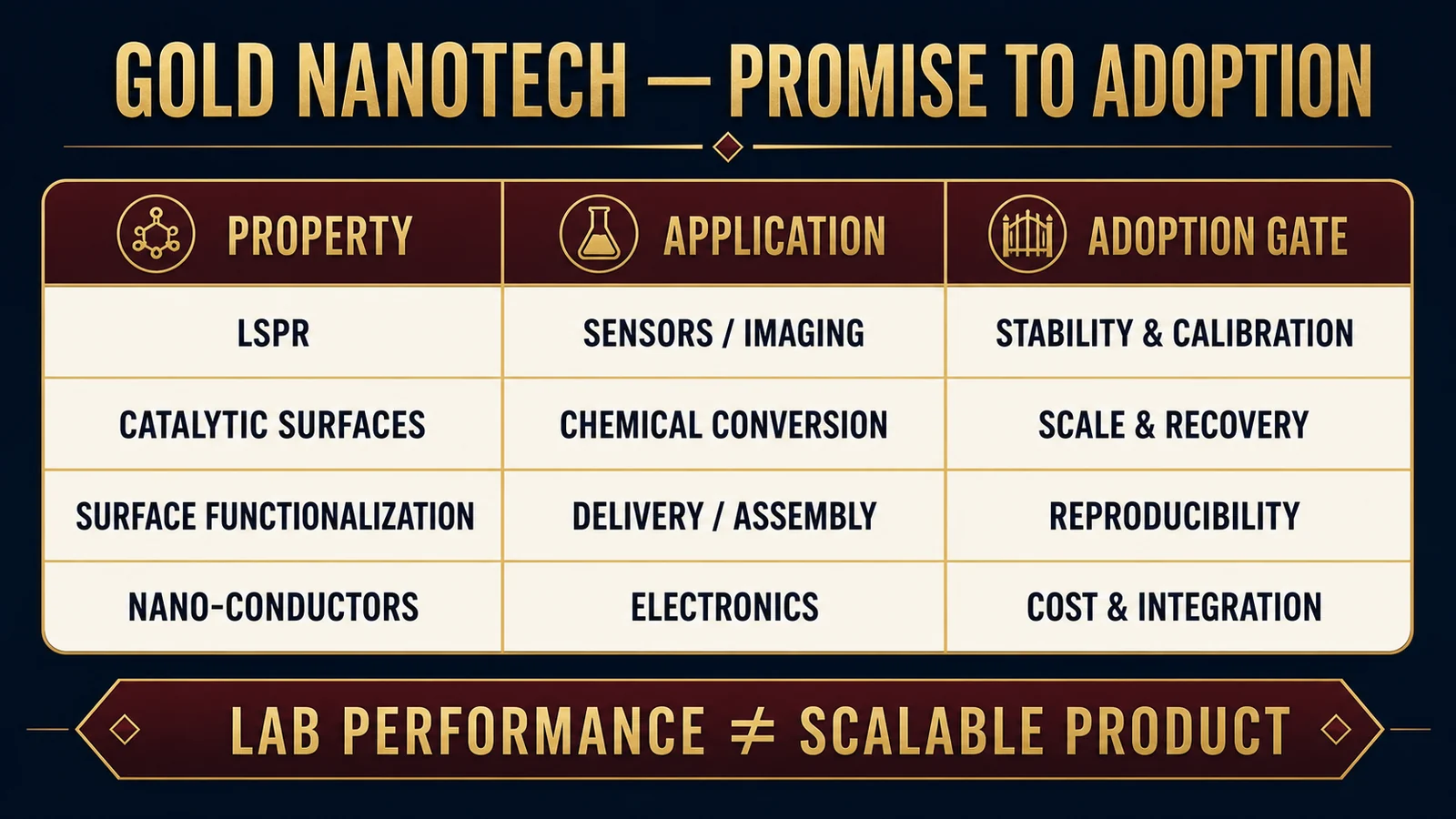
| Property | Potential application | Adoption gate |
|---|---|---|
| Tunable plasmon resonance | Optical sensing, imaging, photothermal systems | Calibration, stability and matrix interference |
| Catalytic nanosurfaces | Oxidation, reduction and chemical conversion | Support durability, poisoning, scale and recovery |
| Functionalized surface | Biosensors, self-assembly and delivery | Batch identity, ligand stability and nonspecific binding |
| Conductive nanostructure | Contacts, flexible electronics and nanoantennas | Integration, migration, cost and competing materials |
| High atomic number | X-ray imaging and radiation research | Dose, distribution, clearance and clinical benefit |
Sensors may be the most durable growth area
Gold nanostructures can convert molecular binding into color, wavelength shift, electrical change or enhanced Raman signal. The amount of gold per test can be tiny, so material cost is less important than reliable detection. Applications span medical diagnostics, food safety, environmental monitoring and industrial process control.
Real samples contain proteins, salts, dust and competing chemicals. A research sensor must therefore prove specificity, storage stability, calibration transfer, manufacturing consistency and performance against a reference method.
Plasmonics and photonics
Nanostructured gold can confine light below conventional optical dimensions, enabling antennas, metasurfaces and enhanced spectroscopy. Losses in gold also convert light to heat, which can be useful for photothermal processes but harmful in low-loss photonic circuits.
Alternative plasmonic materials, dielectrics and hybrid structures may offer lower loss or easier semiconductor integration. Gold wins when chemical stability and surface chemistry outweigh optical loss and price.
Catalysis and green chemistry
Small supported gold particles can catalyze reactions such as low-temperature carbon-monoxide oxidation and selective transformations. Future applications could improve chemical efficiency or pollution control. Catalytic claims require activity, selectivity and lifetime under realistic feeds—not only initial conversion in a clean laboratory stream.
Sintering can enlarge particles and reduce activity; sulfur or other contaminants can poison sites; support materials can change. Because gold is valuable, a commercial process also needs recovery and recycling after the catalyst reaches end of life.
Medicine: high promise, high evidence burden
Gold nanostructures are studied for diagnostics, imaging, drug delivery, photothermal therapy and radiation enhancement. Medical products face the strictest identity, toxicology and clinical-outcome requirements. A particle’s coating, dose and biodistribution are as important as its core.
This broad future guide does not treat preclinical ideas as therapies. Use gold nanoparticles in medicine for the translation ladder from material design to standard care.
Nanoelectronics and quantum interfaces
Gold nanowires, contacts and molecular junctions can support research in flexible devices, sensors and single-molecule electronics. At very small dimensions, electron scattering, grain boundaries and surface diffusion change conductivity. Bulk conductivity rankings cannot be copied directly into a nanoscale design.
Gold also appears in selected quantum-device contacts, packages and experimental surfaces. That supporting role is explained in gold in quantum computing. It does not imply gold is a universal qubit material.
Energy and environmental technologies
Gold nanoparticles are tested in solar cells, photocatalysis, fuel-cell research and environmental sensors. High value per gram can be acceptable if loadings are minute and lifetime performance is compelling. Commodity energy devices, however, demand exceptional cost discipline and scalable deposition.
See gold in solar panels for why a research electrode or plasmonic additive should not be generalized to every commercial module.
Scale-up is a materials problem
A beaker synthesis can produce a narrow particle distribution under careful conditions. Manufacturing must control nucleation, growth, mixing, temperature, impurities and surface coverage across much larger volumes. Small shifts can change optical resonance, aggregation or biological response.
Quality control may combine microscopy, spectroscopy, particle-size analysis, surface chemistry and functional tests. A specification should identify which attributes are critical to performance, not merely provide an average diameter.
Standards and measurement infrastructure
Comparable nanotechnology needs common vocabulary, reference materials and traceable methods. ISO terminology distinguishes nanoscale objects and related concepts, while NIST develops measurements that help laboratories compare particle dimensions, surfaces and optical behavior. Without measurement uncertainty, two apparently identical diameter values may not be equivalent.
Reference materials do not make a product safe or effective; they make analytical claims more comparable. A manufacturer still needs fit-for-purpose tests tied to performance, exposure and the intended environment.
Recovery should be designed in
Gold’s value favors recovery, but nanoscale dispersion can make collection difficult. A catalyst fixed to a removable support is easier to reclaim than particles released into a mixed waste stream. Sensors and cartridges can be designed for take-back, while medical particles administered to patients generally cannot be recovered.
Designers should compare the environmental burden of synthesis, solvents, ligands and recovery with the benefit delivered during use. High recovery rates in a laboratory do not guarantee a practical collection system in the field.
Environmental health and lifecycle
Risk depends on exposure as well as hazard. Particles bound in a device pose a different route than free colloids in water or aerosols in manufacturing. Coatings can transform, particles can aggregate and biological systems can alter surfaces. Lifecycle work must follow the material through production, use, recycling and disposal.
OECD and NIST programs support measurement and safety approaches for manufactured nanomaterials. Absence of an observed acute effect is not proof of long-term ecological safety, and “gold is inert” is not a complete nanosafety argument.
- Define particle size distribution, shape, coating and support
- Connect one property to one measured application benefit
- Compare with a gold-free control and the best incumbent material
- Report loading, device area and total gold mass
- Test aging, cycling, contamination and storage
- Show batch-to-batch reproducibility and scalable process conditions
- Quantify cost per delivered function, not price per gram alone
- Address worker exposure, release, recovery and disposal
- State the current readiness level without calling research inevitable
What this could mean for gold demand
Nanotechnology can create high-value demand with very low mass. A diagnostic used millions of times may matter, while an impressive one-off research chip may not. Thrifting is also built into nanoscale engineering: the point is often to place very little gold exactly where it works.
A defensible demand estimate needs gold loading per unit, production volume, adoption rate, yield, recycling and substitution. Until those inputs exist, forecasts should be scenarios rather than tonnage claims.
For the core science, compare gold nanoparticles, atomic structure, electrical conductivity, gold in electronics, gold isotopes and gold in EV manufacturing.
The literature is rich in performance demonstrations but thin in comparable lifecycle datasets. Gold loading, ligand fate, scale-up yield, recovery rate and full device cost are rarely reported in one study.
The future of gold nanotechnology will probably be a portfolio of small, high-value interfaces rather than one mass-market “gold nano revolution.” The winning products will make the nanoscale formulation almost invisible to the user because reliability—not novelty—carries the value.
Watch: Why aren’t Gold Nanoparticles Gold?
This materials demonstration explains why nanoparticle color differs from bulk gold and makes the size-and-optics relationship visible without turning it into a product claim.
Video: Breaking Taps. Availability validated July 16, 2026.
Bottom Line
Gold nanotechnology has credible paths in sensing, catalysis, medicine, photonics and advanced interfaces. The future belongs to applications that preserve nanoscale performance through manufacturing, real-world exposure, economics and recovery.
Frequently Asked Questions
Why are gold nanoparticles red or purple?
Their electrons interact with light through a size-, shape- and environment-dependent plasmon resonance, so colloids need not look metallic yellow.
What is the most promising use of gold nanotechnology?
Sensing and diagnostics are strong candidates because tiny gold loadings can create valuable optical signals, but readiness varies by product.
Can gold nanoparticles replace bulk gold in electronics?
Not generally. Nanoscale structures solve selected contact, sensing and photonic tasks and face integration and reliability constraints.
Are gold nanoparticles environmentally safe?
Safety depends on coating, size, exposure route, transformation and lifecycle. Bulk gold’s reputation does not settle nanoscale risk.
Will nanotechnology increase gold demand?
Possibly in high-value niches, but mass demand requires loading, adoption, substitution and recovery data that many early studies do not provide.
Sources and verification
These sources define the material, market, engineering or regulatory boundaries used above. Check the current document and product-specific evidence before acting.
- NIST — Nanotechnology overview
- National Nanotechnology Initiative — Benefits and applications
- ACS — Gold nanoparticles: properties and applications
- Nature Reviews Materials — Gold nanoclusters
- Nanomaterials — 2025 SPR sensor review
- NIST — Environmental, health and safety impact of nanoparticles
- OECD — Safety of manufactured nanomaterials
- ISO/TS 80004-1 — Nanotechnology vocabulary
- World Gold Council — Technology sector demand
- FDA — Nanotechnology programs
 When you purchase a service or a product through our links, we sometimes earn a commission, at no extra cost to you.