
See how much gold is in a computer, where it sits, what recovery may be worth, and why safe e-waste recycling usually matters more than DIY stripping.
- Expect tiny gold amounts per device, even when parts are gold-plated.
- Check CPUs, RAM contacts, boards, and connectors before estimating value.
- Compare scrap value with safe certified recycling before DIY recovery.
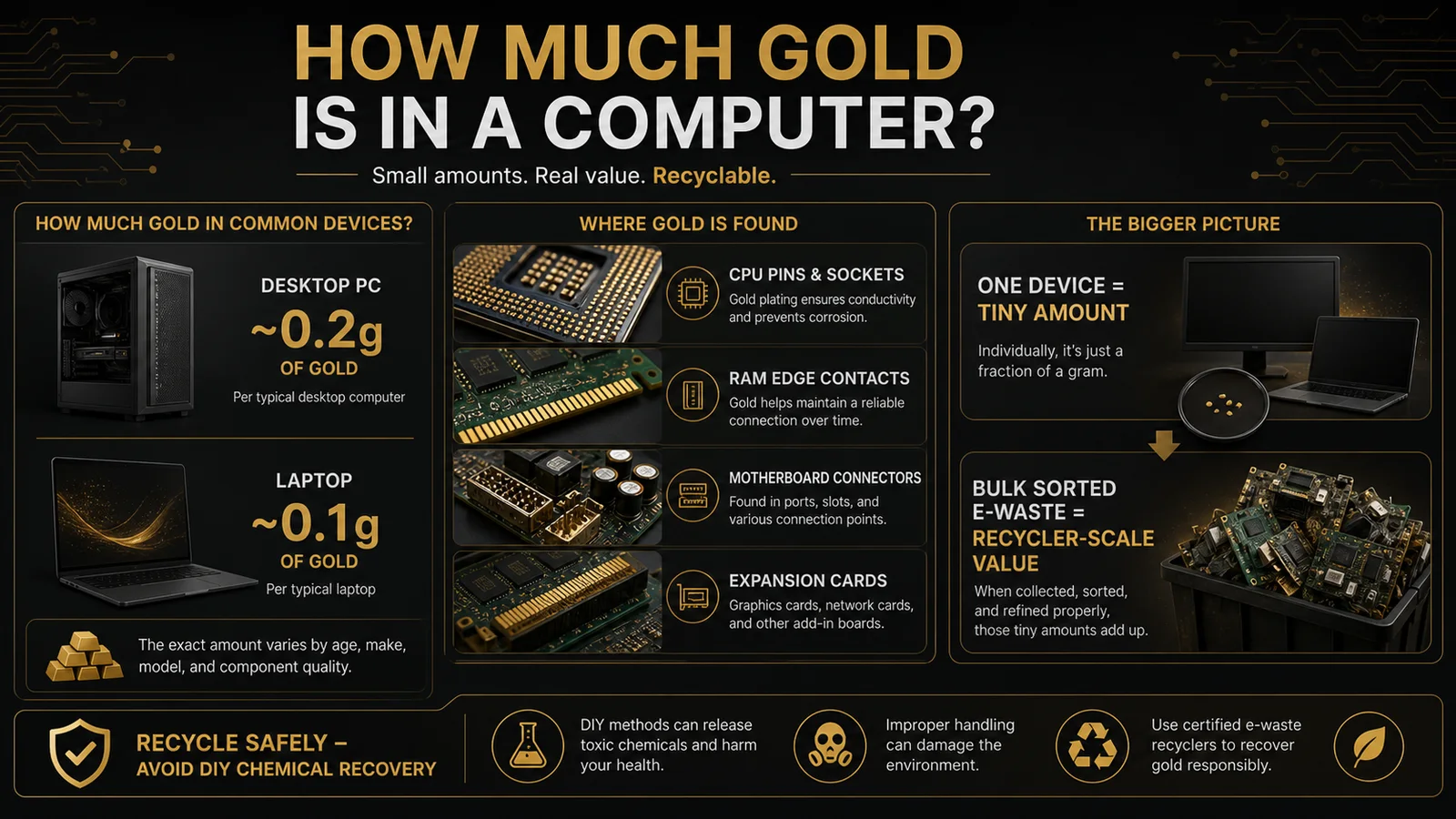
A typical desktop computer contains only a small amount of gold, usually around 0.2 grams in the whole machine. A laptop often contains less, commonly around 0.1 grams.
That makes computer gold real, but easy to overstate. The value is meaningful for professional e-waste recyclers processing thousands of pounds of boards, not for most people stripping one old PC at home.
- Most modern desktop PCs contain roughly 0.2 grams of gold; many laptops contain about 0.1 grams.
- The gold is mainly in CPUs, RAM edge contacts, motherboard connectors, expansion cards, and some ports.
- Older ceramic CPUs, telecom equipment, and server boards can be richer than modern consumer hardware.
- DIY chemical recovery is usually uneconomic and can be dangerous; certified recycling is the safer route.
- The real value of e-waste recovery comes from bulk processing and recovering copper, silver, palladium, and gold together.
How Much Gold Is in a Computer?
For a normal reader, the useful answer is not “computers contain gold.” The useful answer is: how much, where, and whether it is worth recovering.
Public estimates vary by device age and component mix, but current consumer-facing ranges cluster around a small number: about 0.2 grams of gold in a typical desktop and about 0.1 grams in a laptop. That aligns with recent reporting that puts a desktop at about 0.2 grams and a laptop at roughly 0.1 grams.
At the same time, the broader recycling case is real. The U.S. Geological Survey has long noted that personal-computer scrap can be richer in gold than many mined ores, while the U.S. EPA highlights recoverable gold, silver, palladium, and copper from recycled electronics.
Where Gold Is Found Inside a Computer
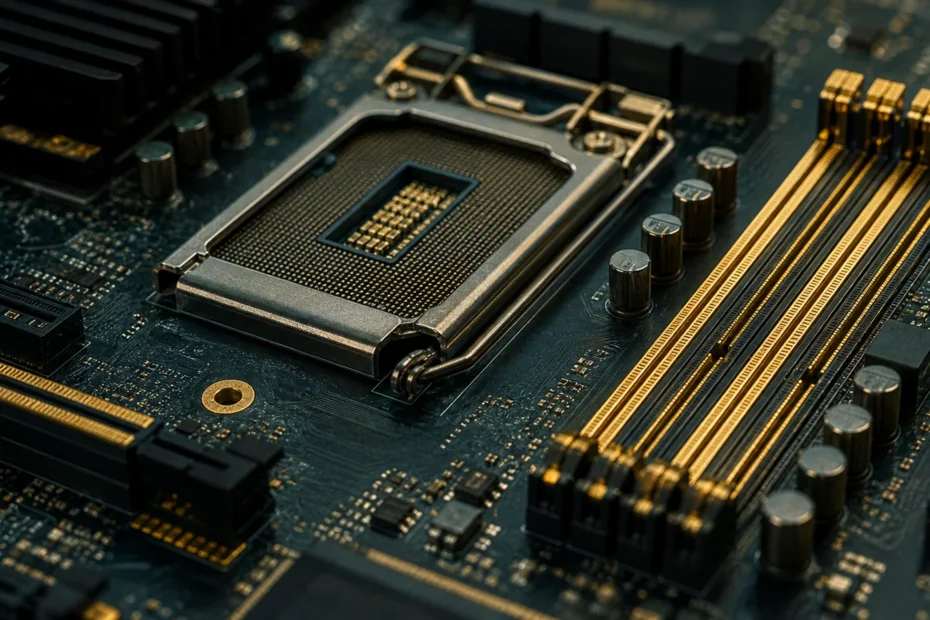
Gold is used because it resists corrosion and keeps low-voltage electrical contacts reliable over time. It is not used as thick chunks of metal in ordinary computers; it is usually thin plating, tiny bonding wires, or contact material.
- CPU packages: older CPUs may have gold-plated pins, pads, or internal bonding wires.
- RAM modules: the gold-colored edge fingers are thin plated contacts.
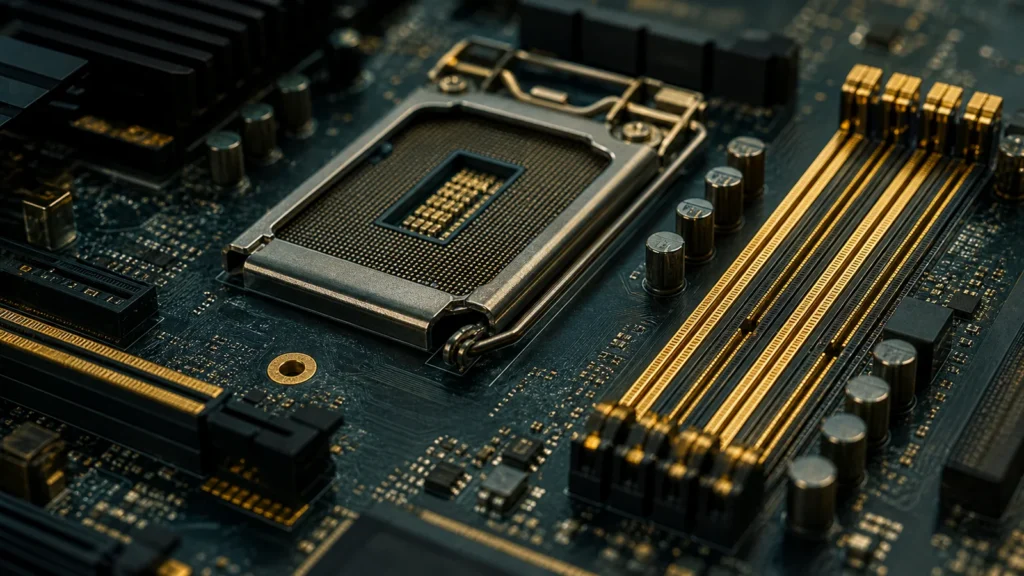
- Motherboards: CPU sockets, RAM slots, PCIe slots, and some connectors use gold-plated contact surfaces.
- Expansion cards: graphics cards, network cards, and sound cards may have gold-plated edge connectors.
- Ports and connectors: some USB, HDMI, Ethernet, and high-reliability contacts use gold plating.
If you want the broader chemistry context, see our plain-English guide to gold as an element. The same properties that make gold useful in bullion and jewelry also make it useful in electronics: stability, conductivity, and resistance to tarnish.
Typical Gold Content by Computer Part
| Component | Typical gold reality | Why it matters | Practical recovery note |
|---|---|---|---|
| Whole desktop computer | Often around 0.2 g total, depending on age and configuration | Useful benchmark for consumer expectations | Usually not worth chemical recovery as a single unit |
| Laptop | Often around 0.1 g or less | Compact boards use smaller amounts of metal | Better recycled through certified programs |
| Modern motherboard | Fraction of a gram | Gold is spread across sockets and contacts | Bulk board grade matters more than one board |
| Older ceramic CPU | Can be richer than modern CPUs | Older packages may use more gold-bearing material | Often worth more as collectible or sorted scrap than as DIY chemistry feedstock |
| RAM sticks | Thin gold-plated edge fingers | Visible gold color can look more valuable than it is | Value improves only in larger sorted lots |
How much gold is in a CPU or 10 processors?
There is no reliable grams-per-processor figure that applies to every Intel or AMD CPU. Identify the exact model and package before using a recovery estimate; a whole-computer estimate is not a CPU estimate.
For a batch of 10 processors, do not multiply an unrelated online yield by 10. Ask a recycler how it grades that specific lot and whether its quote is for the complete parts or for assayed recoverable metal.
How much gold is in a motherboard or RAM stick?
A motherboard’s weight and a RAM stick’s gold-colored contacts do not tell you the grams of gold inside. Treat the whole-desktop estimate above as a total across components, not an amount to assign to each board or memory module.
For a useful scrap quote, record the board model, the number of RAM sticks, and the lot weight separately. Keep working parts intact until you have compared resale and recycling offers.
Why Online Gold-in-Computer Numbers Differ So Much
The biggest mistake is mixing old industrial hardware with modern consumer PCs. A 1990s ceramic CPU, server board, or telecom card is not the same as a recent office desktop.
Another problem is confusing gross metal value with recoverable value. If a computer contains a few dollars worth of gold at the current live gold price, that does not mean a hobbyist can extract that amount profitably.
Interpretation: this is a practical sorting scale, not a precise assay. Actual value depends on model, year, board grade, lot size, and refiner payout.
Quick Value Formula for Computer Gold
Use this simple formula to avoid inflated expectations:
Example: if a desktop contains about 0.2 g of gold and gold trades at $110 per gram, the gross gold value is about $22.
Realistic payout is lower. Collection, sorting, shipping, refining loss, refiner margin, and minimum-lot requirements reduce what you can actually receive.
For live context, use the GoldConsul gold weight estimator and gold price outlook. Just remember that a calculator can estimate metal value; it cannot make a tiny mixed-material scrap lot easy to refine.
Is It Worth Extracting Gold from Old Computers?
For most individuals, no. Selling, donating, or recycling through a reputable electronics recycler is usually more sensible than trying to chemically recover gold at home.
The U.S. Government Accountability Office notes that electronics recycling has real supply-chain value but faces narrow margins, difficult separation, hazardous materials, and data-security issues. That is exactly why professional scale matters.
Best Practical Options for an Old Computer
- If it still works: sell it, donate it, or repurpose it. Reuse normally beats scrap value.
- If it is broken but intact: remove personal data, then use a certified electronics recycler or manufacturer take-back program.
- If you have many units: sort high-grade boards, RAM, CPUs, and cables separately before asking refiners or scrap buyers for quotes.
- If it is vintage: check collector value before scrapping. Some old CPUs, boards, and complete systems can be worth more as parts.
- If you only want gold exposure: buying bullion is cleaner than trying to mine a few milligrams from mixed electronics. Our guide to where to store gold explains the custody side.
Recycling in the United States: Start with the EPA’s certified electronics recycler guidance, which links to R2 and e-Stewards recycler directories. Before a drop-off or shipment, confirm that the facility accepts household computers, ask about fees and data destruction, and check whether any payment is actually offered.
Gold in Computers vs Gold Ore
It is true that high-grade electronic scrap can contain more gold per ton than some mined ore. But that comparison can mislead readers if it ignores processing complexity.
A ton of computer scrap is not a ton of clean gold-bearing material. It includes plastics, steel, aluminum, copper, glass, solder, batteries, coatings, and hazardous substances. The value is unlocked by sorting, shredding, smelting, chemical processing, environmental controls, and refining contracts.
That is why e-waste recycling belongs in the same conversation as gold recycling, not in the same category as a backyard treasure hunt.
Why Gold Is Still Used in Electronics
Gold is expensive, but it performs well in small, mission-critical contact points. It does not tarnish like silver and is easier to use reliably in thin coatings than many alternatives.
This is especially important in devices where failure is costly: computers, aerospace electronics, telecommunications gear, data-center hardware, medical devices, and advanced chips. For more on advanced uses, see our article on how gold is used in AI and quantum computing.
Video: What Gold Recovery from Electronics Looks Like
Video walkthrough: this clip gives visual context for why electronics recovery is a process, not a quick scrape-and-melt job.
Bottom Line
Computers contain gold, but not as much as viral recovery claims suggest. A modern desktop may contain around 0.2 grams, a laptop often around 0.1 grams, and the gold is spread thinly across contacts, chips, and connectors.
The practical takeaway is simple: recycle electronics responsibly, sort bulk material if you handle many machines, and avoid hazardous DIY recovery. The gold is real, but the economics belong mostly to professional recyclers.
FAQ: How Much Gold Is in Computers?
How much gold is in a desktop computer?
A typical desktop computer is often estimated at about 0.2 grams of gold, though the amount varies by age, model, motherboard, CPU, RAM, and expansion cards.
How much gold is in a laptop?
A laptop commonly contains around 0.1 grams of gold or less. Compact designs generally use less board area and fewer large connectors than desktop systems.
Which computer part has the most gold?
Older CPUs, RAM edge contacts, motherboard connectors, and expansion-card edge connectors are the main places to look. Older ceramic CPUs and server hardware can be richer than modern consumer parts.
Is extracting gold from computers profitable?
Usually not for individuals. Profitability depends on large volumes, sorted material, safe processing, refining terms, and the current gold price.
Should I recycle or sell old computer parts?
If the hardware works or has collector value, selling or donating may be better. If it is dead or obsolete, use a certified electronics recycler after removing personal data.
 When you purchase a service or a product through our links, we sometimes earn a commission, at no extra cost to you.