
See where 5G hardware uses gold, why engineers choose it, how substitution works, and what telecom growth means for recycling and demand.
- Gold protects critical electrical interfaces from corrosion and connection failure.
- Most 5G equipment uses tiny, carefully engineered quantities rather than large masses of gold.
- Network growth matters for demand, but miniaturization, substitution, and recycling limit simple forecasts.
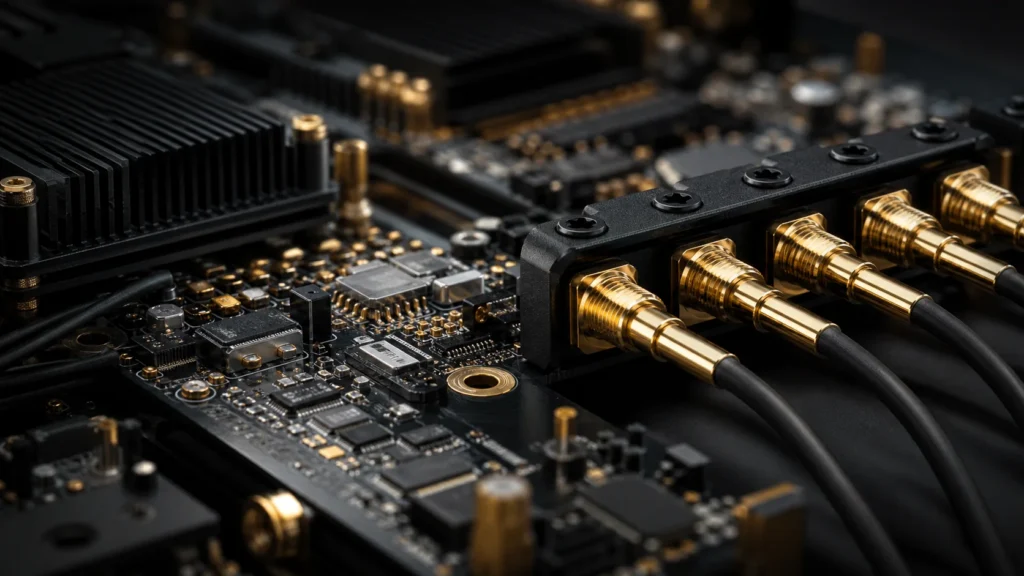
Gold is used in 5G hardware mainly where a tiny, dependable electrical connection matters more than raw material cost. You can find it in selected semiconductor packages, RF power amplifiers, bonding wires, plated contacts, connectors, sensors, and optical components. The quantities are small, and manufacturers actively reduce or replace gold where reliability permits, so 5G growth should not be treated as a simple forecast for gold demand.
Fifth-generation mobile networks move more data, use more frequency bands, and depend on a denser web of radios, servers, antennas, and connected devices than earlier networks. That makes reliability at thousands of small interfaces important.
Gold helps at some of those interfaces because it conducts electricity, resists corrosion, can be formed into extremely fine wire, and can be deposited as a thin, stable surface. It is rarely used as a large structural part. The engineering value comes from putting a small amount in the exact place where oxidation or connection failure would be costly.
- Gold is a reliability material in selected contacts, packages, wire bonds, and high-frequency components.
- 5G does not mean every antenna, phone, or base station contains a large amount of gold.
- Copper, silver, aluminum, and palladium-coated copper replace gold when cost and performance allow.
- AI data centers, satellites, Wi-Fi 7, and future 6G systems may support high-reliability electronics demand, but thrifting continues.
- End-of-life telecom equipment should enter professional recycling streams, not informal recovery.
Why Engineers Still Choose Gold
Gold is not the most conductive metal; silver and copper conduct electricity better. Its advantage is the combination of useful conductivity with chemical stability. A clean gold surface does not form the insulating oxide layer that can develop on many base metals.
That stability matters in low-voltage contacts, high-frequency signal paths, and equipment expected to work for years. Gold is also ductile enough to become very fine bonding wire and thin enough to serve as a targeted coating rather than a solid component.
The broader background is covered in GoldConsul’s guide to gold in electronics. The key point for telecommunications is that gold is selected by function, not sprinkled uniformly through every device.
Where Gold Appears in a 5G Network
| Network area | Possible gold use | Why it may be chosen | Important limit |
|---|---|---|---|
| RF power amplifier modules | Wire bonds, die attach, package finishes, selected conductors | High-frequency reliability and heat-tolerant packaging | Designs vary; gold-free or lower-gold packages also exist |
| Base-station radios | Plated connectors, contacts, circuit finishes, semiconductor packages | Outdoor life, vibration, humidity, and service reliability | The bulk of the equipment is aluminum, copper, steel, plastics, and silicon |
| Smartphones and modems | Chip packages, board finishes, camera and sensor contacts, connectors | Miniaturization and stable low-voltage signals | Gold loading per device is small and has generally been reduced |
| Data centers and edge servers | High-density connectors, memory and processor packages, optical hardware | Continuous operation and fast data movement | Gold is one material in a much larger semiconductor and power system |
| Satellites and network optics | Reliable contacts, packages, photonic and sensor components | Long life, thermal cycling, and difficult maintenance | Requirements differ sharply by platform and mission |
The World Gold Council’s electronics review identifies contacts, connectors, semiconductor bonding, and wireless power-amplifier components as important use areas. Its more recent technology reporting also links 5G-enabled smartphone adoption with wireless-sector gold use, while documenting ongoing regional and product-cycle variation.
Gold in RF Power Amplifiers and Advanced Packages
A 5G radio must transmit and receive across multiple bands. Power amplifiers boost outgoing radio signals, and their packages must manage heat while maintaining predictable microwave behavior. Gold wire bonds are one established way to connect an amplifier die to its package or surrounding circuit.
That does not make gold mandatory in every amplifier. Flip-chip assembly, copper wire, silver-filled attachment materials, and alternative surface finishes can reduce gold use. The right material depends on frequency, package geometry, production volume, qualification history, thermal cycling, and acceptable failure risk.
A useful rule is to ask where the gold sits. A claim that names the exact interface, such as a wire bond or connector finish, is more credible than a claim that says a whole base station is “powered by gold.”
One Network, Several Very Different Material Environments
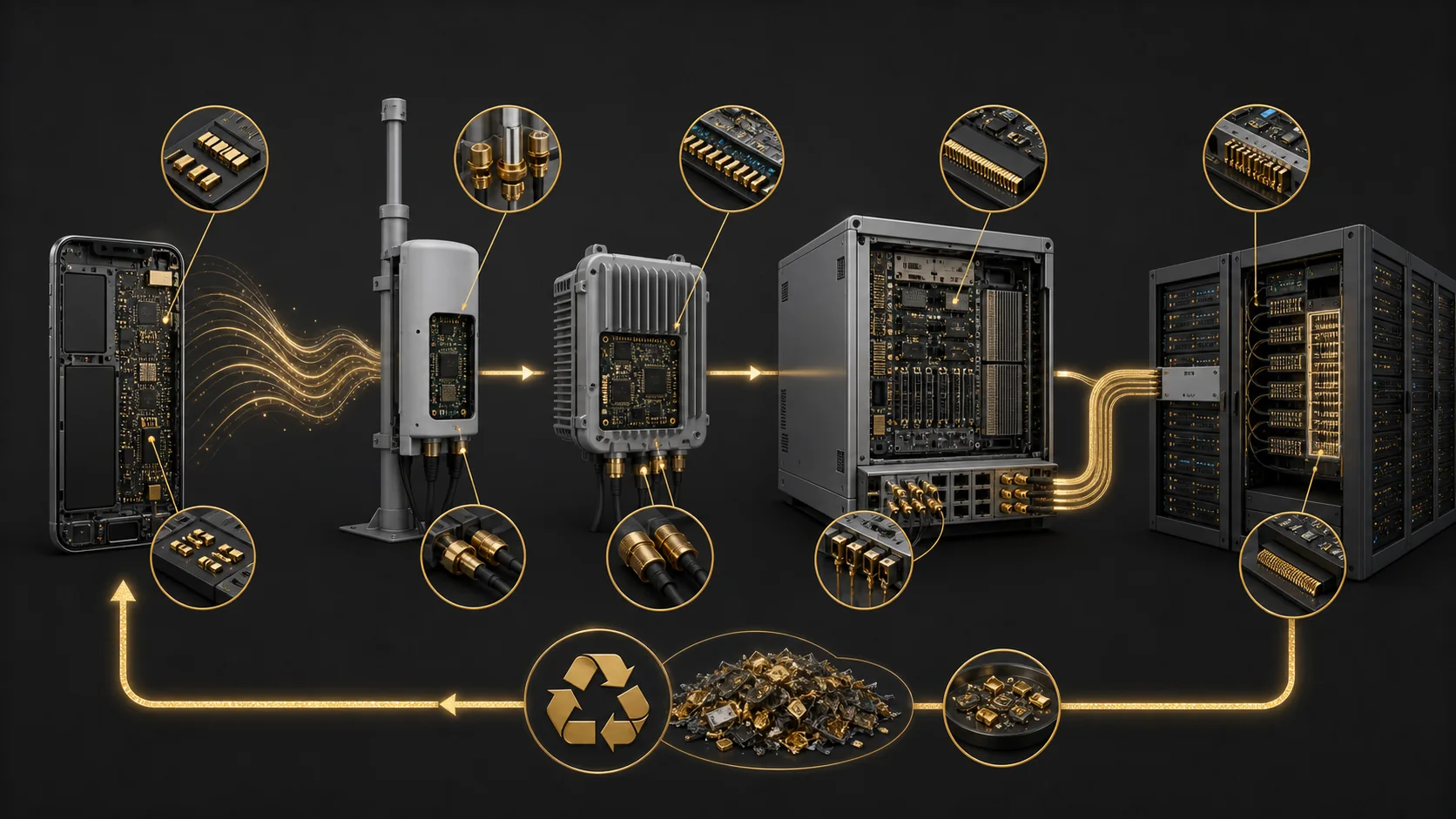
A 5G connection passes through more than a smartphone and an antenna. The radio-access network links user equipment to outdoor or indoor radios. Fiber or microwave backhaul carries traffic toward transport networks, edge facilities, and large data centers. Each layer has a different service life, thermal load, maintenance pattern, and tolerance for failure.
A consumer handset is designed under extreme cost and space pressure. Its gold surfaces must be tiny and compatible with high-volume assembly. A remote radio mounted on a tower faces temperature swings, moisture, vibration, and expensive service visits. A data-center connector may be inserted and removed during maintenance while carrying high-speed signals continuously.
These differences explain why a material choice cannot be generalized across the network. A connector may justify selective hard-gold plating, while a board finish may use an immersion-gold layer over nickel. A semiconductor package may retain gold bonds for a qualified high-reliability design, while the next product generation moves to copper or flip-chip interconnection.
The distinction also matters when estimating recycling value. A whole base station may be heavy but contain a relatively small precious-metal fraction. A compact board or package can be richer per kilogram, yet difficult to separate without losing other valuable metals. Asset age, manufacturer, board grade, and component mix are more informative than equipment size.
What Most 5G Gold Claims Miss
A component can require gold and still contain only milligrams or a microscopic coating.
Gold is favored where failure cost is high, not automatically in every consumer-grade interface.
More electronics can increase use while thinner coatings and substitution reduce use per unit.
Does 5G Increase Gold Demand?
Network expansion creates more radios, processors, memory, sensors, connectors, and optical links. Some of these contain gold. The World Gold Council reported that adoption of 5G-enabled smartphones supported wireless-sector gold usage in 2024.
But demand cannot be estimated by counting devices alone. Manufacturers redesign packages, reduce plating thickness, switch bonding materials, and integrate functions. A more expensive gold price strengthens the incentive to use less wherever qualification rules allow.
For investors, this distinction is essential. Electronics is one source of gold demand, but jewelry, central banks, bars, coins, recycling, and mine supply are much larger parts of the market. A 5G deployment headline is not, by itself, a gold-price thesis.
The GoldConsul Editorial Perspective
Use component-level evidence before drawing a market conclusion. Confirm what the gold does, whether the design is commercially deployed, how much is used, and which substitutes are already qualified. Technical importance and commodity-market importance are not the same measurement.
Video walkthrough: Video context: NTT DOCOMO Euro-Labs explains how 6G extends telecom beyond faster speeds into sensing, AI-native networks, resilience, and sustainability.
What Changes with Wi-Fi 7, Satellites, Edge Computing, and 6G?
Higher data rates push more work into advanced radio-frequency chips, optical connections, memory, and power modules. The World Gold Council’s Q1 2026 technology update points to Wi-Fi 7, power-amplifier expansion, AI data centers, low-Earth-orbit satellites, and faster optical communications as supportive areas for high-reliability components.
Future 6G research explores higher frequencies, integrated sensing, distributed intelligence, and new antenna architectures. Those directions may create demanding interfaces, but the material mix is not settled. Research prototypes should not be described as mass-market demand.
Readers interested in adjacent hardware can continue with gold in AI hardware, the dedicated guide to gold in quantum computing, and GoldConsul’s broader overview of gold and technology.
Substitution: When Gold Wins and When It Does Not
Copper offers excellent conductivity at far lower material cost, but its surface chemistry and bonding behavior require careful control. Palladium-coated copper can improve wire-bond performance. Silver is highly conductive but can migrate or tarnish in some environments. Aluminum remains common in power and semiconductor applications.
Gold wins when its total system value exceeds the cost difference. That can happen when a failed connection would trigger a field repair, satellite loss, service interruption, or difficult product recall. It loses when another material can pass the same qualification tests at lower cost.
Qualification itself has a cost. Changing a bond wire, plating stack, or package finish can require new process development, accelerated aging, thermal cycling, humidity testing, vibration testing, and supplier approval. A manufacturer may therefore retain a proven gold-containing design even when the metal is more expensive, then remove it during a larger product redesign.
- Component: Does the source name the contact, package, bond, electrode, or coating?
- Scale: Is this a laboratory sample, a qualified product, or mass deployment?
- Loading: Does the source state the amount of gold or only its presence?
- Alternative: Are copper, silver, aluminum, or palladium-based options discussed?
- Market link: Is a demand conclusion supported by data rather than a device count?
Recycling Gold from Telecom Equipment
Network hardware can remain in service for years and may pass through refurbishment before recycling. At end of life, professional processors recover copper and other bulk materials first, while precious metals are concentrated from selected boards and components.
Informal burning or chemical stripping can release toxic substances and destroy recoverable value. GoldConsul’s guide to professional gold recovery from e-waste explains why controlled dismantling, separation, refining, and residue management matter.
Bottom Line
Gold earns a place in 5G and future telecommunications by solving small but consequential reliability problems. It appears in selected bonds, contacts, packages, sensors, and high-frequency components, not as a bulk ingredient in the network.
More connected hardware can support gold use, but substitution, thinner coatings, integration, and recycling shape the final demand. The strongest analysis names the component, quantifies the scale, and separates technical necessity from an investment headline.
FAQ: Gold in 5G Networks
How much gold is in a 5G smartphone?
The amount varies by model and is not reported consistently by manufacturers. Gold is usually present as tiny bonds, contact finishes, and package materials, so its technical importance is greater than its physical volume.
Do 5G antennas contain gold?
Some antenna modules and supporting RF electronics may use gold in packages, bonds, contacts, or surface finishes. The antenna structure itself is more commonly made from copper, aluminum, or printed conductive materials.
Why not replace all electronic gold with copper?
Copper is widely used, but it oxidizes and can require different bonding, plating, and process controls. Gold remains useful where a stable surface and proven long-term connection justify the higher cost.
Will 6G require more gold than 5G?
It is too early to give a reliable per-device comparison. 6G research may create more demanding RF, sensing, and optical interfaces, while new packaging and substitution could reduce gold used in each interface.
Is 5G growth a reason to buy gold?
No single technology trend is sufficient investment analysis. Electronics demand is only one part of the gold market, and device growth must be weighed against substitution, recycling, investment flows, jewelry demand, central-bank activity, and supply.
This article is educational and does not constitute financial or investment advice.
 When you purchase a service or a product through our links, we sometimes earn a commission, at no extra cost to you.