
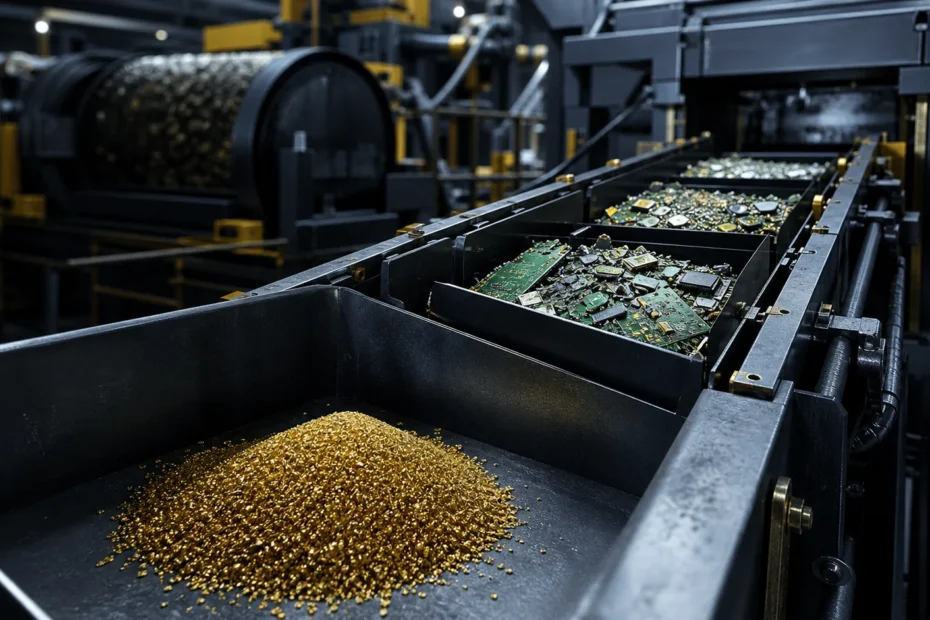
Learn how professional recyclers recover gold from e-waste through sorting, metallurgy, leaching, refining, and strict safety controls.
- Gold recovery starts with accurate sorting and concentration, not with acids.
- Industrial plants combine mechanical, thermal, and chemical steps under controlled conditions.
- Home extraction can release toxic fumes and contaminated waste and should not be attempted.
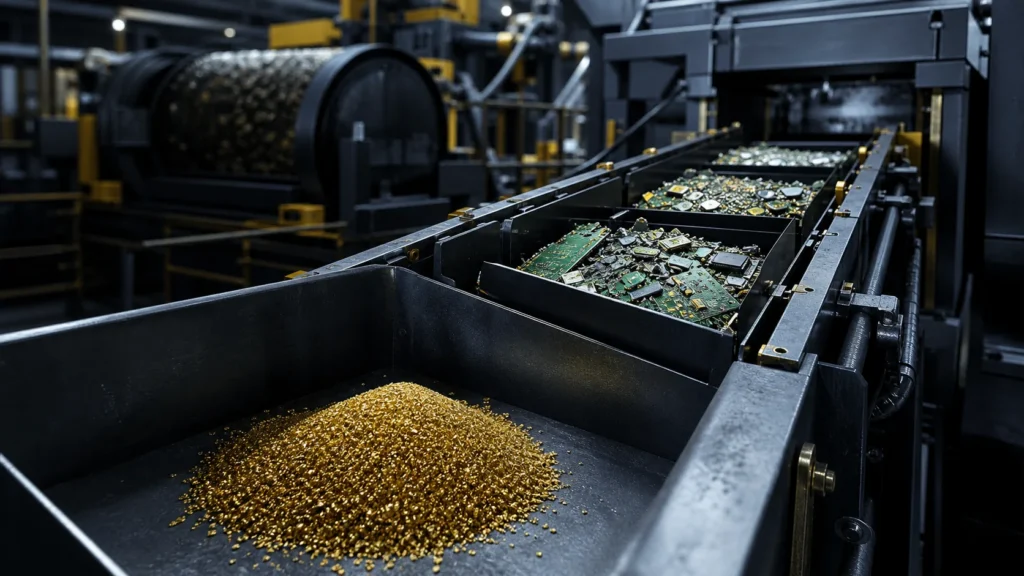
Professional recyclers recover gold from selected electronic components through a chain of dismantling, mechanical concentration, metallurgical treatment, chemical separation, purification, and refining. There is no single universal recipe: the process depends on the device mix, gold concentration, facility scale, environmental controls, and the other metals being recovered. Home extraction is unsafe because common methods can involve corrosive chemicals, toxic gases, high temperatures, and hazardous residues.
Electronic waste is often called an urban mine because discarded devices contain copper, gold, silver, palladium, and other useful materials. The comparison is helpful, but it can also mislead. A recycler does not open a laptop and remove a visible gold nugget.
Most electronic gold exists as a thin contact finish, tiny bonding wire, plated connector surface, or small part of a complex circuit board. Recovering it economically requires concentrating valuable fractions and treating several metals as one integrated material stream.
This article explains industrial process categories, not chemical instructions. Acid mixtures, cyanide systems, oxidizers, high-temperature treatment, and metal-bearing residues require trained personnel, engineered ventilation, protective equipment, emissions control, wastewater treatment, and legal authorization.
- Printed circuit boards, processors, contacts, and connectors can contain recoverable gold.
- Recyclers first sort and concentrate valuable fractions before metallurgical processing.
- Pyrometallurgy uses high temperatures; hydrometallurgy uses controlled leaching and separation.
- Laboratory recovery percentages do not automatically prove commercial profitability or environmental performance.
- Certified collection and processing protect workers, communities, data, and recoverable materials.
Where Gold Is Found in Electronic Waste
Gold is chosen for electronics because it resists corrosion and provides a stable contact surface. Older equipment may have thicker plating or more gold wire than some modern consumer products, but age alone does not determine value.
For the scale of an individual device, see how much gold is in a computer. Whole-device weight, gold content, and recoverable value are different quantities.
Gold is only part of the value. Copper often dominates the recoverable metal mass, while palladium, silver, tin, nickel, cobalt, and other materials may influence processing economics. Batteries, screens, plastics, and hazardous components require separate handling.
For the original technical role, see GoldConsul’s guide to gold in electronics. The articles on gold in 5G equipment and gold in AI hardware show why end-of-life electronics contain many different gold-bearing interfaces.
The Professional Gold-Recovery Chain
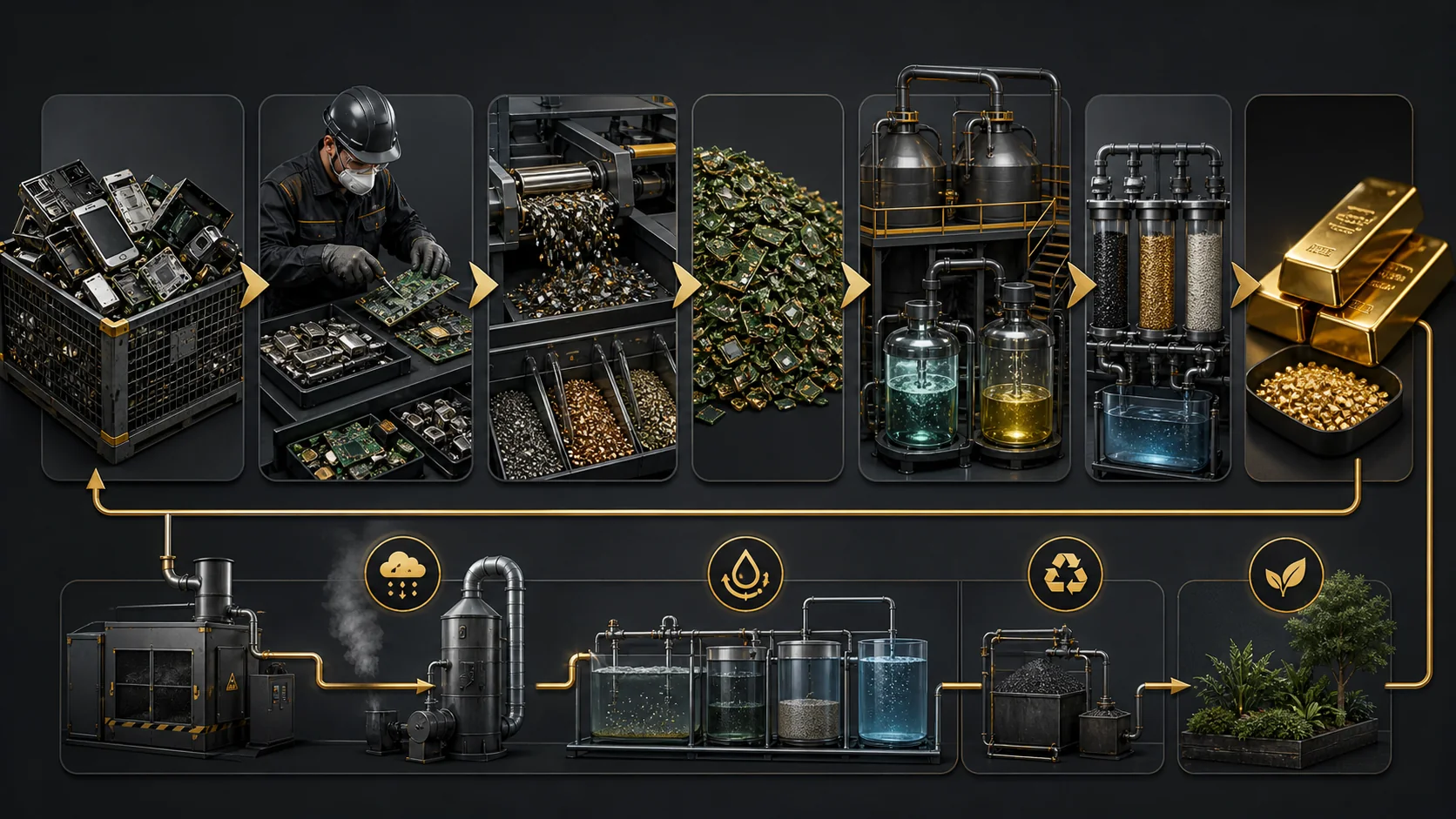
A formal recycling facility does not begin with gold chemistry. It begins with logistics and material control. Products are collected, recorded, assessed for reuse, depolluted, dismantled, and sorted into streams suitable for specialist processors.
Mechanical Processing: Concentrating the Valuable Fraction
Mechanical processing reduces a mixed device into material streams with different physical properties. Magnets remove ferrous metal. Eddy-current systems help separate non-ferrous metal. Screens divide material by particle size, while density or sensor-based sorting can improve concentration.
This stage does not normally produce pure gold. It creates a metal-rich fraction that is more efficient to transport and process. Poor sorting can dilute value, send hazardous material into the wrong stream, or lose fine precious-metal particles in dust.
Manual dismantling remains useful for removing batteries and identifying high-grade boards, but it requires worker protection and careful dust management. The best balance between manual and automated processing depends on labor conditions, product type, scale, and local regulation.
Pyrometallurgy: Recovery Through High-Temperature Processing
Pyrometallurgical routes use furnaces to treat metal-rich e-waste concentrates. Organic material is destroyed or converted, base metals form metallic or slag phases, and precious metals report into a recoverable collector-metal stream for later refining.
The advantages are industrial maturity, large throughput, and the ability to process complex feeds. The disadvantages include high energy demand, expensive infrastructure, emissions-control requirements, and the possibility of losing certain metals to slag or dust if the process is not designed for them.
A modern smelter is not comparable to open burning. It uses engineered furnaces, gas cleaning, heat recovery, process monitoring, and controlled handling of slag and residues. Informal heating can expose workers and communities to lead, mercury, brominated compounds, dioxins, and other hazards.
Hydrometallurgy: Leaching and Selective Separation
Hydrometallurgy uses liquid chemistry to dissolve selected metals from a prepared material. Subsequent steps separate dissolved metal ions through precipitation, reduction, solvent extraction, adsorption, ion exchange, or electrochemical methods.
The appeal is selectivity and potentially lower processing temperatures. The trade-off is chemical consumption, wastewater treatment, sensitivity to feed composition, and the need to manage solutions and residues safely.
A 2025 open-access study on end-of-life mobile phones combined dismantling with selective hydrometallurgical treatment and recovered gold, silver, and copper in metallic form. The authors also identify scale-up and cost-efficient sustainability as central challenges. A successful controlled experiment is evidence for a route, not proof that every e-waste business can reproduce it profitably.
The complete process and reported yields are available in the open-access Journal of Material Cycles and Waste Management study.
Bioleaching and Newer Selective Methods
Researchers are testing microorganisms, organic ligands, alternative oxidants, functionalized adsorbents, and other systems intended to improve selectivity or reduce hazardous reagents. Bioleaching uses biological activity to help mobilize metals, often under milder conditions than conventional high-temperature processing.
These approaches may reduce certain impacts, but they can be slower, sensitive to feed composition, and difficult to scale. A reagent described as “green” still requires a full assessment of production, toxicity, reuse, energy demand, recovery yield, wastewater, and final residue.
| Method | Main role | Strength | Core challenge | Typical maturity |
|---|---|---|---|---|
| Mechanical concentration | Separates and enriches material fractions | Reduces downstream volume | Dust, fine-particle losses, mixed feeds | Commercial |
| Pyrometallurgy | Concentrates precious metals through furnace processing | Large scale and complex feed capability | Energy, capital, emissions, metal losses | Commercial |
| Hydrometallurgy | Dissolves and selectively separates metals | Potentially high selectivity | Chemicals, wastewater, feed sensitivity | Commercial and developing |
| Bioleaching | Uses microorganisms to mobilize metals | Milder operating conditions | Speed, control, and scale-up | Research and selected applications |
| Advanced adsorbents | Captures gold selectively from solution | Potential selectivity and reagent reuse | Cost, durability, regeneration, real-feed performance | Research to pilot |
What Recovery-Rate Headlines Miss
A high percentage from a prepared concentrate says little about mixed household e-waste.
Recovery yield must include dismantling, concentration, leaching, purification, and residue losses.
Collection, labor, transport, reagents, energy, equipment, compliance, and refining charges matter.
A process is not sustainable if it transfers metals into untreated water, air emissions, or unstable waste.
Health and Environmental Risks
The World Health Organization identifies e-waste as one of the fastest-growing solid-waste streams. It reports that 62 million tonnes were generated in 2022 and only 22.3% was documented as formally collected and recycled.
Improper processing can release lead, mercury, combustion products, and many other toxic substances. Children and pregnant women are especially vulnerable around informal recycling sites. These risks are why valuable metal content does not justify backyard burning or improvised chemical treatment.
The Global E-waste Monitor provides broader collection and recycling data, while the Basel Convention framework addresses international movement of hazardous wastes. Local rules determine who may transport, store, dismantle, and process specific products.
The GoldConsul Editorial Perspective
The safest value-recovery decision is usually better sorting and a qualified downstream recycler, not stronger chemistry. If a buyer cannot document where boards, batteries, dust, solutions, and residues go, the quoted gold yield is not a complete business or environmental result.
What Determines Whether Recovery Is Profitable?
Profit begins with feedstock knowledge. A homogeneous batch of telecom boards is easier to sample and price than mixed appliances. Contracts, collection density, labor, transport distance, metal prices, sampling accuracy, and payment terms can matter more than a laboratory extraction percentage.
Scale also changes the process. A large integrated smelter can recover several metals and spread compliance costs across high throughput. A small collector may create more value by sorting, documenting, and selling graded fractions than by attempting final refining.
Gold is only one revenue stream. A process that maximizes gold but loses copper, palladium, silver, or reusable components may produce a worse overall result.
- Does the company provide permits, certifications, and traceable downstream partners?
- Are batteries, data-bearing devices, displays, and hazardous parts handled separately?
- How are weights, grades, sampling, fees, and metal settlements documented?
- Are worker protection, dust control, emissions, wastewater, and residues addressed?
- Does the recycler prioritize reuse before destructive material recovery?
Video walkthrough: Video walkthrough: this facility-scale report shows why formal e-waste recycling depends on sorting, machinery, worker controls, and multiple material streams.
What Consumers and Businesses Should Do
Keep devices intact until data and battery risks are managed. Use manufacturer take-back programs, municipal collection, reputable refurbishers, or certified electronics recyclers. Businesses should require certificates of destruction or reuse, downstream transparency, and clear ownership of recovered value.
Do not estimate value from gold color. Many yellow surfaces are extremely thin plating, while valuable components may not look gold at all. Professional sampling and assay are the only reliable basis for large transactions.
For the wider technology context, continue with gold and technology or explore how nanotechnology changes gold applications.
Bottom Line
Gold recovery from e-waste is a controlled industrial chain, not a single extraction trick. Collection, reuse, depollution, dismantling, concentration, metallurgical separation, refining, and residue management all affect the result.
The strongest process recovers several materials, protects workers, controls emissions and wastewater, and remains economical at real feed grades. For individuals, the responsible route is qualified collection and recycling, not home chemistry.
FAQ: Gold Recovery from E-Waste
Which electronic waste contains the most gold?
High-reliability circuit boards, some older processors and memory, telecom equipment, connectors, and selected industrial hardware can be richer than ordinary appliances. Actual value depends on model, age, construction, and recoverable fraction.
Can gold be safely extracted from electronics at home?
Home chemical or thermal extraction is not a safe recommendation. Common routes can create corrosive exposure, toxic gases, fires, heavy-metal contamination, and hazardous waste that requires licensed treatment.
Is e-waste richer in gold than mined ore?
Selected circuit-board concentrates can contain more gold per tonne than many natural ores. Mixed e-waste is not a uniform ore, however, and collection, sorting, other materials, and processing costs determine whether that comparison is meaningful.
What is the difference between pyrometallurgy and hydrometallurgy?
Pyrometallurgy uses high-temperature processing to separate and concentrate metals. Hydrometallurgy uses controlled liquid chemistry to dissolve and selectively recover them. Industrial flowsheets may combine both.
Does recycling electronics reduce gold mining?
Recycling returns existing gold and other metals to supply and can reduce demand for equivalent newly mined material. It does not eliminate mining, but it improves resource efficiency when collection and recovery are responsibly managed.
This article is educational. Follow local waste, transport, environmental, workplace, and data-protection requirements.
 When you purchase a service or a product through our links, we sometimes earn a commission, at no extra cost to you.