
Learn how the Black Hills Gold Rush began, why mining violated the 1868 treaty, how Deadwood and Homestake grew, and why the legacy remains disputed.
- The 1874 gold report triggered mass entry into land reserved for the Sioux under the 1868 Fort Laramie Treaty.
- Deadwood grew from placer mining, while the Homestake discovery shifted the region toward capital-intensive hard-rock mining.
- The rush cannot be separated from the 1877 taking of the Black Hills or the continuing Sioux claim to the land.
- The rush did not begin on vacant public land: the Black Hills were within the Great Sioux Reservation.
- Custer’s 1874 expedition confirmed gold; the major illegal influx followed in 1875–76.
- Deadwood was a placer boomtown, while nearby Lead and Homestake represented the lode-mining future.
- The United States took the Black Hills in 1877 after war and coercive pressure.
- A 1980 Supreme Court judgment awarded compensation, but Sioux nations have maintained that the issue is land, not a sale price.
A rush cannot be separated from where it happened
The most useful way to understand the Black Hills Gold Rush is to follow three connected systems: treaty-protected land, a fast-moving placer rush, and a capital-intensive mining industry. Popular accounts often begin with famous Deadwood personalities. The causal story begins earlier, with a federal promise about land and a government expedition that made mineral information public.
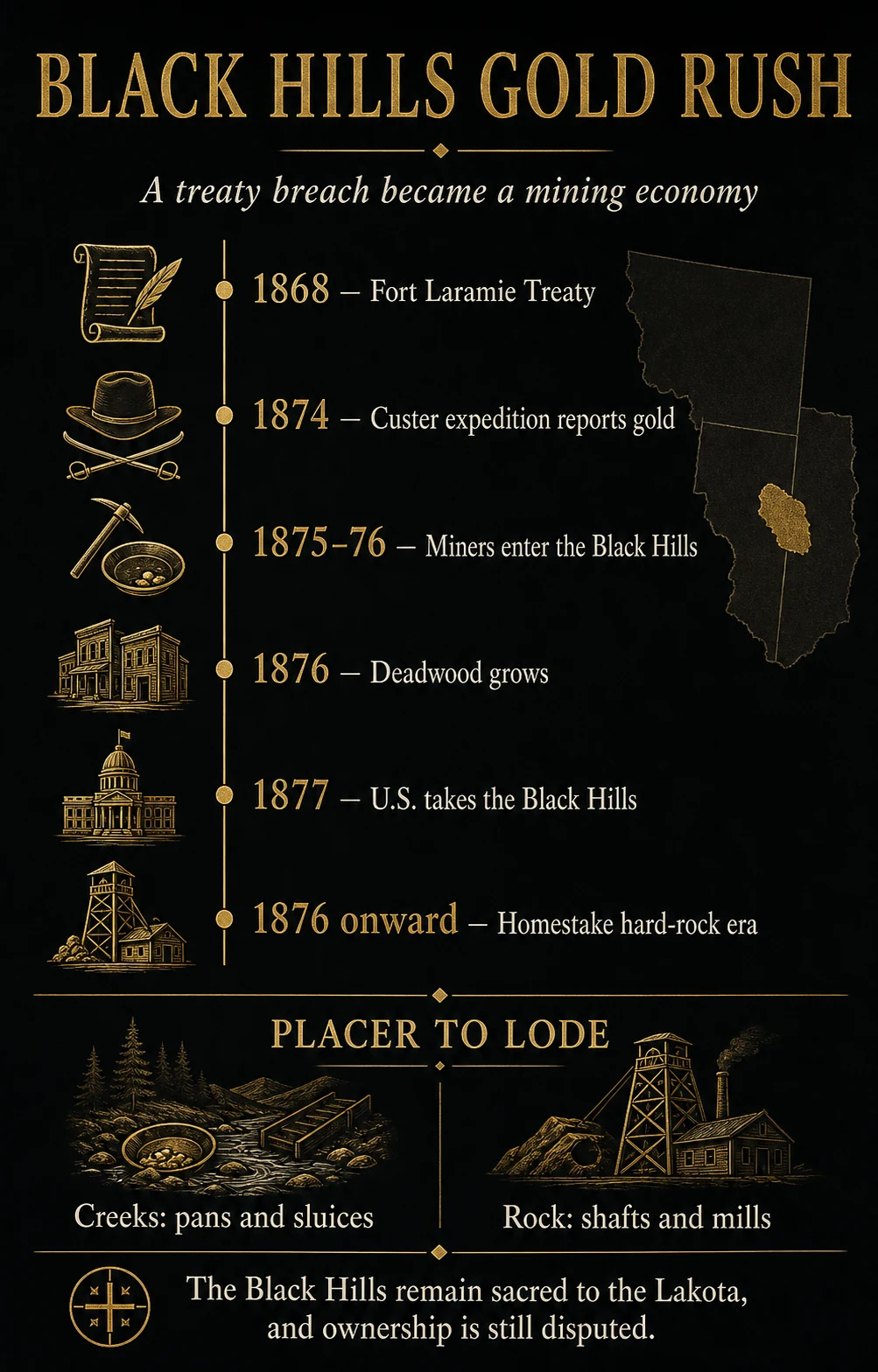
Black Hills Gold Rush timeline
| Date | What happened | Why it matters |
|---|---|---|
| 1868 | The Fort Laramie Treaty established the Great Sioux Reservation, including the Black Hills, for the “absolute and undisturbed use” of the named Indigenous nations. | Later prospecting and settlement were not ordinary entry onto open federal mineral land. |
| 1874 | George A. Custer led an expedition into the Black Hills; accompanying specialists reported gold. | The report transformed earlier rumors into a national rush signal. |
| 1875–76 | Prospectors entered in growing numbers. Richer northern placers drew a stampede toward Deadwood Gulch. | Federal attempts to exclude miners failed, and settlements expanded in violation of the treaty. |
| 1876 | Deadwood developed rapidly; Fred and Moses Manuel located the Homestake claim near present-day Lead. | The region began shifting from shallow placer work to organized lode mining. |
| 1876–77 | The Great Sioux War and federal pressure culminated in the taking of the Black Hills. | Gold and settlement were central pressures behind a military and political land transfer. |
| 1877 onward | Homestake became a long-lived hard-rock operation, eventually closing in 2002. | The speculative rush matured into an industrial economy with deep shafts, mills, labor systems and environmental impacts. |
The 1868 treaty is the starting point
The National Archives transcript of the 1868 Fort Laramie Treaty records the reservation and bars unauthorized people from settling or residing there. The Black Hills—Paha Sapa in Lakota—also hold continuing cultural and spiritual significance. Calling the area an unexplored wilderness erases both political rights and a much longer Indigenous relationship with the landscape.
Custer’s expedition had military and mapping purposes as well as a search for resources. Once the gold report circulated, small Army removals could not contain the inflow. The National Park Service describes the miner influx as an invasion in direct violation of the treaty. That language is historically important: the conflict was not simply miners competing with other miners for claims.
Why Deadwood became the rush center
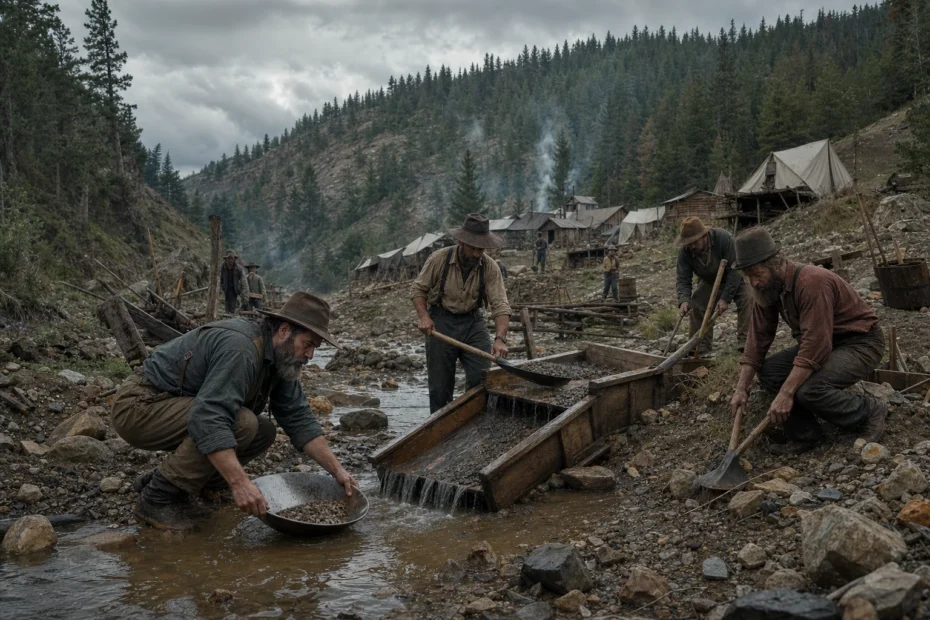
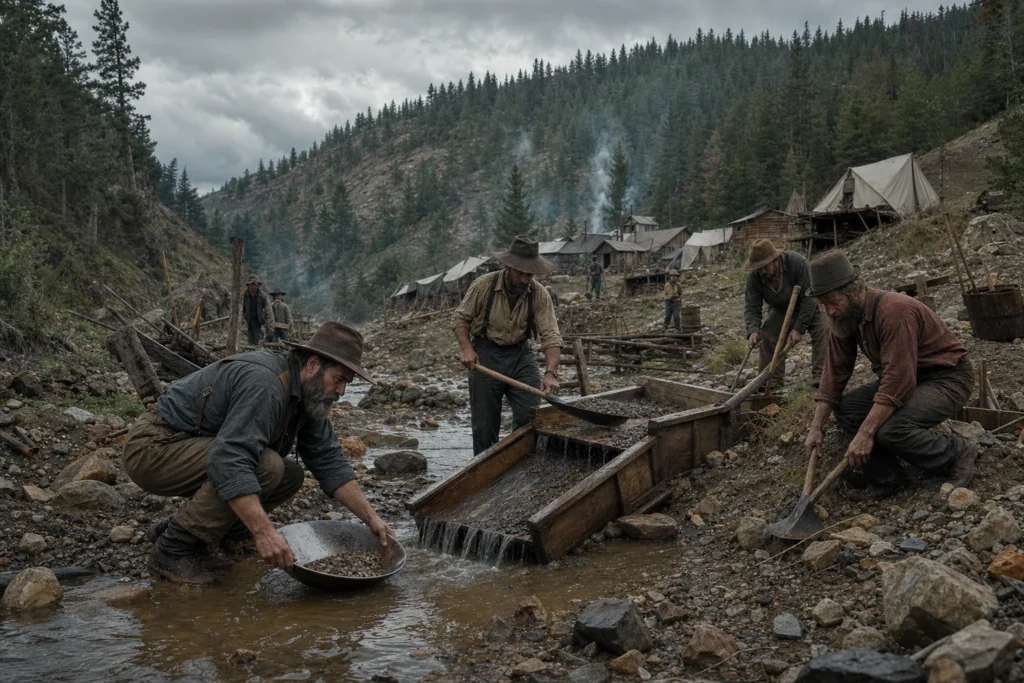
Initial activity clustered in the southern Hills near French Creek and Custer. The decisive northern shift came when gold was found in Deadwood Gulch and nearby drainages. Placer gold could be separated from stream gravel with pans, rockers and sluices, so an individual or small partnership could begin with less capital than a deep mine required.
But easy entry did not mean easy profit. Productive ground was limited, claims filled quickly, water and timber were contested, and merchants often earned more predictably than miners. Deadwood became a supply, entertainment and transport town because thousands of people needed food, shelter, tools, animals, lumber and credit. Its celebrated “lawlessness” was partly the result of a large unauthorized settlement operating before stable civil institutions caught up.
Homestake changed the scale of mining
The Manuel brothers’ 1876 Homestake discovery near Lead exposed a different economic model. Placer miners recover gold already freed and concentrated by erosion. Lode miners must follow mineralized rock, break and hoist ore, crush it, recover a small gold fraction and manage water, ventilation and waste. That process rewards capital, engineering and consolidated ownership.
Homestake eventually became one of the best-known gold mines in the United States. Its growth did not prove that every rush-era claim was rich. It showed that a durable ore body plus machinery, labor, milling and finance could outlast the individual prospector phase. For a broader process comparison, see GoldConsul’s guides to gold mining methods, gold-rush mining techniques and early mining tools.
What happened to the Black Hills?
The rush intensified federal efforts to acquire the Hills after Sioux leaders rejected purchase proposals. War followed. In 1877, Congress attached conditions to appropriations and took the Black Hills without the three-fourths adult-male consent required for cession under the treaty. The legal history is complex; the core fact is not.
In United States v. Sioux Nation of Indians (1980), the Supreme Court upheld a compensation award for the taking. That judgment did not convert the event into a consensual sale. Sioux nations have not accepted the money because acceptance would undermine the position that the Black Hills were never validly sold. A reader should therefore avoid the misleading shortcut “the government later paid for the land.”
Use “Sioux” when referring to the treaty parties or court case, and use specific nation names—such as Lakota, Dakota or Nakota—when the source supports that precision. Do not treat one modern spokesperson as representing every affected nation, and do not imply that a compensation fund resolved ownership.
Who profited—and who carried the risk?
A gold rush distributes gains unevenly. A small number of claim holders and investors obtained valuable properties. Merchants, freight operators, property owners and professional service providers earned from population growth. Wage miners later received income but faced underground hazards and dependence on mine employment. Many independent prospectors lost their stake or left.
The largest cost cannot be measured through miner earnings: Lakota and other Indigenous peoples lost control of treaty-protected land and faced military force, restricted movement and damage to sacred landscapes. Mining also changed streams, forests and waste patterns. Any “economic impact” section that counts town growth but omits these transfers is incomplete.
How to evaluate a Black Hills Gold Rush claim
- Does the account begin before 1874 and name the Fort Laramie Treaty?
- Does it distinguish early southern discoveries from the northern Deadwood rush?
- Does it separate placer mining from Homestake-style lode mining?
- Are exact output or population numbers tied to a dated source and defined geography?
- Does it explain that 1877 was a coerced taking, not a normal open-market purchase?
- Does it identify whether a claim comes from a primary record, later scholarship or tourism marketing?
Names and dates are useful only when relationships are clear. Compare this rush with the Pikes Peak Gold Rush, the Nome Gold Rush, the Klondike and the broader gold-rush era. Each moved from discovery publicity to migration, claims, services, capital and legal consequences—but the land and political context differed.
Video context: Why the Black Hills rush became a treaty and land-rights crisis
Knowledge Gap and Editorial Perspective
Rush-era production and population figures often mix different dates, districts and valuation bases. A dollar total at nineteenth-century prices is not a physical gold total, while a Deadwood figure is not automatically a Black Hills total. Treat precise numbers without a defined period, unit and boundary as provisional.
The Black Hills Gold Rush is clearest when Deadwood is treated as one node in a larger causal chain. Gold explains the influx, but treaty rights explain why the influx became a national conflict. Homestake explains the industrial legacy, but it does not erase the continuing land claim.
Bottom Line
The Black Hills Gold Rush moved from a government gold report to illegal migration, a Deadwood placer boom and a durable hard-rock industry. Its economic history matters, but the defining fact is that the rush unfolded on treaty-protected Indigenous land whose ownership remains disputed.
FAQ: Black Hills Gold Rush
When did the Black Hills Gold Rush start?
The decisive trigger was the Custer expedition’s 1874 gold report. Prospecting intensified in 1875, and the major Deadwood-centered rush developed during 1875–76.
Was gold discovered in Deadwood first?
No. The 1874 expedition reported gold in the southern Black Hills. Richer northern placers later drew miners to Deadwood Gulch and shifted the rush center.
Was mining in the Black Hills legal?
The mass entry occurred on land reserved for the Sioux under the 1868 Fort Laramie Treaty, so the settlements and prospecting violated the treaty framework.
What was the Homestake Mine?
Homestake was a major hard-rock gold mine near Lead that grew from an 1876 claim. It represented industrial lode mining rather than the shallow placer methods associated with early Deadwood.
Did the Supreme Court return the Black Hills?
No. The 1980 Supreme Court case upheld monetary compensation for the taking. Sioux nations have not accepted the award and continue to maintain that the land was never validly sold.
Sources and verification
The dates, physical values and evidence boundaries in this guide are based on the following primary or specialist sources.
- National Archives — Fort Laramie Treaty (1868) — Primary federal record and transcript recognizing the Black Hills within the Great Sioux Reservation.
- NPS — 1868 Treaty Field Area — Explains the treaty, gold discovery, miner influx and escalation toward war.
- NPS — Fighting for the Black Hills — Indigenous perspectives on the invasion of treaty-protected lands and the Great Sioux War.
- NPS — Little Bighorn battle context — Connects the Custer expedition, gold report, treaty violation and federal military response.
- Oyez — United States v. Sioux Nation of Indians — Case summary for the Supreme Court compensation decision.
- Deadwood History — Timeline — Local chronology for Deadwood and the northern Black Hills.
- Insider News — Whitewashed: Black Hills Gold Rush — Video context that centers the treaty breach and Indigenous dispossession.
 When you purchase a service or a product through our links, we sometimes earn a commission, at no extra cost to you.