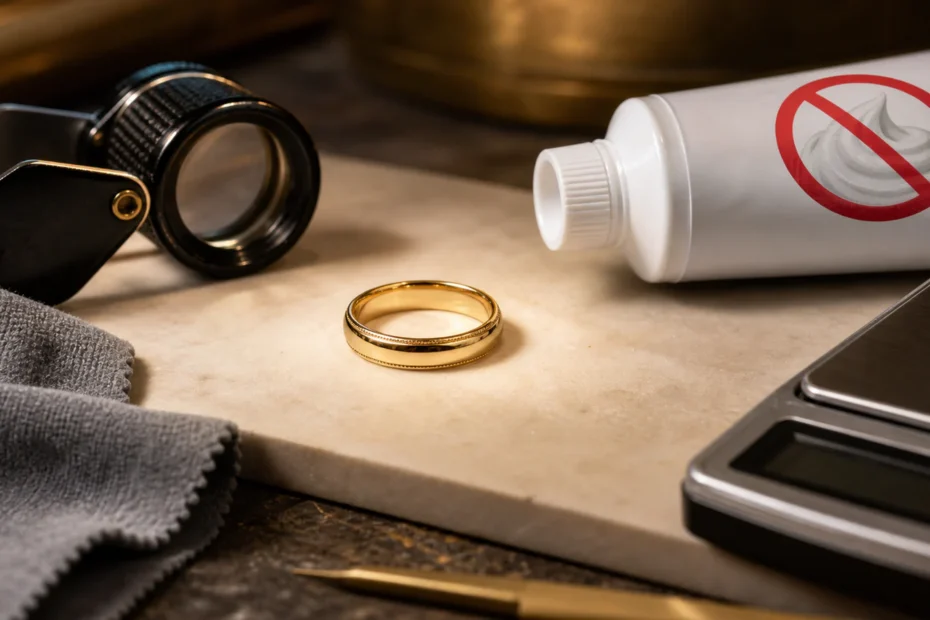
Toothpaste cannot verify gold purity. See why marks mislead, what damage it may cause, and which safer checks and professional tests work better.
- Toothpaste is an abrasive cleaner, not a chemical assay for gold purity.
- A brighter or darker rubbed spot can reflect residue, plating wear or scratching—not whether an item is real gold.
- Start with documentation and non-destructive checks; use a qualified jeweler, XRF or assay when money or resale depends on the answer.
- Toothpaste tests surface appearance, not gold composition.
- A brighter patch can be cleaning; discoloration can be residue or exposed base metal.
- Plated, filled, hollow and stone-set pieces defeat many simple home tests.
- Hallmarks and magnet response are useful clues but not proof.
- Use non-destructive professional testing for valuable, sentimental or resale items.
A viral trick is not an assay
The toothpaste myth usually says “rub it on gold and watch the color.” That observation has no calibrated relationship to 10K, 14K, 18K or 24K fineness. The same visual result can come from polishing dirt, abrading plating, reacting with another alloy component or leaving a white film.
Why the toothpaste gold test fails
The American Dental Association describes toothpaste as a dentifrice containing abrasives. Formulas also vary in detergents, humectants, flavorings, fluorides and whitening ingredients. No standardized “toothpaste test” specifies product, pressure, rub time, surface condition, lighting or pass/fail threshold.
| What you observe | Possible cause | What it proves |
|---|---|---|
| The metal looks brighter | Dirt or tarnish was removed; surface was polished. | Nothing about karat or interior composition. |
| A dark mark appears | Residue, loosened grime, alloy tarnish or abrasion. | Not a reliable fake-gold result. |
| The color changes | Thin plating may be worn; another material may be exposed. | Surface damage, not measured fineness. |
| Nothing happens | Gold may resist tarnish, or the test may be too mild. | Neither authenticity nor purity. |
Damage risk is highest where the test is least informative
Gold-plated jewelry can have a very thin gold layer. Abrasion may expose nickel, copper, brass or silver-toned material. Gold-filled pieces have a mechanically bonded gold layer thicker than ordinary electroplate, but rubbing still does not reveal the construction or total gold fraction. Hollow jewelry can dent, and toothpaste can lodge under stones, in porous gems and inside settings.
GIA laboratory notes document cases where surface gold plating masked underlying composition. Surface-sensitive methods therefore need interpretation, and destructive sampling may be required for a definitive bulk result. That is exactly why a bathroom product cannot settle the question.
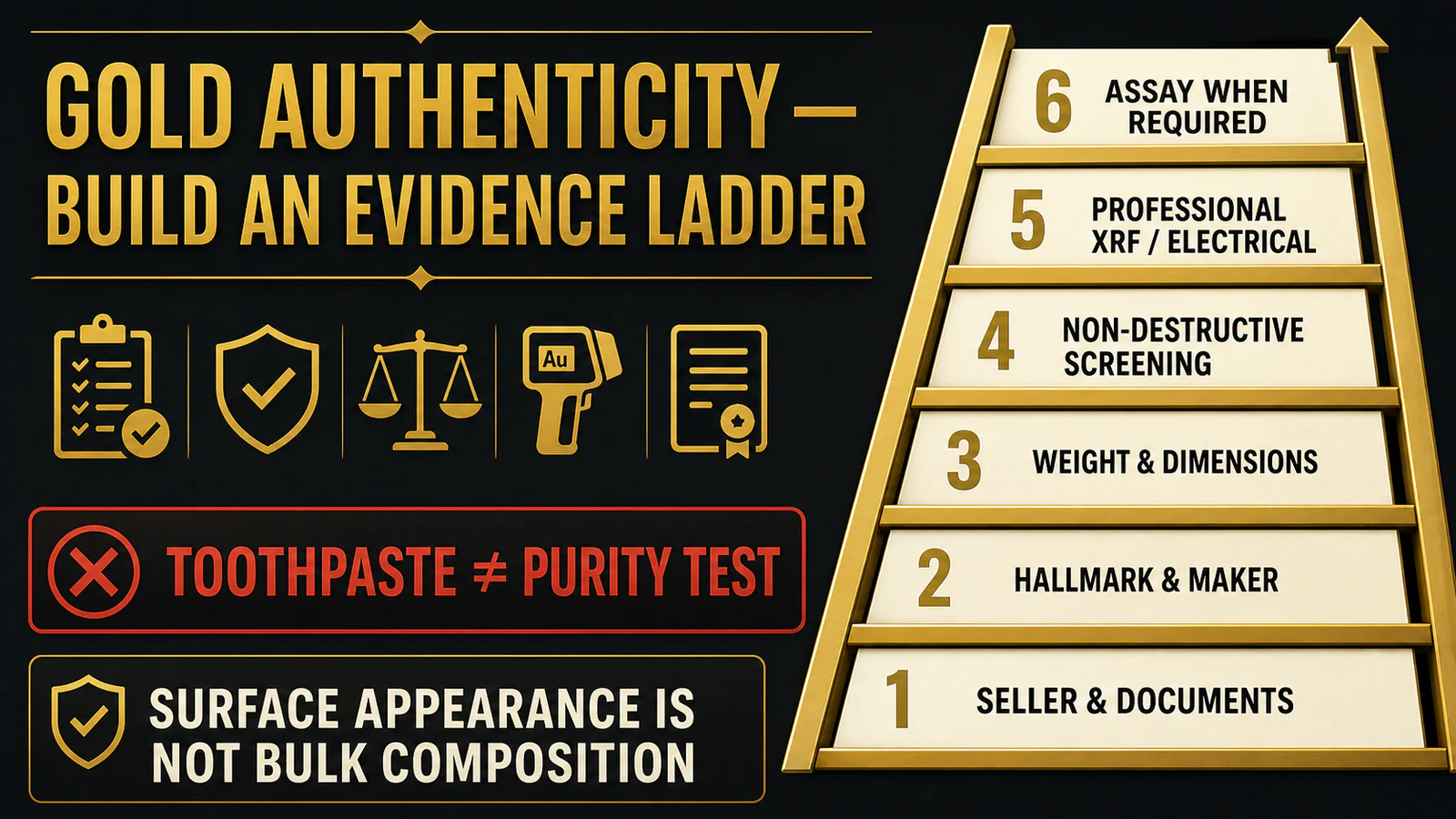
The evidence ladder: safest first
- Seller and documents: invoice, return policy, manufacturer specifications and chain of custody.
- Hallmark and maker: inspect fineness marks, trademark and construction terms under magnification.
- Weight and dimensions: compare the exact model or coin with reliable specifications.
- Non-destructive screening: magnet behavior, density where geometry permits and careful visual examination.
- Professional instruments: XRF, electrical conductivity, ultrasound or purpose-built precious-metal verification.
- Assay: use an appropriate laboratory method when a legally or commercially definitive answer is required.
What hallmarks can—and cannot—tell you
Common fineness marks include 375 for 9K, 417 for 10K, 585 for 14K, 750 for 18K, 916 for 22K and 999 for high-fineness gold. Marks such as GP, GEP, HGE, GF or RGP can indicate plating or bonded-layer constructions. Jurisdictions and eras use different systems.
A correct mark supports identification but can be forged or transferred. A missing mark does not automatically mean fake, especially on worn, repaired, antique or very small items. Match the mark to maker, country, age and construction.
Magnet testing is only a screen
Gold is not strongly attracted to an ordinary magnet, so strong attraction can reveal ferromagnetic components. But many non-gold metals are also nonmagnetic, while clasps and springs can legitimately contain magnetic parts. A passed magnet test is weak evidence; a suspicious local response tells you where to investigate.
Learn the limitations in does gold stick to magnets? and compare broader methods in how to tell if gold is real.
Density works only for suitable solid objects
Pure gold has a density near 19.3 g/cm³ at room conditions, but jewelry alloys are less dense. Hollow objects, internal voids, stones, solder, mixed metals and trapped air invalidate a simple displacement calculation. Plated tungsten can also approach gold’s density. Use density as one consistency check, not proof.
A solid-looking object weighs 15.0 g and displaces 1.5 mL. Its apparent density is 10.0 g/cm³—far below pure gold. That is a reason for further evaluation, but it does not identify the alloy. If the same object is hollow or stone-set, the calculation cannot establish fineness.
Professional methods and their boundaries
| Method | Strength | Important limitation |
|---|---|---|
| XRF | Fast, non-destructive elemental analysis near the surface. | Coatings and geometry can mask the bulk; multiple spots and interpretation matter. |
| Touchstone + acid | Traditional comparative karat screening by a trained tester. | Leaves a streak; acids are hazardous and results are operator-dependent. |
| Electrical verification | Compares conductivity/resistivity response with expected ranges. | Requires correct calibration, contact and product profile. |
| Ultrasound | Can reveal internal boundaries in suitable bars. | Geometry and operator skill matter; not a general jewelry test. |
| Fire assay | Highly authoritative bulk fineness method. | Destructive sampling, time and cost. |
GIA’s touchstone guidance emphasizes controlled comparison by trained users. Its XRF research likewise treats instrument output as analytical evidence, not a consumer pass/fail button.
When to stop testing at home
For at-home screening that avoids folklore, see how to test gold at home, testing gold purity, the gold purity calculator and why gold-plated jewelry may turn green.
What to ask a jeweler or buyer
- Which instrument or method will you use?
- Does it read only the surface, and will you test more than one location?
- Can you distinguish solid, hollow, plated and gold-filled construction?
- Will the test mark or damage the item?
- Will I receive the reading or written result?
- Does your purchase offer depend on recoverable gold weight, stones, fees or refining assumptions?
Cleaning is a separate decision from testing
If the goal is simply to remove dirt, identify the item and stones before choosing a cleaning method. Warm water and a small amount of mild soap may suit some solid-gold jewelry, but it is not universal. Pearls, opals, emerald treatments, glued settings, antique patina and plated finishes need specialist care. Cleaning never becomes evidence of purity.
Photograph marks and condition before any service. For a valuable piece, ask the jeweler to inspect loose stones, worn prongs, solder repairs and plating before cleaning. A newly bright surface can hide wear that matters more than the metal test.
Buying and resale evidence
Authentication and valuation are related but different. A genuine 14K chain is priced from recoverable gold weight, construction, condition, stones, labor, brand and market. A buyer may deduct non-gold components and refining cost. Request the measured weight, assumed fineness, payable percentage and price timestamp so the offer can be compared.
Most toothpaste-test pages judge a color change without specifying the toothpaste chemistry, alloy, plating thickness or control sample. An observation with no standardized method and no validated threshold cannot be an authenticity test.
The right question is not “Which household substance reacts with gold?” It is “What claim must be proven—surface color, construction, karat, or bulk composition—and which method can actually measure it?”
Do not abrade, scratch, heat or apply household chemicals or acids to valuable, plated, antique, hollow or stone-set jewelry. Professional testing can still have limitations; discuss them before authorizing any destructive step.
Video context This jeweler demonstration shows how XRF produces elemental evidence without relying on surface folklore. A qualified operator must still interpret coatings and geometry.
Bottom Line
Toothpaste can clean or damage a surface, but it cannot authenticate gold or measure purity. Start with provenance, marks and specifications, use screening tests only within their limits, and obtain qualified non-destructive or laboratory testing when the answer affects value.
FAQ: Testing Gold With Toothpaste
Does toothpaste turn fake gold black?
Not reliably. Dark residue can come from grime, toothpaste ingredients, tarnish or abrasion. There is no validated color threshold for authenticity.
Can toothpaste damage gold jewelry?
It can scratch softer finishes, wear plating and lodge in settings. The risk is greater for plated, polished and stone-set pieces.
What is the safest home gold test?
There is no single proof test. Inspect marks and seller documents, compare weight and dimensions, and use non-destructive professional testing when value matters.
Can a magnet prove gold is real?
No. Strong attraction is suspicious, but many base metals are nonmagnetic and some legitimate jewelry parts can respond.
Is XRF definitive for gold purity?
XRF is strong non-destructive elemental evidence near the surface, but coatings, shape and sampling can matter. A qualified operator may combine methods.
Sources and verification
Primary and specialist sources are linked below. Rules, market data and product specifications can change; verify the dated source before acting.
- American Dental Association — Toothpastes — Toothpaste is an abrasive-containing dentifrice.
- GIA — Methods for Determining Gold Content — Density, touchstone, electronic and XRF method comparison.
- GIA — Chemical Analysis: XRF and LA-ICP-MS — XRF use and analytical limits in gemological labs.
- GIA — Gold-Plated Gold — Plating can affect surface XRF results.
- GIA — Touchstone Method — Professional chemical testing workflow and acid hazards.
- FTC — Buying Gold Jewelry — Karat marks, trademarks and plated-product terminology.
- ISO 11426:2021 — Cupellation fire-assay standard for homogeneous material.
- BIS — Hallmark Consumer Protection — Official hallmark verification and assaying-center route.
- GIA — Electroformed Gold Bracelet — Why construction and verification services matter.
- GIA — Gold Testing PDF — Detailed analytical method limitations.
 When you purchase a service or a product through our links, we sometimes earn a commission, at no extra cost to you.