
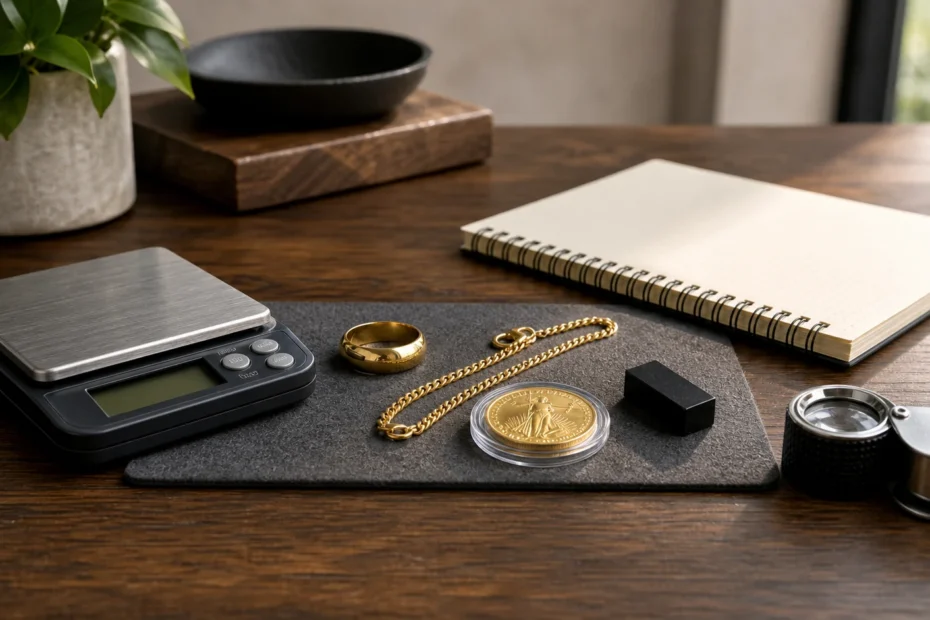
Learn how to test gold at home safely with hallmarks, magnet checks, weight, density, acid-test cautions, and when XRF or assay matters.
- Home tests can reject obvious fakes, but they cannot prove gold by themselves.
- Start with hallmarks, visual inspection, magnet response, weight, and density.
- Avoid lighter, vinegar, and skin tests when value or surface damage matters.
Quick answer
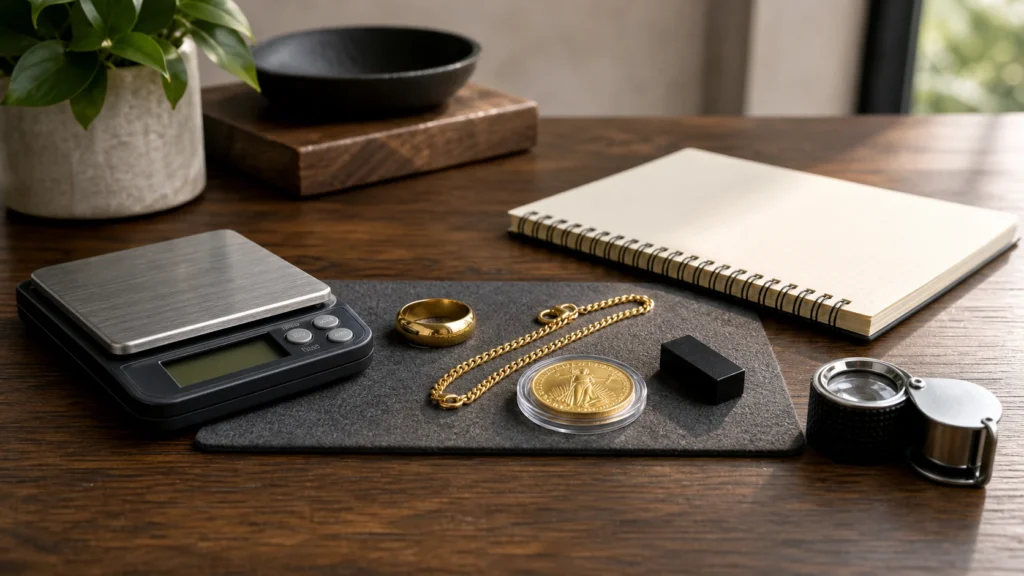
Can you test gold at home?Yes, but home tests should be treated as screening checks, not final proof. The safest sequence is to inspect markings, compare weight and dimensions, use a magnet only as a red-flag screen, and escalate valuable or confusing items to XRF, ultrasound, fire assay, or a qualified jeweler.
Quick summary
- Hallmarks such as 585, 750, 916, and 999 describe millesimal fineness, not percent-style purity labels.
- A magnet can catch some obvious problems, but no pull does not prove that an item is real gold.
- Vinegar, skin-discoloration, toothpaste, ceramic-scratch, and lighter tests are unreliable or risky.
- Acid testing can help with surface screening, but it can damage jewelry and does not replace professional verification.
- Coins, bars, scrap, watches, and finished jewelry need different checks because plating, fillers, solder, stones, and packaging change the risk.
Testing gold at home is useful when you want to slow down before buying, selling, or sending an item for appraisal. It is not useful when one quick trick is treated as a verdict. Real gold authentication is a chain of evidence: markings, measurements, metal behavior, documentation, and professional tools all matter. For a branded online purchase, the NuraGold verification chain separates the brand, exact listing, seller, delivered construction, and independent test.
How to test gold at home: use a safe screening sequence
Choose the right test for the gold item
| Item type | Best first checks | Main risk | When to escalate |
|---|---|---|---|
| Jewelry | Hallmark, wear points, clasp, magnet, weight, careful acid test only if acceptable. | Gold plated, gold filled, vermeil, solder, mixed parts, stones, and repairs. | Before resale, insurance, inheritance decisions, or destructive testing. |
| Coins | Weight, diameter, thickness, sound, magnet response, known mint specifications, holder check. | Counterfeit coins, altered dates, fake holders, and overpaying for condition. | When premiums or collectible value are meaningful. |
| Bars | Weight, dimensions, serial, assay card, packaging, dealer documentation, magnet response. | Tungsten cores, fake assay packaging, unknown refiner, and poor chain of custody. | Before buying or selling investment-grade bullion. |
| Scrap gold | Karat marks, grouping by purity, scale weight, buyer payout terms, spot-price context. | Mixed karats, non-gold components, stones, and unrealistic buyer quotes. | Before accepting a cash offer or melt-value estimate. |
Understand hallmarks, karats, and fineness numbers
Gold markings are a starting point. In the United States, jewelry sellers must follow Federal Trade Commission guidance on gold, gold-plated, and gold-filled descriptions. Internationally, fineness numbers such as 585, 750, 916, and 999 are common. They are millesimal fineness marks, not percentages. When shopping abroad, combine that hallmark check with a Mexico jewelry comparison based on fine-gold grams, receipt details, exchange costs, and import rules.
| Mark | Common meaning | Approximate gold content | Reader check |
|---|---|---|---|
| 333 / 8K | Low-karat gold in some markets | 33.3% gold | May not qualify as gold jewelry in every market. |
| 375 / 9K | 9 karat gold | 37.5% gold | Common in some jewelry markets; not bullion-grade. |
| 417 / 10K | 10 karat gold | 41.7% gold | Minimum gold content for many U.S. jewelry claims. |
| 585 / 14K | 14 karat gold | 58.5% gold | Common jewelry purity; alloy color and wear vary. |
| 750 / 18K | 18 karat gold | 75.0% gold | Common for fine jewelry; still contains alloy metals. |
| 916 / 22K | 22 karat gold | 91.6% gold | Used in some coins and jewelry traditions. |
| 999 / 999.9 | High-fineness gold | 99.9% or higher | Usually bullion context; verify refiner, weight, and documentation. |
Plated, filled, vermeil, and rolled gold marks
Many false assumptions start with surface gold. A piece can have real gold on the outside and still not be solid gold. Look for marks such as GP, GEP, HGE, GF, RGP, rolled gold, gold filled, gold plated, gold overlay, vermeil, or electroplate.
- Gold plated: a thin gold layer over a base metal; surface tests can mislead.
- Gold filled: a thicker bonded gold layer than ordinary plating, but still not solid gold.
- Vermeil: gold over sterling silver; valuable differently from solid gold.
- HGE or RGP: heavy gold electroplate or rolled gold plate; not the same as karat gold throughout.
Use the magnet test as a red-flag screen
Pure gold is not ferromagnetic, so a normal magnet should not pull solid gold the way it pulls iron, steel, nickel, or cobalt. That makes the magnet test useful for catching some obvious problems. It does not make the test a proof of authenticity.
For a deeper explanation, see GoldConsul’s guide to whether gold sticks to magnets.
Compare weight, dimensions, and density
Weight becomes more useful when you know the expected specification. A bullion coin has a published diameter, thickness, and weight. A loose ring or chain has more variation, so density and weight checks become less precise.
For a simple, solid shape, use our gold weight calculator to compare a dimension-based estimate with the scale reading. Agreement does not prove authenticity, and hollow pieces or stones make this comparison unreliable.
Gold’s density is about 19.3 g/cm3, which is much higher than silver, copper, or brass. But a home density test can still fail if the shape traps air, the scale is poor, stones or solder are included, or a counterfeit uses a dense core such as tungsten.
- Weigh the dry item on a scale accurate enough for the item size.
- Measure dimensions when specifications are available, especially for coins and bars.
- Use specific gravity only when the item can safely be suspended in water without damage.
- Do not use density alone as proof when the item has high value.
Use the Gold Purity Calculator to translate karat, fineness, and pure gold weight once you have a reliable purity estimate.
Reader-supported tools
Useful tools after your first home check
These tools can help you weigh, screen, and document what you see. They reduce uncertainty, but they do not replace XRF, ultrasound, assay, or a qualified professional for high-value items.
As an Amazon Associate, GoldConsul may earn from qualifying purchases. Prices are not shown and can change on Amazon.

New Personal Coin Scale Pro
Best for: checking small coins, bars, jewelry components, and scrap lots by weight.
Caveat: weight is only one clue; pair it with dimensions, documentation, and stronger testing.
Check current price on Amazon
Coin Ping Tester
Best for: adding a sound check to common bullion coin screening.
Caveat: ping testing can catch some problems, but it does not prove authenticity by itself.
Check current price on Amazon
GTE Jewelry Testing Kit
Best for: basic home screening of common jewelry karat claims.
Caveat: acid can mark or damage finishes. Use conservatively and avoid valuable pieces unless damage risk is acceptable.
Check current price on AmazonAcid testing can help, but it is not harmless
Gold acid testing is a common jewelry-screening method, but it is not a clean, risk-free home trick. It usually tests a small surface area and may require rubbing the item on a test stone. That can mark finishes, expose plating, or damage a piece that has collectible or sentimental value.
- Use acid only with eye protection, gloves, ventilation, and a surface that can tolerate spills.
- Do not acid-test valuable finished jewelry, coins, or bars unless you accept the damage risk.
- Do not treat an acid result as an exact purity determination.
- Escalate inconsistent results to XRF or a jeweler who can explain the method used.
Tests to avoid as proof
XRF, ultrasound, and fire assay
Professional testing matters when a home test cannot answer the real question. XRF can identify surface composition quickly without the same damage profile as acid testing. Ultrasound can help screen some bullion for internal problems. Fire assay is a destructive laboratory method used for precise metal-content analysis.
Each method has limits. XRF is strongest for surface composition, ultrasound depends on the object and operator, and fire assay destroys a sample. The right method depends on whether you are checking jewelry, coins, bars, scrap, or a high-value estate piece.
When to stop testing at home
Stop before a home check becomes more expensive than professional verification. Move to a jeweler, refiner, coin dealer, XRF provider, assay lab, or bullion specialist when any of these apply:
- The item is inherited, high value, insured, or intended for resale.
- The result affects a buying or selling decision.
- The item is a coin, bar, graded holder, or sealed assay package.
- Home tests conflict with each other.
- You suspect plating, filling, tungsten, repair work, or altered packaging.
Common mistakes when testing gold at home
- Calling a non-magnetic item real gold without checking anything else.
- Reading 585 or 750 as a percentage instead of millesimal fineness.
- Ignoring clasps, solder, stones, and non-gold components in jewelry weight.
- Using viral tests that can damage the item or give false confidence.
- Assuming a stamp is reliable without checking wear, documentation, and seller context.
- Using a scrap-gold estimate without separating different karats first.
If you are estimating sale value, use the Scrap Gold Calculator after separating items by likely purity and checking the current gold price context.
Editorial perspective
A good home test helps you decide what to do next. It should not make a valuable decision for you. Use simple checks to catch obvious red flags, then rely on documentation and professional verification when money, insurance, resale trust, or family property is involved.
What to read next
Sources and further reading
FAQ: how to test gold at home
What is the safest way to test gold at home?
Start with non-destructive checks: hallmarks, weight, dimensions, magnet response, and visual inspection under good light. Use acid testing only when surface damage is acceptable, and escalate valuable items to XRF, assay, or a qualified jeweler.
Can a magnet prove that gold is real?
No. A strong pull is a warning sign for iron, steel, nickel, or a magnetic core, but no pull does not prove authenticity. Tungsten, brass, copper, lead, plated items, and some counterfeits can also be non-magnetic.
Does vinegar prove gold is real?
No. Vinegar is not a reliable gold authentication test and can create false confidence. It may affect some base metals, but it does not verify karat, plating thickness, tungsten cores, or bullion authenticity.
Should I use a lighter or flame test on gold?
No. Flame tests can damage finishes, stones, solder, plating, and jewelry components. They are not a professional authentication method and should not be used on valuable or wearable pieces.
What does 585, 750, or 999 mean on gold?
These are millesimal fineness marks. 585 is usually 14K gold, 750 is 18K gold, 916 or 916.7 is 22K gold, and 999 or 999.9 is high-fineness bullion gold.
Can gold-plated jewelry pass home tests?
Yes, some plated or filled items can pass simple surface checks. Gold plated, gold filled, vermeil, HGE, RGP, and washed items need careful inspection, weight context, and sometimes XRF or destructive testing to separate surface gold from solid gold.
Can fake gold pass a density test?
Some fakes can get close enough to confuse a basic density check, especially if the shape is irregular or measurements are poor. Tungsten is a known problem because its density is close to gold.
What is the best test for gold coins or bars?
For bullion coins and bars, combine weight, dimensions, magnet response, sound or ping checks, packaging inspection, dealer documentation, and professional verification when value is meaningful.
When should I pay for XRF, ultrasound, or assay?
Use professional testing when the item is high value, inherited, intended for resale, has conflicting home-test results, or could be plated, filled, counterfeit, or altered.
Can acid testing tell the exact gold purity?
Acid testing is a surface screening method, not an exact assay. It can help separate common karat ranges, but it can damage finishes and may miss plated or layered construction.
 When you purchase a service or a product through our links, we sometimes earn a commission, at no extra cost to you.