
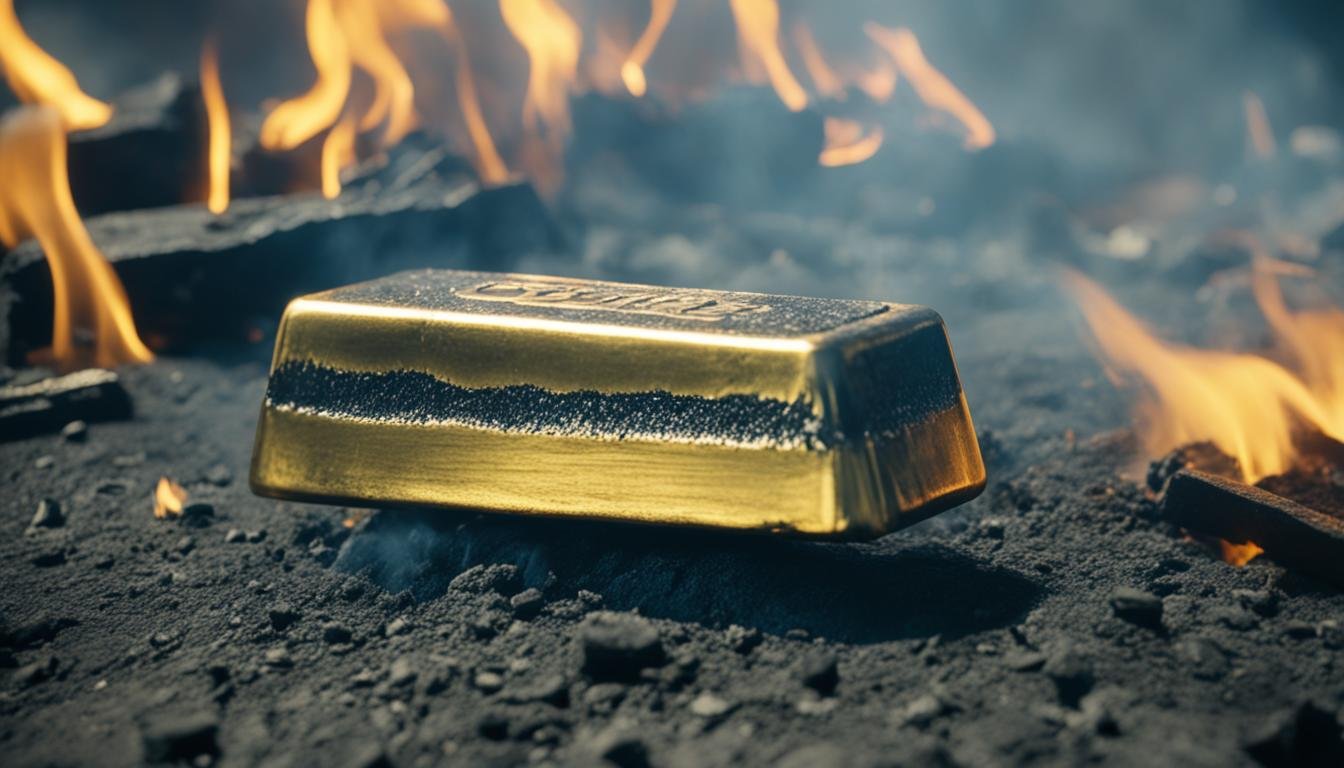
See what happens to gold in a fire, why it does not burn, when it can melt, and how jewelry, coins, bullion, and records may be affected. in practical context.
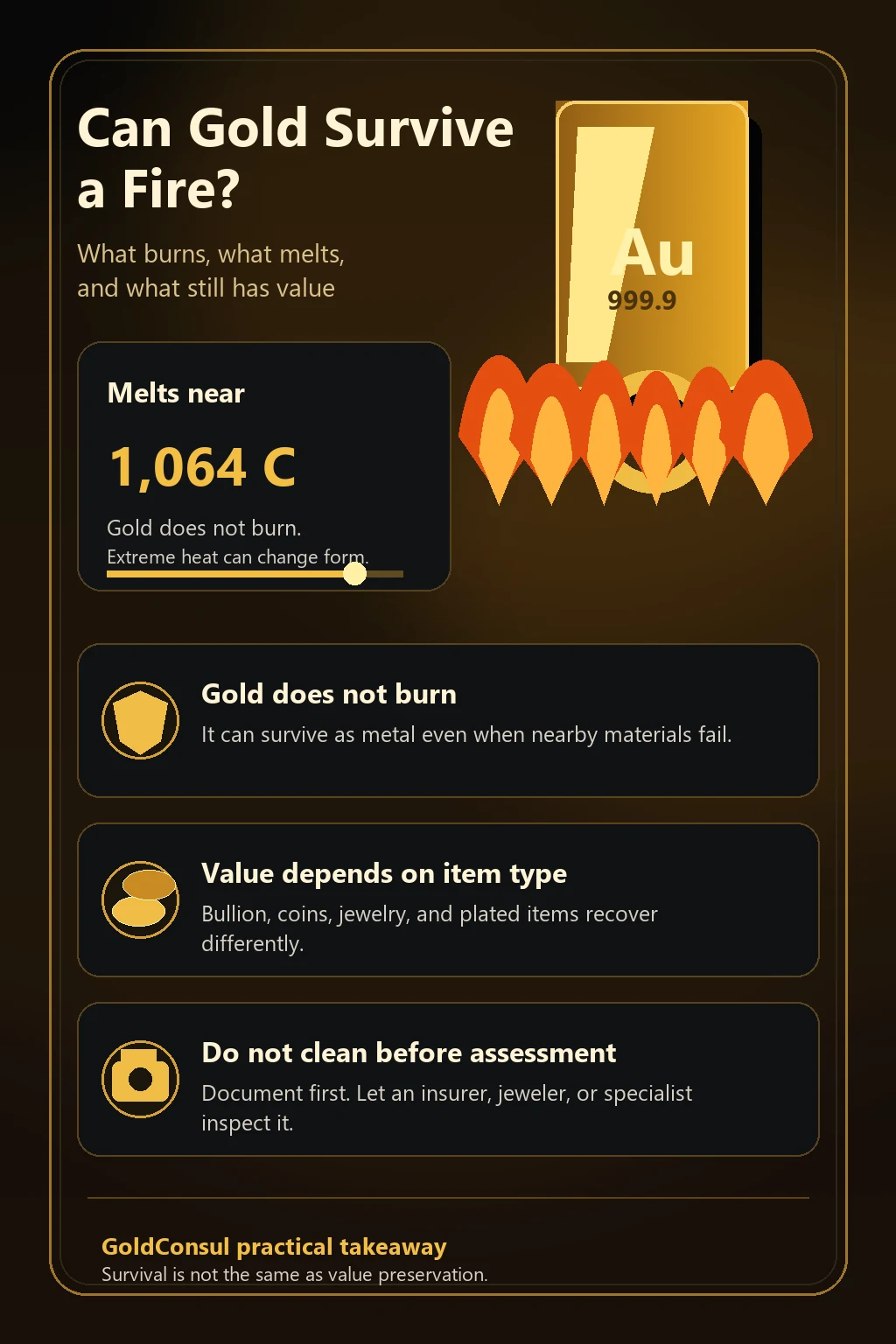
- Gold does not burn, but extreme heat can melt or deform it.
- Gemstones, settings, solder, capsules, and papers may be the weak points.
- After a fire, document the item before cleaning or selling it.
Yes, gold can usually survive a fire, but that answer is incomplete. Gold does not burn or turn into ash, but it can melt if the fire environment gets hot enough. Even when the gold itself survives, jewelry settings, gemstones, clasps, solder, paperwork, capsules, and collectible premiums can be damaged.
The practical answer depends on what you own. A plain bullion bar, a collectible coin, a 14k ring with stones, and a gold-plated item do not face the same fire risk.
TL;DR
- Gold is not flammable. It does not burn like wood, paper, plastic, or fabric.
- Pure gold melts around 1,064°C / 1,947°F, according to standard chemistry references.
- Many house fires stay below that point, but flashover or localized hot zones can approach or exceed severe temperatures.
- Even if the metal survives, jewelry design, gemstones, solder, plating, coin condition, and documentation may not.
- After a fire, do not clean or scrape valuable gold items before documentation, insurance, and professional assessment.
Animated Summary: Gold in Fire, From Burn Risk to Value Recovery
This short animation shows the key distinction: gold does not burn, but extreme heat can melt it, and value recovery depends on documentation and item type.
What Most Readers Miss
The mistake is treating fire survival as a yes-or-no question. Gold may survive as metal while losing form, beauty, premium, or proof of condition.
Gold Does Not Burn, But It Can Melt
Gold is a noble metal with very low chemical reactivity. In normal fire conditions, it does not combust or oxidize into ash.
The key threshold is melting. PubChem lists gold’s melting point at about 1,064.76°C, and Xetra-Gold cites 1,064.18°C. That is far above ordinary boiling water or kitchen-oven temperatures, but it is not unreachable in extreme fire conditions.
This is why GoldConsul’s related guide on whether gold is flammable gives only the first half of the answer. Non-flammable does not mean immune to every heat outcome.
Chart 1: Fire Temperature vs Gold Melting Point
Interpretation: Many fires will not melt gold, but severe localized conditions can move close to the danger zone.
House Fire Reality: Average Heat Is Not the Whole Story
NIST describes flashover as a major transition in room fire behavior and lists about 1,000°C inside a room undergoing flashover. The eCFR definition of flashover uses an upper gas layer temperature of 600°C and high heat flux at floor level.
That means the location of your gold matters. Gold inside a cool drawer, a basement safe, a jewelry box near a burning sofa, or a post-flashover room can see very different heat histories.
Mass also matters. A large bar takes time to heat through, while a thin chain, clasp, solder joint, or coin capsule can fail earlier because surrounding materials burn, melt, or deform.
Pure Gold vs 14k and 18k Jewelry
Pure 24k gold has the cleanest melting-point reference. Jewelry is different because it is usually an alloy.
Common jewelry alloys include copper, silver, nickel, zinc, palladium, or other metals depending on color and karat. Those alloy choices can affect melting behavior, discoloration, solder performance, and structural strength.
A 14k or 18k ring may survive as metal, but prongs can weaken, solder can fail, stones can loosen, and surface finishes can be damaged. This is especially relevant for white gold, which often has rhodium plating; see GoldConsul’s guide to what white gold is for the alloy and finish distinction.
Bullion Bars, Coins, Jewelry, and Plated Items
Gold bullion is usually simpler than jewelry. A plain gold bar or common bullion coin may retain metal value even if it is soot-covered or deformed.
Collectible coins are different. Heat, cleaning, scratches, melted capsules, or surface alteration can reduce numismatic premium even if the gold content remains.
Gold-plated, gold-filled, and vermeil items have a different risk profile. The base metal, bonding layer, or thin gold surface may be damaged long before a solid gold object would be.
If you own coins, read testing gold coins before attempting any aggressive post-fire cleaning. A bad cleaning decision can destroy collectible value.
Chart 2: Fire Outcome by Gold Item Type
| Item type | Likely fire outcome | Value risk | Best first action |
|---|---|---|---|
| Plain bullion bar | Often survives; may be soot-covered, warped, or melted in extreme heat. | Mostly metal-weight value. | Document, weigh later, assay if needed. |
| Bullion coin | Metal may survive, but surface and capsule may be damaged. | Premium can fall if condition changes. | Do not clean; photograph and assess. |
| Collectible coin | Surface alteration can be more costly than metal loss. | High numismatic premium risk. | Use a coin specialist or insurer. |
| Gold jewelry | Metal may survive, but settings, solder, stones, and finishes may fail. | Design and gemstone value risk. | Bag fragments and see a jeweler. |
| Gold plated/filled | Base metal and thin layers may deform, oxidize, or separate. | Low recoverable gold value. | Identify material before spending on repair. |
What Happens to Gemstones, Solder, Prongs, and Plating?
Many jewelry losses in a fire are not “gold losses.” They are setting losses.
Diamonds can tolerate high heat better than many gems, but they can still be damaged by thermal shock, surface changes, or firefighting conditions. Opals, pearls, emeralds, enamel, adhesives, and treated stones are much more vulnerable.
Prongs and solder are another weak point. A ring can survive as gold while losing the structural details that held stones in place.
Post-Fire Recovery Checklist
- Do not enter an unsafe structure to recover valuables.
- Photograph the scene and item locations before moving anything if safe and permitted.
- Do not scrub, polish, acid-test, or scrape coins or jewelry.
- Bag fragments separately so prongs, stones, and melted pieces are not lost.
- Contact your insurer before repair or refining decisions.
- Use a jeweler, coin specialist, or assayer for high-value items.
Fireproof Safe Reality: Paper Ratings vs Bullion Reality
A safe can help, but “fireproof” does not mean invincible. Fire ratings often focus on keeping internal temperatures low enough for paper or digital media for a defined period.
Bullion has different needs. Gold itself can tolerate more heat than paper, but plastic capsules, certificates, receipts, packaging, and collectible surfaces may not.
If your goal is bullion protection, combine fire planning with theft planning, documentation, and insurance. GoldConsul’s gold bar buying guide explains why documentation and storage choices matter after purchase.
Chart 3: Fire Damage Decision Map
Location and heat history decide first-level risk.
Warping or melting affects object premium.
Coins and designer jewelry need careful handling.
Receipts, photos, and appraisals support claims.
Jeweler, assayer, coin specialist, or insurer.
Interpretation: Recovery is not just about whether the gold exists. It is about proving and preserving value.
The GoldConsul Editorial Perspective
Gold’s fire resilience is real, but buyers should separate metal survival from value survival. A melted bar may still be gold; a damaged collectible coin may lose much more than its metal content suggests.
Knowledge Gap: Survival Is Not the Same as Value Preservation
The strongest answer to “can gold survive a fire?” is not just “yes.” It is a four-part answer.
- Gold does not burn: It is not flammable and will not turn to ash.
- Gold can melt: Extreme temperatures can deform or liquefy it.
- Objects can lose premium: Coins, jewelry, and designer pieces can lose condition value.
- Attachments can fail: Gemstones, solder, clasps, capsules, and paperwork are usually weaker than gold.
- Recovery needs documentation: Photos, receipts, appraisals, and professional handling matter after a fire.
Bottom Line
Gold can usually survive a fire because it does not burn and has a high melting point. But “survive” does not always mean “unchanged.”
If the item is plain bullion, the metal value may be largely recoverable even after heat damage. If the item is jewelry or a collectible coin, the main risk is often condition, structure, setting, or premium loss.
For broader ownership context, see what gold and silver bullion means and how to buy gold coins.
FAQ: Can Gold Survive a Fire?
Can gold survive a house fire?
Yes, gold often survives a house fire because it does not burn and has a high melting point. Severe fire conditions can still melt or deform it.
At what temperature does gold melt?
Pure gold melts at about 1,064°C or 1,947°F under standard conditions.
Does gold lose value if it melts?
It can still retain metal value, but it may lose jewelry, collectible, numismatic, or proof-of-condition value.
Can gold jewelry be repaired after a fire?
Sometimes. A jeweler must inspect the alloy, solder, prongs, stones, and structural damage before repair is realistic.
Should I clean gold after a fire?
No, not before documentation and professional assessment. Cleaning can damage coin surfaces, remove evidence for insurance, or loosen stones.
 When you purchase a service or a product through our links, we sometimes earn a commission, at no extra cost to you.