Check marks, provenance, weight and dimensions before using a magnet as a screen. Learn what each step can show—and when a jeweler or XRF test is needed.
- Define whether the claim is solid karat gold, gold-filled, plated or bullion.
- Marks, provenance, weight and dimensions build evidence; a magnet only screens.
- Use suitable professional testing when value or uncertainty justifies it.
- A hallmark can be genuine, misleading, misplaced or counterfeit; inspect the whole object.
- Weight plus dimensions is stronger evidence than a “sink,” skin or color test.
- Gold is not strongly magnetic, but many convincing fakes are also nonmagnetic.
- Surface XRF is useful and nondestructive, yet plating and geometry can complicate interpretation.
- Do not scratch, acid-test or heat valuable jewelry without informed consent and proper safety controls.
First define the claim you are checking: solid karat gold, gold-filled or plated jewelry, or bullion. This page focuses on what the evidence can establish; use our at-home gold-testing guide for a screening sequence and gold-coin testing guide for coin specifications.
No single home test proves that an item is real gold. Use a sequence: inspect markings and construction, check weight and dimensions, screen with a magnet, and escalate valuable items to professional testing.
A magnet can expose an obvious steel core. A non-magnetic result does not prove gold because many counterfeit metals are also non-magnetic.
Acid and XRF readings can be surface-biased. Thick plating, filled products, mixed parts, and hollow construction may require multiple methods or an assay.
Start with Gold Made Simple to move from basic gold terms to buying, testing, investing, and storage without the jargon.
Build evidence in layers
“Real gold” can mean several things: pure gold, a genuine karat-gold alloy, gold-filled material, a plated item, or authentic bullion with the correct metal content. Define the claim before testing. A 14K ring is real gold jewelry even though 14K is an alloy; a gold-plated brass chain contains real gold at the surface but is not solid karat gold.
The safe gold-testing ladder
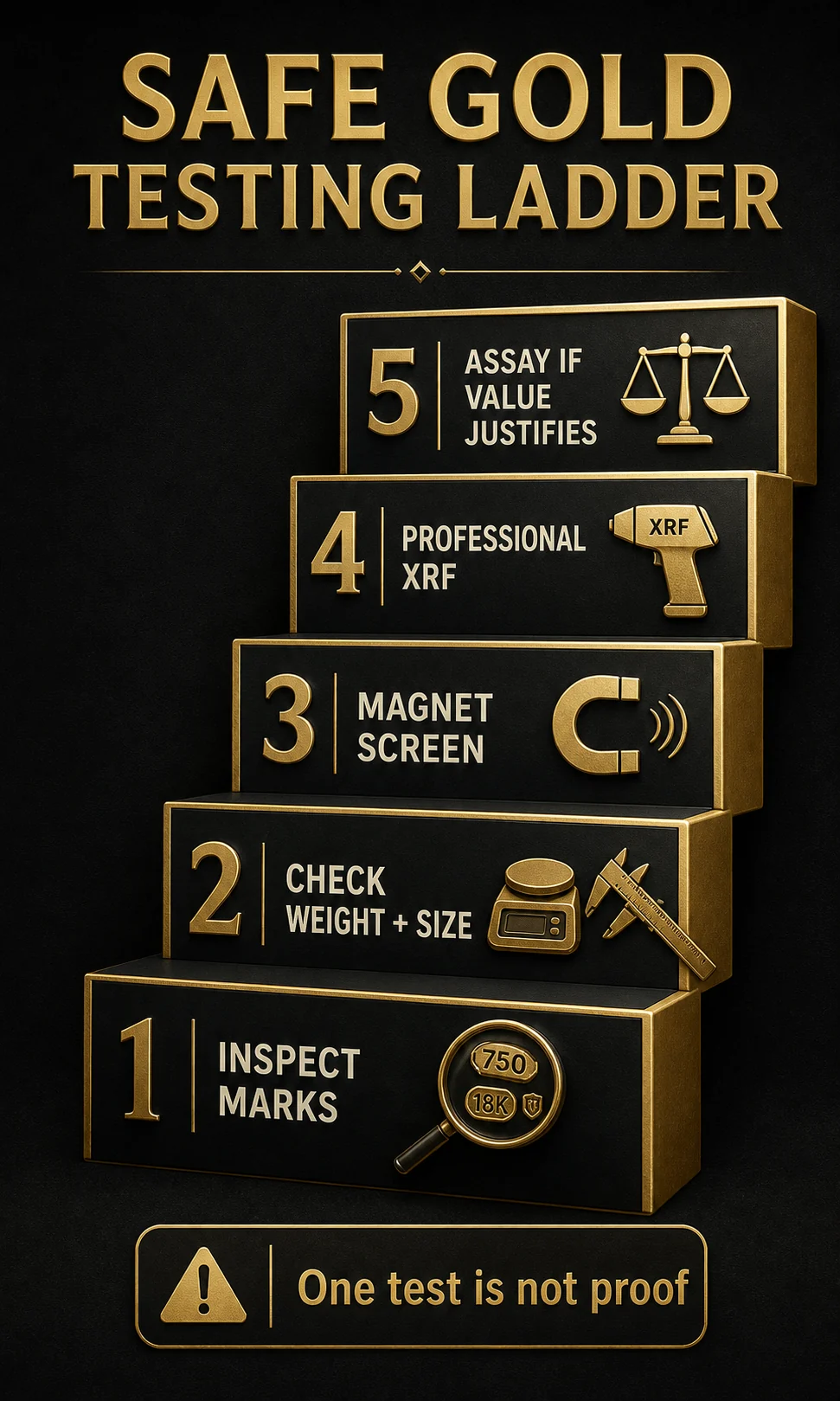
| Check | Useful for | Cannot prove | Risk |
|---|---|---|---|
| Marks + maker | Identifying claimed fineness and construction | That the mark is truthful or applies to every part | None |
| Weight + dimensions | Comparing coins/bars with official specs; finding gross anomalies | Composition by itself | Low if handled carefully |
| Strong magnet screen | Rejecting iron/steel-containing cores or parts | Gold, because many non-gold metals are nonmagnetic | Low; protect polished surfaces |
| Professional XRF | Rapid surface alloy analysis | Every hidden layer or interior without suitable method/interpretation | Low, operator dependent |
| Touchstone / assay | Confirming fineness with trained comparison or bulk analysis | A damage-free result in all cases | Acid and sampling hazards |
Step 1: inspect the marks and the object
Use magnification and record every mark. Common fineness numbers include 375, 417, 585, 750, 916/917 and 999, while karat marks include 9K, 10K, 14K, 18K, 22K and 24K. Construction abbreviations such as GF, RGP or GP change the meaning.
The FTC’s jewelry guidance explains several U.S. coating terms.
Then inspect seams, cut edges, clasp components and worn spots. Different colors beneath the surface, flaking or a suspiciously attached hallmark are red flags, not a verdict. GIA documented an electroformed bracelet with misleading construction clues, showing why the whole object matters.
Step 2: use weight and dimensions together
For a modern bullion coin, compare mass, diameter and thickness with the issuing mint’s current specification. The U.S. Mint specifically recommends checking published weight and diameter. Use a calibrated scale and calipers, and account for capsules before weighing.
Jewelry is harder because gemstones, solder, hollow sections and mixed components distort density calculations. A water-displacement result is not a universal karat answer. GIA’s comparison of testing methods found hydrostatic weighing poorly suited to precise karat determination.
Step 3: understand the magnet test
Strong attraction: the attracted part likely contains ferromagnetic material, so the claimed solid-gold construction needs explanation. No attraction: continue testing.
It does not confirm gold. Clasps may include small steel springs even when the chain is genuine.
Tests we do not recommend as proof
Professional tests and their limits
X-ray fluorescence can rapidly identify major alloy elements at the analyzed surface. GIA describes handheld XRF as useful for precious metals, but its 2025 report on gold-plated gold shows how surface layers can produce misleadingly high readings under some conditions. A competent operator chooses multiple points and interprets seams, plating and geometry.
Touchstone testing removes a tiny streak and compares acid reactions with known needles. GIA calls it relatively nondestructive, not risk-free, and specifies ventilation, protective equipment and acid handling. Fire assay offers high-quality bulk results but requires sampling and is not appropriate for an intact heirloom without consent.
- The purchase price is material to you.
- The item is unmarked, second-hand or from an unverifiable seller.
- Home checks disagree.
- A bar or coin will be stored long-term and may be harder to return later.
- The piece has plating, stones, hollow areas or multiple colors that complicate interpretation.
Watch: At-home gold tests and their limits
This video is included as a practical visual supplement. Use the evidence and decision rules in this guide—not a dramatic demonstration—as the basis for a purchase or test.
Match the method to the item
For bullion, preserve packaging and provenance, compare official specifications and use a dealer or verifier familiar with that product. For jewelry, first determine whether the claim is solid karat gold, gold filled, white gold or plated.
For chains, also separate authenticity from mechanical condition. Learn why a detector response is not a purity test in our metal-detector guide, and compare bullion buying checks in our gold-coin guide.
A worked verification scenario
Suppose a one-ounce bullion coin arrives from a marketplace seller. It is nonmagnetic and carries convincing marks. Those facts are encouraging but insufficient.
First, preserve the packaging and record the seller, invoice and photos. Next, compare mass, diameter, thickness and edge details with the issuing mint’s specifications. If all agree, the probability of a crude counterfeit falls, but plated dense cores and sophisticated copies remain possible.
Because the coin’s value is substantial and the seller is not an established bullion dealer, the buyer then uses an independent verifier familiar with that coin series. The verifier checks multiple surfaces and dimensions and interprets the results together. This is a better process than choosing the most dramatic home test because each step addresses a different failure mode.
How to choose an independent verifier
Ask what method will be used, whether the test is nondestructive, how the instrument is calibrated and whether the result covers only the surface. For jewelry, disclose gemstones, plating and repairs. For bullion, ask whether the shop routinely handles the exact mint and series.
A useful written result identifies the item, test points, method and limitations; a verbal “looks good” is weaker evidence. If the item may be sold later, keep the verification record with the purchase documentation but separate from the physical storage location.
Counterfeiters can combine genuine surface gold, copied marks and dense nonferrous cores. No public DIY checklist defeats every construction. The more valuable the item, the less sensible it is to rely on a viral trick.
The best home result is often “no obvious contradiction found,” not “certified genuine.” That distinction prevents false confidence and avoids damaging the item in pursuit of certainty.
FAQ: How to Tell If Gold Is Real
Does real gold stick to a magnet?
Pure gold and common karat-gold alloys are not strongly magnetic, but clasp springs or repairs may react. No attraction does not prove gold.
Can vinegar tell if gold is real?
Vinegar is not a calibrated fineness test and can affect other materials in jewelry. It should not replace professional analysis.
What does 585 mean on gold?
It generally indicates 585 parts per thousand gold, equivalent to 14K fineness. The mark itself still needs context and verification.
Is XRF testing conclusive?
It is powerful and nondestructive for surface composition, but plating, geometry and calibration can complicate results. Skilled interpretation and complementary checks may be needed.
How can I test a gold coin without damaging it?
Compare official weight, diameter, thickness and design details, keep provenance, and use a reputable dealer or nondestructive professional verifier when uncertainty remains.
Sources and methodology
This guide favors consumer regulators, scientific institutions and technical trade references. Commercial claims are not treated as proof.
Update policy: Product rules, scientific interpretations and market practices can change. We date-check the linked authority pages during a major revision, avoid live-price claims in evergreen guidance and distinguish measured evidence from editorial judgment.
If a source describes one jurisdiction, alloy, coin or experiment, we do not silently generalize it to every product. Readers making a material purchase should confirm the current specification and local rules at the point of decision.
- GIA — Methods for Determining Gold Content — Limitations of density, touchstone, capacitive and XRF tests.
- GIA — Chemical Analysis in the Gemological Laboratory — Current XRF capabilities and limits.
- GIA — Gold-Plated Gold — Surface plating can distort XRF results.
- GIA — Touchstone Method — Professional acid-testing procedure and hazards.
- FTC — Buying Gold Jewelry — Marks and coating terms.
- U.S. Mint — Bullion Consumer Awareness — Compare official weight, dimensions and features.
 When you purchase a service or a product through our links, we sometimes earn a commission, at no extra cost to you.