
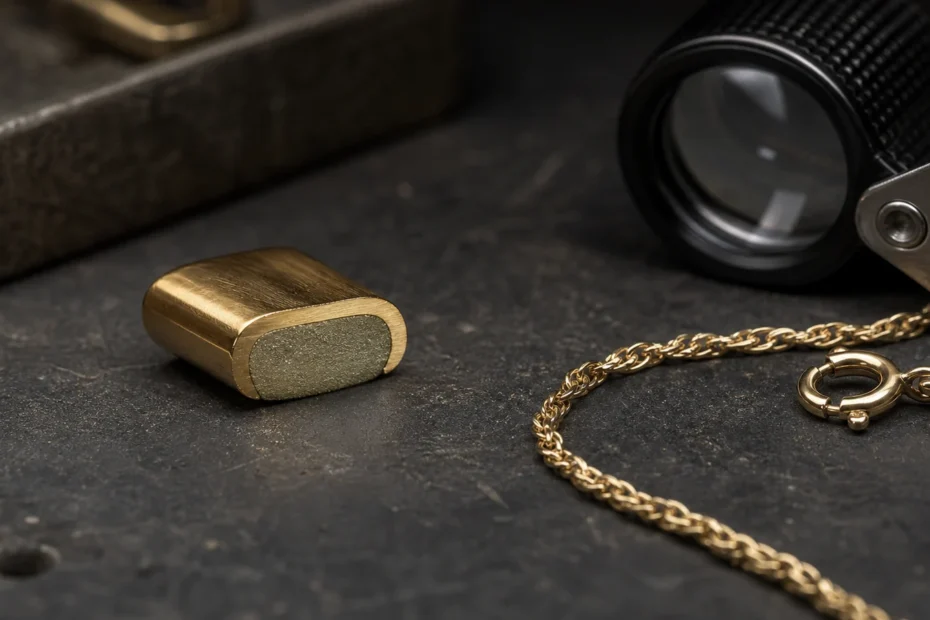
Learn what gold filled means, how to read 1/20 14K GF, and how it compares with solid gold, vermeil, and plating for wear, value, and care.
- Gold filled is a bonded karat-gold layer over base metal, not solid gold and not ordinary electroplating.
- A mark such as 1/20 14K GF identifies the layer fraction and karat quality of that layer.
- Judge the finished item by construction, exposed edges, seller disclosure and intended wear—not the color alone.
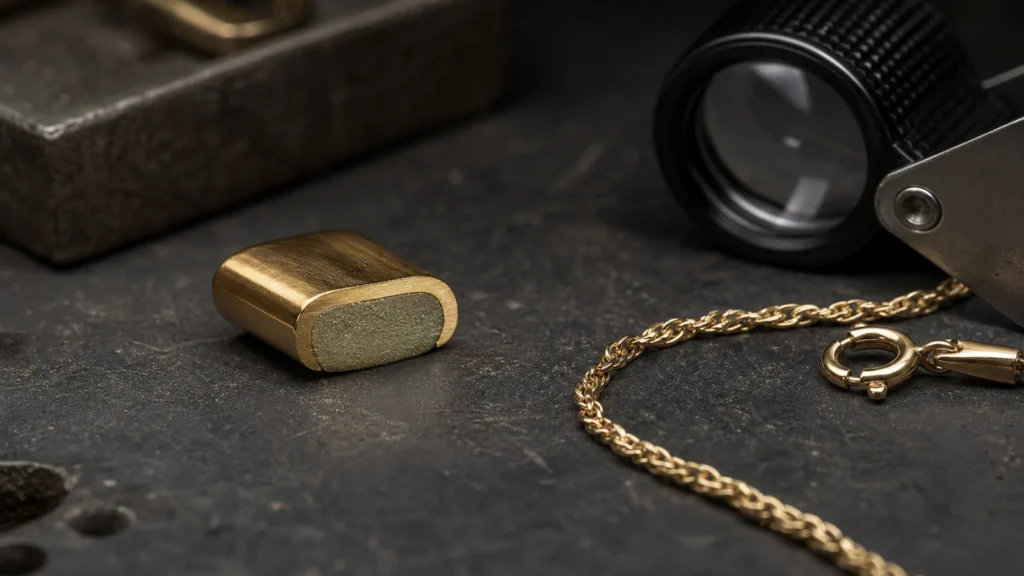
- The outside is real karat gold, but most of the item’s mass is base metal.
- In U.S. guidance, the wording and fraction matter; “gold filled” is not a free-form synonym for any gold-colored coating.
- It normally offers more wear life than a very thin plated finish, but edges, solder joints and high-friction areas can expose the core.
- It is a jewelry-value choice, not a substitute for owning solid gold by weight.
Read the construction, not the color
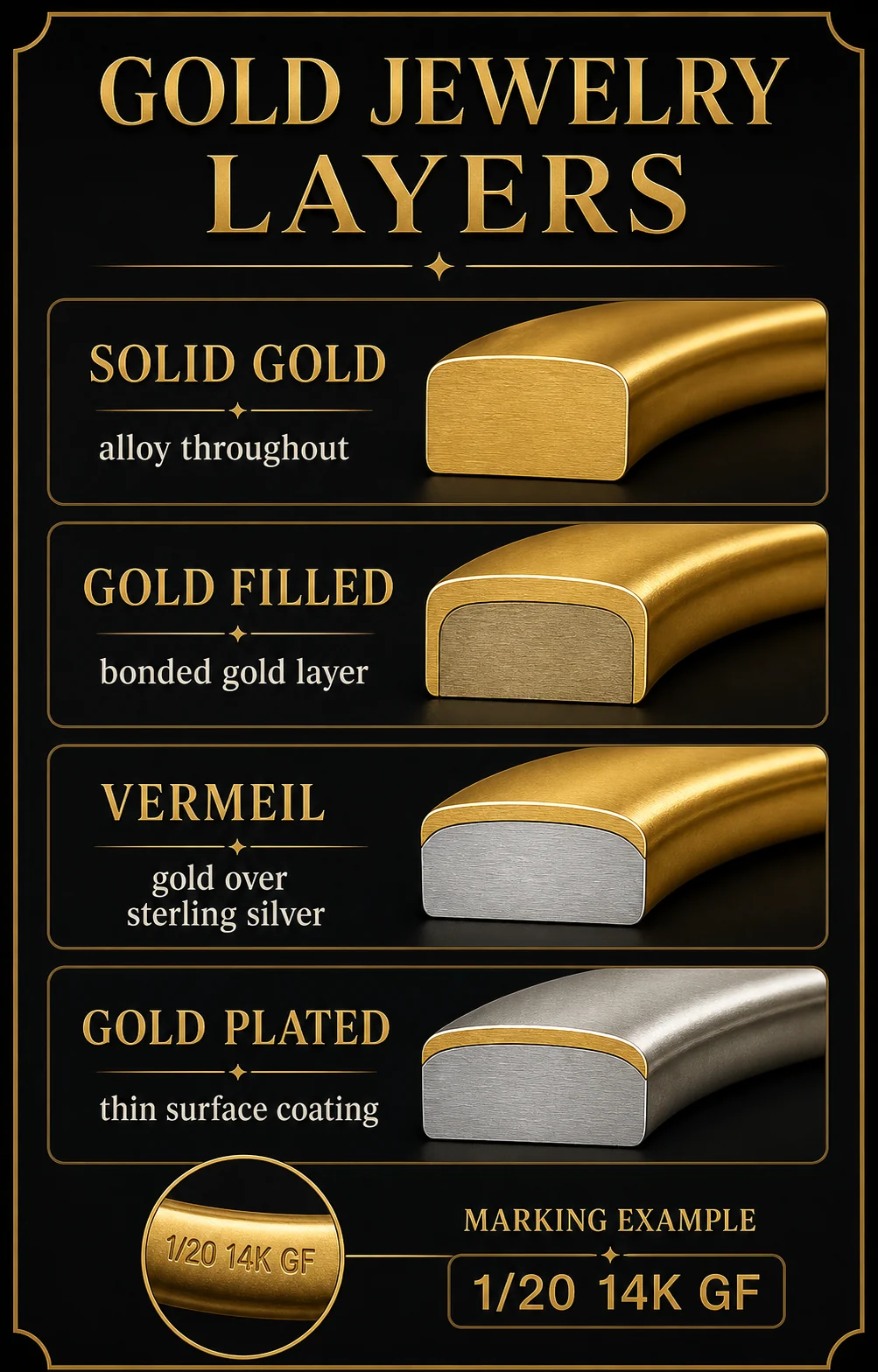
The name is confusing because the piece is not filled with molten gold. In common manufacturing, karat-gold sheet is bonded to a base metal and then formed into wire, sheet or components. What you receive depends on the material specification and on whether every visible component uses the same construction.
How to decode a gold-filled mark
The FTC consumer guidance groups “gold filled,” “gold overlay” and “rolled gold plate” with mechanically applied gold layers. It also explains that when the gold layer is below one-twentieth of the item’s metal weight, the fraction should be disclosed. Do not reverse the terms: 14K describes the purity of the outer gold alloy, not the purity of the whole piece.
Gold filled vs solid, vermeil and plated
| Label | Underlying construction | What the buyer should verify |
|---|---|---|
| Solid karat gold | Gold alloy throughout the metal section; “solid” may also distinguish non-hollow construction | Karat/fineness, gram weight, hollow vs solid geometry, maker mark |
| Gold filled / overlay / RGP | Karat-gold layer mechanically bonded to base metal | Fraction, karat of layer, which components are covered, exposed edges |
| Vermeil | Gold coating over sterling silver under applicable market definitions | Silver mark, gold fineness, coating disclosure and local standard |
| Gold electroplate | Gold deposited on another metal by an electrolytic process | Base metal, coating claim, wear points and seller warranty |
The current U.S. framework sits in the FTC Jewelry Guides, 16 CFR Part 23. Other countries use different legal terms and hallmark systems, so an online listing that ships internationally should identify the actual material—not rely on a regional nickname such as “laminated gold.”
Where gold-filled jewelry wears first
Wear is rarely uniform. Ring shanks rub against objects and skin. Chain clasps, jump rings and pendant bails move against neighboring metal. Ear-wire bends and cut ends can expose the layered cross-section. Sweat, cosmetics and cleaning agents can also affect the base metal once the surface is breached.
A precise lifetime claim is not credible without the article, layer specification and wear pattern. “Waterproof” is especially unhelpful if it ignores chlorine, salt, detergents, abrasion and component differences.
- Look for the fraction, karat and GF/RGP/overlay wording—not only “18K finish.”
- Ask whether the clasp, jump rings, posts and soldered areas use the same material.
- Check close-up photos of edges, ends and high-friction surfaces.
- Request the return policy and care instructions in writing.
- For a high price, compare the item with a similar piece in solid 10K or 14K gold.
Watch: Gold filled versus gold plated
This video is included as a practical visual supplement. Use the evidence and decision rules in this guide—not a dramatic demonstration—as the basis for a purchase or test.
Care without exaggerated promises
Remove the piece before chlorinated pools, strong cleaning products and abrasive work. Put jewelry on after perfume and lotions have dried. Rinse only as the maker recommends, pat dry and store pieces separately. Avoid aggressive polishing because every abrasive pass removes a little surface material.
If exposed base metal irritates skin, stop wearing the piece. Do not assume the gold layer makes every underlying alloy hypoallergenic. For related decisions, compare gold authentication methods, white-gold alloys, rhodium wear on white gold, chain construction and break risk and gold’s material properties.
Is gold-filled jewelry worth anything as scrap?
Yes, a marked gold-filled piece contains real karat gold, but its total weight is mostly base metal. The stamp describes a bonded layer; it does not guarantee that a buyer will accept the item or pay the full theoretical metal value.
| Step | Illustrative 20 g item marked 1/20 14K GF |
|---|---|
| Marked gold-alloy layer | 20 g × 1/20 = 1 g of 14K alloy |
| Fine-gold equivalent | 1 g × 14/24 ≈ 0.583 g of fine gold |
| Illustrative metal baseline | 0.583 g × the current fine-gold spot price per gram |
| Actual offer | May be lower after testing, separation, refining and buyer margin—or no offer at all |
Important distinction: “1/20” is the stated fraction of 14K alloy, not a claim that 5% of the entire item is pure gold. Findings, clasps, stones and wear can further change the recoverable material. The FTC’s jewelry guide explains why the construction mark matters.
For an unwanted piece, first identify its full marking and weigh only the relevant metal parts. Ask a buyer specifically whether it accepts gold-filled scrap, what assay or minimum lot size it requires, and whether the quote is a cash offer. Compare that with the item’s wearable resale value: attractive jewelry can be worth more intact than as refining feedstock. See our scrap-value formula and offer-comparison checklist.
Is gold-filled jewelry valuable?
It has functional and retail value because it uses a real karat-gold surface and more involved manufacturing than a minimal decorative coating. Its recoverable gold value, however, is not equivalent to a same-weight solid-gold item. Small mixed-material articles can also be uneconomic to refine. Buy it for appearance, wear and budget fit—not because a social post calls it “investment gold.”
Worked example: compare two online listings
Listing A says “18K gold filled” but gives no fraction, base metal, component disclosure or close-up of the clasp. Listing B says “1/20 14K GF over brass,” identifies the clasp and jump rings as the same material, gives gram weight and provides a written return policy. Listing A may look more luxurious because 18K sounds higher, but Listing B supplies far more decision-grade information. The karat of the layer is only one variable.
Now compare total price with a lightweight solid 10K or 14K alternative. If the difference is small, solid karat gold may offer easier repair and clearer metal value. If the difference is large and the design is fashion-led, accurately described gold-filled jewelry may be the rational choice. This comparison prevents the label from making the decision for you.
What sellers should state
A high-quality listing should identify the regulated or customary material term, gold-layer karat, relevant fraction, substrate, component exceptions and care limits. It should not describe a surface product simply as “real gold,” “waterproof gold” or “non-tarnish” without qualification. When only the ear wire, post or clasp is gold filled, the description should make that scope obvious. Save a copy of the listing and receipt because the physical stamp may be tiny, partial or lost during future repair.
A stamp is evidence, not independent verification. It may apply to one component, may be worn or may be counterfeit. Marketplace listings also use inconsistent terms across jurisdictions. When the distinction matters financially, combine the mark with seller documentation and professional inspection.
Gold filled occupies a legitimate middle ground. The mistake is treating it as either “fake” or “basically solid gold.” A construction-first description lets the reader decide without either sales framing.
Frequently asked questions
Is gold filled real gold?
The bonded outer layer is real karat-gold alloy, but the core is base metal. The complete item is not solid gold.
Does 14K GF mean the whole item is 14 karat?
No. It identifies the karat quality of the gold layer. The fraction and construction describe how that layer relates to the item.
Can gold-filled jewelry tarnish?
The gold surface is relatively resistant, but exposed base metal, solder, contamination and wear can discolor. Results depend on construction and use.
Is gold filled the same as vermeil?
No. Vermeil uses sterling silver as the substrate under applicable definitions, while gold-filled material normally uses a mechanically bonded layer over base metal.
Can a jeweler resize gold-filled rings?
Sometimes, but cutting, heating and soldering can expose or damage layers and create a visible repair. Ask a bench jeweler to inspect the exact piece first.
Sources and methodology
This guide favors consumer regulators, scientific institutions and technical trade references. Commercial claims are not treated as proof.
Update policy: Product rules, scientific interpretations and market practices can change. We date-check the linked authority pages during a major revision, avoid live-price claims in evergreen guidance and distinguish measured evidence from editorial judgment. If a source describes one jurisdiction, alloy, coin or experiment, we do not silently generalize it to every product. Readers making a material purchase should confirm the current specification and local rules at the point of decision.
- FTC — Buying Gold Jewelry — Consumer definitions and marking examples.
- FTC — Revised Jewelry Guides basis — Regulatory context for gold-filled, overlay and RGP claims.
- 16 CFR Part 23 — Current U.S. Jewelry Guides.
- Rio Grande — Guide to Jewelry Chain — Material construction and 14/20 convention.
 When you purchase a service or a product through our links, we sometimes earn a commission, at no extra cost to you.