
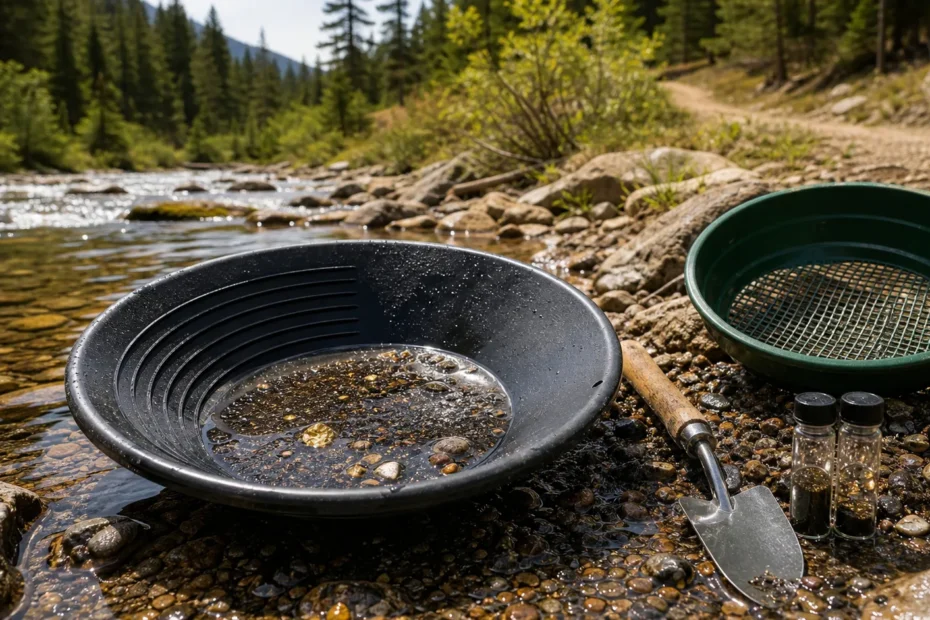
Find safer legal gold panning sites by checking access, claims, seasons, land ownership, local rules, and the signs of realistic placer potential.
- Confirm land ownership, claims, park rules, and water limits first.
- Choose beginner sites by access, safety, season, and placer potential.
- Use low-impact technique so a legal trip does not become a damage issue.
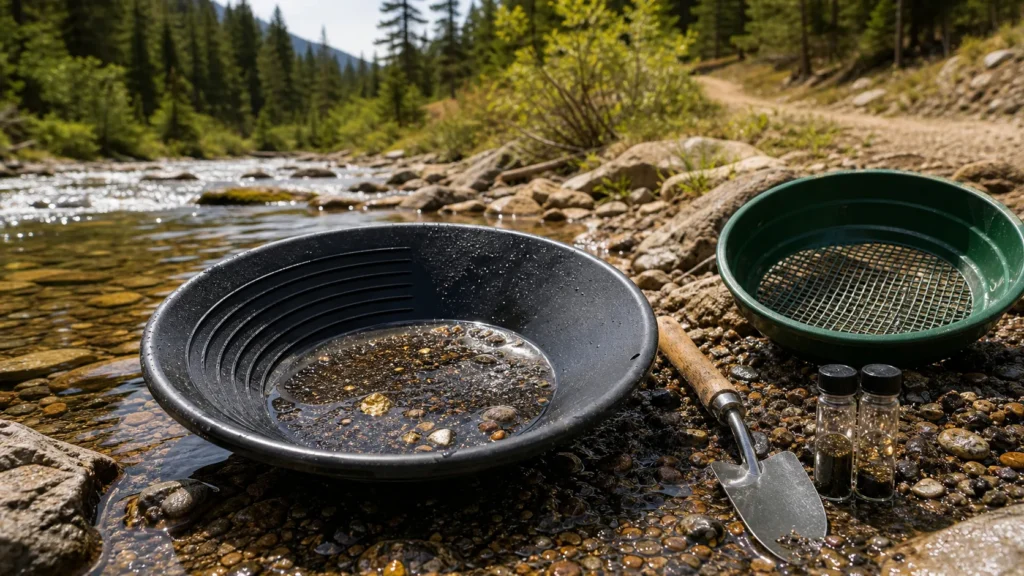
Gold panning sites are worth choosing with more care than most beginner guides suggest. A scenic creek is not automatically legal, safe, or likely to hold placer gold. If Nevada is your destination, use the Nevada-specific five-gate field-planning workflow before treating a historic district as an open place to pan.
This guide gives you a practical way to evaluate public gold panning locations, pay-to-pan attractions, club claims, and historic mining districts before you pack a pan. It focuses on recreational panning, not commercial mining or claim staking.
TL;DR: Gold Panning Sites
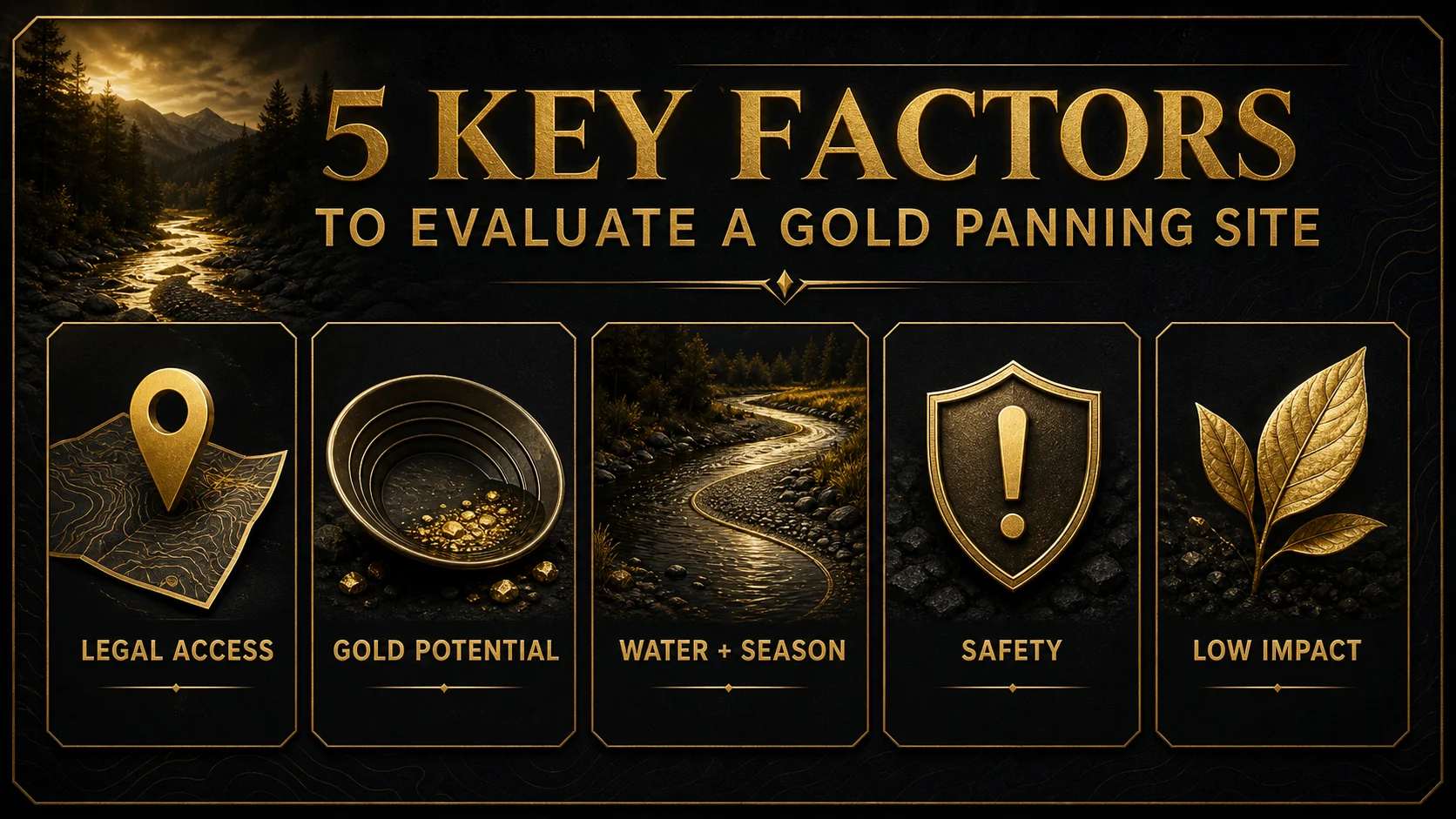
- Legal access comes first: confirm land ownership, active mining claims, park rules, and waterway restrictions before panning.
- Best beginner sites are usually fee-based panning areas, club outings, designated public areas, and historically productive placer districts.
- Do not assume public land is open: BLM, Forest Service, state, tribal, private, and park lands can follow different rules.
- Look for placer logic: inside bends, bedrock cracks, gravel bars, black sand, and old workings matter more than online hype.
- Safety is part of site selection: water level, weather, remoteness, cold exposure, unstable banks, and private property boundaries can change the plan.
What Makes a Good Gold Panning Site?
A good gold panning site is not just a place where someone once found gold. It is a place where you can legally access the ground, work with hand tools, find stream gravels that could concentrate gold, and leave without damaging banks, habitat, claims, or private property.
The best sites for beginners usually fall into four groups:
- Designated recreational sites where panning is explicitly allowed.
- Pay-to-pan or historic mine attractions that provide instruction and controlled material.
- Club claims where access is managed by a local prospecting group.
- Historically productive placer districts where rules and claim status have been checked in advance.
If you are new to gold panning, start with a legal and instructional site before hiking into remote public land. You will learn pan control, black-sand separation, and realistic expectations much faster.
Gold Panning Site Evaluation Table
| Site Type | Best For | Main Advantage | Main Risk | Pre-Trip Check |
|---|---|---|---|---|
| Designated public panning area | First legal outdoor trip | Clearer rules and easier access | Can be heavily worked | Agency page, seasonal notices, equipment limits |
| Pay-to-pan mine or attraction | Families and complete beginners | Instruction, rentals, safer setting | Material may be seeded or curated | Hours, fees, keep-what-you-find policy |
| Prospecting club claim | Learning with experienced panners | Known access and shared local knowledge | Membership rules and claim boundaries | Current claim map, guest policy, allowed tools |
| Historic placer district | Intermediate research trips | Gold has been proven in the drainage | Active claims, private land, old hazards | Land status, claim status, road access, weather |
| Random creek found online | Only after verification | Potential solitude | Unknown legality and weak gold evidence | Official maps, claims, landowner permission |
Legality Comes Before Geology
Evidence check: The U.S. Geological Survey prospecting guide explains both the geology of placer deposits and the need to check land records and local rules. A promising stream is not automatically open to panning, and public access is not the same as mineral permission.
In the United States, recreational gold panning rules depend on the land manager and the exact location. The Bureau of Land Management administers mining claims on many federal lands, but a parcel being public does not mean it is free of active claims or open to digging.
National forests can allow certain low-impact mineral activities, but each forest can set local restrictions. Check the relevant U.S. Forest Service minerals guidance, district office notices, fire restrictions, road closures, and rules for sluices or motorized equipment.
National parks are different. The National Park Service generally protects natural and cultural resources, and collecting or disturbing minerals is typically restricted unless a specific site has a clearly posted exception. Review NPS mining claim and mineral resource guidance before assuming a park stream is open.
Legality and Safety Checklist
Before you pan a site, confirm these items:
- Land ownership: public, private, tribal, state, municipal, or mixed.
- Claim status: active mining claims, club claims, or closed areas.
- Allowed equipment: pan only, hand tools, sluice, classifier, or no mineral collection.
- Water rules: stream disturbance limits, fish habitat rules, seasonal closures, and turbidity concerns.
- Access route: legal parking, road condition, gates, trail mileage, and private crossings.
- Water level: snowmelt, storms, flash flood risk, cold water, and slippery bedrock.
- Personal safety: gloves, eye protection, sun protection, first aid, drinking water, and a trip plan.
- Leave-no-trace finish: refill test holes, stabilize disturbed gravel, and pack out trash.
How to Spot Better Panning Ground
Gold is dense, so it tends to settle where water loses energy. That makes creek geometry more important than wishful thinking.
Look for inside bends, cracks in bedrock, natural riffles, gravel bars below boulders, compacted clay layers, and black sand concentrations. These do not guarantee gold, but they are more logical test points than loose sand in fast water.
Use the same disciplined thinking you would use when reading about gold mining methods. The tool only works when it fits the deposit. A gold pan is excellent for loose placer material and nearly useless for hard rock that needs crushing and assay work.
Where Beginners Should Start
Beginners should prioritize instruction over secrecy. A pay-to-pan site, a gold rush heritage park, or a club outing can teach more in one afternoon than several frustrating solo trips to unverified creeks.
Good starter regions include historically productive placer belts in California, Alaska, the Black Hills, Georgia, North Carolina, Arizona, Montana, Idaho, and parts of the Appalachian gold belt. The point is not to chase a state name. It is to match legal access with placer history and current rules.
For regional context, compare our guides to gold mining in Arizona, gold mining in Montana, and gold mining in Alaska. They help explain why some districts keep attracting recreational prospectors long after the original rushes ended.
What to Bring to a Gold Panning Site
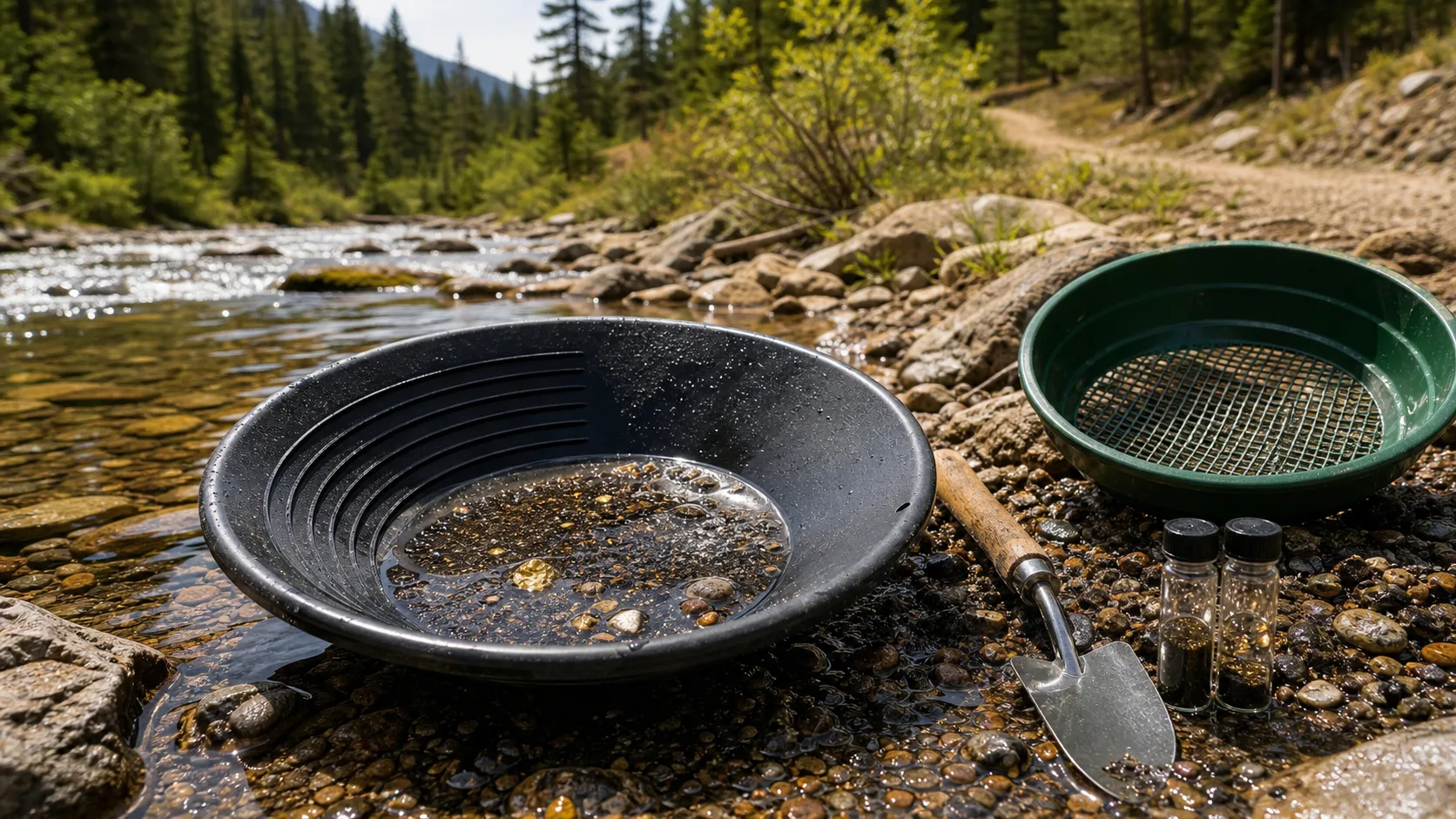
A simple kit is enough for most legal beginner sites. Bring a 14-inch pan, a smaller finishing pan, classifier, snuffer bottle, small scoop, vials, gloves, kneeling pad, and a magnet for black sand cleanup.
Also bring the boring items that prevent bad days: water, food, sun protection, warm layers, map, headlamp, phone power bank, first aid kit, trash bag, and a written note of where you are going.
Leave powered equipment at home unless the land manager clearly allows it. The legal line between casual panning and regulated mining activity can change quickly once engines, pumps, dredges, or large excavation are involved.
Common Mistakes at Gold Panning Sites
- Following old blog lists without checking current rules. Access, ownership, and claims change.
- Panning only loose surface sand. Heavier material near bedrock, clay, and inside bends is usually more logical.
- Digging into banks. It can damage habitat, trigger erosion, and violate local rules.
- Confusing pyrite, mica, and brass with gold. Real gold is heavy, malleable, and does not glitter from every angle.
- Expecting wages from recreation. Most legal recreational sites produce flakes, colors, and learning, not meaningful income.
If you want to understand why some “gold” is not gold at all, our guide to gold ore is a useful companion.
Editorial Perspective
The internet treats gold panning sites like a treasure map. A better approach is to treat each site like a small field decision: legal status first, safety second, placer logic third, and expectations last. That order keeps the hobby enjoyable and defensible.
Knowledge Gap
Most public lists name places but do not show readers how to verify access, claims, equipment limits, or stream protections. The missing skill is not memorizing site names. It is learning how to decide whether a site is legal, safe, and geologically sensible this season.
Bottom Line
The best gold panning sites are not always the most famous ones. They are the places where legal access, placer history, current conditions, and safe low-impact technique line up.
Use official land-manager information, verify claims and ownership, start with beginner-friendly instruction, and test ground methodically. Gold panning is more satisfying when the site choice is disciplined before the first pan hits the water.
For more background, read our guides to Gold Rush mining techniques and early gold mining techniques.
FAQ: Gold Panning Sites
Can I pan for gold on any public land?
No. Public land can still have active mining claims, protected habitats, park restrictions, state rules, tribal jurisdiction, or equipment limits. Always check the specific land manager and current claim status before panning.
What is the best gold panning site for beginners?
The best beginner site is usually a designated recreational panning area, a reputable pay-to-pan attraction, or a local prospecting club outing. These options reduce legal uncertainty and help you learn proper technique.
Do I need a permit to pan for gold?
Sometimes. Simple hand panning may be allowed in some places without a permit, while other areas require permission, prohibit mineral collection, or restrict tools beyond a pan. Rules can change by agency, state, river, and season.
Where in a creek should I test first?
Start where water slows and heavy material can settle: inside bends, behind boulders, bedrock cracks, natural riffles, gravel bars, and compacted layers. Test small samples and compare results instead of digging randomly.
Can recreational gold panning make money?
Usually no. Recreational panning is best treated as a hobby, field skill, and outdoor activity. Some people find flakes or small pickers, but most legal beginner sites do not produce income after travel, gear, and time.
 When you purchase a service or a product through our links, we sometimes earn a commission, at no extra cost to you.