
Gold has one natural stable isotope, 197Au. Compare important radioisotopes, half-lives, production, uses, and safety without confusing isotopes with karat.
- Natural gold is essentially 100% stable gold-197, with 79 protons and 118 neutrons.
- Radioisotopes such as gold-198 and gold-199 are deliberately produced for research or medical use.
- Karat, oxidation state and isotope are different labels; ordinary bullion and jewelry do not become radioactive through normal use.
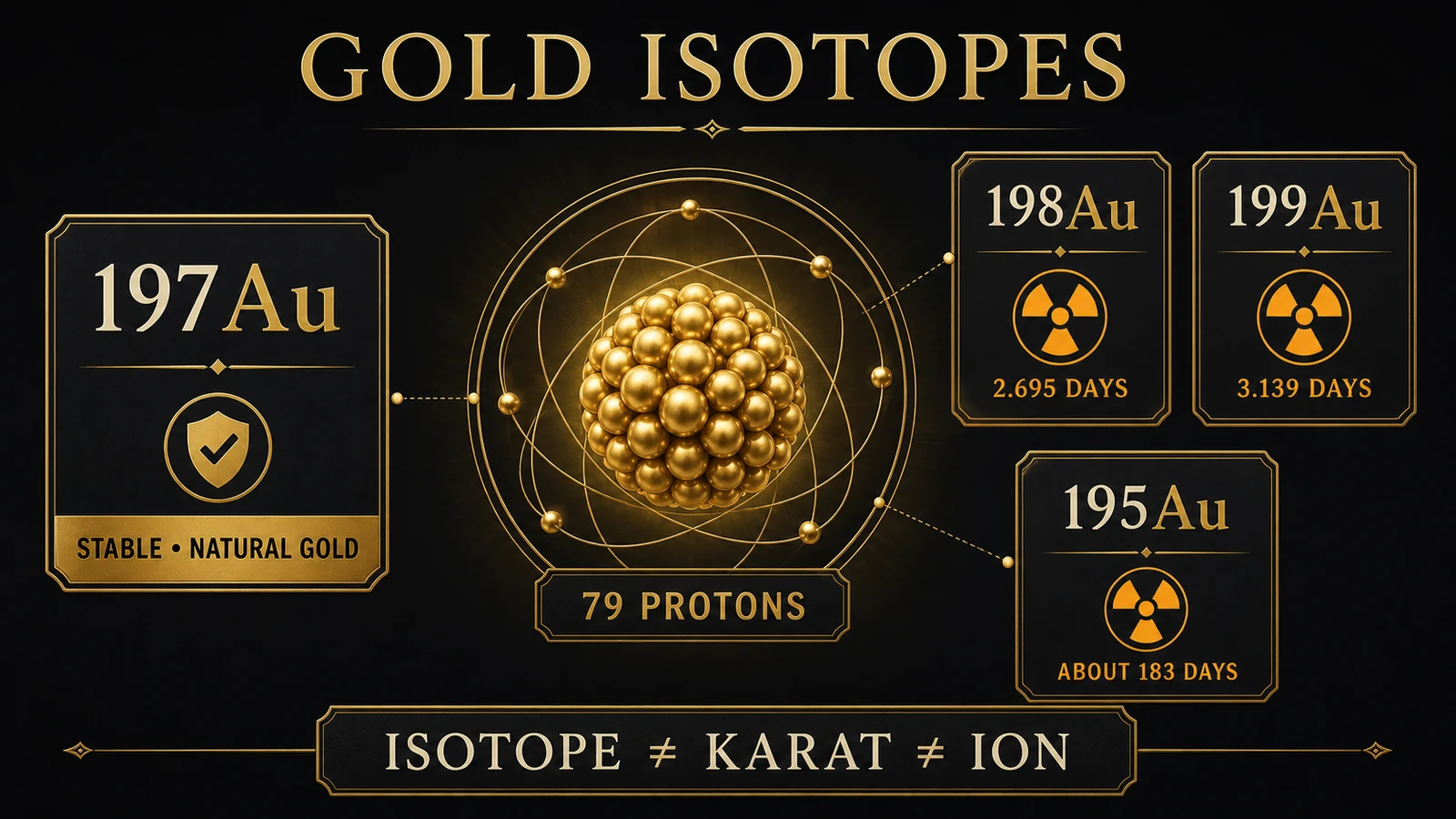
- Natural gold is essentially 100% stable 197Au: 79 protons and 118 neutrons.
- An isotope changes neutron count—not karat, color or electrical charge.
- 198Au has a half-life of about 2.695 days; 199Au about 3.139 days.
- Radioisotope uses are product- and protocol-specific, not evidence that consumer gold is radioactive.
- Half-life claims need an evaluated nuclear-data source and the correct ground state or isomer.
One element, different nuclei
The word isotope identifies a nuclear version of an element. Gold remains gold because its nucleus contains 79 protons. Add or remove neutrons and the mass number changes; add or remove electrons and the atom becomes an ion instead. That distinction prevents most confusion around gold-197, radioactivity and karat.
How isotope notation works
In 197Au, “Au” is the chemical symbol and 197 is the mass number—the total of protons and neutrons. Because all gold has 79 protons, stable gold-197 contains 118 neutrons. The atomic mass printed on a periodic table is closely tied to gold-197 because natural gold is monoisotopic.
Why natural gold is gold-197
The NIST isotopic-composition table assigns natural gold an abundance of 1 to 197Au. In practical terms, refined natural gold is gold-197. “Stable” means no radioactive decay has been observed under ordinary conditions; it does not mean a gold atom can never participate in a nuclear reaction.
That single stable isotope also makes gold different from elements whose natural samples contain several stable isotopes. It does not determine whether an object is 24K or an alloy: copper and silver atoms mixed into jewelry change purity, while the gold atoms remain overwhelmingly 197Au.
Selected gold radioisotopes
| Nuclide | Status / half-life | Practical context |
|---|---|---|
| 197Au | Stable; natural abundance essentially 100% | Bullion, jewelry, electronics and ordinary geological gold. |
| 195Au | Radioactive; about 183 days | Specialist research and tracer contexts; not natural consumer gold. |
| 198Au | Radioactive; about 2.695 days | Can be made by neutron capture on 197Au; decays toward stable mercury-198. |
| 199Au | Radioactive; about 3.139 days | Reactor-produced research or medical-use contexts under controlled handling. |
This is a practical comparison, not a complete nuclide chart. Gold has many short-lived isotopes and nuclear isomers. An isomer has the same proton and neutron count as another state but a different nuclear energy state, so a suffix such as “m” matters when quoting a half-life.
How radioactive gold is produced
One common route is neutron activation. Stable gold-197 absorbs a neutron and becomes gold-198. Accelerators and other nuclear reactions can produce different nuclides. These changes happen in the nucleus; melting, polishing, alloying or electroplating cannot perform nuclear transmutation.
Production is only the first step. A useful radioisotope must have a documented activity, radionuclidic purity, chemical form, dose, shielding plan and disposal pathway. The IAEA radioisotope manual describes production and decay data, while NNDC NuDat provides evaluated nuclear records.
Applications—and the evidence boundary
Radioactive gold has been used in activation analysis, tracing and selected medical or biological work. But “gold isotope used in medicine” is too broad to guide a patient. It may refer to a historical practice, a research protocol, a sealed source, or a specific radiopharmaceutical in one jurisdiction. Current clinical relevance must be checked for the exact isotope, formulation and indication.
Stable gold also appears in analytical work without being radioactive. For example, a gold sample may be measured by mass spectrometry, while nanoparticle research can involve ordinary 197Au. See the related guides to gold’s atomic structure, gold as an element, gold nanoparticles, electrical conductivity and the cosmic origin of gold.
- Does it name the nuclide and, if relevant, its nuclear isomer?
- Is the half-life tied to NIST, IAEA, NNDC or another evaluated source?
- Does it distinguish natural abundance from laboratory production?
- Is the use current, historical or preclinical?
- Does the safety statement specify activity, route and handling context?
Normal gold jewelry, coins and bars do not require radiation precautions. A suspected activated source, laboratory sample or unknown industrial item should not be handled as ordinary scrap; follow radiation-safety and regulatory procedures.
Half-life, activity and decay are not the same thing
Half-life tells you how quickly the number of radioactive nuclei falls by half; it does not by itself tell you the radiation dose from an object. Activity also depends on how many radioactive atoms are present, while dose depends on radiation type, energy, geometry, shielding, exposure time and whether material is outside or inside the body. Two samples of the same isotope can therefore have the same half-life but radically different activities.
After one half-life, one-half of the original radioactive nuclei remain; after two, one-quarter remain; after ten, roughly one-thousandth remain. Decay is statistical for an individual atom but predictable for a large population. It also creates a daughter nuclide, so a complete record names the parent, decay route and daughter rather than describing the gold as simply “disappearing.”
This matters when reading medical claims. A short physical half-life limits how long an isotope remains active, but biological distribution and clearance can change exposure. Those questions require the exact chemical form and route, which is why a nuclide name alone is never a treatment recommendation.
Knowledge Gap and Editorial Perspective
Popular isotope tables often merge ground states and isomers or copy rounded half-lives without a date. This article limits the comparison to nuclides useful for understanding natural gold and avoids treating every reported gold isotope as equally relevant.
The most useful consumer answer is simple: isotope identity answers a nuclear question, while karat answers a purity question. Keeping those systems separate turns a long nuclide list into a practical explanation.
Video walkthrough: This short SciShow explainer shows why changing one element into another requires nuclear physics rather than ordinary chemistry.
Bottom Line
Natural gold is stable gold-197. Radioactive gold exists, but it is deliberately produced and controlled for specialized work. Nothing about normal buying, wearing or melting makes ordinary gold radioactive.
FAQ: Gold Isotopes
How many stable isotopes does gold have?
One naturally occurring stable isotope: gold-197.
Is gold-198 found in jewelry?
Not as an ordinary constituent. Gold-198 is produced through nuclear reactions and decays quickly.
What is the half-life of gold-198?
About 2.695 days for the ground-state nuclide, according to evaluated nuclear data.
Can gold become radioactive?
Yes, through nuclear activation or contamination—not through chemical cleaning, alloying or normal use.
Does 18K gold use a different isotope?
No. 18K describes alloy purity; its gold atoms are still overwhelmingly gold-197.
Sources and verification
Physical values, safety boundaries and market examples were checked against the following primary or specialist sources.
- NIST — Atomic Weights and Isotopic Compositions for Gold — Primary reference for the 100% natural composition of 197Au and its atomic mass.
- NIST — Atomic Data for Gold — Atomic number, configuration, abundance and nuclear spin for natural gold.
- IAEA — Manual for Reactor Produced Radioisotopes — Production, decay and half-life data for 198Au and 199Au.
- IAEA — Safety and Security Series nuclide table — Official half-life table for selected gold radioisotopes.
- NNDC — NuDat 3 — Evaluated nuclear-structure and decay-data database.
- Royal Society of Chemistry — Gold — Element properties, isotope context and applications.
- PubChem — Gold element — Cross-check for isotope abundance and element identity.
- SciShow — Can Lead Actually Turn into Gold? — Visual context for nuclear transmutation and why making gold is not ordinary chemistry.
 When you purchase a service or a product through our links, we sometimes earn a commission, at no extra cost to you.