
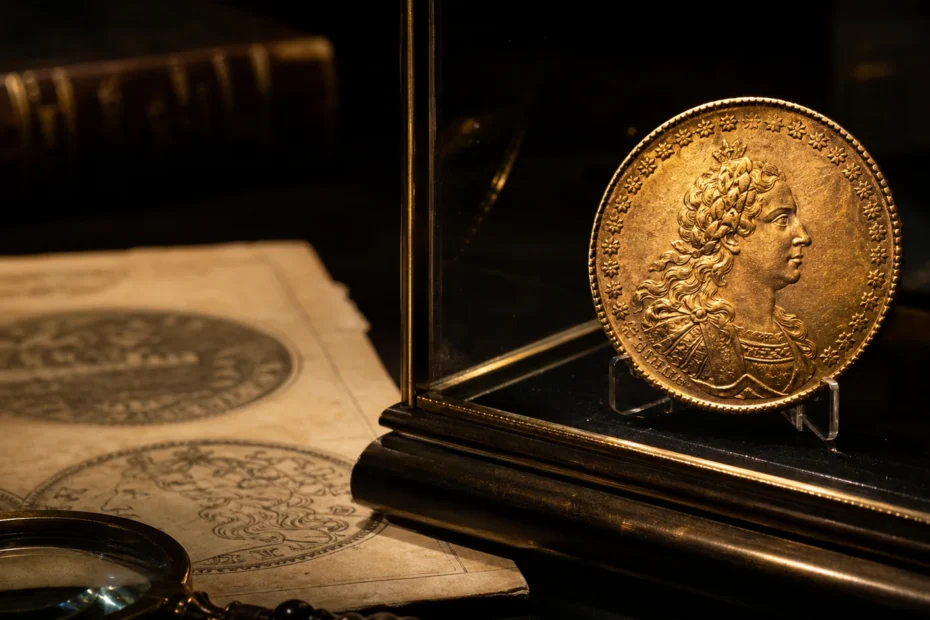
Compare verified record-setting gold coin sales and learn how rarity, grade, provenance, legal title, and demand create multimillion-dollar values.
- The 1933 Double Eagle holds the clearest public auction record among gold coins.
- Rarity alone is insufficient; grade, provenance, legal title, and bidder demand shape price.
- Auction records are historical facts, not reliable forecasts of future investment returns.
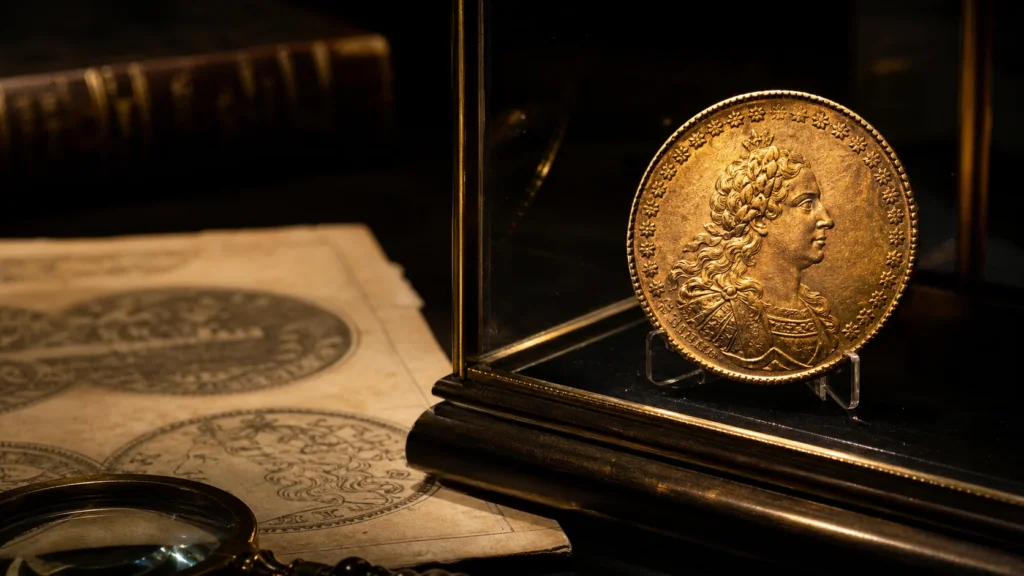
The 1933 Saint-Gaudens Double Eagle holds the verified public-auction record for a coin, realizing $18,872,250 at Sotheby’s in June 2021. Other exceptional gold-coin results include the 1787 Brasher Doubloon at $9.36 million and the privately ownable 1822 Capped Bust Half Eagle at $8.4 million. These prices reflect rarity, grade, legal title, provenance, and collector competition – not the value of the gold alone.
A valuable gold coin is not simply an expensive piece of bullion. At the highest level of numismatics, a few grams or ounces of metal become evidence of a vanished monetary system, a famous collection, a minting experiment, a political crisis, or an extraordinary survival story.
Record lists can still be deceptive. Dealer asking prices are not completed sales. Insurance values are not bids. Private transactions may be reported without full documentation. This guide prioritizes public auction results that can be traced to an auction house, mint, museum, or major grading service.
- The 1933 Double Eagle remains the public-auction leader at $18.872 million.
- The finest 1787 Brasher Doubloon realized $9.36 million in 2021.
- The only privately ownable 1822 Half Eagle realized $8.4 million.
- Condition, provenance, legal ownership, population, and sale venue drive the premium.
- A record price for one trophy coin does not make ordinary old gold coins equally rare or liquid.
How This Ranking Defines “Most Valuable”
The table uses nominal prices realized at public auction, including the buyer’s premium when the reporting source states that the realized price includes it. Prices are not adjusted for inflation or exchange-rate changes after the sale.
Private sales are discussed only when they clarify a coin’s history. A private price can be genuine, but the terms may not be independently visible. Likewise, a unique coin with a high estimate has not established that value until a transaction occurs.
- Transaction: Is this a completed sale or only an asking price, estimate, or valuation?
- Price basis: Does the figure include the buyer’s premium?
- Identity: Are date, denomination, variety, grade, and certification stated?
- Provenance: Can the specific specimen be traced through collections and prior sales?
- Legal title: Could the buyer lawfully own and resell the coin?
Verified Gold-Coin Auction Records
| Rank | Coin | Sale date | Reported realized price | Why it matters |
|---|---|---|---|---|
| 1 | 1933 Saint-Gaudens $20 Double Eagle, PCGS MS65 | June 2021, Sotheby’s | $18,872,250 | The only 1933 Double Eagle authorized for private ownership |
| 2 | 1787 New York-Style Brasher Doubloon, NGC MS65 Star | January 2021, Heritage | $9,360,000 | Finest known example of one of the earliest American gold issues |
| 3 | 1822 Capped Bust $5 Half Eagle, PCGS AU50 | March 2021, Stack’s Bowers | $8,400,000 | Only one of three known examples available to private collectors |
| 4 | EID MAR gold aureus of Brutus, NGC Ancients MS Star | October 2020, Roma Numismatics | About $4,188,000 | Rare gold version of the coin commemorating Julius Caesar’s assassination; later subject to serious provenance and legal controversy |
| 5 | 1907 Ultra High Relief Saint-Gaudens Double Eagle | March 2021, Heritage | $3,600,000 | Exceptional realization for the technically ambitious high-relief design |
| 6 | 1937 Edward VIII Pattern Gold 5 Sovereign, NGC PF67 Ultra Cameo | March 2021, Heritage | $2,280,000 | One of very few private examples from a reign that produced no circulating coinage |
| 7 | 1880 Coiled Hair $4 Stella, NGC PF67 Cameo | January 2026, Heritage | $2,074,000 | Top-grade example of an experimental U.S. international gold denomination |
The ranking is a documented snapshot, not a permanent universal list. New sales, restitution decisions, currency conversion, and revised provenance can change how a result should be interpreted.
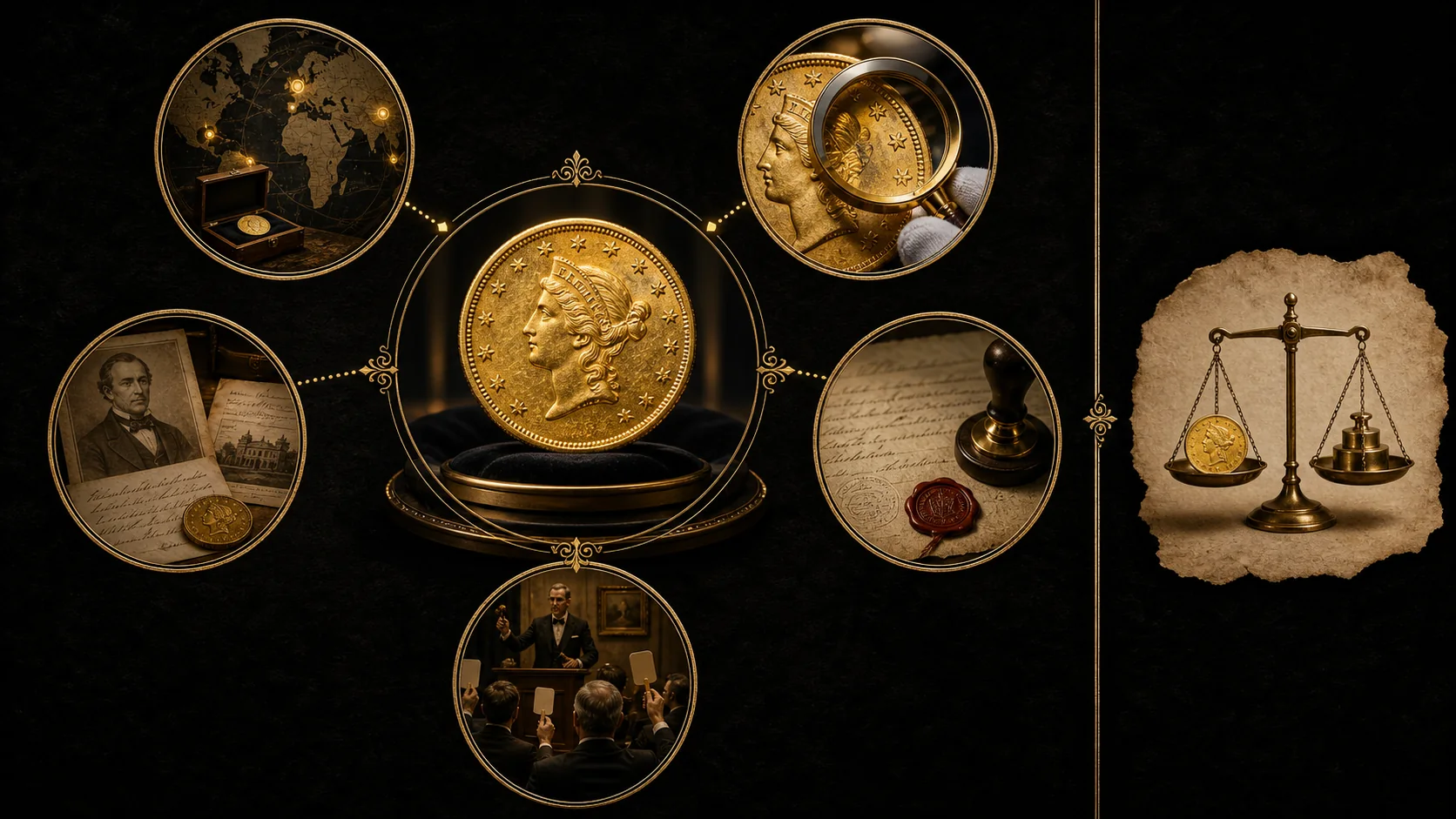
1. The 1933 Saint-Gaudens Double Eagle
The U.S. Mint struck 445,500 Double Eagles dated 1933, but the coins were not issued for circulation after the United States changed its gold policy during the Great Depression. Most were ordered melted. Two were transferred to the Smithsonian, while other examples left the Mint without authorization.
The specimen later associated with Egypt’s King Farouk received an export license before the government recognized the issue. It disappeared for decades, resurfaced in a 1996 sting operation, and became the subject of a legal settlement. In 2002 the U.S. government monetized that single coin and authorized private ownership.
Sotheby’s sold it again in 2021 for $18,872,250. The auction house describes it as the only example the U.S. government has authorized for private ownership. The U.S. Mint and the Smithsonian document the surviving government-held pieces.
The Sotheby’s digital catalogue documents the Farouk specimen’s legal history and private-ownership status.
The record is therefore not explained by mintage alone. Legal title, cultural fame, Saint-Gaudens’ design, royal provenance, and the unique ability to own this specimen all converge.
2. The 1787 Brasher Doubloon
New York goldsmith Ephraim Brasher produced a small group of gold pieces before the federal mint began regular U.S. coinage. The New York-style doubloons carry his EB counterstamp and have become symbols of early American commerce.
The finest known EB-on-wing example realized $9.36 million at Heritage Auctions in January 2021. Heritage reported only seven examples of the type and described the sold coin as the finest. That combination of early national history, tiny surviving population, recognizable maker, and exceptional condition created the result.
Heritage’s sale report records the realized price, grade, and known population for that specimen.
Another Brasher Doubloon may have a different counterstamp position, grade, surfaces, ownership history, and price. Even within a famous rarity, the specimen matters.
3. The 1822 Capped Bust Half Eagle
The U.S. Mint recorded a mintage of 17,796 half eagles dated 1822, yet only three examples are known today. Two belong to the Smithsonian. The remaining privately ownable specimen passed through major collections including those of Virgil Brand and Louis Eliasberg.
That coin realized $8.4 million at Stack’s Bowers in March 2021. PCGS graded it AU50 and documented the sale. The price reflects an extreme form of collector pressure: anyone attempting a complete date set of U.S. half eagles has only one privately available example to pursue.
The PCGS sale summary confirms the realized price and the three-known-specimen population.
The story also shows why surviving population is more useful than original mintage. Meltings, loss, circulation, and institutional ownership can transform a five-figure mintage into a one-coin private market.
Other Record-Setting Gold Coins
The ancient EID MAR aureus illustrates both the attraction and the danger of dramatic provenance. Its design refers to the assassination of Julius Caesar, and the example sold for roughly $4.188 million in 2020. Subsequent legal controversy over ownership and export history shows why an auction result does not eliminate title risk.
The 1907 Ultra High Relief Double Eagle connects Theodore Roosevelt’s coinage reform with Augustus Saint-Gaudens’ sculptural ambition. Producing the high-relief design was difficult, so surviving examples occupy a special place between pattern, technical experiment, and circulating-coin concept.
The Edward VIII Pattern 5 Sovereign reflects a reign that ended before regular coinage entered circulation. NGC reported a $2.28 million result in 2021. A top-grade 1880 Coiled Hair Stella then realized $2.074 million in January 2026, demonstrating that the million-dollar market extends beyond the three best-known American rarities.
What Most Valuable-Coin Lists Miss
A 2021 dollar price is not directly comparable with an older sale without inflation and exchange-rate context.
Some reports quote hammer price; others quote total price with buyer’s premium.
Export, ownership, theft, restitution, and archaeological laws can affect title and resale.
Record coins receive publicity; ordinary rare coins may be difficult to sell at an expected price.
What Makes One Gold Coin Worth Millions?
Bullion Value Versus Numismatic Value
Bullion value begins with metal weight, purity, and the current gold price. Numismatic value adds collector demand for the date, mint, variety, condition, history, and specimen. For a multimillion-dollar rarity, the melt value is a tiny part of the price.
Most modern bullion coins behave differently. Their price is usually much closer to gold content plus a dealer premium. GoldConsul’s guides to the weight of American Gold Eagles and buying American Gold Eagles explain that market.
If you are evaluating an old coin, start with authentication rather than a record list. Review GoldConsul’s guide to testing gold coins and use recognized grading and numismatic specialists for consequential purchases.
The GoldConsul Editorial Perspective
A famous date is not enough. Match the exact variety, certification number, grade, provenance, and legal title before using a record sale as a comparison. If one of those fields is missing, widen the uncertainty rather than raising the valuation.
A Collector’s Verification Checklist
- Confirm weight, dimensions, metal composition, date, mintmark, and die variety.
- Verify the grading-service holder and certification number directly with the service.
- Compare completed sales for the same variety and similar grade, not dealer listings.
- Request provenance and legal-title documentation for archaeological, shipwreck, or contested material.
- Include buyer’s premium, tax, insurance, storage, grading, and future selling costs.
- Use an independent specialist when the seller’s valuation depends on an extraordinary claim.
New collectors can continue with how to buy gold coins, GoldConsul’s broader gold coin buying guide, and the Gold Coins and Collectibles library.
Video walkthrough: Video context: Smithsonian Channel summarizes the extraordinary history behind the privately ownable 1933 Double Eagle.
Bottom Line
The most valuable gold coins earn their prices through a rare convergence of survival, condition, provenance, legal ownership, historical meaning, and competitive demand. Their metal content is real, but it does not explain a multimillion-dollar premium.
Use verified realized prices, not estimates or headlines. Then check whether the specific coin being valued shares the record specimen’s variety, grade, history, and title. In numismatics, similarity is not identity.
This content is educational and does not constitute financial, investment, legal, or tax advice. Rare coins can be illiquid, grading is opinion-based, transaction costs are substantial, and past auction records do not guarantee future prices.
FAQ: The Most Valuable Gold Coins
What is the most expensive gold coin ever sold?
The verified public-auction record is the 1933 Saint-Gaudens Double Eagle, sold by Sotheby’s in June 2021 for $18,872,250 including the reported premium.
Why is the 1933 Double Eagle legal to own?
Only one specimen was monetized and authorized for private ownership through a U.S. government legal settlement. Other known 1933 Double Eagles remain government or museum property.
Does an old gold coin always have collector value?
No. Many old gold coins trade mainly for metal value plus a modest premium. Rarity, demand, condition, variety, authenticity, and provenance determine whether a substantial numismatic premium exists.
Should rare coin prices be adjusted for inflation?
Inflation adjustment can help compare economic scale across time, but auction records are normally reported in nominal currency at the sale date. State the method before ranking results.
Can grading guarantee a rare coin’s future price?
No. Third-party grading helps describe authenticity and condition, but demand, market liquidity, provenance, legal title, and bidder competition still affect price.
 When you purchase a service or a product through our links, we sometimes earn a commission, at no extra cost to you.