
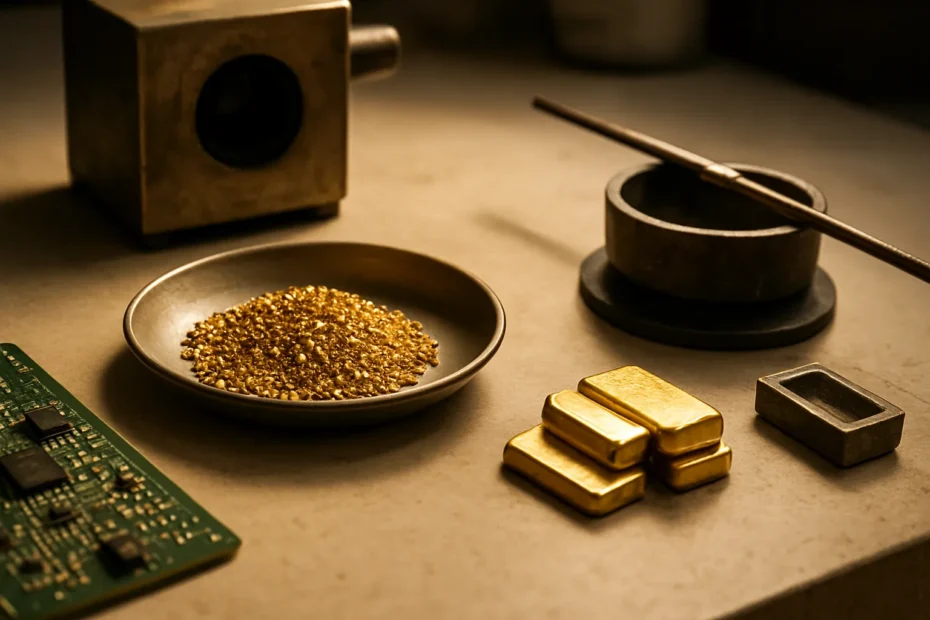
Yes, gold can be recycled, and it can be refined repeatedly to high purity for reuse in jewelry, bullion, and industry. But “recycled gold” is not one simple category: source quality, process losses, and traceability standards all affect the final outcome.
TL;DR
- Gold is highly recyclable and can be refined back to high-purity standards.
- Main streams: jewelry scrap, investment scrap, industrial/e-waste recovery.
- Recycling is real, but yield and cost depend on feedstock quality.
- Buyers should verify recycled claims with chain-of-custody and refinery credibility.
Can Gold Be Recycled?
Yes. Gold is one of the few materials that can be repeatedly recovered and refined without losing its core chemical identity. In practice, this means old jewelry, scrap bars, electronics feedstock, and process residues can all re-enter the market after refining.
Supply-side tracking from groups like the World Gold Council regularly distinguishes mine output from recycled supply, showing recycling as a meaningful contributor in many periods.
The 3 Main Gold Recycling Streams
| Stream | Typical Inputs | Practical Note |
|---|---|---|
| Jewelry scrap | Old rings, chains, broken pieces | Most visible to consumers |
| Investment scrap | Bars/coins resold and reprocessed | Usually cleaner feedstock |
| Industrial/e-waste | Electronics connectors, plated components | More complex recovery economics |
What Most Buyers Miss
“Recycled” does not automatically mean identical environmental impact across all products. Source stream and process efficiency matter.
How Recycled Gold Is Refined Back to High Purity
Recycled feedstock is melted, assayed, and processed through refining stages until target fineness is reached. Modern refining can return gold to very high purity grades suitable for investment or manufacturing standards.
Technical pathways differ by refinery and feedstock mix, but the principle is consistent: separate base metals/impurities, then certify final purity. For process context, references to industrial methods like the Wohlwill process provide a basic orientation.
The GoldConsul Editorial Perspective
For buyers, the key question is not “new or recycled” alone. The key question is whether purity, assay quality, and resale acceptance are equally strong at your chosen dealer and product format.
Knowledge Gap: Recycled Supply vs “Green” Marketing
Some pages treat all recycled gold claims as equivalent. They are not.
- Best-case: audited chain-of-custody and transparent refining documentation.
- Weak-case: vague recycled language with no source verification details.
- Buyer action: ask who refined it, what standard was used, and how purity was verified.
How Important Is Recycled Gold in Total Supply?
Recycled gold is a significant part of annual supply in many years, though the exact share changes with price environment, economic stress, and scrap flow incentives. When prices rise sharply, scrap return can increase as holders monetize old items.
USGS materials-flow references can help contextualize long-term recycling behavior: USGS circular and materials flow analysis.
Buyer Checklist: How to Evaluate Recycled Gold Claims
- Check stated purity/fineness and assay documentation.
- Ask the dealer/refinery source of recycled feedstock.
- Verify return/buyback terms before purchase.
- Compare premium and spread against equivalent non-recycled products.
- Prioritize verifiable chain-of-custody over vague “eco” claims.
Related practical context: what bullion is, how to buy gold bars, and gold price factors.
Video walkthrough: documentary context on e-waste pathways that feed precious-metal recycling streams.
Bottom Line
Gold can absolutely be recycled and returned to high purity. The real buyer advantage comes from verifying purity and traceability quality, not assuming every recycled claim has equal credibility.
FAQ: Can Gold Be Recycled?
Can recycled gold be as pure as newly mined gold?
Is all recycled gold from jewelry?
Does recycled gold always cost less?
How can I verify a recycled gold claim?
Why does gold recycling matter for supply?
 When you purchase a service or a product through our links, we sometimes earn a commission, at no extra cost to you.