
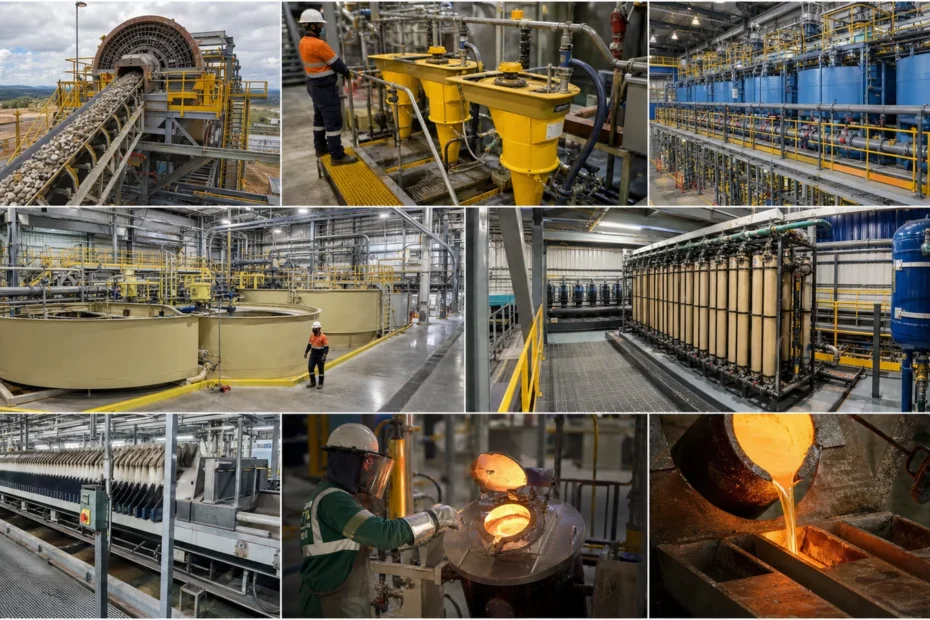
See how ore testing, crushing, gravity, flotation, cyanidation, carbon recovery, doré smelting, refining, water, and tailings fit together.
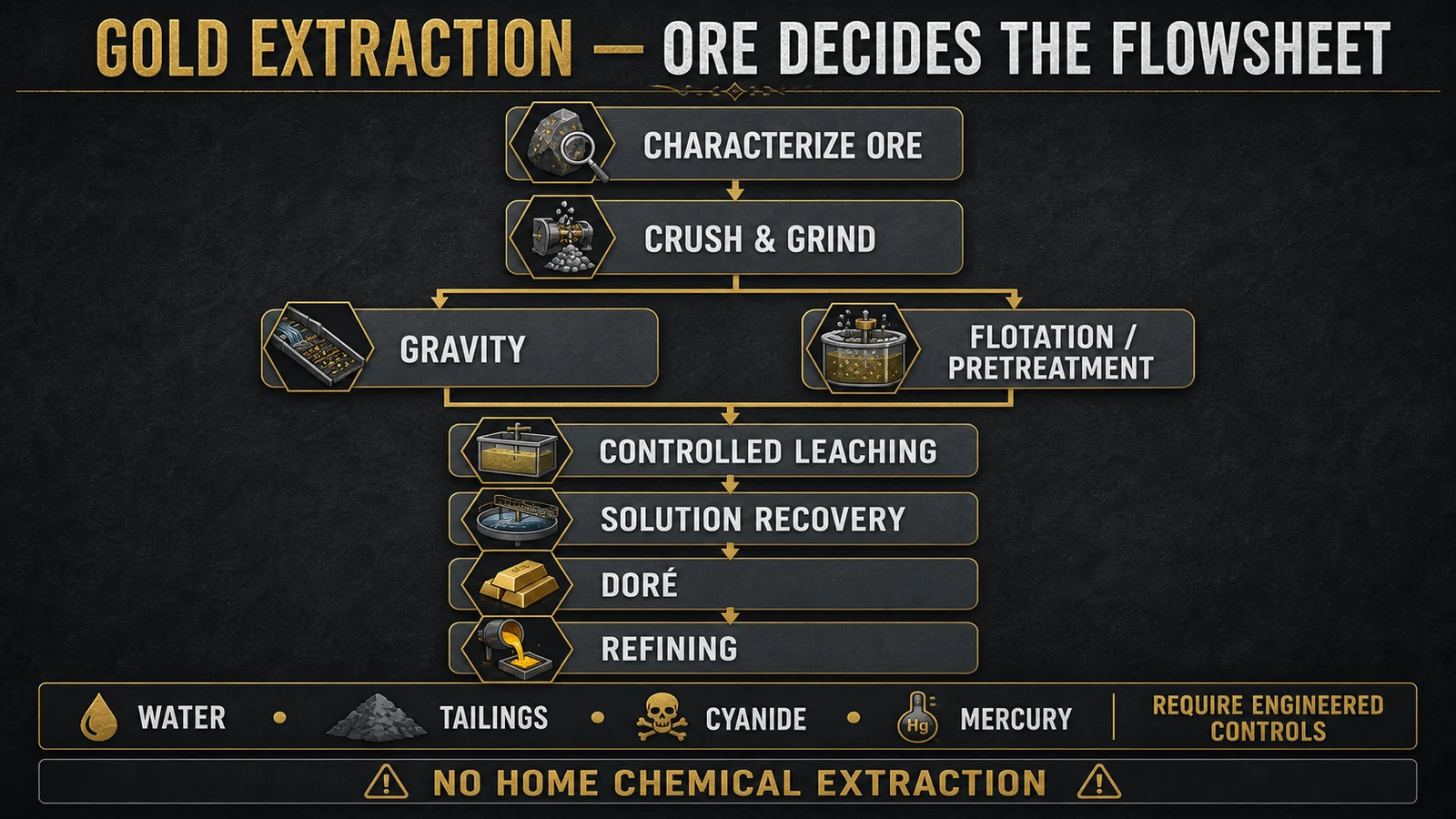
- There is no universal gold flowsheet: mineralogy, particle size, grade and gold liberation determine which recovery stages can work.
- Gravity can recover coarse free gold; flotation or pretreatment may concentrate refractory sulfides; controlled leaching recovers many fine particles.
- Cyanide, mercury, tailings, water and refining emissions require engineered systems, trained operators, monitoring and regulation—not home experiments.
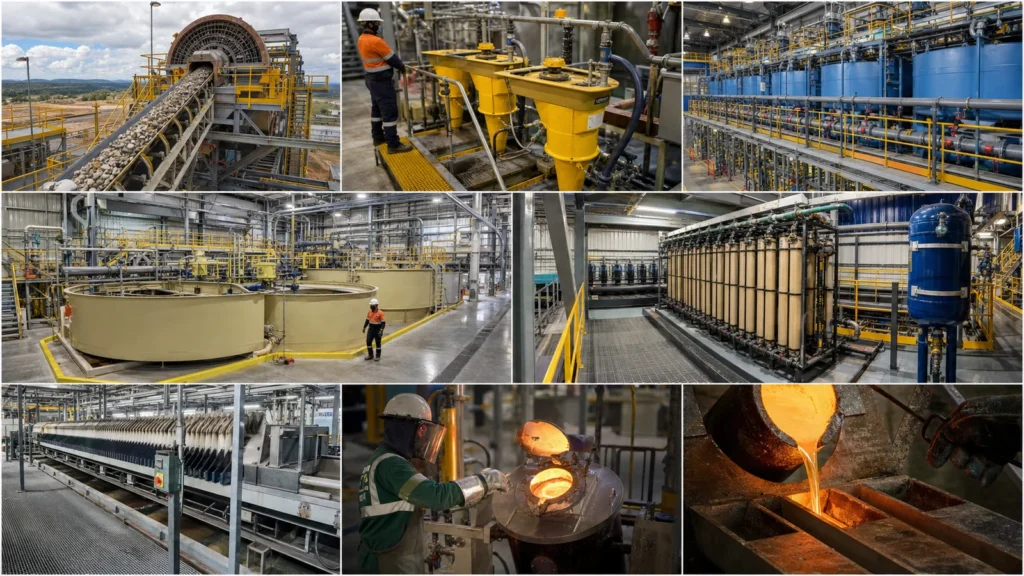
- Ore mineralogy, liberation size and testwork decide the process.
- Mining removes rock; mineral processing separates value; refining produces higher-purity metal.
- Gravity, flotation and leaching solve different recovery problems.
- Recovery percentage must be read with ore mass and grade.
- Cyanide, mercury, water and tailings require engineered controls—never home experiments.
The ore decides the circuit
Diagrams often show “rock in, gold bar out” as a fixed recipe. In reality, a plant is a set of choices constrained by geology, metallurgy, water, energy, scale, regulation and economics. Geoscience Australia distinguishes gravity recovery, cyanidation and carbon-based recovery; the sequence changes with the ore.
Mining, extraction and refining are not the same stage
| Stage | Purpose | Typical output |
|---|---|---|
| Mining | Remove ore and waste from the deposit | Run-of-mine rock |
| Mineral processing/beneficiation | Reduce size and concentrate or expose valuable minerals | Gravity concentrate, flotation concentrate or prepared ore |
| Extraction | Separate gold from the solid matrix into a recoverable product or solution | Concentrate, pregnant solution or precipitate |
| Smelting | Melt recovered material and separate slag | Doré bullion |
| Refining | Remove remaining impurities to a specified purity | Refined bullion or grain |
Everyday language may use “extraction” for the whole chain. Technical accuracy improves when the boundary is stated. See the broader list of gold-mining methods. The refining stage is explained in Step 7 below.
Step 1: characterize the ore and run metallurgical testwork
Assays estimate grade; mineralogy asks where gold sits and what surrounds it. Important variables include gold particle size, association with quartz or sulfides, preg-robbing carbon, clay, hardness, oxidation state and deleterious elements. A sample must represent the deposit and its variability, not only a visually rich fragment.
Bench tests compare grind sizes, gravity response, flotation, leach kinetics and reagent demand. Pilot work may be required before scale-up. A flowsheet selected from a photo of “gold ore” is speculation; learn the visual limits in how to identify gold ore.
Step 2: crush, grind and liberate
Primary crushing reduces mine rock to manageable pieces. Secondary crushing and grinding reduce it further, often as a slurry with water. Screens and cyclones classify particles so coarse material returns for more grinding while suitable material advances.
More grinding is not automatically better. It consumes energy, can create difficult slimes and may overgrind liberated gold. The target is sufficient liberation for the selected recovery process. Wear metals and process water chemistry can also affect downstream behavior.
Step 3: recover coarse free gold by gravity when appropriate
Gold’s high density enables centrifugal concentrators, jigs, sluices and tables to separate liberated heavy particles from lighter gangue. Gravity recovery can produce a high-grade concentrate early, reduce the gold circulating in the plant and lower the load on later stages.
Gravity does not recover gold merely because gold is dense. The particle must be sufficiently liberated, and very fine or flat particles behave differently in flowing slurry. Tailings from gravity commonly proceed to another process rather than being declared barren.
| Route | Best fit | Does not solve |
|---|---|---|
| Gravity | Coarse, liberated, high-density gold | Most microscopic locked gold |
| Flotation | Gold associated with floatable sulfides | Final metal production without treating concentrate |
| Direct cyanidation | Accessible free-milling fine gold | All refractory or preg-robbing ores |
| Pretreatment + cyanidation | Gold locked in sulfides or otherwise inaccessible | Economic viability without testwork and controls |
Step 4: flotation and refractory-ore pretreatment
Flotation uses controlled air bubbles and reagents to separate selected mineral surfaces, commonly producing a smaller sulfide concentrate. The concentrate can then be processed on site or shipped to a specialist facility. Gold remains associated with the concentrate until a later extraction step.
Refractory ore resists conventional cyanidation because gold is physically locked, chemically inaccessible or affected by carbon that adsorbs dissolved gold. Pretreatment options can include oxidation under pressure, roasting or biological oxidation, each with major capital, energy, emission and residue implications. The choice belongs to professional metallurgical design.
Step 5: controlled cyanide leaching
Under controlled alkaline conditions, cyanide can form a soluble complex with gold in the presence of oxygen. Plants monitor pH, concentration, dissolved oxygen, residence time and particle size. Maintaining alkalinity is a critical protection against highly toxic hydrogen cyanide gas.
Heap leaching applies solution to crushed or placed ore on engineered lined pads and collects the pregnant solution. Tank leaching agitates finely ground slurry in vessels and generally offers tighter control and faster kinetics at higher cost. Neither is a household procedure.
| Feature | Heap leach | Tank leach |
|---|---|---|
| Feed | Usually coarser, lower-grade, permeable material | Finely ground slurry |
| Residence time | Longer—often weeks or months | Shorter—commonly hours to days |
| Capital/intensity | Lower intensity but large lined area | Higher equipment and energy intensity |
| Control | Flow distribution and permeability are major challenges | Mixing, chemistry and time are more directly controlled |
| Residue | Spent heap requiring closure and water management | Tailings slurry requiring treatment and storage |
The U.S. EPA’s gold mining industry profile describes process routes and waste streams; the International Cyanide Management Code focuses on responsible cyanide manufacture, transport and use in gold mining.
Step 6: recover dissolved gold from solution
In carbon-in-pulp (CIP), activated carbon contacts leached slurry in separate adsorption tanks. In carbon-in-leach (CIL), leaching and carbon adsorption overlap. Carbon-in-column (CIC) commonly treats clearer solutions such as heap-leach liquor. Gold loads onto the carbon surface.
Loaded carbon is screened from slurry, washed and treated in an elution circuit that strips gold into a smaller, richer solution. Electrowinning deposits gold-bearing material onto cathodes; an alternative route for some clear solutions is zinc precipitation. Carbon can be thermally regenerated and returned to service under controlled conditions.
Step 7: smelt doré and refine it
Recovered sludge or concentrate is dried and mixed with fluxes, then smelted so impurities report to slag and precious metals form doré bars. Doré is not the same as a finished 99.99% investment bar; it commonly contains gold, silver and residual impurities in proportions that depend on the mine.
A refinery assays the doré and uses controlled chemical or electrochemical processes to reach commercial specifications. Chain of custody, mass balance and sampling matter because settlement depends on contained metal, not only bar weight.
Recovery, grade and yield: a worked mass balance
A plant treats 10,000 metric tonnes of ore averaging 2.0 grams of gold per tonne. Contained gold is 20,000 grams. At 92% overall recovery, recovered gold is 18,400 grams, or 18.4 kilograms.
The remaining 1,600 grams is not necessarily visible or practically recoverable; it is distributed in tailings, solution inventory, residues and process losses. Recovery alone does not show profit because mining, processing, capital, energy, closure and refining costs remain.
Two plants can report the same recovery percentage while producing very different amounts of gold because tonnage and grade differ. Reconciliation compares mine estimates, plant feed, inventory, doré and tailings over defined periods. Sampling error and changing ore blends can create apparent gains or losses.
Water, tailings and cyanide controls
Water moves ore, controls dust, enables grinding and carries reagents. Sites manage intake, recycle, seepage, stormwater and discharge according to local conditions and permits. Tailings storage must address geotechnical stability, water balance, closure and long-term monitoring—not merely “hold waste.”
Cyanide-bearing streams can be recycled and treated, but wildlife and water risks remain if controls fail. The USGS review of cyanide hazards documents exposure pathways. Engineered liners, secondary containment, leak detection, process monitoring, emergency response and independent oversight form a system; no single safeguard is enough.
Mercury and artisanal gold mining
Mercury amalgamation persists in some artisanal and small-scale mining and can expose miners, families and ecosystems to severe harm. Burning amalgam releases mercury vapor; tailings can continue contaminating water and food chains. The EPA guide to mining without mercury describes gravity-based alternatives and boundaries.
The Minamata Convention on Mercury establishes an international framework to reduce mercury releases, including action on artisanal gold mining. Mercury-free does not mean risk-free: gravity circuits still require safe excavation, water and tailings management, and chemical leaching requires specialized controls.
Process-selection matrix
Reprocessing gold from electronic waste is a different feed and regulatory problem. Cornstarch research is also often misrepresented as a kitchen extraction trick; read the limitations in cornstarch and gold extraction.
Industrial due-diligence checklist
- Are ore samples representative across domains and grades?
- Does mineralogy show whether gold is free, locked or preg-robbing?
- Is recovery supported by testwork at relevant grind and chemistry?
- Are concentrate, solution, doré and tailings included in a mass balance?
- Are water supply, recycle, discharge and closure modeled?
- Are cyanide transport, storage, detoxification and emergency systems specified?
- Are capital, operating, energy and residue costs included?
Many explanations name machines but omit the decision logic between them. The most important “step” happens before construction: representative sampling and metallurgical testwork determine whether a machine belongs in the circuit at all.
A high recovery number is not automatically a good flowsheet. The better design recovers value reliably while controlling water, energy, reagents, residues, worker exposure and closure obligations across changing ore.
Do not attempt cyanide, mercury, aqua regia, chlorine, roasting or other chemical gold extraction at home. These processes can create lethal gases, toxic exposure and regulated waste. Industrial extraction requires qualified metallurgists, engineered containment, monitoring, permits and emergency systems.
Watch: This visual overview connects mining, processing and metal production at industrial scale.
Bottom Line
Gold extraction is an ore-specific chain: characterize, liberate, select gravity or flotation and pretreatment where justified, leach suitable material under control, recover dissolved gold, produce doré and refine. Process safety and environmental management are part of the flowsheet, not an appendix.
FAQ: The Gold Extraction Process
What is the most common way to extract gold from ore?
Many large operations use controlled cyanide leaching followed by carbon adsorption, but there is no universal method. Ore mineralogy and testwork decide the route.
What is the difference between heap leaching and tank leaching?
Heap leaching treats coarser ore on engineered pads over longer periods; tank leaching treats finely ground slurry with more intensive mixing and control.
Can gravity separation recover all gold?
No. It works best for sufficiently coarse, liberated gold. Fine or locked gold may require flotation, pretreatment or controlled leaching.
What is a doré bar?
Doré is an intermediate precious-metal bar produced at a mine or processing site. It contains gold, often silver, and other impurities and must be refined.
Can gold be chemically extracted at home?
Do not attempt it. Cyanide, mercury, aqua regia, chlorine and roasting can create lethal exposure and hazardous waste; qualified industrial systems and regulation are required.
Sources and verification
This article separates documented evidence from inference and links the primary or specialist sources used. Dates, access rules, care advice and industrial controls should be rechecked when a decision depends on them.
- Geoscience Australia — Gold — Gravity concentration, free-milling ore, cyanidation and carbon recovery overview.
- U.S. EPA — Artisanal Gold Mining Without Mercury — Gravity methods, chemical leaching boundaries and mercury risk.
- USGS — Cyanide Hazards from Gold Mining — Wildlife, water and tailings risks associated with cyanide processing.
- U.S. EPA — Metal Mining CDR Fact Sheet — Crushing, grinding, pretreatment, cyanidation, solution separation and tailings.
- U.S. EPA — Mining Industry Profile: Gold — Gold extraction process stages and waste streams.
- U.S. EPA — Ore Mining Effluent Development Document — Cyanidation and mineral-processing treatment context.
- U.S. EPA — Technical Resource Document: Extraction and Beneficiation of Ores — Technical descriptions of gold beneficiation, leaching, process residues and environmental controls.
- International Cyanide Management Code — Voluntary industry code for cyanide manufacture, transport and gold-mining use.
- Minamata Convention on Mercury — International framework to reduce mercury releases including artisanal gold mining.
- Seeker — How Gold Mining Works — Visual overview selected for the article video.
 When you purchase a service or a product through our links, we sometimes earn a commission, at no extra cost to you.