
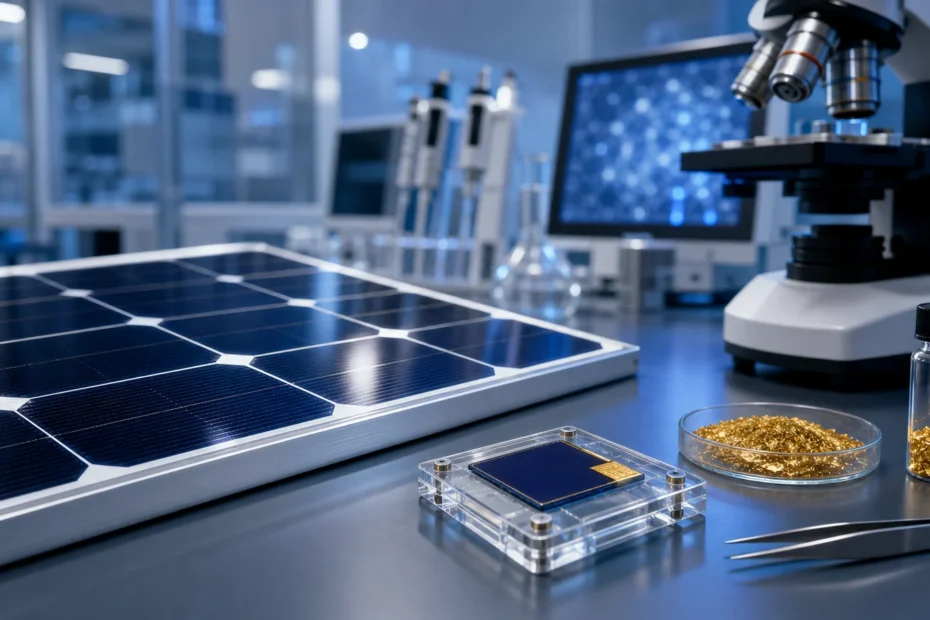
Find out whether solar panels contain gold, where gold appears in research cells, and why silver, copper and aluminum dominate mainstream modules.
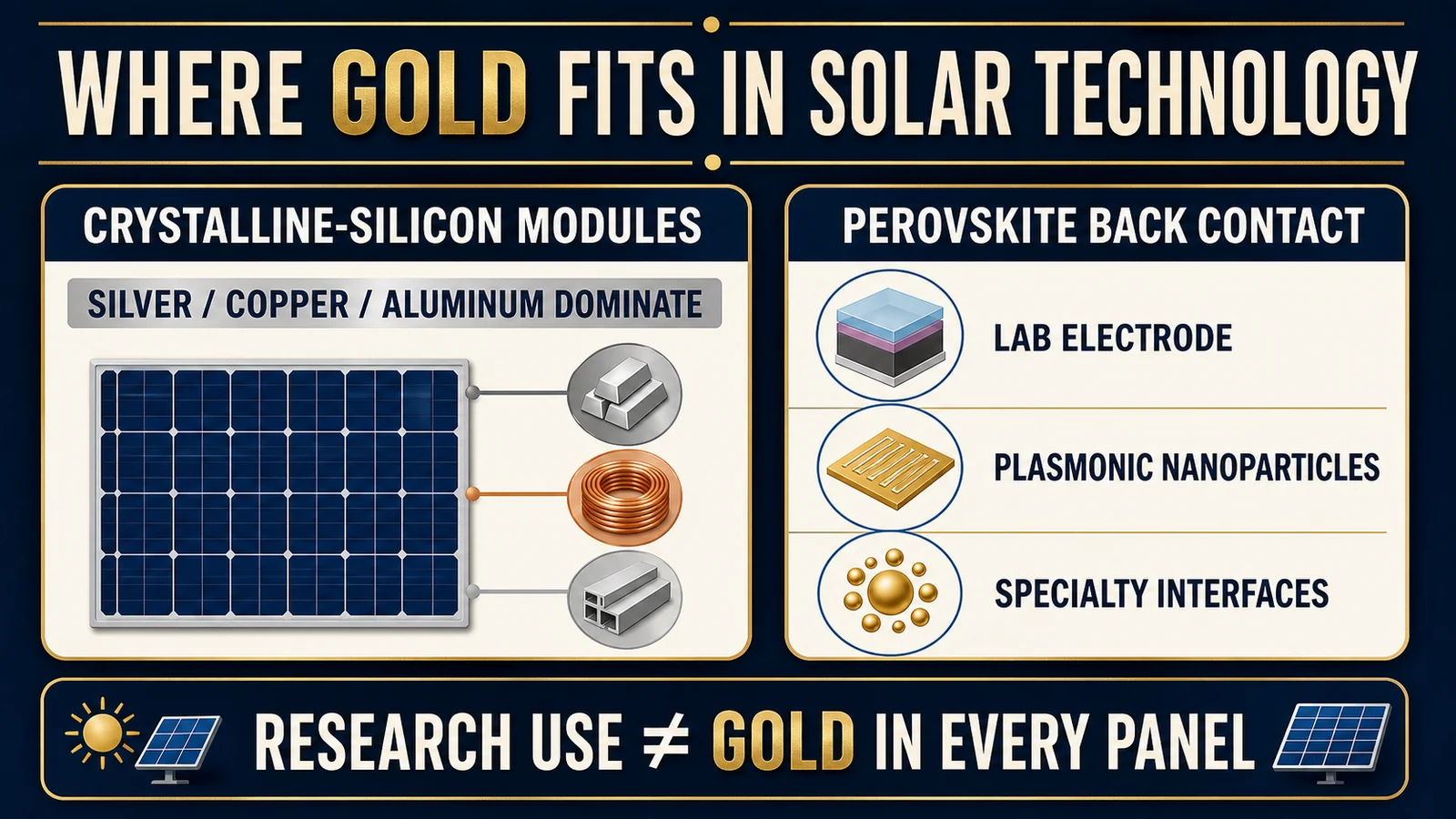
- Mainstream crystalline-silicon modules are not meaningful gold products; silver, copper and aluminum perform the main electrical jobs.
- Gold appears mainly in research cells as a stable electrode, specialty interface or plasmonic nanoparticle—not in every commercial panel.
- A laboratory efficiency gain matters only if it survives cost, scale-up, durability and recycling tests.
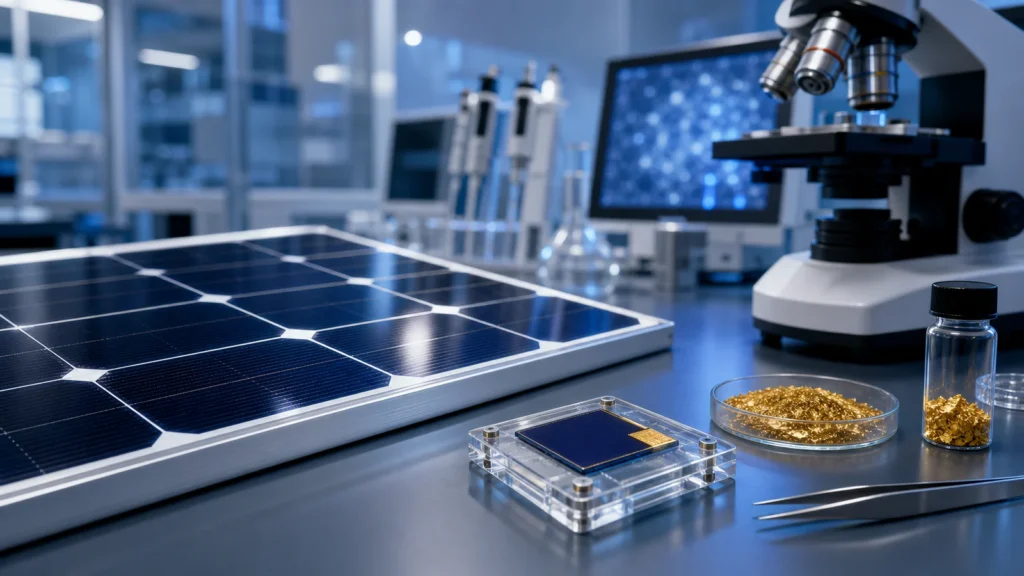
- Do not assume every solar panel contains recoverable gold.
- Commercial silicon cells rely primarily on silver contacts, copper conductors and aluminum frames or rear structures.
- Researchers use gold electrodes in perovskite, organic and other test cells because gold is conductive and chemically stable.
- Gold nanoparticles can alter light absorption or interfaces, but more particles do not automatically improve efficiency.
- Commercial adoption requires stable performance per dollar, scalable deposition and responsible end-of-life recovery.
Separate the module market from the research literature
A paper may describe a gold back contact or gold nanoparticles in a record laboratory cell. A rooftop module sold at scale can use a different architecture entirely. The word “solar panel” collapses cell, module, wiring, inverter and research prototype into one phrase; this guide keeps them separate.
What a mainstream silicon module contains
Crystalline-silicon cells convert light in a semiconductor wafer. Fine front contacts collect current, interconnect ribbons link cells, glass and encapsulants protect them, and an aluminum frame often provides structure. Silver has historically been used in cell metallization, while manufacturers continue to reduce silver use and develop copper-based alternatives.
Gold is not listed as a dominant commodity in mainstream module bills of materials because its cost would be difficult to justify for broad-area contacts. If a particular high-reliability component elsewhere in the system uses gold-plated electronics, that does not mean the photovoltaic cells themselves contain economically recoverable gold.
| Layer or component | Mainstream material family | Where gold may appear |
|---|---|---|
| Semiconductor absorber | Crystalline silicon | Usually not a bulk constituent |
| Cell metallization | Silver pastes; growing copper substitution | Special research contacts, not the default |
| Interconnects | Copper with solder or coatings | Possible in niche electronics, not module-scale conductors |
| Frame / structure | Aluminum, glass, polymers | No functional need for bulk gold |
| Experimental back electrode | Varies by cell architecture | Gold is common in lab devices because it is stable and easy to deposit |
| Optical enhancement research | Textures, coatings and nanostructures | Gold nanoparticles or nanorods may be tested |
Why researchers like gold electrodes
Gold conducts electricity, resists oxidation and has a high work function useful for certain device stacks. Thin films can be deposited reproducibly in a laboratory, making gold a convenient reference electrode. That convenience can help isolate scientific questions even when gold would be too expensive for manufacturing.
Perovskite solar-cell papers frequently use evaporated gold as a rear contact. Researchers then compare carbon, copper, silver and other alternatives because electrode cost, metal migration and interfacial reactions influence long-term stability.
Plasmonic gold nanoparticles
Nanoscale gold interacts strongly with light through localized surface plasmon resonance. Depending on size, shape and surroundings, particles can scatter light, concentrate electromagnetic fields or alter charge behavior. That makes them attractive for experiments intended to increase absorption in a thin active layer.
The effect is not automatically beneficial. Nanoparticles can introduce recombination sites, change morphology, absorb without generating useful current or destabilize an interface. The Joule study in the source list emphasizes concentration and placement rather than a simple “gold boosts efficiency” rule.
Cell efficiency is not module economics
NREL/NLR efficiency charts track independently confirmed research cells under defined conditions. A small-area record does not include module interconnection loss, encapsulation, degradation, factory yield, warranty exposure or cost per watt. Commercial decisions depend on energy delivered over decades, not only peak laboratory efficiency.
A gold-enabled device could still make sense in space, sensors, indoor power or another high-value niche where area is constrained and reliability is unusually valuable. That would not prove a role in commodity rooftop panels.
Gold versus silver, copper and aluminum
| Material | Why solar uses it | Constraint |
|---|---|---|
| Silver | Excellent conductivity and mature screen-printing processes | Cost and supply intensity encourage thrifting |
| Copper | Highly conductive and cheaper for bulk conductors | Oxidation and contact integration require process control |
| Aluminum | Light, inexpensive and useful for frames and some cell contacts | Lower conductivity than copper and different interface behavior |
| Gold | Corrosion resistant, stable and easy to use in research thin films | Too expensive for most broad-area commercial functions |
The correct comparison is cost per delivered function. Gold may win at a microscopic corrosion-resistant interface while losing decisively as a busbar or full-area electrode.
Can you recover gold from old solar panels?
Do not process modules at home looking for gold. Broken glass, lead-containing solders in older products, polymers and electrical hazards make informal recovery unsafe. Commercial recycling typically prioritizes aluminum frames, glass, copper, silicon and silver according to process economics and regulation.
An inverter or control board may contain tiny gold-plated contacts like other electronics. That material belongs in an accredited electronics or PV recycling stream, not a chemical stripping experiment. See gold in electronics and gold in EV electronics for the same selective-use principle.
Module recycling and material accounting
A proper lifecycle analysis begins with an inventory per square meter or per watt, then applies manufacturing yield, service life, collection rate and recovery efficiency. A trace element can be technically present yet economically unrecoverable when it is dispersed in coatings or mixed with glass and polymers.
Solar recyclers design processes around the materials and hazards actually present in large volumes. Aluminum frames and copper cables are relatively accessible; glass dominates mass; silver can contribute value; polymers complicate separation. Any future gold-bearing layer would need to be identified so recovery does not create more environmental burden than the recovered metal avoids.
What would change the commercial conclusion?
Evidence would become persuasive if a manufacturer disclosed a gold-containing stack, quantified milligrams per module, demonstrated certified module efficiency and multi-year durability, and showed a cost or lifetime-energy advantage over a gold-free design. Factory throughput and recovery would need to remain credible at gigawatt scale.
Until then, laboratory use should be described as research demand. It can advance science without materially changing the composition of deployed panels.
- Identify the cell architecture and whether it is a cell, mini-module or commercial module
- Find the exact role: electrode, nanoparticle, interface, catalyst or external electronics
- Record gold thickness, loading or area—not just the word “gold”
- Check stabilized efficiency and independent certification
- Check operational stability and accelerated aging
- Compare a gold-free control and realistic alternative materials
- Look for cost, deposition throughput, supply and recovery analysis
- Do not extrapolate a square-centimeter result to global module demand
Where future use is most plausible
Specialty optoelectronics, tandem-cell research, transparent or flexible devices, sensors integrated with photovoltaics and high-value space systems can tolerate material choices that commodity modules cannot. Nanostructured gold may also be valuable as a diagnostic tool during research even if it is absent from the final product.
For adjacent material science, read gold nanoparticles, the future of gold nanotechnology, gold’s electrical conductivity, the atomic structure of gold and gold extraction processes.
Research papers often report device area and efficiency but do not translate nanometers of gold into grams per square meter, factory yield, module lifetime or recovery value. Without that bridge, global gold-demand claims are speculative.
Gold’s strongest solar role may be as a precise research and specialty-interface material, not a mass-market ingredient. That is still technologically useful; it simply should not be marketed as gold in every panel.
Watch: Silicon PV
This laboratory lecture explains the mainstream silicon-cell stack, providing the baseline needed before judging claims about specialty gold electrodes or nanoparticles.
Video: NLR Learning. Availability validated July 16, 2026.
Bottom Line
Mainstream solar modules depend on silicon, silver, copper, aluminum, glass and polymers—not recoverable quantities of gold. Gold earns attention in experimental electrodes and nanophotonic structures, but only durability, scale, cost and recovery can convert a lab result into commercial demand.
Frequently Asked Questions
Do solar panels contain gold?
Mainstream silicon modules generally do not use meaningful gold in their cells. Specialty electronics or research devices may use tiny amounts.
Why is gold used in experimental solar cells?
It is conductive, oxidation resistant and convenient to deposit as a stable laboratory electrode.
Do gold nanoparticles make solar cells more efficient?
They can alter light and interfaces, but results depend on size, placement and concentration and can also reduce performance.
Can I recover gold from solar panels?
Home recovery is unsafe and generally uneconomic. Use authorized PV and electronics recycling channels.
Will solar growth significantly increase gold demand?
Not from mainstream modules under current architectures. A future specialty use would need quantified loading and commercial scale.
Sources and verification
These sources define the material, market, engineering or regulatory boundaries used above. Check the current document and product-specific evidence before acting.
- NLR — Best Research-Cell Efficiencies
- Fraunhofer ISE — Photovoltaics Report
- IEA PVPS — Trends in Photovoltaic Applications
- U.S. DOE — Solar Photovoltaic Cell Basics
- NLR — Silicon PV lecture
- Joule — Gold nanoparticles in perovskite solar cells
- NLR — Perovskite solar cells
- World Gold Council — Technology demand
- USGS — Silver statistics
- IRENA — End-of-life management of solar PV panels
 When you purchase a service or a product through our links, we sometimes earn a commission, at no extra cost to you.