

Explore gold nanoparticles in diagnostics, drug delivery, imaging and cancer research—and the evidence, safety and regulatory gates before clinical use.
- “Gold nanoparticle” describes a platform whose behavior changes with size, shape, coating, payload and dose.
- Diagnostics, imaging, delivery, photothermal treatment and radiosensitization are active research areas; a trial is not the same as approval or standard care.
- Clinical translation depends on reproducible manufacturing, biodistribution, clearance, toxicity and demonstrated patient benefit.

- “Gold nanoparticle” is not one medicine.
- Gold’s optical properties and modifiable surface make it useful for sensing and targeted research.
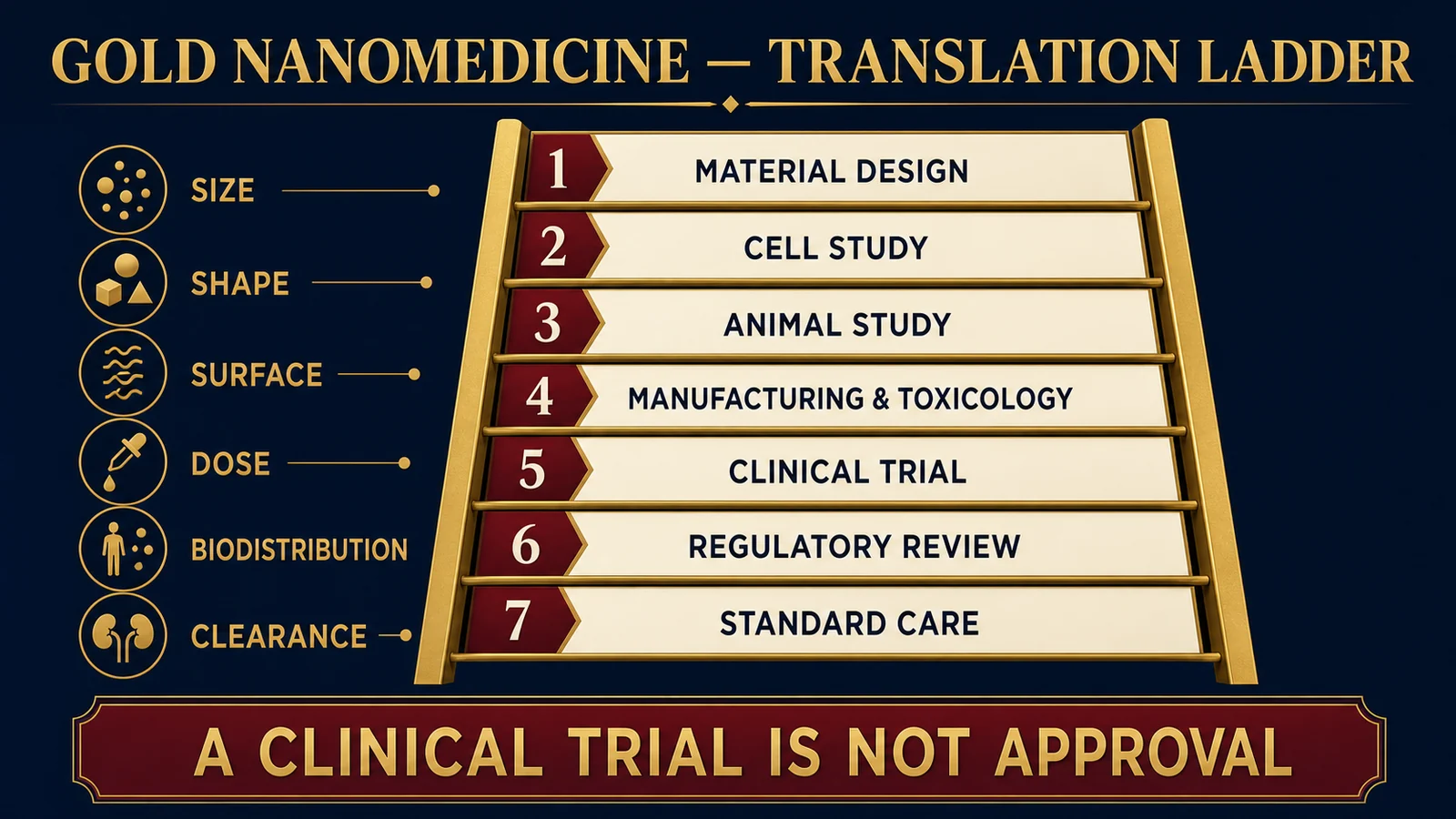
- Most therapeutic claims must be located on an evidence ladder: cell, animal, manufacturing, trial, review or standard care.
- Biodistribution, clearance, immune response and batch reproducibility are central safety questions.
- Patients should use regulated products and qualified clinical advice, never DIY colloidal gold or unapproved injections.
Platform science, not a miracle material
At nanoscale, gold can absorb and scatter light in ways bulk metal does not. Researchers can attach polymers, antibodies, peptides, drugs or imaging agents to its surface. That combination makes gold versatile, but every modification changes biological identity and evidence requirements.
What counts as a gold nanoparticle?
Particles may be spheres, rods, shells, cages, clusters or composites. Their core can range from a few nanometers to well above 100 nanometers, and coatings alter charge, water compatibility, protein binding and circulation. Two papers that both say “gold nanoparticle” may be testing substantially different products.
| Design variable | Why it matters medically |
|---|---|
| Size | Influences circulation, tissue penetration, cellular uptake and clearance pathways |
| Shape | Changes optical resonance, surface area and cellular interactions |
| Surface chemistry | Controls aggregation, protein corona, targeting and immune recognition |
| Payload | Determines whether the particle is a carrier, contrast agent or active therapy |
| Dose and route | Change which organs are exposed and at what concentration |
| Manufacturing | Batch variability can alter safety and performance |
Diagnostics and biosensing
Gold nanoparticles can produce visible color changes when they aggregate and can amplify optical signals. Lateral-flow assays are a familiar diagnostic format, though not every gold-colored test uses the same particle or claim. In laboratory instruments, surface-enhanced Raman and plasmonic sensing can detect molecular interactions at low concentrations.
Diagnostic value depends on sensitivity, specificity, reproducibility, clinical workflow and comparison with an accepted reference. Detecting a biomarker in a controlled sample is far from proving that a test improves patient outcomes.
Imaging and image-guided treatment
Gold’s high atomic number makes it interesting for X-ray and computed-tomography contrast research. Its optical response supports photoacoustic and other imaging approaches. Researchers also design theranostic particles that combine imaging and treatment functions.
More signal is not enough. A useful contrast agent must reach the target at an acceptable dose, clear predictably, avoid misleading background and perform better than established options. Imaging studies should report tissue distribution and time, not only a bright image.
Drug and gene delivery
Gold surfaces can carry molecules and targeting ligands. MIT research illustrates how a specific ligand pattern can influence membrane interaction. That mechanism is design-dependent; it does not mean any colloidal gold preparation slips safely into cells or carries a useful drug.
Targeting is also probabilistic. A ligand may increase binding to a receptor, while liver, spleen and immune-system uptake still remove much of the injected dose. Manufacturing must preserve particle size, coating density and payload release through storage and administration.
Photothermal therapy
Gold nanorods, shells and other structures can be tuned to absorb near-infrared light and convert it to heat. The concept is to concentrate particles near a tumor and illuminate them so local heating damages tissue. The clinical challenge is delivering a sufficient, uniform particle concentration and light dose without harming healthy structures.
A treatment protocol therefore includes more than nanoparticles: imaging, delivery, laser wavelength, power, exposure duration, temperature monitoring and patient selection all affect the outcome.
Radiation enhancement
Because gold interacts strongly with X-rays, nanoparticles are studied as radiosensitizers. Proposed effects include physical dose enhancement and biological responses. Magnitude depends on radiation energy, particle distribution and cellular context. Results from a cell dish do not directly predict dose enhancement in a human tumor.
Safety: the gold core is only one part
Bulk gold’s reputation for inertness does not automatically transfer to nanoparticles. Small size increases surface area, and coatings or residual synthesis chemicals can drive toxicity. Particles can accumulate in liver and spleen, interact with proteins, trigger immune responses or persist depending on design.
FDA nanomaterial guidance asks developers to characterize physical and chemical properties, manufacturing controls, pharmacology and toxicology. Tests must be product-specific. “Made with gold” is neither a safety certification nor a clinical indication.
Manufacturing is part of the medicine
A nanomedicine cannot be defined only by an ingredient list. Developers specify particle-size distribution, morphology, aggregation state, surface-ligand density, free versus attached payload, residual reagents, sterility and endotoxin. Analytical methods must distinguish a stable product from one that changes during storage, dilution or infusion.
Scale-up can alter mixing and nucleation, producing a different distribution than a laboratory batch. Regulators therefore assess process controls, release tests, stability and comparability after manufacturing changes. If a revised process changes a critical quality attribute, previous toxicology or clinical data may not transfer automatically.
Protein corona and biological identity
Once a nanoparticle enters blood or tissue fluid, proteins and other molecules adsorb to its surface. This “corona” can mask a targeting ligand, change immune recognition and redirect tissue uptake. Its composition depends on the surface and biological environment, so a pristine microscopy image does not represent the particle a cell encounters in a patient.
Researchers use serum studies and in-vivo measurements to understand this transformation. The clinically relevant identity includes both the manufactured surface and the acquired biological layer.
Biodistribution and clearance
Researchers quantify how much material reaches blood, tumor, liver, spleen, kidneys and other tissues over time. Very small clusters may have greater renal clearance, while larger or aggregated particles can persist in the mononuclear phagocyte system. Surface coatings can extend circulation but may change immune responses.
Long-term studies matter because an acute toxicity test can miss chronic inflammation, organ retention or delayed effects. Labeling the core, coating and payload separately can help distinguish where each component goes.
- What exact particle size, shape and coating was tested?
- Was the study in cells, animals or people?
- What dose and administration route were used?
- Was there a gold-free control and an accepted-treatment comparison?
- How were biodistribution, clearance and long-term toxicity measured?
- Is the product listed in a registered clinical trial?
- Was the trial designed for safety, dose finding or efficacy?
- Is there regulatory authorization for this specific indication?
- Are conflicts, sample size and adverse events reported?
Clinical trials versus approval
NU-0129 is an example of a registered early-phase study involving spherical nucleic acids with gold nanoparticle cores. Its presence in a registry demonstrates human research, not general approval of gold nanoparticles for cancer. Search results must be checked for status, design, enrollment and published outcomes.
A platform may produce an approved diagnostic in one indication while a different particle remains preclinical for therapy. Regulatory decisions attach to a defined product and use—not to “gold nanomedicine” as a category.
How clinical benefit is established
Early-phase trials often focus on dose, feasibility and adverse events. Later studies must choose meaningful endpoints and an appropriate comparator. Tumor heating, imaging contrast or biomarker change can support a mechanism without proving longer survival, better function or improved quality of life.
Sample size, eligibility and follow-up determine how widely results apply. A specialized procedure at one center may also require training, laser or imaging equipment and quality assurance before it can become routine care.
Patient decision boundary
Do not ingest, inject or apply unapproved colloidal gold in response to research headlines. Discuss any trial with an oncology or specialty team and ask about alternatives, eligibility, monitoring, costs and what happens after the study. Report products making disease-treatment claims through the relevant regulator.
For the underlying materials, see gold nanoparticles, future nanotechnology uses, gold’s atomic structure, gold isotopes, gold’s sensory properties and gold in electronics.
Many reviews group dozens of particle designs under one conclusion. What is often missing is a standardized cross-study link between synthesis, surface identity, administered dose, tissue exposure and long-term outcome.
The revolution is not that gold is magically therapeutic. It is that engineers can tune a well-characterized surface and optical response. Clinical progress will come from specific products that survive the translation ladder—not from the category name.
This article is educational and does not diagnose or recommend treatment. Use licensed clinicians, registered trials and regulator-authorized products. Never substitute colloidal gold or online nanoproducts for medical care.
Watch: Gold nanoparticles easily penetrate cells
This MIT research animation demonstrates one specific surface-designed particle interaction with a membrane and illustrates why coating—not only the gold core—changes biological behavior.
Video: Massachusetts Institute of Technology (MIT). Availability validated July 16, 2026.
Bottom Line
Gold nanoparticles enable valuable diagnostic and therapeutic research, but evidence belongs to a specific size, shape, coating, dose and indication. The responsible question is where that product sits between material design and standard care—and what safety and outcome data move it upward.
Frequently Asked Questions
Are gold nanoparticles approved for cancer treatment?
Some gold-related technologies have entered human studies, but a trial does not create blanket approval. Check the specific product and indication with regulators and clinicians.
Why are gold nanoparticles useful in medicine?
Their optical response, high atomic number and modifiable surface support sensing, imaging, delivery and heat or radiation research.
Are gold nanoparticles toxic?
Toxicity depends on size, shape, coating, contaminants, dose, route, distribution and persistence. “Gold” alone does not answer it.
Can gold nanoparticles target tumors?
Ligands and tumor biology can increase accumulation, but delivery is imperfect and much material may reach liver, spleen or other tissues.
Is colloidal gold the same as a tested nanomedicine?
No. A clinical product has defined composition, manufacturing, dose and evidence. Consumer colloids are not substitutes.
Sources and verification
These sources define the material, market, engineering or regulatory boundaries used above. Check the current document and product-specific evidence before acting.
- FDA — Nanotechnology guidance documents
- FDA — Drug products including biological products that contain nanomaterials
- ClinicalTrials.gov — NU-0129
- NCI — Nanotechnology in cancer
- NIBIB — Nanomaterials
- PMC — Gold nanoparticle applications and safety in clinical trials
- MIT — Gold nanoparticles penetrate cells
- Nature Communications — ligand-striped nanoparticle membrane fusion
- ISO/TR 10993-22 — Nanomaterials in biological evaluation
- ClinicalTrials.gov — Search gold nanoparticles
 When you purchase a service or a product through our links, we sometimes earn a commission, at no extra cost to you.