
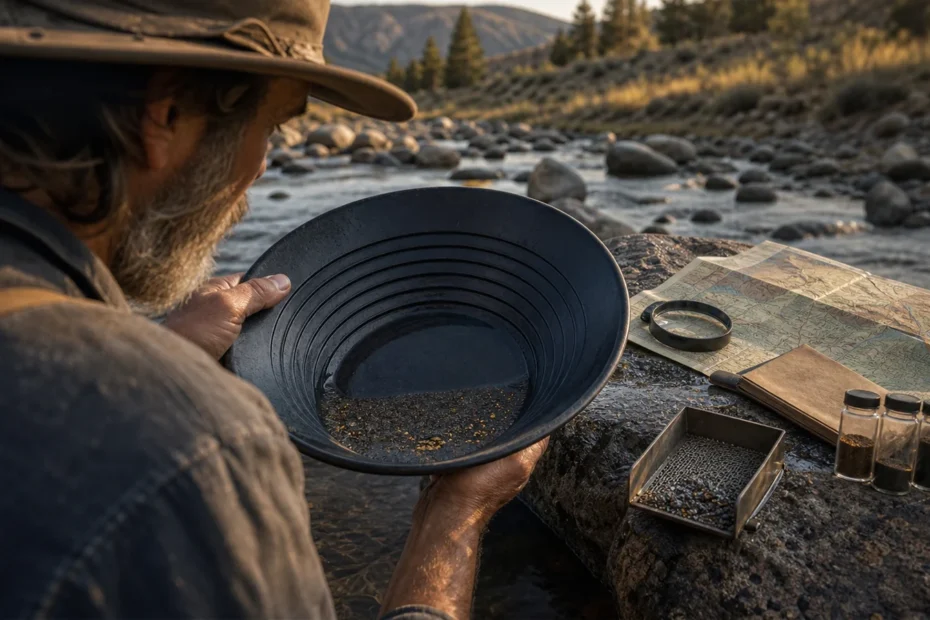
Use legal access, geology, placer traps, panning and field clues, then qualified assay to detect possible gold without a metal detector.
- Start with legal access, district records and geology; random searching is far less useful than a documented gold setting.
- Panning concentrates dense minerals and can reveal visible placer gold, but black sand, quartz and pyrite are only clues.
- Invisible or fine gold may require representative sampling and a professional assay; no visual trick proves ore grade.
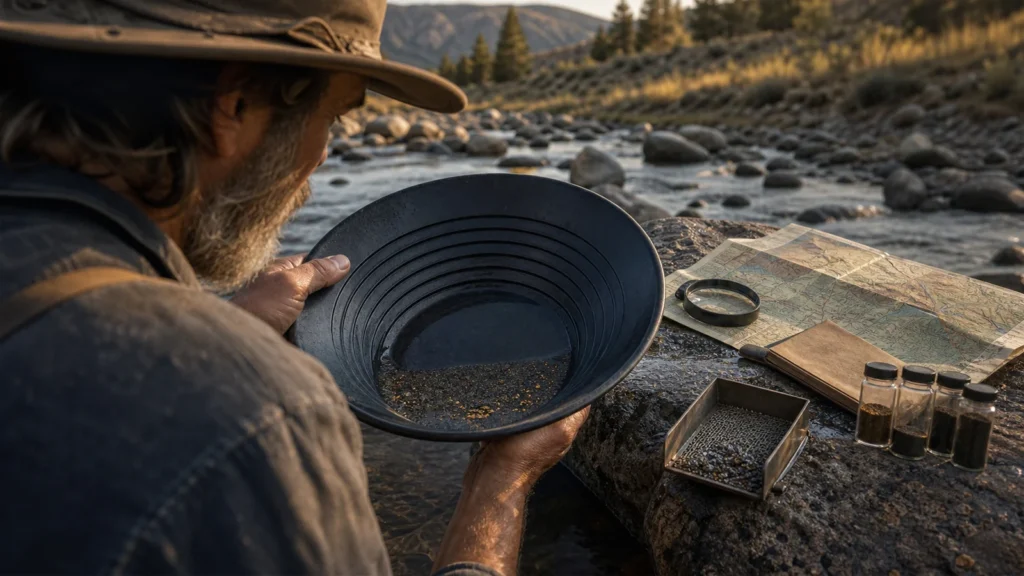
- Check ownership, closures and active mining claims before fieldwork.
- Start in a documented gold district with a plausible deposit type.
- Sample likely traps systematically and keep location notes.
- Gold is dense, malleable and stays yellow in shade; pyrite is brittle and angular.
- Never use mercury or improvised chemical extraction.
Build an evidence chain, not a treasure story
A metal detector is only one tool, and it is poorly suited to every kind of deposit. Fine placer flakes may be too small or deep, while hard-rock ore can contain gold that is invisible to the eye. The practical alternative is a staged workflow: records identify plausible ground, geology predicts where gold could occur, samples test the prediction and an assay resolves what field observation cannot.
Step 1: confirm that you may legally prospect
Public access is not the same as permission to remove minerals. National parks, wilderness rules, state lands, private property, tribal lands, patented claims, active unpatented claims and withdrawn federal land can have different rules. In the United States, start with the land-management agency, county records and the BLM’s Mineral & Land Records System.
- Identify the landowner and managing agency.
- Check closures, withdrawals and site-specific collecting rules.
- Search current mining-claim records and maps.
- Obtain explicit permission for private land.
- Confirm which hand tools and quantities are allowed.
- Respect cultural sites, waterways and seasonal restrictions.
- Leave if boundaries or authorization remain uncertain.
BLM explains that a mining claim gives a claimant rights related to a valuable mineral deposit, while a discovery requires more than casual color in a pan. Do not enter, sample or disturb another person’s claim without permission.
Step 2: use records to select a plausible district
Historic mine reports, geological maps, mineral-occurrence databases and old placer records are filters, not guarantees. Look for documented lode sources upstream, past placer production, suitable host rocks and drainage systems that can transport heavy minerals. A productive name on an old map does not prove accessible gold remains today.
The USGS prospecting guide explains how maps, publications and field observations fit together. For regional preparation, compare gold indicators and location-specific guides such as gold mining in Nevada.
Step 3: decide whether you are looking for placer or lode gold
| Deposit model | Where the gold occurs | Useful non-electronic evidence | Main limitation |
|---|---|---|---|
| Placer | Loose sediment after erosion and transport | Heavy-mineral traps, black sand, repeated pan colors | Black sand is common without economic gold. |
| Lode/vein | Bedrock structures and mineralized zones | Mapped faults, veins, alteration, old workings and assays | Gold may be microscopic or absent from a promising-looking vein. |
| Disseminated | Fine particles through a larger rock volume | Geochemistry, alteration and systematic laboratory samples | Visual inspection is usually insufficient. |
Quartz alone is not a gold test. Iron staining alone is not a gold test. Black sand alone is not a gold test. Each clue gains value only when it fits a documented geological model and repeats across a sensible sampling pattern.
Step 4: read placer traps in moving water
Because gold is about 19.3 times as dense as water, it tends to settle where current energy drops and into protected cracks. Productive micro-sites can include bedrock crevices, the downstream side of large boulders, natural riffles, potholes, false-bedrock contacts and selected inside bends. Flood history can move or bury pay layers, so the obvious surface is not always representative.
Learn the mechanics in the gold-panning guide. Pan only where permitted and avoid undercutting banks or disturbing habitat.
Step 5: sample systematically
A sample becomes useful when you know exactly where, how deep and how much material it represents. Mark positions on a map or GPS, number containers, describe sediment and record the same approximate starting volume. Sample across and along the feature rather than taking only the most attractive scoop.
Take equal-volume samples from upstream of a boulder, directly behind it and several meters downstream. Pan each to the same endpoint and count only clearly identified gold colors. If the protected sample repeatedly contains more gold while controls contain less, the trap hypothesis gains support. One bright speck in one pan does not establish a trend.
Step 6: distinguish gold from pyrite and mica
| Clue | Natural gold | Pyrite or mica |
|---|---|---|
| Color in shade | Remains rich yellow | Often darkens, flashes or looks brassy |
| Shape | Rounded, flattened or irregular | Pyrite often angular/crystalline; mica flaky |
| Behavior under gentle pressure | Malleable and flattens | Pyrite breaks; mica cleaves |
| Pan behavior | Stays low and moves reluctantly | Mica may float or wash readily |
| Streak | Yellow on appropriate surface | Pyrite tends dark greenish-black |
The USGS overview of fool’s gold emphasizes color, crystal form, hardness and malleability. Preserve uncertain grains rather than crushing the only specimen. For object testing rather than prospecting, use how to tell if gold is real.
Step 7: know when only an assay will answer
Ore can contain gold too fine to see, locked in sulfides or distributed below visual detection. A hand lens cannot quantify grade. A representative sample prepared by a qualified laboratory can be analyzed by fire assay and instrumental finish; sampling and preparation errors can still dominate if the material is heterogeneous.
How to make a rock sample less misleading
Do not select only the brightest fragment from a vein and call it representative. Define the interval, collect material across the same width, label every sample, clean tools between sites and record coordinates and orientation. A laboratory can analyze only what it receives; a precise assay of a biased sample is still a biased answer.
Weathered rock can differ from fresh material, and coarse visible gold produces a severe “nugget effect” in small samples. Discuss sample mass and preparation with the laboratory. Chain-of-custody becomes important when results affect a claim, sale or investment. Learn the visual limits in how to identify gold ore and the deposit context in the gold ore guide.
Do not use mercury. EPA documents serious health and environmental harm from mercury use in artisanal gold processing. Do not improvise cyanide, aqua regia, chlorine or acid leaching. These are not field-identification tricks and can create lethal exposure and regulated waste.
What a “gold detector app” can and cannot do
A phone can store maps, coordinates, photographs and field notes. It does not turn its ordinary magnetometer or camera into a reliable natural-gold detector. Apps that claim to identify underground gold without specialized hardware should be treated as entertainment unless independently validated for the exact task.
Common failure modes
- Confirmation sampling: taking only material that looks promising.
- Boundary blindness: relying on an old paper map without current claim checks.
- Indicator inflation: treating quartz or black sand as proof.
- Scale mismatch: searching visually for gold in a deposit known for microscopic mineralization.
- No controls: failing to compare likely traps with background sediment.
- Destructive shortcuts: using unsafe chemicals instead of qualified analysis.
What success looks like at each stage
A good reconnaissance day does not need to produce gold. It may eliminate inaccessible ground, disprove a trap hypothesis or identify where a better sample is needed. Record negative results with the same care as positive ones. Otherwise you will revisit unproductive locations and remember only the exciting pans.
If repeated legal samples show a consistent trend, the next step is not automatically excavation. The scale of disturbance, environmental review, claim rights and professional geological work all increase with the project. Recreational prospecting and establishing a valuable mineral discovery are different thresholds.
Photograph the final pan and the original site, then archive the sample number with the observation. That modest discipline makes a second visit comparable and prevents memory from upgrading a weak clue into “a proven spot.”
Back up field notes before leaving the area. A coordinate without a sample description—or a vial without a coordinate—cannot support a reliable follow-up decision.
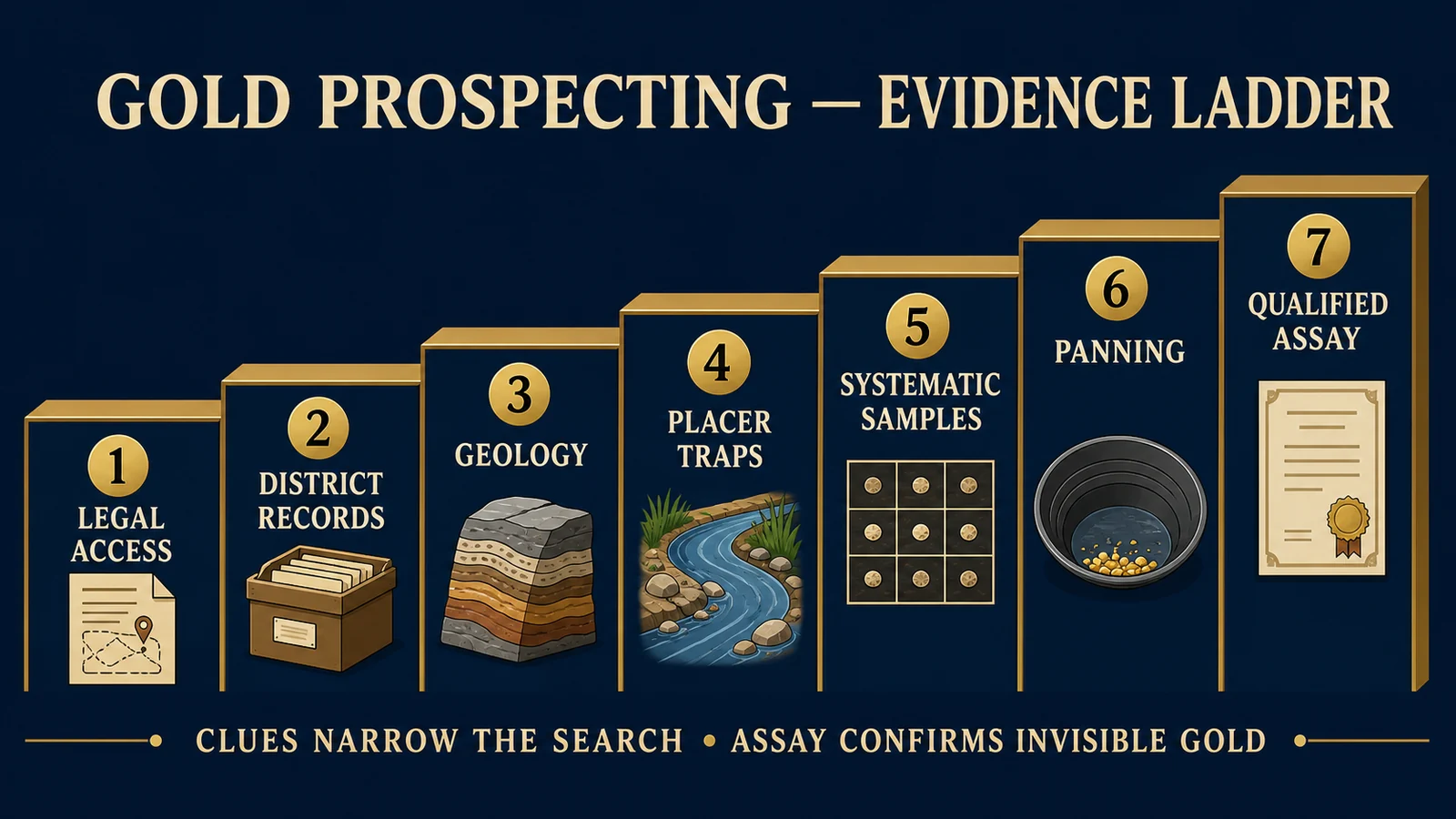
Many guides list visual clues but omit the order that makes them useful. Legal status must precede sampling; deposit model must precede clue hunting; controls must precede confidence; and assay must replace eyesight when gold is invisible.
The best detector-free prospecting tool is disciplined elimination. Most ground should be rejected by records, access or geology before a pan is filled. That does not remove uncertainty—it makes the remaining uncertainty measurable.
Rules differ by land and jurisdiction. This guide does not grant access or mining rights. Avoid unstable workings, contaminated tailings, mercury and chemical extraction; follow agency rules and qualified professional guidance.
Selected explainer This video adds a concise visual explanation to the evidence and decision framework above.
Bottom Line
Without a metal detector, use an evidence ladder: legal access, records, geology, placer traps, systematic samples, careful panning and qualified assay. Repeatable context is more valuable than one shiny speck, and invisible gold cannot be confirmed by appearance.
FAQ: Detecting Natural Gold Without a Metal Detector
Can you find gold with only a pan?
Yes, visible placer gold can be recovered by careful panning in suitable, legally accessible sediment. A pan cannot reveal every lode or microscopic deposit.
Does black sand mean gold is present?
It shows that heavy minerals concentrated there. Gold may occur with black sand, but black sand by itself is not proof.
How can I tell gold from pyrite?
Gold is dense, malleable and stays yellow in shade; pyrite is harder, brittle and commonly angular or crystalline.
Can a phone detect underground gold?
An ordinary phone is useful for maps and records, but is not a validated substitute for specialist geophysical or metal-detection equipment.
How do I confirm invisible gold in rock?
Use a representative sample and a qualified assay laboratory. Visual clues and home chemistry cannot reliably quantify microscopic gold.
Sources and verification
Values, rules and historical interpretations were checked against the linked primary or specialist sources. Recheck any current rule or market data before acting.
- USGS — Prospecting for Gold in the United States — District research, placer formation, panning and laboratory-analysis limits.
- USGS — Gold — Gold geology, density, placer concentration and analytical methods.
- USGS — What Is Fool’s Gold? — Malleability and breakage distinctions between gold and pyrite.
- BLM — Mining Claim Discovery — Official discovery and valuable-mineral requirements on federal land.
- BLM — Mining Claims and Sites — Land and claim framework for locatable minerals.
- BLM — MLRS — Official system for federal mining-claim and land-record research.
- EPA — Mercury in Gold Mining — Why mercury amalgamation is hazardous and inappropriate for casual testing.
- USGS — Geochemical Sampling in Arid Environments — Professional stream-sediment and heavy-mineral sampling context.
- Geology.com — How to Pan Gold — Visual panning technique and density explanation.
- BCghostTownsDOTcom — Gold Panning Made Easy — Experienced visual demonstration of basic panning technique.
 When you purchase a service or a product through our links, we sometimes earn a commission, at no extra cost to you.