
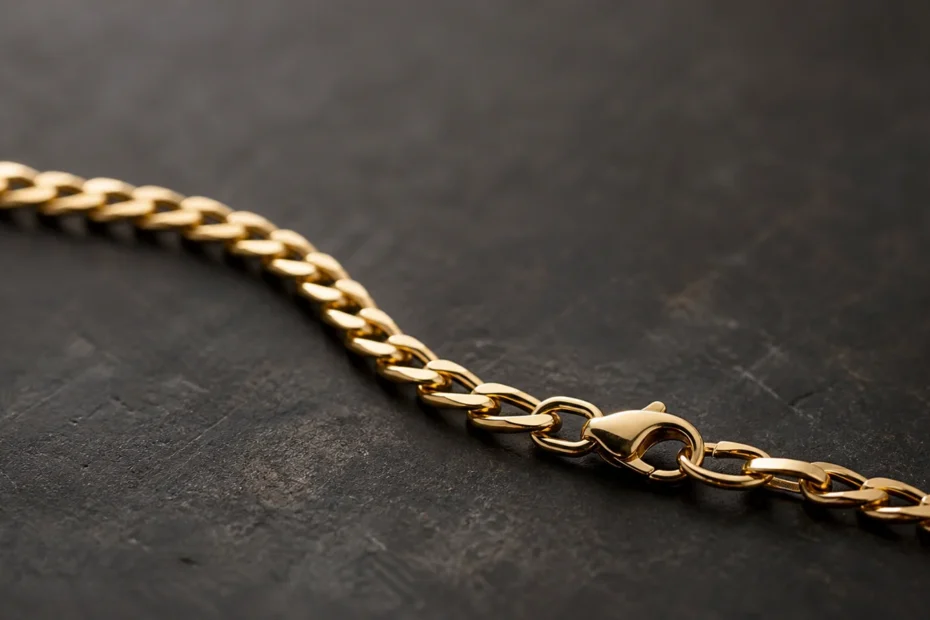
See why a gold chain can break under a whipping motion, which links fail first, and how construction, wear, pendants, and repairs change the risk.
- A whipping motion can break a gold chain because a sudden shock load is harsher than steady pulling.
- Construction, link gauge, wear and solder quality matter more than karat alone.
- Do not test a valuable chain deliberately; inspect it and use a jeweler when damage is visible.
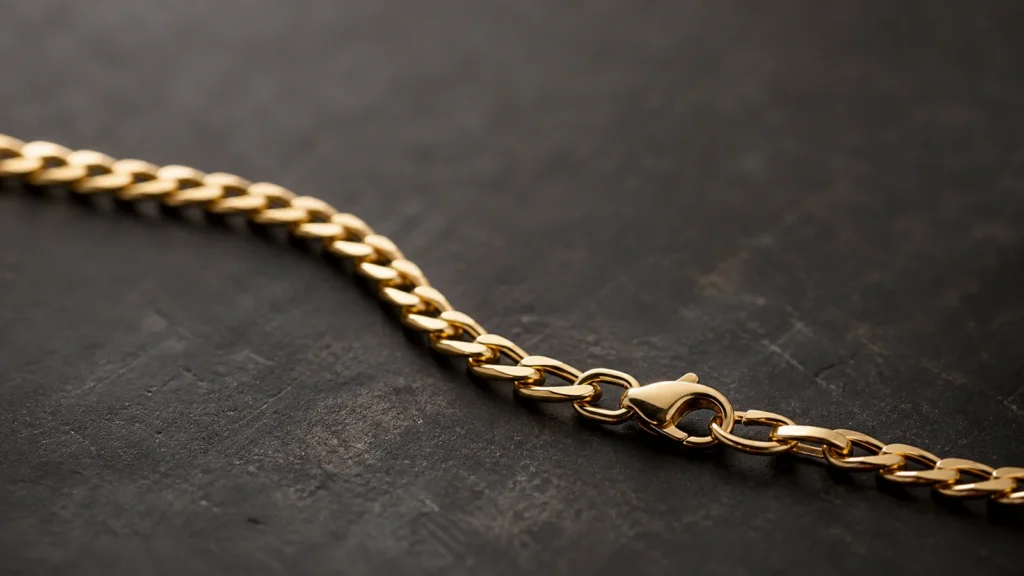
- Whipping adds speed and a sudden change of direction, concentrating force at a small weak point.
- Solid versus hollow construction, wire gauge, link geometry, wear and repairs matter more than karat alone.
- A chain that survives once has not been proven safe; it may have stretched or cracked.
- Never whip a chain at a person, animal or object, and do not use a valuable chain as a test specimen.
Jewelry mechanics, without the myth
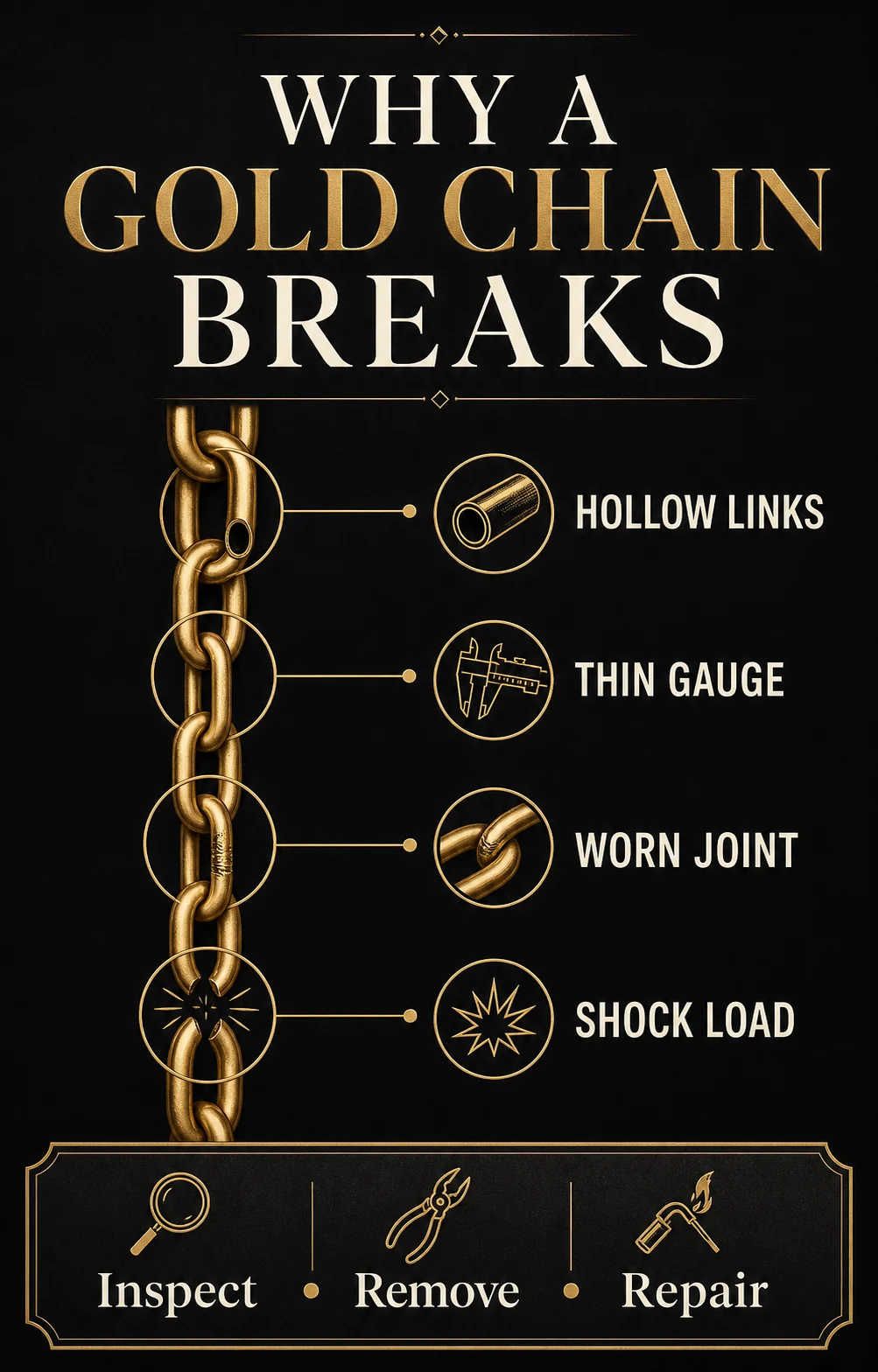
The useful question is not “How hard can I swing it?” but “What controls the failure of this particular chain?” A necklace is a system of hundreds of links plus end caps, jump rings and a clasp. The load follows that path until the least capable component opens, tears or deforms.
Why whipping is different from pulling
A slow pull is a mostly steady tensile load. A whipping motion accelerates the chain, curves it and then forces part of it to stop or reverse quickly. That change in momentum produces a short shock load. If the tip catches on something, the local load can rise before the rest of the chain has time to share it.
Gold itself is notably ductile and malleable, as the Royal Society of Chemistry explains. Ductility does not mean indestructibility. A link can stretch, a solder seam can separate, and a thin hollow wall can crush. Alloys used for 10K, 14K and 18K jewelry change hardness and strength, but there is no honest universal “karat break force.”
The weak-link model
Technical chain testing published through Ganoksin shows large variation by alloy, size and construction. The same source reports markedly different break loads between solid and hollow rope samples of similar nominal size. That evidence supports a direction—not a promise about an unknown necklace.
Which chains deserve the most caution?
| Observation | What it suggests | Practical action |
|---|---|---|
| Large appearance but unusually low gram weight | Possibly hollow or lightweight construction | Ask the seller to state solid, semi-hollow or hollow in writing. |
| Flattened herringbone, snake or omega section is kinked | Local deformation may not redistribute load normally | Stop wearing it until inspected; do not bend it back repeatedly. |
| One link near the clasp looks elongated or thin | Wear or an opened joint is becoming the weak point | Have a bench jeweler inspect and repair before adding a pendant. |
| Heavy pendant on a fine chain | Continuous movement and shock at the bail raise fatigue risk | Match chain construction and gauge to the pendant, not color alone. |
| Previous repair is stiff, lumpy or discolored | Heat, excess solder or altered geometry may have changed the link | Request a second professional opinion. |
Wear normally when links move freely, the clasp closes decisively and no local thinning is visible. Inspect soon when the chain carries a valuable pendant, has a prior repair or shows asymmetric wear. Remove now when a link is cracked, open, kinked, crushed or visibly thinner than its neighbors.
What to do after a snap or snag
- Stop pulling and collect every loose component.
- Photograph the break before attempting to reshape it.
- Keep the chain flat in a small bag or box so damaged links do not tangle.
- Tell the jeweler whether it is hollow, plated or stone-set if known.
- Ask whether the repair restores function, whether it will remain visible and whether nearby links are also worn.
MJSA’s bench-jewelry discussion illustrates why hollow rope chains are difficult to repair: thin walls can deform or melt during heat work. “Repairable” therefore depends on style, access and the jeweler’s equipment—not merely whether the piece is real gold.
Watch: Gold chain strength demonstrated
This video is included as a practical visual supplement. Use the evidence and decision rules in this guide—not a dramatic demonstration—as the basis for a purchase or test.
Buying a chain for real daily wear
Ask for gram weight, karat, length, width and construction. “Solid gold” can be used in everyday conversation to mean genuine gold alloy, while a product may still use hollow links; get the physical construction stated separately. Compare the piece with our guides to checking whether gold is real, gold-filled construction and white-gold alloys.
If a pendant is valuable, inspect the bail and clasp as carefully as the chain. For broader material context, see why gold’s elemental properties matter and how gold behaves in metal detection.
A practical inspection routine
Lay the clean, dry chain on a plain light surface and move along it under magnification. Compare neighboring links rather than judging one link in isolation. Look for an opening at a seam, a link that no longer lies in the same plane, a flattened tube, a rough repair or a darker groove where two links rub. Operate the clasp several times without pulling on the chain. A lobster clasp should close fully; a spring ring should return without hesitation.
Next, hold the chain only a few centimeters above a padded surface and let it settle naturally. Sections that remain stiff may be kinked, contaminated or heat-affected from repair. Do not force them straight. Photograph any anomaly next to a ruler and take the chain to a bench jeweler. This comparison is far more useful than attempting to reproduce a whipping load at home.
Worked scenario: fine chain with a pendant
A buyer has a fine 18K cable chain that looks intact but carries a pendant much heavier than the chain. The chain has never snapped, yet the end ring is visibly elongated. The correct conclusion is not that 18K is weak; the system has a local wear point and an unfavorable pendant-to-chain match. The prudent response is to remove the pendant, have the end assembly inspected and choose a chain whose construction—not merely width—fits the load.
There is no single public table that predicts the break force of every retail chain. Manufacturing tolerances, alloy temper, link closure, repair history and wear can dominate. A style name or karat stamp is not enough to calculate safety.
The viral yes-or-no framing encourages a destructive stunt. The responsible answer is simpler: shock loading can break jewelry, and surviving a stunt does not certify a chain. Inspection gives better information without sacrificing the item.
Frequently asked questions
Can a 14K gold chain break more easily than a 10K chain?
Not necessarily. Alloy differences matter, but link gauge, construction, solder quality and wear can outweigh karat. Compare the whole chain, not one number.
Does a broken chain mean the gold is fake?
No. Genuine karat-gold chains can break. Authenticity and mechanical condition are separate questions.
Is a hollow gold chain real gold?
It can be genuine karat gold while still having hollow links. Hollow describes geometry, not whether the alloy contains gold.
Can a jeweler make a repaired chain as strong as new?
Sometimes a well-executed repair restores practical wear, but nearby worn links and delicate hollow construction may remain limiting factors. Ask for a condition assessment, not only a solder quote.
Should I test a chain by pulling it?
No. Deliberate pulling can stretch or weaken links without producing an obvious break. Visual and magnified inspection is safer.
Sources and methodology
This guide favors consumer regulators, scientific institutions and technical trade references. Commercial claims are not treated as proof.
Update policy: Product rules, scientific interpretations and market practices can change. We date-check the linked authority pages during a major revision, avoid live-price claims in evergreen guidance and distinguish measured evidence from editorial judgment. If a source describes one jurisdiction, alloy, coin or experiment, we do not silently generalize it to every product. Readers making a material purchase should confirm the current specification and local rules at the point of decision.
- Royal Society of Chemistry — Gold — Gold is soft, malleable and ductile.
- Ganoksin — Chain Strength and Quality Evaluation — Chain strength varies with alloy, wire size, construction and load path.
- MJSA — Repairing a Broken Hollow Rope Chain — Hollow links deform and are difficult to repair.
- Santa Fe Symposium — Evaluation of Strength and Quality of Chains — Mechanical testing and break modes.
- FTC — Buying Gold Jewelry — Karat and construction terminology.
 When you purchase a service or a product through our links, we sometimes earn a commission, at no extra cost to you.