
Pure gold has no characteristic smell. Learn why skin, alloy metals, polish and contamination can smell metallic—and why odor is not a gold test.
- Pure gold has no characteristic odor under normal handling conditions.
- A metallic smell usually comes from skin reactions, alloy metals, polish, packaging or contamination.
- Smell cannot authenticate gold; use markings, measurements and professional testing when value matters.
- An odor must come from airborne molecules; bulk pure gold does not normally release an odorous vapor.
- The familiar “metal smell” on hands can be produced by skin compounds reacting with more reactive metals.
- 14K and 18K gold contain alloy metals, so genuine jewelry may smell while pure gold does not.
- Residue, repairs and storage can create odor without saying anything reliable about authenticity.
- Smell is not a gold test; clean safely and use real verification methods when value matters.
The object can smell without gold being the odor source
When people ask what gold smells like, they often expect a sensory description such as metallic, warm or coin-like. The more accurate answer is simpler: elemental gold itself is effectively odorless, but the object you are holding may be a complex mixture of gold alloy, skin oils, cosmetics, dust, solder and storage residue.
That distinction matters because smell is sometimes treated as a shortcut for deciding whether jewelry is “real.” It cannot do that job.
Why pure gold has no characteristic odor
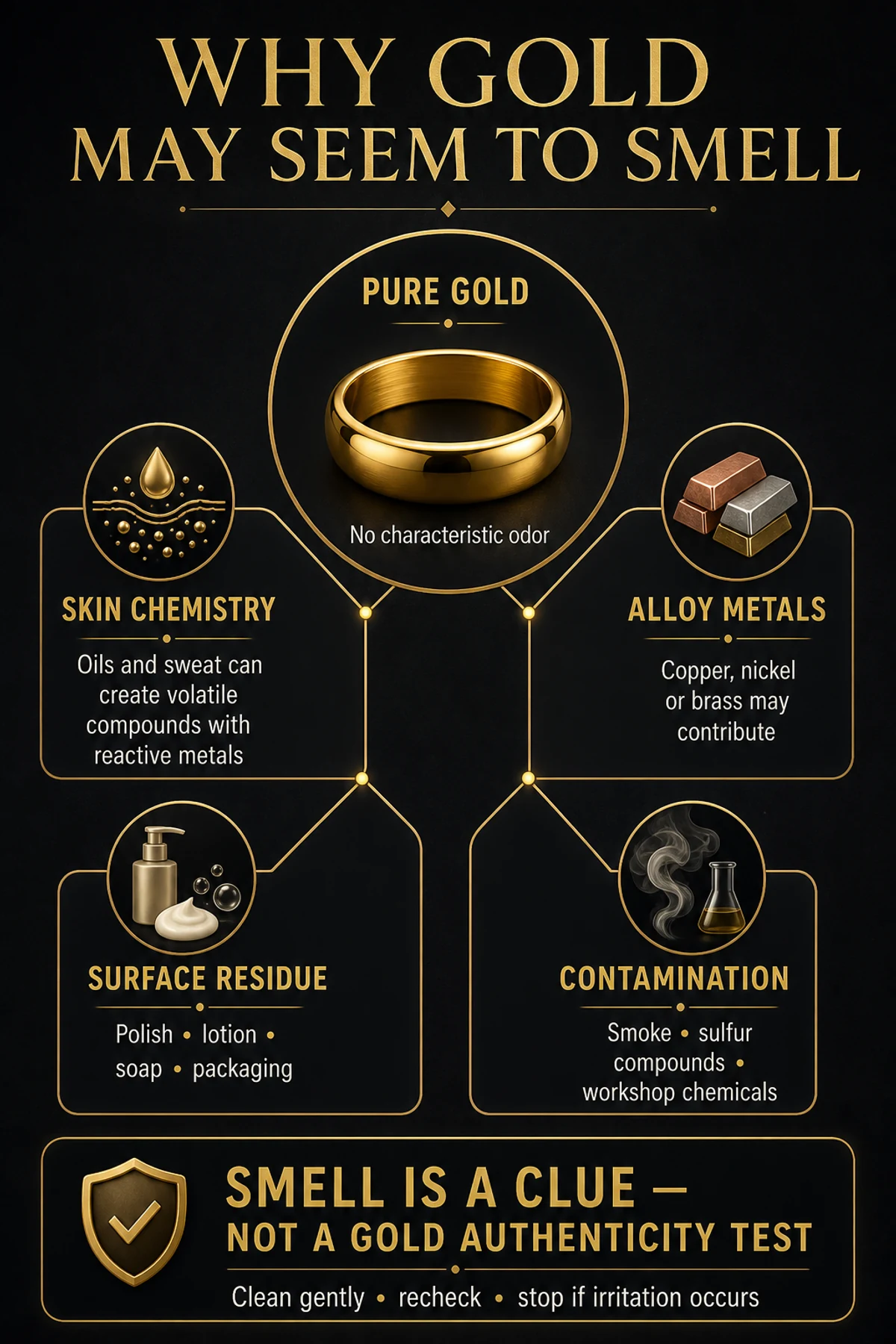
Your nose detects volatile molecules that reach smell receptors. A clean piece of bulk gold does not normally emit a meaningful stream of volatile gold molecules at room temperature. The Royal Society of Chemistry describes gold as chemically unreactive and resistant to corrosion, properties that help it remain stable in jewelry and electrical contacts.
“Odorless” does not mean a gold surface can never carry an odor. It means the smell is not an intrinsic characteristic of clean elemental gold under ordinary conditions.
Where a metallic smell actually comes from
The best-known chemistry concerns iron, copper and brass rather than gold. A peer-reviewed study indexed by PubMed found that the metallic odor after touching iron comes largely from volatile carbonyl compounds formed when metal ions interact with skin peroxides. The researchers reported related skin–metal odor mechanisms for copper and brass.
This does not prove that pure gold creates the same reaction. It explains why a “metal smell” is often body or surface chemistry triggered by a reactive metal, rather than vapor from the metal itself.
| Likely source | Typical clue | What it means | Safe next step |
|---|---|---|---|
| Skin oils and sweat | Odor appears after wearing or handling | Surface chemistry; not an authenticity verdict | Wash hands and clean the item with a material-appropriate method |
| Gold alloy metals | Lower-karat jewelry smells more than a high-karat piece | Copper, nickel or other constituents may be more reactive | Check the karat mark and obtain professional composition testing if needed |
| Base-metal core or exposed plating | Odor is strongest at worn edges, clasp or scratch | Underlying metal may be exposed | Stop aggressive polishing and have construction inspected |
| Polish, lotion or soap | Perfumed, waxy or detergent-like smell | Residue trapped in texture, setting or hollow area | Use gentle cleaning or a jeweler for complex pieces |
| Storage or contamination | Musty, smoky, sulfur-like or solvent odor | Packaging or environment is the likely source | Isolate, ventilate safely and avoid unknown chemicals |
Why karat and construction change the answer
Twenty-four-karat gold is close to pure gold. Eighteen-karat gold is 75% gold, while 14K is 58.3% gold; the remainder is an alloy recipe selected for color, hardness and manufacturing. That recipe can include copper, silver, zinc, nickel, palladium or other metals.
A genuine 14K ring can therefore produce a different surface response than a high-purity bar. FTC jewelry guidance also distinguishes karat gold from plated, gold-filled and other surface constructions. A worn coating can expose a base metal that behaves very differently from the visible gold layer.
A safe clean-and-recheck process
- Remove the item if it causes burning, itching, swelling or a rash.
- Note whether the smell is on the object, on your skin or only inside its container.
- For plain, stone-free gold jewelry, use lukewarm water, a small amount of mild soap and a soft brush or cloth.
- Rinse and dry completely; trapped moisture in hollow pieces can create a separate odor.
- Do not mix household chemicals or use bleach, chlorine, unknown acids or abrasive powders.
- For pearls, opals, glued stones, antique patina or complex settings, ask a jeweler before cleaning.
- If the smell returns at one seam or worn edge, have the construction and repair history inspected.
A strong chemical or sulfur-like odor after workshop, fire, flood or cleaning exposure calls for caution. Bag the item separately, avoid deliberate sniffing at close range and ask an appropriate professional how to handle the suspected contaminant.
Why smell cannot tell you whether gold is real
Authenticity is a materials question, not a fragrance test. Genuine gold alloys can smell because they contain other metals, while a fake object may have no smell because it is clean, coated or made from a stable material. Perfume can mask either one.
For a valuable piece, combine provenance, marks, weight, dimensions and construction with an appropriate professional method. GoldConsul’s guide to testing whether gold is real explains the evidence ladder and why XRF, touchstone tests and assay have different limitations. A classic GIA review of gold-content methods likewise shows that real composition testing requires more than one casual clue.
A stamped 14K ring has no odor in its box, but a metallic smell appears on the finger after exercise. The ring shows no exposed patch or irritation. The most reasonable first hypothesis is sweat, skin oils and alloy interaction—not that the stamp has been disproved. Clean the ring gently, wash and dry the skin, then observe whether the effect repeats.
If odor is strongest at a discolored solder seam, or if redness develops, stop wearing it and let a jeweler inspect the repair and alloy. A composition test may answer the metal question; a dermatologist can address a persistent skin reaction.
Strong evidence explains metallic odors from iron, copper and brass interacting with skin. Direct studies of everyday odor perception across specific gold-alloy recipes, plating thicknesses and wear states are much thinner. It is safer to apply the mechanism as a plausible explanation for reactive alloy metals—not claim that every gold-jewelry odor has one proven cause.
Use smell to locate a surface, storage or wear problem, not to authenticate an object. When money or skin safety is involved, move from sensory clues to documentation, construction inspection and a suitable analytical test.
Video walkthrough: Video context: a chemistry demonstration explains why the familiar metallic smell is not simply metal vapor.
Bottom Line
Pure gold does not have a characteristic smell. What you perceive around gold usually comes from skin chemistry, alloy metals, a worn surface, cleaning products or contamination. Clean gently, stop if there is irritation or unknown chemical exposure, and verify valuable gold with evidence that actually measures the material.
FAQ: What Gold Smells Like
Does real gold smell metallic?
Clean high-purity gold does not have a characteristic metallic odor. Genuine lower-karat gold can be associated with odor because alloy metals, skin chemistry and residue are part of the object-and-wear environment.
Can smell tell if jewelry is fake gold?
No. Genuine alloys can smell and clean fake or plated items may not. Smell does not measure gold content or reveal a hidden core reliably.
Why does my gold ring smell after I wear it?
Sweat, skin oils, cosmetics and reactive alloy metals are common explanations. Clean it gently and inspect worn edges or solder seams if the smell keeps returning.
Does 24K gold have a smell?
Under normal handling, clean 24K gold has no characteristic odor. Any smell is more likely carried on the surface or transferred from the environment.
Should I use acid or bleach to remove a smell from gold?
No. Unknown acids, bleach and chlorine can be hazardous and may damage alloys, solder, coatings or gemstones. Use a mild material-appropriate method or a professional jeweler.
Sources and verification
Use these primary and specialist references to verify the technical, legal or market framework behind the guide.
- Royal Society of Chemistry — Gold — Gold is chemically unreactive and corrosion resistant under ordinary conditions.
- PubMed — The Two Odors of Iron when Touched or Pickled — Metallic odor from touched iron is linked to volatile compounds generated from skin chemistry.
- Wiley — The Two Odors of Iron — Primary research describing skin carbonyl compounds and related metal odors.
- FTC — Buying Platinum, Gold, and Silver Jewelry — Karat and coating terms clarify why a gold-colored object may contain other metals.
- GIA — Methods for Determining Gold Content — Explains why real verification relies on analytical methods, not sensory clues.
- NileRed — Can You Actually Smell Metal? — Accessible video demonstration of the skin-chemistry explanation for metallic odor.
 When you purchase a service or a product through our links, we sometimes earn a commission, at no extra cost to you.